Why We Don’t Recommend Quoting a Mechanical LED Project Before a Site Survey
One-Sentence Definition: A custom mechanical LED project is not simply about “buying a screen.” It is an engineered system that must be deeply integrated with the building itself. Before a site survey is completed, any price given should be considered an estimate rather than a final quotation. What determines whether a project succeeds is often not the price of the LED display itself, but the installation conditions that cannot be seen on the drawings.
1. A Real-World Scenario: The Quotation Was Sent, but the Project Got Stuck
A client sends an inquiry:
They want a moving LED wall approximately 10 meters wide and 3 meters high, installed in a shopping mall atrium.
Under a standard product-sales approach, the supplier might respond immediately with a price per square meter, a total price, and a lead time.
But a company that approaches the project from an engineering perspective will first ask several questions:
What is the wall made of?
Can it withstand the dynamic loads generated by mechanical movement?
How high is the shopping mall atrium?
Is there enough space behind the display for a maintenance corridor?
Is the available power capacity sufficient?
Without answers to these questions, the quotation is built on assumptions.
In industry practice, more than half of the problems encountered in failed retractable mechanical LED projects are rooted not in the equipment itself, but in mismatched installation conditions.
Many project teams discover only after the equipment arrives that the wall cannot support the required load, maintenance space is insufficient, or the available electrical capacity is inadequate.
By the time the solution has to be redesigned, the cost of modification may already have multiplied several times.
That is why we do not recommend starting a mechanical LED project with a final quotation.
2. What a Quotation Can—and Cannot—Tell You
The purchasing logic for a standard LED display is relatively straightforward:
Measure the dimensions, select a model, and calculate the price.
This works because the installation methods for standard LED displays are relatively standardized.
Mechanical LED projects are fundamentally different.
They involve more than a display. They are electromechanical systems integrating mechanical structures, motion control, power systems, and signal systems.
And these systems must interact directly with the building itself.
Every building is different.
A Quotation Can Tell You:
- The approximate price per square meter
- The expected lead time
- The warranty period
A Quotation Cannot Tell You:
- Can the wall withstand the dynamic load?
- If the ceiling depth is only 350 mm, can the system physically fit?
- If something fails, how will technicians access the system for maintenance?
- Is the available electrical capacity sufficient?
- Does the content team need programming skills to create kinetic content?
These questions determine whether the project is simply usable—or too difficult and expensive to operate over the long term.
A quotation answers “what to buy.” A site survey answers “how to make it work.”
3. What Does a Mechanical LED Site Survey Actually Check?
A site survey is not simply a matter of visiting the site and taking a few measurements.
It is a systematic engineering assessment.
In Spectrum Display’s engineering workflow, a mechanical LED site survey typically covers five key dimensions.
3.1 Structural Load Capacity
A mechanical LED wall is considerably heavier than a conventional LED display.
In addition to LED modules and cabinets, the system also includes motors, linear guides, transmission mechanisms, and control components.
For example, within Spectrum Display’s SPKI series:
- SPKI-160: 75 kg/m²
- SPKI-128: 152 kg/m²
More importantly, a mechanical LED display generates dynamic loads while moving.
When a large number of modules extend and retract simultaneously, the dynamic forces acting on the supporting structure can be significantly different from the static weight of the display.
The site survey therefore needs to determine:
- What is the wall or supporting structure made of?
- Can it withstand the required loads?
- Is an additional steel support structure required?
For a mechanical LED project, structural assessment is not an optional step. It is part of determining whether the concept is physically feasible.
3.2 Space Conditions
Mechanical LED systems need physical space to move.
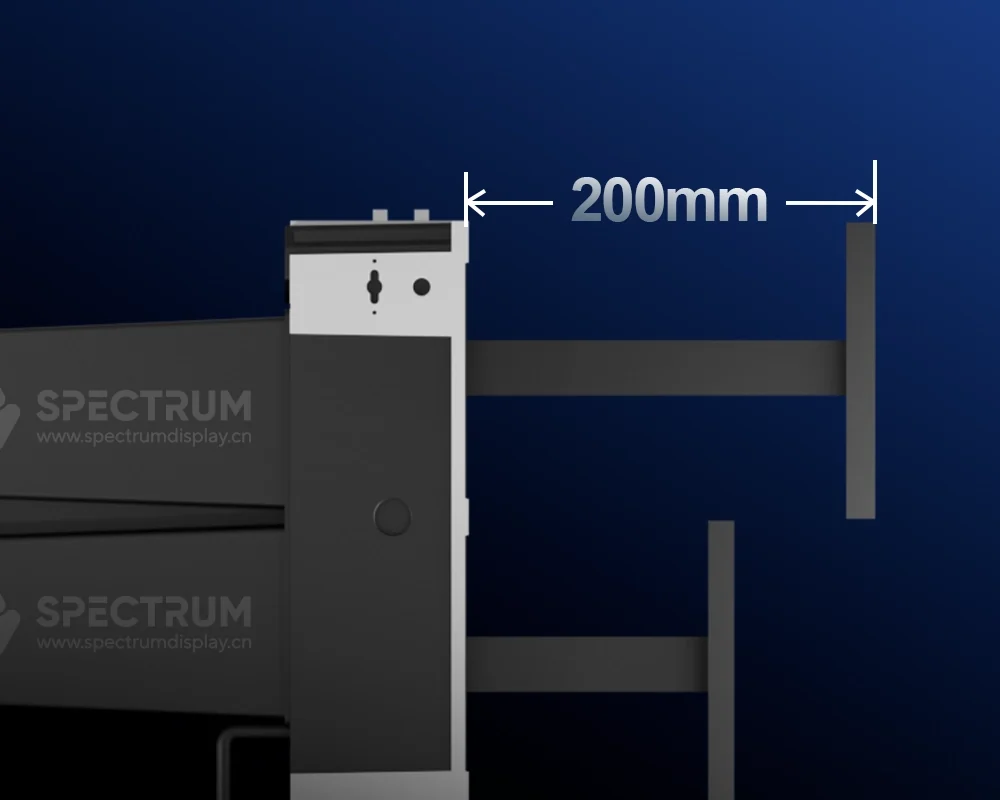
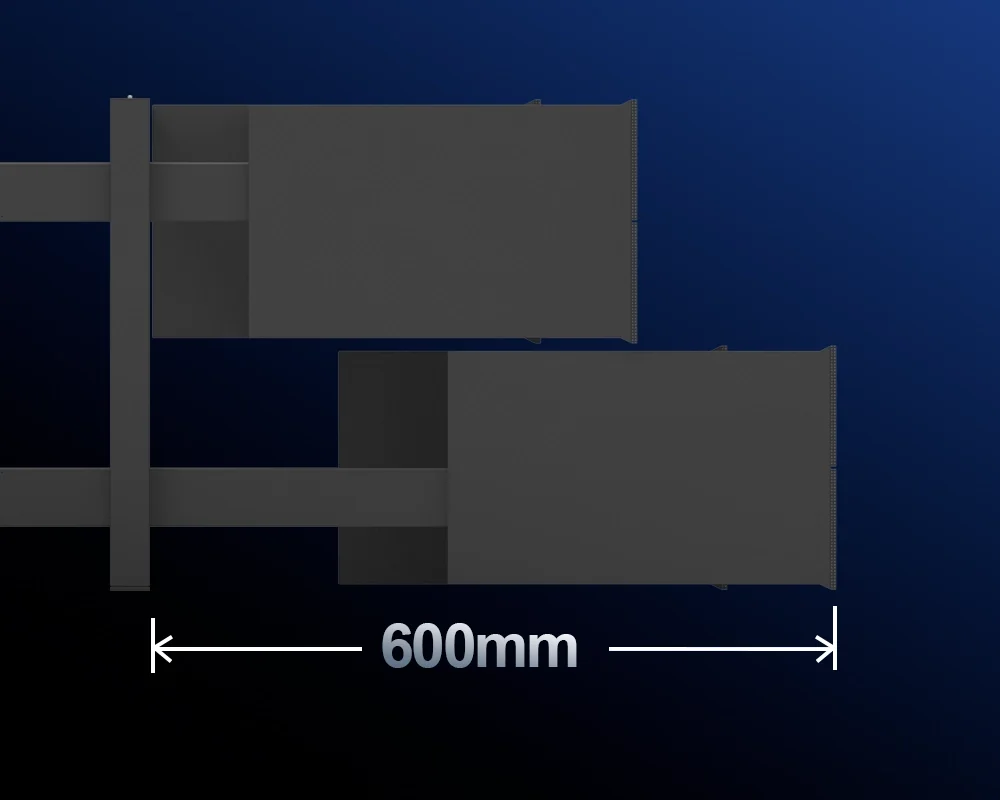
Each motion unit requires sufficient depth for extension and retraction.
For example:
- SPKI-160: maximum extension stroke of 200 mm
- SPKO-500: maximum extension stroke of 600 mm
The body depth of the system is equally important.
The SPKI-160 has a body depth of approximately 330 mm, with a finished installation depth of around 350 mm.
The SPKO-500, by comparison, has a body depth of approximately 1430 mm.
In space-constrained environments, a difference of only a few hundred millimeters can determine whether the project is physically installable.
The site survey therefore needs to verify not only the width and height of the installation area, but also the actual available depth.
3.3 Maintenance Accessibility
Maintenance access is one of the most commonly underestimated factors in mechanical LED projects—and one of the factors with the greatest impact on long-term operating costs.
The site survey needs to determine whether the project should use:
Front maintenance or rear maintenance.
A front-maintenance system does not require access behind the display.
A rear-maintenance system typically requires a 600–800 mm maintenance corridor behind the screen.
This decision cannot simply be postponed until installation.
A maintenance corridor cannot realistically be “added later” without consequences.
Once the walls have been closed, the architectural structure finalized, and the interior construction completed, creating a new maintenance corridor may cost many times more than reserving it during the design stage.
3.4 Power and Signal Infrastructure
Mechanical LED walls typically require significantly more electrical capacity than conventional LED displays because the system must power not only the LED modules but also motors, drivers, control systems, and other electromechanical components.
For Spectrum Display’s SPKI series, the rated power distribution requirements include:
- SPKI-128: 1250 W/m²
- SPKI-160: 965 W/m²
- SPKI-250: 720 W/m²
For a 100 m² mechanical LED wall, the peak power requirement of the display system alone may exceed 100 kW, depending on the selected configuration.
The site survey therefore needs to confirm:
- Whether sufficient electrical capacity is available
- Whether the existing power infrastructure can support the system
- Whether the signal system is compatible
- Whether long-distance signal transmission can remain stable
These conditions can directly affect both the engineering solution and the final project cost.
3.5 Environmental Conditions
A mechanical LED wall is a precision electromechanical system, so the surrounding environment must also be evaluated.
For indoor projects, the site survey needs to assess factors such as:
- Heat dissipation conditions
- Humidity control
- Nearby sources of strong electromagnetic interference
For outdoor projects, additional factors may include:
- Wind load
- Rain exposure
- Temperature variation
- Salt-spray corrosion
Environmental conditions may require changes to materials, protective treatments, cooling systems, structural design, or component selection.
What Does the Site Survey Deliver?
The result should be a detailed site survey report covering:
- Installation dimensions
- Structural conditions
- Power and signal infrastructure
- Maintenance accessibility
- Environmental conditions
This report becomes the engineering basis for both solution design and accurate pricing.
4. Only After the Site Survey Does the Quotation Really Mean Something
Once the site survey is complete, the engineering team can provide a quotation based on actual project conditions rather than assumptions.
This matters because the survey findings can directly change both the technical solution and the cost.
If the wall cannot support the required load: An independent steel structure may need to be designed, increasing structural engineering and fabrication costs.
If installation depth is limited: An ultra-slim front-maintenance model may be required, changing the product configuration and price.
If rear maintenance is required: A maintenance corridor must be incorporated into the architectural design, potentially affecting the building layout and interior construction cost.
If the existing electrical capacity is insufficient: Power expansion or distributed power architecture may be required, adding electrical engineering costs.
If the environment is particularly demanding: Additional protective treatments, materials, cooling solutions, or structural measures may be necessary.
Without a site survey, a quotation is only an estimate. It may underestimate the project or overestimate it—but it cannot accurately reflect the final engineering requirements.
More importantly, the site survey affects more than the price.
It affects whether the project can actually be delivered.
A concept may look perfect on architectural drawings but prove impossible to install under real site conditions.
If that discovery happens only after the equipment has already been manufactured and transported to the site, the cost of redesigning the project can be several times higher than addressing the issue during the planning stage.
5. Case Study: From “Impossible to Install” to a “Breathing Ceiling”
A premium bar in Singapore wanted to install a retractable mechanical LED display on the ceiling.
There were two immediate constraints:
The available ceiling depth was extremely limited, and there was no space for a rear maintenance corridor.
Under a “quote first” approach, the requirement might simply have been rejected:
“It cannot be installed.”
Instead, Spectrum Display’s engineering team started with the actual site conditions.
The team measured the available ceiling depth, assessed the load-bearing capacity of the ceiling structure, and confirmed the accessibility of the power and signal infrastructure.
The conclusion was clear:
- The ceiling cavity could accommodate a finished installation depth of no more than approximately 350 mm
- Rear access was impossible, so front maintenance was required
- The ceiling structure could support the lightweight system at 75 kg/m²
- Power could be supplied from a nearby distribution box
- A viable signal-routing path was available
Based on these conditions, the team determined that the SPKI-160, with its 330 mm ultra-slim body and front-maintenance architecture, was the appropriate solution.
Ultimately, a 1440 × 3840 mm retractable mechanical LED display was installed in the ceiling, transforming an otherwise unused surface into a “breathing ceiling.”
When the music begins, the LED units extend, retract, rise, and fall with the rhythm.
The ceiling becomes part of the spatial experience—and a visual feature that guests naturally photograph and share.
If the project had started with a quotation alone, it might never have moved forward. The site survey revealed that “impossible to install” was actually “possible—with the right engineering solution.”
6. Frequently Asked Questions (FAQ)
Q1: Why can’t a mechanical LED project be quoted immediately?
A: Because the cost of a mechanical LED project depends on multiple variables, including available space, structural complexity, motion-control requirements, power and signal infrastructure, maintenance accessibility, and environmental conditions.
Before these conditions are assessed, any price should be treated as an estimate rather than a final project quotation and may differ significantly from the actual project cost.
Q2: How long does a site survey take?
A: It depends on the complexity of the project.
A typical survey may take 1–3 days, including on-site measurements, structural assessment, verification of power and signal conditions, and discussions with the client, designers, and contractors.
Large or particularly complex projects may require more time.
Q3: If the client already has architectural drawings, is a site survey still necessary?
A: Yes.
Dimensions shown on drawings do not always perfectly match actual site conditions.
Walls may not be perfectly vertical, ceilings may not be completely level, and reserved electrical points may be several meters away from their intended locations.
A site survey verifies whether the solution shown on the drawings can actually be implemented under real-world conditions.
Q4: Will the solution and quotation change after the site survey?
A: They may.
Site conditions can directly affect the engineering design.
The project may require a different installation method, another product model, additional steel structures, or a revised power solution.
Only after these conditions have been confirmed can the project quotation become accurate and reliable.
Q5: How is a site survey arranged for an overseas project?
A: Spectrum Display serves projects across multiple countries and regions.
For overseas projects, the engineering team may arrange an on-site survey or work with local partners to complete the initial site assessment.
The specific approach depends on the project location, scale, and engineering complexity.
Q6: What types of projects require an on-site survey?
A: Mechanical LED projects involving non-standard spaces, special motion requirements, architectural integration, or complex system integration should undergo a site survey.
Small projects with highly standardized conditions may first be assessed through drawings and remote communication.
For complex projects, however, an on-site survey is an essential part of the engineering process.
▶Video · YouTubeFrom Installation to Motion — onsite installation and commissioningWatch on YouTube →7. Conclusion
A mechanical LED project is not simply about “buying a screen.”
It is an engineered system that must interact deeply with the architecture around it.
Key Takeaways
1. Why we do not recommend quoting immediately
The cost of a mechanical LED project depends on multiple variables, including available space, structural load capacity, power and signal infrastructure, and maintenance accessibility.
Without a site survey, the price is only an estimate.
2. What a quotation cannot answer
Can the wall support the system?
Will the display physically fit?
How will it be maintained?
Is the available power capacity sufficient?
These questions determine whether the project will be practical and sustainable over the long term.
3. The five dimensions of a mechanical LED site survey
Structural load capacity → space conditions → maintenance accessibility → power and signal infrastructure → environmental conditions.
4. Only after the site survey does the quotation become meaningful
The survey findings directly influence the engineering solution and project cost.
Without this information, a solution that looks perfect on paper may be impossible to implement on site.
5. The Singapore bar ceiling project demonstrates why this matters
What initially appeared to be an “impossible” ceiling installation became a 1440 × 3840 mm “breathing ceiling” after the site survey identified the correct combination of ultra-slim system depth and front-maintenance architecture.
Recommendations for Project Owners
- At the beginning of a mechanical LED project, do not make “How much does it cost?” the only first question. Start by asking the engineering team to assess the actual site conditions.
- Involve the engineering team as early as possible instead of manufacturing the equipment first and trying to “figure out the installation later.”
- When evaluating suppliers, do not look only at the quotation. Check whether they can provide site surveys, custom engineering, and project-specific solution design.
- To learn more about the site survey process or discuss a customized mechanical LED solution, contact the Spectrum Display team through its official website.