Why Do Some Kinetic LED Displays Stay Smooth for Years While Others Start to Stutter?
One-Sentence Definition: Closed-loop motion control is a control method that continuously corrects motor movement through real-time position feedback. It allows every motion unit in a kinetic LED display to “know where it is,” maintaining precision, synchronization, and stability even under long-term, high-frequency operation — unlike an open-loop system that simply sends a command without verifying the result.
1. An Overlooked Divide: Open-Loop vs. Closed-Loop Control
When purchasing a kinetic LED display, most buyers focus on specifications such as:
How long is the motion stroke? How fast can it move? How small are the module gaps? How bright is the display?
But there is another parameter that rarely appears prominently in product brochures, yet can determine how the system performs three years later:
Is the motion control system open-loop or closed-loop?
In an open-loop control system, the controller sends a motion command but does not verify whether the motor has actually reached the target position.
It is like giving someone directions and then walking away. You do not know whether they took the wrong turn, stopped halfway, or actually reached the destination.
In a closed-loop control system, sensors continuously provide real-time position feedback after a command is issued. The system verifies whether the motor has reached its target position and immediately corrects any deviation.
It is more like giving someone directions while continuously monitoring their progress until they arrive at the correct destination.
The difference may be almost invisible during a short-term demonstration. But under years of high-frequency operation, it can determine whether a kinetic LED display remains smooth and precise or gradually begins to drift, desynchronize, and stutter.
2. Open-Loop Stepper Motors: Why Do They Lose Steps and Drift Over Time?
Many conventional mechanical display systems on the market use relatively low-cost open-loop stepper motors.
Open-loop stepper systems have several inherent limitations.
Lost Steps
A stepper motor rotates according to pulse commands, with each pulse corresponding to a defined angular movement.
However, if the mechanical load suddenly increases — for example, because linear-guide friction increases or a motion unit encounters an obstruction — the motor may fail to complete the required number of steps.
The result is a positional error.
Because there is no feedback mechanism, the control system may not know that anything has gone wrong.
Position Drift
After long-term operation, factors such as mechanical wear, temperature variation, or transmission-component loosening can gradually cause the actual position of a motion unit to deviate from its original reference position.
An open-loop system cannot detect this deviation.
Over time, these errors can accumulate.
Loss of Synchronization
In a large kinetic LED matrix, every motion unit is controlled independently.
If some units begin to lose steps or drift from their intended positions, the visual consistency of the entire matrix is compromised.
Instead of seeing a smooth wave, viewers may notice that some modules move while others lag behind, or that a clean wave pattern gradually turns into an uneven, jagged surface.
Noise and Heat
Open-loop stepper motors can also generate more noticeable noise at low speeds and may produce significant heat during operation.
In quiet commercial environments, this can directly affect the audience experience.
The problem is that these weaknesses may not appear during project acceptance.
With new equipment, new linear guides, and relatively light loads, everything may look perfect.
One or two years later, however, the differences begin to emerge.
3. Closed-Loop Servo Control: Letting Every Motion Unit Know “Where It Is”
The foundation of closed-loop motion control is real-time position feedback.
Spectrum Display uses its proprietary bus-based servo motor system, combined with 32-bit MCU chips and high-precision magnetic encoders.
Each servo motor is equipped with an encoder capable of continuously recording and feeding back the precise rotor position.
This creates several important advantages.
Automatic Position Referencing at Power-On
Every time the system is powered on, the encoder provides position information that allows the system to correct the physical coordinates of each motion unit and establish a consistent reference point.
This helps ensure that all units begin operation from the correct coordinate system.
Real-Time Error Correction
During movement, if a motion unit deviates from its target because of resistance, mechanical wear, or external interference, the system can detect the deviation and correct it immediately.
The unit is continuously guided back toward the intended position.
Absolute Position Control
The system knows the position of each motion unit rather than simply calculating how far it has moved relative to its previous position.
This prevents positional errors from continuously accumulating over time and addresses the problems of step loss and position drift.
Synchronized Motion
All motion units execute commands under the same timing architecture.
Combined with real-time position feedback, this allows the physical movement of the kinetic LED display to remain synchronized with the visual content at the millisecond level.
4. How Closed-Loop Control Improves Stability: Five Key Dimensions
The advantages of closed-loop motion control can be understood across five dimensions.
1. Positional Accuracy
Closed-loop control continuously receives position feedback from the encoder.
This helps prevent the positional accuracy of individual motion units from gradually deteriorating with use.
Even after tens of thousands of movement cycles, positional deviation can remain within a very small range.
2. Synchronization Stability
In a large kinetic LED matrix, all motion units operate within the same control architecture.
If an individual unit deviates from its target position, the closed-loop system can detect and correct the error, helping maintain consistent movement across the entire matrix.
This becomes particularly important when hundreds or thousands of units must form synchronized waves, geometric patterns, or other 3D kinetic effects.
3. Long-Term Mechanical Reliability
Closed-loop control reduces unnecessary wear and heat caused by step loss, motor stalling, and incorrect positioning.
This helps extend the service life of both motors and transmission mechanisms.
Spectrum Display’s core motion components are designed for a service life of more than 50,000 hours, while accumulated high-intensity, failure-free operational testing has exceeded 18,000 hours.
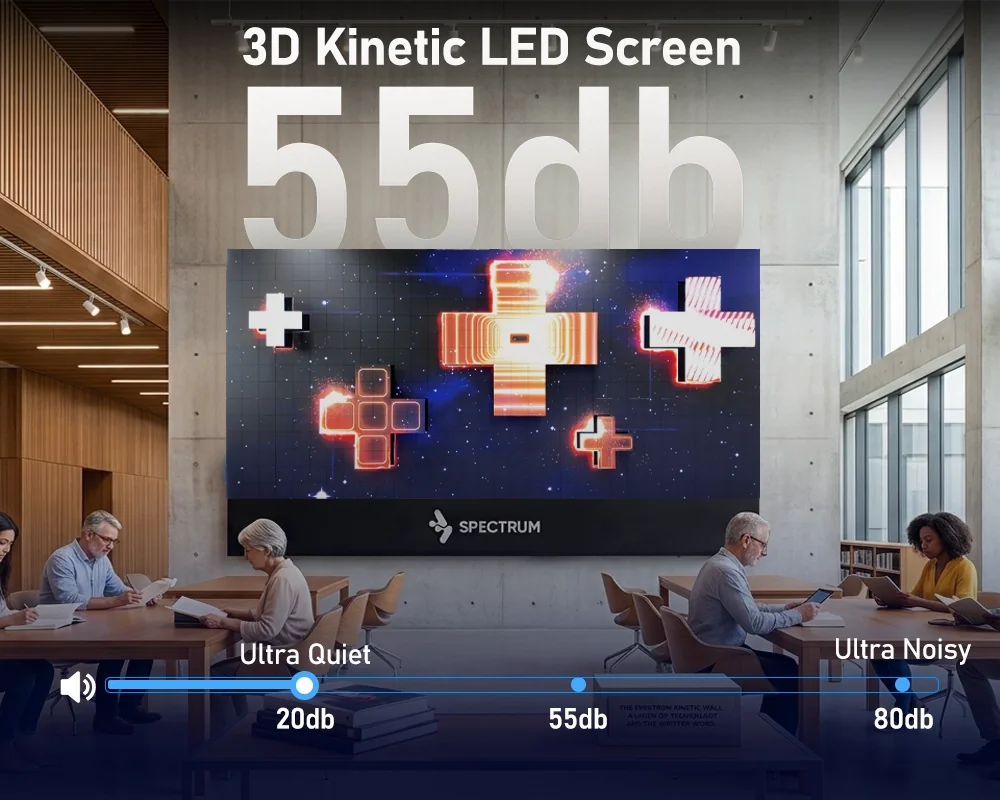
4. Acoustic Stability
Spectrum Display’s closed-loop servo system uses an FOC (Field-Oriented Control) vector control algorithm to achieve smoother and quieter motor operation.
Compared with conventional open-loop stepper systems, the reduction in mechanical noise is particularly valuable in environments such as:
- Premium retail stores
- Corporate showrooms
- Hotels
- Bars and clubs
- Exhibition spaces
- Other noise-sensitive commercial interiors
5. Safety Stability
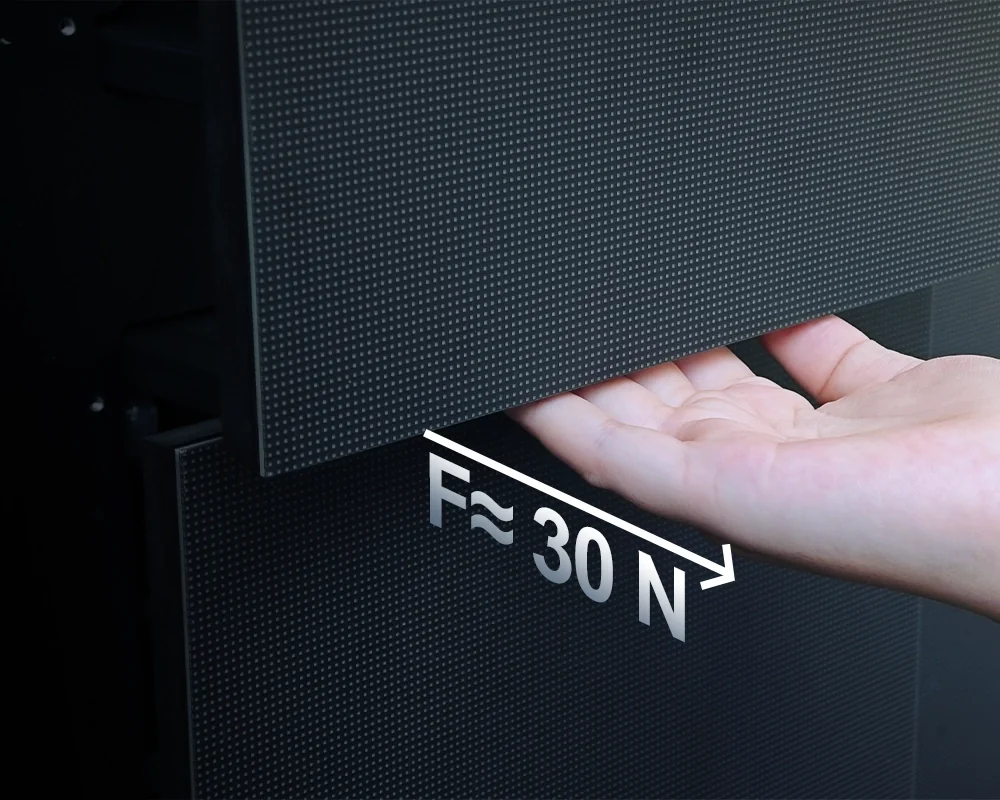
A closed-loop system can monitor changes in motor current and torque in real time.
When abnormal resistance is detected — for example, if a person or object obstructs a moving module — the system can trigger a protection response within milliseconds.
Spectrum Display’s indoor SPKI series comes standard with 3 kg intelligent anti-pinch protection.
When the detected resistance exceeds 3 kg, the motor immediately disengages and powers down. After remaining stationary for several seconds, the system performs a smooth reset.
5. Spectrum Display’s Closed-Loop System: From Encoders to FOC Algorithms
Spectrum Display’s closed-loop motion control architecture can be understood at three levels.
Level 1: Hardware
The system uses proprietary bus-based servo motors equipped with high-precision magnetic encoders.
The encoder provides the positional feedback required for closed-loop control.
Higher-resolution position feedback allows the control system to detect smaller deviations and make more precise corrections.
Level 2: Algorithms
Spectrum Display uses an FOC (Field-Oriented Control) vector control algorithm combined with a fully closed-loop control architecture.
FOC enables precise control of motor torque and speed, supporting:
- Smooth start-up
- Controlled acceleration
- Stable movement
- Soft stopping
- Lower operating noise
- Higher motion efficiency
Instead of simply commanding a motor to move from Point A to Point B, the system continuously manages how that movement happens.
Level 3: System Architecture
Spectrum Display uses a proprietary industrial-grade distributed control architecture.
Each communication channel supports peer-to-peer communication for up to 48 motion units, while the complete network can support up to 65,536 motion units online simultaneously.
Each motion unit has a unique ID.
When the system is powered on, units can be automatically identified and networked, avoiding configuration errors associated with conventional serial-port addressing changes.
This architecture allows a kinetic LED system with thousands — or even tens of thousands — of moving nodes to operate as one coordinated mechanical surface.
Proven in Real Projects
The practical value of this closed-loop control architecture has been demonstrated across different project environments.
At a premium bar in Singapore, an SPKI-160 kinetic LED ceiling installation was integrated with the venue’s lighting control system through DMX512.
The physical movement of the display could be synchronized with the music at the millisecond level while maintaining quiet and stable long-term operation.
At the Mandarin Oriental Jakarta outdoor project, the motion system had to operate under demanding conditions involving high temperatures, high humidity, and salt-laden air.
The closed-loop architecture helped maintain precise synchronization across hundreds of moving units under these challenging environmental conditions.
6. Frequently Asked Questions (FAQ)
Q1: What is the main difference between an open-loop stepper system and a closed-loop servo system?
A: An open-loop system sends a movement command without verifying whether the motor actually reaches the target position. This makes it more vulnerable to lost steps, positional drift, and synchronization errors.
A closed-loop system uses encoder feedback to continuously monitor actual motor position and automatically correct deviations, helping maintain long-term positional accuracy and synchronization.
Q2: How does closed-loop motion control prevent position drift?
A: Each servo motor is equipped with a high-precision magnetic encoder that continuously records rotor position.
At power-on, the system establishes its reference coordinates. During operation, it continuously detects positional deviations and corrects them.
Because the system uses position feedback rather than relying only on accumulated movement commands, positional errors do not simply continue to build up over time.
Q3: How does a closed-loop system keep a large kinetic LED matrix synchronized?
A: All motion units operate within the same control architecture and timing reference.
The system sends coordinated commands to the motion units, while closed-loop feedback verifies whether each unit actually reaches its intended position.
If an individual unit is disturbed, the deviation can be detected and corrected rather than silently accumulating.
Q4: How does closed-loop control reduce noise?
A: The closed-loop servo system uses FOC vector control to manage motor torque and speed more smoothly.
This reduces vibration and mechanical noise compared with conventional open-loop stepper systems.
The advantage is especially important in environments such as bars, showrooms, luxury retail stores, hotels, and other spaces where mechanical noise could interfere with the visitor experience.
Q5: How many motion units can Spectrum Display’s closed-loop control system support?
A: Each communication channel supports peer-to-peer communication for up to 48 motion units, while the complete network can support up to 65,536 motion units online simultaneously.
This architecture is designed to maintain synchronized command delivery across projects containing thousands or even tens of thousands of motion nodes.
Q6: Does closed-loop control increase project cost?
A: The initial hardware cost of a closed-loop servo system is generally higher than that of a basic open-loop stepper solution.
However, its advantages in long-term stability, reduced maintenance requirements, longer service life, and lower failure risk can result in a lower Total Cost of Ownership (TCO) over the full project lifecycle.
For projects designed for long-term operation, closed-loop control can therefore be the more economical engineering choice.
▶Video · YouTubeHow Content Becomes Physical Motion in Real Time — the Signal and Control SideWatch on YouTube →
7. Conclusion
Why can two kinetic LED displays look similar when they are first installed, yet perform very differently after several years?
One of the most important differences is the motion control architecture: open-loop or closed-loop.
| Comparison | Open-Loop Stepper | Closed-Loop Servo |
|---|---|---|
| Position Feedback | None | Real-time encoder feedback |
| Risk of Lost Steps | High | Extremely low |
| Accumulated Position Drift | Can accumulate | Automatically corrected |
| Synchronization | More vulnerable to desynchronization | Millisecond-level synchronization |
| Noise | Relatively high | Quiet operation |
| Long-Term Stability | May decline over time | Designed to remain stable over long-term operation |
| Maintenance Cost | Relatively high | Lower over the system lifecycle |
Key Takeaways
1. The inherent limitations of open-loop stepper systems: Lost steps, positional drift, synchronization errors, and higher noise can gradually become more visible during long-term operation.
2. The core advantages of closed-loop servo control: Real-time position feedback, automatic error correction, position control, and millisecond-level synchronization.
3. Five ways closed-loop control improves stability: Accuracy, synchronization, lifespan, noise performance, and operational safety.
4. Spectrum Display’s closed-loop architecture: Proprietary bus-based servo motors + high-precision magnetic encoders + FOC algorithms + industrial-grade distributed control architecture.
5. Selection principle: For projects requiring long-term operation, high-frequency movement, large-scale synchronized matrices, or low-noise performance, closed-loop motion control is a critical engineering consideration.
Recommendations for Buyers and Project Teams
- When evaluating a kinetic LED display, do not only ask, “How long is the stroke?” or “How fast can it move?” Ask whether the system uses open-loop or closed-loop motion control.
- Request technical data on encoder resolution, positioning accuracy, and long-term operational testing.
- For large kinetic matrices or high-frequency applications, closed-loop control should be treated as a core system requirement rather than an optional upgrade.
- For more technical information or a customized kinetic LED solution, contact the Spectrum Display team through its official website.