Why Can’t a Finished LED Display Ship Yet? Tests Complex LED Projects Must Pass Before Leaving the Factory
One-Sentence Definition: Factory testing for a complex LED project is not a simple “spot check.” It is a comprehensive validation system covering mechanical structures, motion control, display-motion synchronization, safety systems, and environmental aging. The goal is simple: identify and solve every potential problem before the equipment leaves the factory—rather than discovering it on site.
1. The Display Is Finished. Why Can’t It Ship Yet?
There is one stage in the LED display industry that is often underestimated:
Factory testing.
For many conventional projects, the workflow is simple: once the display is manufactured, it is shipped to the site and commissioned there.
For a complex mechanical LED project, however, this approach carries significant risk.
A mechanical LED system is not a static display.
It integrates motors, linear guides, transmission mechanisms, control systems, power systems, and signal systems. If any one of these subsystems develops a problem after transportation or installation, correcting it on site can cost far more than solving the same issue in the factory.
One extra week of factory testing can potentially save a month of downtime and troubleshooting on site.
Spectrum Display’s R&D and manufacturing base in Huizhou, at the heart of the Greater Bay Area’s advanced manufacturing ecosystem, supports a closed-loop production process covering in-house PCB core-board design and prototyping, precision mechanical tooling and customization, automated LED module SMT production, and complete system assembly.
Before any system leaves the factory, it must pass a comprehensive testing process.
This process covers five major dimensions:
Mechanical structure, motion control, display-motion synchronization, safety systems, and environmental aging.
2. Test 1: Mechanical Structure — Every Screw Must Withstand Tens of Thousands of Movements
The mechanical structure is the “skeleton” of a mechanical LED display.
It determines whether the screen can move, whether it remains stable while moving, and whether the movement feels precise and refined.
Motion Cycle Testing
Every motion unit undergoes thousands of movement cycles to simulate high-frequency operation in real-world applications.
Testing includes:
- Full-stroke motion tests
- Maximum-speed tests
- Continuous operation tests
Only units that continue to maintain their designed precision and stability after extensive cycling can proceed to the next stage.
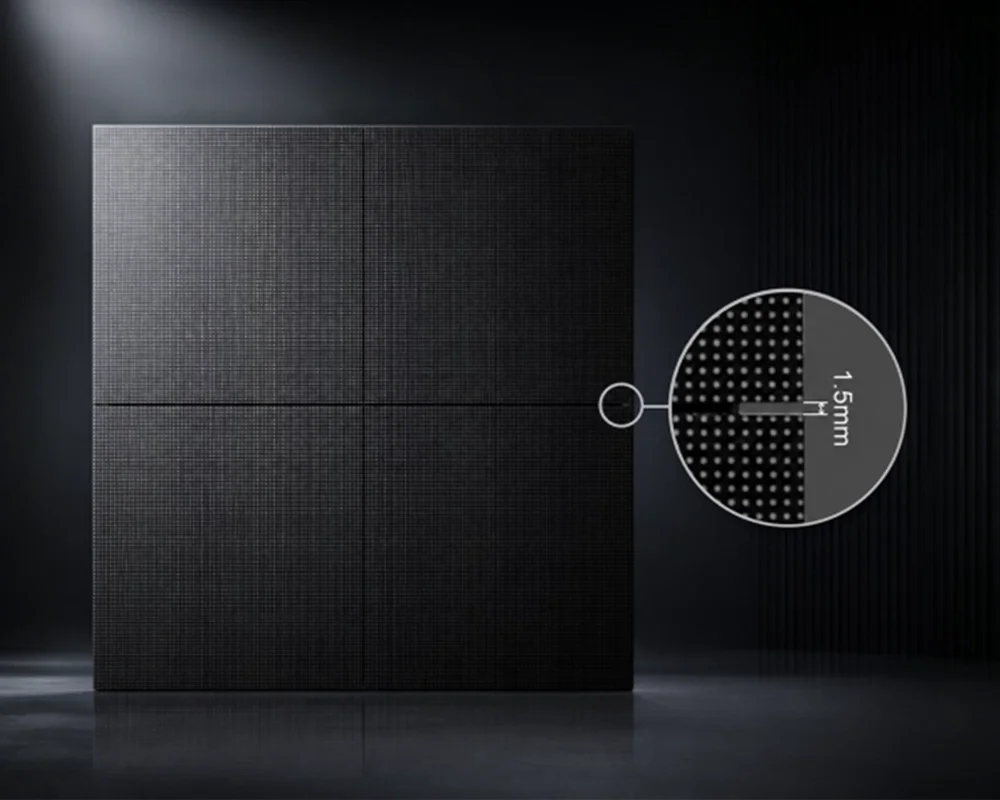
Module Gap Consistency Testing
The physical gap between modules directly affects visual integrity.
During dynamic movement, excessive gaps can create obvious black tearing lines, breaking the visual continuity of the display.
Testing therefore needs to verify whether module gaps remain within the designed tolerance in both static and dynamic conditions.
For Spectrum Display’s SPKI series:
- SPKI-128: 0.5 mm module gap
- SPKI-160: 1.0 mm module gap
- SPKI-250: 1.5 mm module gap
Structural Strength Testing
The system integrates die-cast aluminum cabinets, industrial-grade linear guides, and precision-machined motion mechanisms.
More than 90% of the mechanical components undergo precision machining.
Structural testing verifies whether, after prolonged high-frequency movement:
- The structure remains rigid
- Fasteners remain secure
- Linear guides maintain their performance
- Motion mechanisms show abnormal wear
For a mechanical LED system, every screw, guide, and moving component must be designed for repeated movement—not just for static installation.
3. Test 2: Motion Control — Thousands of Units Must Move as One
The motion control system is the “nervous system” of a mechanical LED display.
Its job is to translate digital content instructions into precise physical movement.
Synchronization Testing
In a large kinetic matrix, every motion unit must operate on the same timing reference.
Spectrum Display’s control system supports peer-to-peer communication for 48 motion units per channel, while the complete network can support up to 65,536 motion units online simultaneously.
Under full-load conditions, testing needs to verify whether every unit receives commands at the correct time and executes them synchronously.
When thousands of physical units form a single visual surface, even small timing differences can become visible.
Closed-Loop Position Accuracy Testing
Spectrum Display uses its self-developed bus-based servo motors combined with 32-bit MCU chips and high-precision magnetic encoders.
This architecture enables absolute position control, preventing the accumulated positioning errors, missed steps, and positional drift commonly associated with open-loop systems.
Testing therefore needs to verify whether each motion unit continues to maintain its designed positioning accuracy after tens of thousands of movement cycles.
Protocol Compatibility Testing
The control system supports international standard protocols including:
- DMX512
- ArtNet
- sACN
Factory testing verifies whether the mechanical LED system can integrate seamlessly with professional lighting consoles.
The goal is to allow lighting designers to control the rise and fall of the kinetic display through the same professional control environment they already use for stage lighting.
4. Test 3: Display-Motion Synchronization — Image and Motion Cannot Be Even One Frame Apart
The core value of a mechanical LED display is that changes in digital content can drive physical changes in the display surface.
If the image and the physical movement are out of sync, viewers immediately perceive a disconnect.
Content-to-Motion Synchronization Testing
Testing needs to verify whether information within the video content—including brightness, color, rhythm, and grayscale values—can be translated accurately and in real time into displacement commands for individual motion units.
Spectrum Display’s MotionMatrix4 plugin allows designers to use grayscale values directly within Adobe After Effects to generate physical Z-axis motion instructions.
The content-to-motion workflow therefore needs to be tested end to end:
Content playback → motion instruction → motor execution → physical displacement
The objective is to keep the delay between digital content and physical movement at the millisecond level.
Full-Stroke Motion Time Testing
Indoor models achieve a full-stroke motion time of less than 0.5 seconds.
Reaching this level of performance requires both high-performance servo motors and optimized control algorithms.
Factory testing therefore verifies whether the system can still meet its full-stroke performance target under full-load operating conditions.
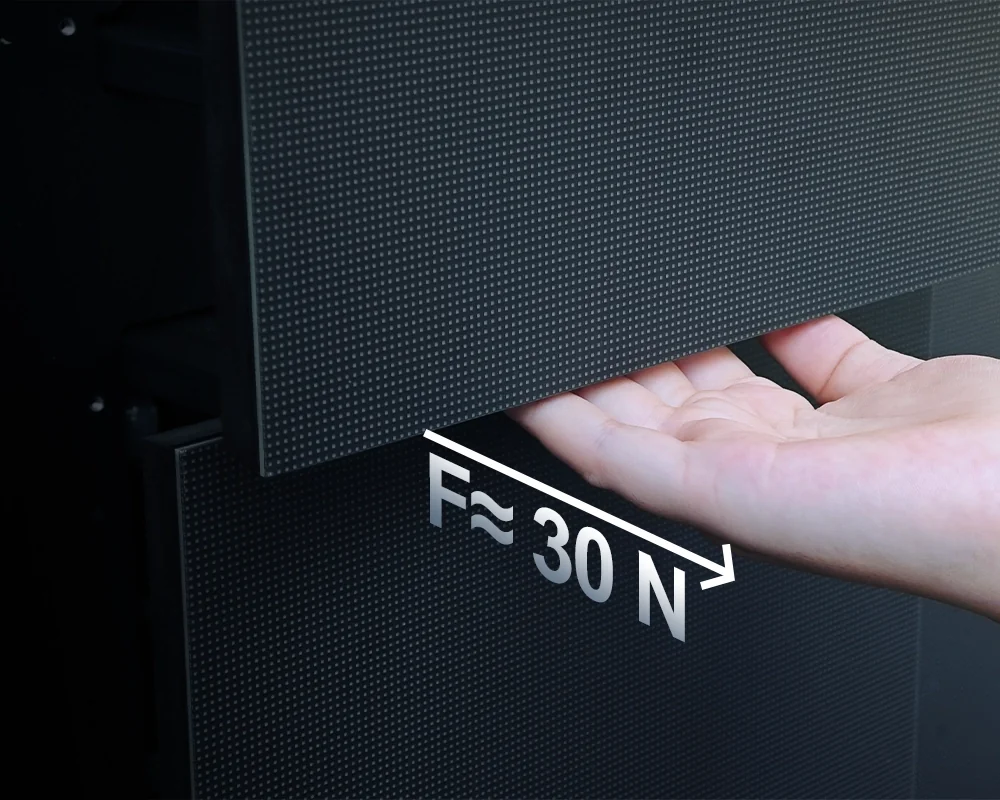
5. Test 4: Safety Systems — When People Get Close, the Machine Must Give Way
A mechanical LED display is an electromechanical system.
Safety must always take priority.
Anti-Pinch Protection Testing
Spectrum Display’s SPKI indoor series is equipped with 3 kg intelligent anti-pinch protection as standard.
When resistance exceeding 3 kg is detected, the motor is immediately disabled and powered down. After remaining stationary for several seconds, the system performs a controlled reset.
Testing needs to verify whether the anti-pinch mechanism can respond within milliseconds during high-speed movement, protecting both people and equipment.
Emergency Stop and Reset Testing
If an abnormal condition occurs:
Can all movement be stopped immediately?
After the emergency stop, can the system return to a safe operating state?
Testing verifies that emergency-stop and reset mechanisms are not only functional, but consistently reliable.
Electrical Safety Testing
The electrical safety of the power system, motor drive system, and control system must also be validated.
Testing includes areas such as:
- Electrical insulation
- Grounding
- Overload protection
For a system combining high-power LED displays with hundreds or thousands of moving electromechanical units, electrical safety is an essential part of factory validation.
6. Test 5: Environmental and Aging Tests — Simulating Years of Use Inside the Factory
Environmental risk is one of the “slowest” risks in a mechanical LED project.
It may not cause a system to fail on the first day.
Instead, it can gradually degrade performance after three, five, or more years of operation.
That is why environmental and aging tests are essential before delivery.
Fatigue Testing
Core motion components—including linear guides, synchronous belts, and flexible cables—must undergo continuous high-speed fatigue testing before shipment.
Spectrum Display’s equipment has accumulated more than 18,000 hours of high-intensity, fault-free operation testing, while the complete system is designed for a service life exceeding 50,000 hours.
The purpose is to expose weaknesses in moving components before those weaknesses have a chance to appear at the project site.
High- and Low-Temperature Testing
For outdoor projects, equipment must operate under simulated extreme conditions such as:
- High temperatures
- High humidity
- Low temperatures
These tests verify the stability of the cooling system, enclosure structure, mechanical components, and electrical system under demanding environmental conditions.
Ingress Protection Testing
Outdoor product series are designed to meet IP65 protection requirements.
Testing includes verification of:
- Water resistance
- Dust protection
- Corrosion resistance
For outdoor mechanical LED systems, these tests are critical to ensuring reliable operation in environments exposed to rain, heat, dust, and other external factors.
7. Digital Twin Simulation — Rehearsing the Site Before Installation
Before the equipment leaves the factory, Spectrum Display uses Mshow4 digital twin simulation software to perform a virtual rehearsal of the project.
Physical surface movement and interference checks can be simulated and verified on a computer before the equipment reaches the installation site.
This allows the project team to validate the system’s motion paths and safety boundaries in a virtual environment before installation begins.
Why Does Digital Twin Simulation Matter?
Because it moves problem-solving upstream.
Instead of discovering movement conflicts, interference risks, or incorrect motion paths during on-site commissioning, the engineering team can identify and resolve them before shipment.
The purpose of digital twin simulation is to discover site problems while the system is still in the factory.
By the time the equipment arrives on site, much of the movement logic and system behavior has already been validated.
This can significantly reduce installation and commissioning time.
8. Frequently Asked Questions (FAQ)
Q1: How long does factory testing for a complex LED project usually take?
A: It depends on the complexity of the project.
Testing may take anywhere from several days to several weeks.
Core motion components need to complete extensive cycle testing, while the complete system must also undergo protocol integration testing and digital twin simulation before shipment.
Q2: Why can’t factory testing be skipped?
A: Factory testing is essentially a rehearsal for the real project site.
If factory testing is skipped, problems may only become visible after the equipment has arrived and been installed—and correcting problems on site is significantly more expensive and time-consuming than correcting them in the factory.
Spectrum Display’s accumulated 18,000+ hours of fault-free high-intensity operation testing, together with digital twin simulation, are designed to reduce these risks before delivery.
Q3: What is tested before a complex mechanical LED system leaves the factory?
A: Factory testing covers five major dimensions:
Mechanical structure: motion cycles, gap consistency, structural strength
Motion control: synchronization, closed-loop accuracy, protocol compatibility
Display-motion synchronization: content-to-motion synchronization and full-stroke timing
Safety systems: anti-pinch protection, emergency stop and reset, electrical safety
Environmental aging: fatigue, high- and low-temperature testing, and ingress protection
Q4: What is digital twin simulation?
A: Digital twin simulation creates a virtual model of the physical system on a computer.
It allows engineers to simulate motion paths, physical movement, interference risks, and safety boundaries before the equipment reaches the project site.
Spectrum Display uses Mshow4 digital twin simulation software to verify physical movement and anti-interference conditions before shipment.
Q5: How is factory testing different for outdoor projects?
A: Outdoor projects require additional testing for environmental exposure.
This includes high- and low-temperature testing, IP65 ingress protection testing, and corrosion-resistance testing.
These tests simulate demanding operating environments and verify that the equipment can remain stable under conditions such as heavy rain, high temperatures, and dust exposure.
Q6: How can a project owner verify whether a supplier’s factory testing is comprehensive?
A: Ask the supplier to provide actual test reports and data.
These should include information such as:
- Motion cycle test results
- Synchronization accuracy data
- Fatigue testing duration
- Safety system test results
If a supplier cannot provide this type of testing evidence, its factory validation process may not be sufficiently comprehensive.
▶Video · YouTubeFrom Automated Craftsmanship to Stunning Visual Reality — Spectrum kinetic screensWatch on YouTube →9. Conclusion
The LED display is finished. Why can’t it ship yet?
Because for a complex mechanical LED project, the real question is not simply:
“Does the screen light up?”
The real questions are:
Does it move reliably?
Does everything stay synchronized?
Is the system safe?
Will it still perform properly after years of operation?
Key Takeaways
1. Mechanical Structure Testing
Motion cycling, module-gap consistency, and structural strength.
Every screw and moving component must withstand tens of thousands of movements.
2. Motion Control Testing
Synchronization, closed-loop positioning accuracy, and protocol compatibility.
Thousands of motion units must behave like one coordinated system.
3. Display-Motion Synchronization Testing
Content-to-motion synchronization and full-stroke timing.
The digital image and physical movement cannot be even one frame apart.
4. Safety System Testing
Anti-pinch protection, emergency stop and reset, and electrical safety.
When people and machinery interact, the machine must always give way.
5. Environmental and Aging Testing
Fatigue testing, temperature testing, and ingress protection testing.
Potential long-term problems need to be exposed before the system leaves the factory.
6. Digital Twin Simulation
The project is virtually rehearsed before installation, allowing potential interference, motion, and safety issues to be identified and resolved in advance.
Recommendations for Project Owners
- When evaluating a supplier, do not ask only, “Is the screen finished?” Ask, “What factory tests have been completed?”
- Request factory test reports and digital twin simulation validation results.
- Whenever possible, visit the manufacturing and R&D facility in person. Mechanical engineering quality, manufacturing precision, and testing capability are much easier to evaluate on the factory floor.
- To learn more about factory testing or discuss a customized mechanical LED solution, contact the Spectrum Display engineering team through its official website.