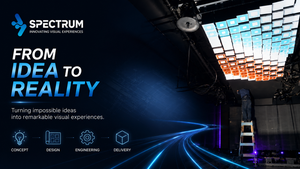
From Sayram Lake to Jeddah: How Spectrum Display Engineers LED Solutions for Different Spaces and Projects
One-sentence definition: From the immersive theater at Sayram Lake in Xinjiang to architectural-scale LED engineering in Jeddah, Saudi Arabia, Spectrum Display does not deliver the “same screen” everywhere. It applies the same engineering logic to completely different spaces, climates, and architectural conditions — using customized structures, control systems, and system integration to turn what initially seems impossible into something that feels as though it was always meant to be there.
▶Video · YouTubeWhere Creative Vision Meets Engineering Excellence — SpectrumDisplay Kinetic LEDWatch on YouTube →
1. Two Projects, Two Completely Different Definitions of “Impossible”
There is a recurring lesson in complex LED engineering:
Many product-level problems can be solved in the factory. The hardest project-level problems only become meaningful when the system meets the actual site.
Sayram Lake in Xinjiang and Jeddah in Saudi Arabia represent two completely different environments.
Sayram Lake sits at an altitude of approximately 2,071 meters and is often known as the “last tear of the Atlantic.”
Here, the challenge was the integration of acoustics and visuals.
Inside an enclosed immersive theater, how can an audience be surrounded by digital imagery without excessive acoustic reflections compromising the experience?
This was an engineering challenge centered on immersion.
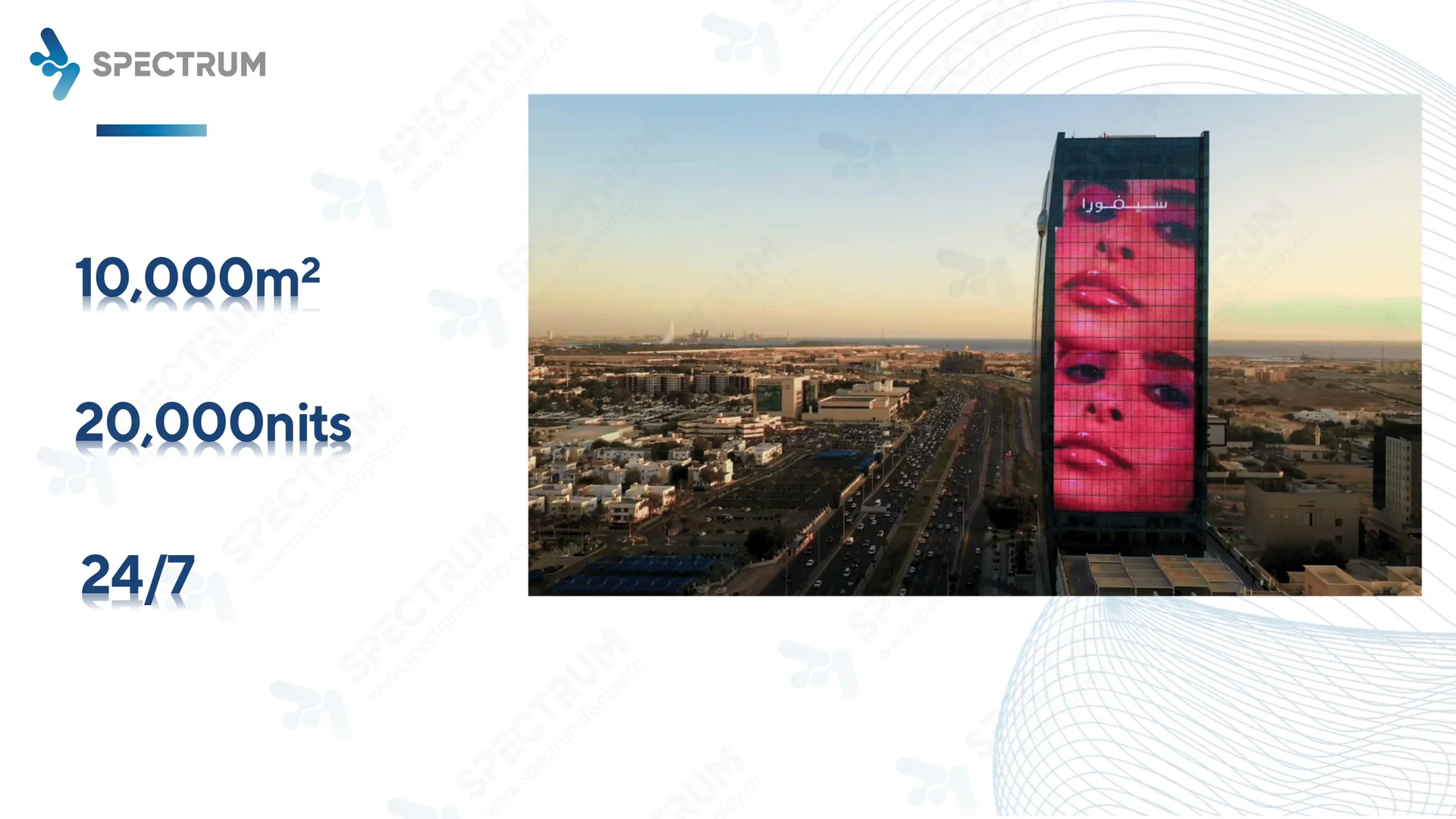
Jeddah sits on the coast of the Red Sea, where extreme heat and coastal environmental conditions create a very different set of requirements.
Here, the challenge is the balance between environmental durability and engineering precision.
How can a sophisticated LED and electromechanical system remain stable when heat, corrosive coastal conditions, and the movement of architectural facade structures all need to be considered?
This is an engineering challenge centered on durability.
One project is located on a high-altitude plateau.
The other is on the edge of a desert beside the Red Sea.
Thousands of kilometers separate them. Their climates, spaces, and cultural contexts are completely different.
But both follow the same fundamental engineering principle:
Start with the conditions of the space, not the specifications of the product.
▶Video · YouTubeCome Feel the Stunning Effect of Spectrum's 3D Immersive LED ScreenWatch on YouTube →
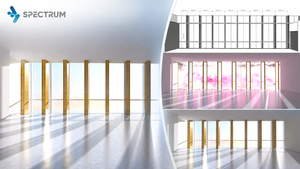
2. Sayram Lake Immersive Theater: When Natural Beauty Needs a Digital Canvas
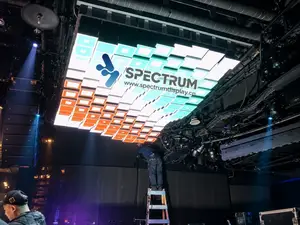
The Sayram Lake immersive theater is one of Spectrum Display’s representative projects in immersive cultural tourism.
The project combines approximately 248m² of curved LED display with approximately 180m² of LED flooring, creating a total visual surface of around 428m².
But what makes a project like this significant is not simply its size.
It is the engineering required to make multiple systems work together inside one immersive environment.
Challenge 1: Acoustics — Preventing the Screen from Becoming an Acoustic Barrier
In a large immersive environment, acoustics and visuals cannot be designed independently.
Hard display surfaces can reflect sound, potentially increasing reverberation and reducing speech and music clarity.
For this type of project, the LED system therefore needs to consider not only visual performance, but also how sound interacts with the display surface.
An acoustically transparent display structure creates physical openings that allow sound to pass through the LED surface toward the acoustic treatment behind it, reducing unwanted reflections from the display itself.
The engineering objective is straightforward:
the screen should contribute to the visual experience without becoming an obstacle to the acoustic experience.
Challenge 2: Energy Consumption and Thermal Management — The Hidden Cost of Long-Term Operation
In a large immersive venue, energy consumption affects more than the electricity bill.
It also affects heat generation, cooling requirements, component stress, and long-term operating costs.
That makes power efficiency and thermal management part of the overall engineering strategy.
Instead of considering brightness, power, and cooling as separate specifications, they need to be evaluated as one operating system.
The goal is not simply to make the screen perform well on opening day.
It is to create a display environment that can operate efficiently and consistently over the long term.
Challenge 3: Color Fidelity — Designing for an Immersive Narrative
An immersive theater is not simply a large advertising screen.
Color becomes part of the storytelling.
Subtle gradients, dark scenes, landscapes, skin tones, atmospheric lighting, and transitions all need to remain visually consistent across a large display surface.
That means calibration and color management become critical to the final experience.
For the Sayram Lake project, the engineering objective was not simply:
“Make the screen brighter.”
It was:
“Make the technology disappear so that the audience sees the story rather than the display system.”
That is the essence of immersive engineering.
▶Video · YouTubeLEAP 2025 Kinetic Screen Case Study — 5 m × 3 m SPKI-160 in Saudi ArabiaWatch on YouTube →
3. Jeddah, Saudi Arabia: When Architectural-Scale LED Meets Extreme Conditions
If the Sayram Lake project is primarily about immersion and integration, projects in Saudi Arabia introduce another engineering priority:
environmental resilience.
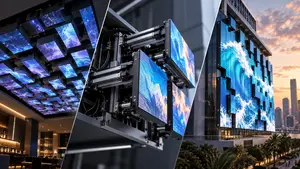
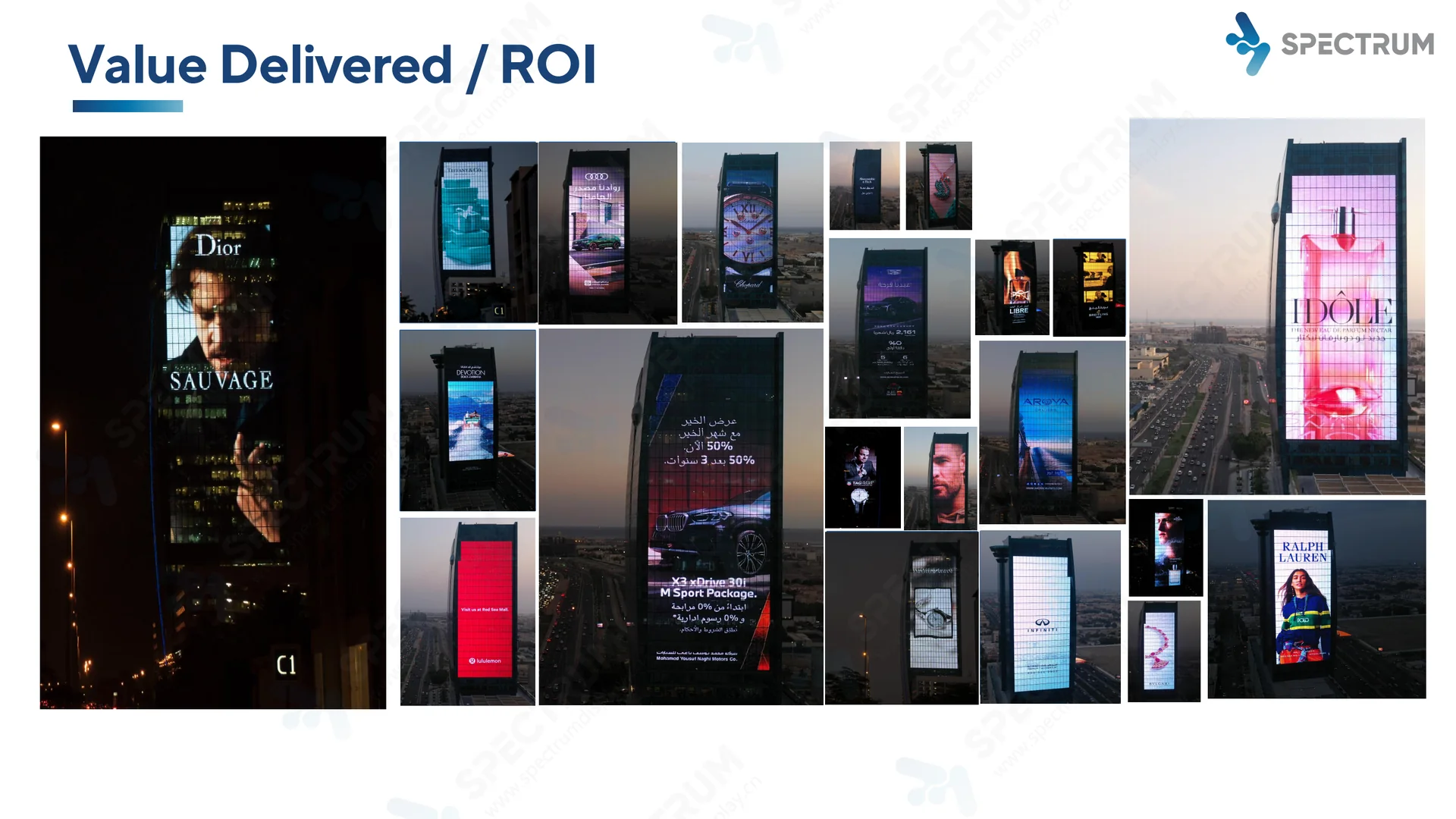
In cities such as Jeddah, large LED installations increasingly interact directly with architecture.
The display is no longer simply equipment mounted onto a building.
In many projects, it becomes part of the facade, interior architecture, exhibition environment, or brand space itself.
Spectrum Display’s experience in the Saudi market illustrates several different engineering scenarios.
Case 1: Mobily Corporate Space — Precision and Controlled Mechanical Movement
For a corporate environment, a 3D Kinetic LED Screen needs to deliver more than dramatic motion.
Movement must feel precise, controlled, and appropriate for the space.
Systems such as the SPKI-160 combine closely spaced motion units with an industrial motion-control architecture to create a more refined kinetic surface for indoor applications.
In a corporate environment, this level of precision communicates something beyond the technology itself.
It communicates attention to detail — and that can become part of the brand experience.
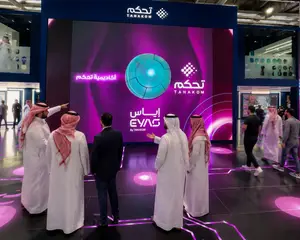
Case 2: Saudi Technology Exhibition — Combining Different Visual Systems
Large technology exhibitions require another type of engineering capability.
Instead of designing one isolated display, the project may combine different visual forms within the same booth or environment.
A kinetic LED wall can provide the primary physical visual impact, while spherical or immersive display systems create additional spatial layers around it.
The engineering challenge is therefore not simply to make each individual system work.
It is to make multiple display systems behave as one coordinated environment.
Case 3: Saudi Indoor Kinetic LED Projects — Adapting to Regional Conditions
Even indoor installations in the Middle East require careful consideration of local environmental and operational conditions.
Thermal management, dust exposure, installation architecture, maintenance access, and long-term reliability all need to be considered during system design.
For a precision electromechanical display, environmental adaptation cannot be treated as an afterthought.
It needs to influence:
- Mechanical design
- Cooling strategy
- Sealing and protection
- Material selection
- Maintenance planning
- Control-system architecture
The engineering question therefore becomes:
How do you preserve precision and reliability when the surrounding environment is demanding?
That is also the broader engineering context behind architectural-scale LED projects in Jeddah.
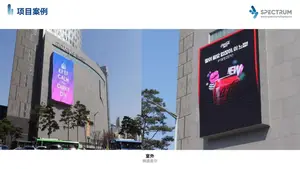
The challenge is not simply whether an LED system can be installed on or integrated into a building.
It is whether that system can fit the architecture, survive the environment, remain maintainable, and continue operating reliably over time.
4. Comparison: How the Engineering Logic Differs Between the Two Projects
| Comparison | Sayram Lake Immersive Theater | Jeddah / Middle East Projects |
|---|---|---|
| Core Challenge | Acoustic integration, energy efficiency, visual fidelity | Heat, environmental protection, architectural integration |
| Space Type | Enclosed immersive theater | Architectural facade / indoor corporate and exhibition spaces |
| Technical Focus | Acoustically transparent LED, thermal efficiency, color management | Thermal management, corrosion protection, structural integration |
| Engineering Logic | Make the technology disappear so the experience can emerge | Help the system survive while maintaining stable performance |
| Core Performance Focus | Acoustic clarity, visual consistency, immersion | Environmental durability, structural precision, long-term stability |
| Delivery Value | Immersive cultural experience | Architectural and branded visual experience |
What Do They Have in Common?
Both projects involve non-standard spaces.
At Sayram Lake, the LED system needs to adapt to a curved immersive theater environment.
In Jeddah and other Middle Eastern projects, the display may need to interact with architectural facades, unusual structures, or demanding installation environments.
Both require multi-system coordination:
display, structure, electrical systems, control, content, and — depending on the project — acoustics or mechanical movement.
And both require custom engineering.
A standard product cannot simply be taken out of a catalog and expected to solve every architectural problem.
What Is Different?
At Sayram Lake, the key word is integration.
The technology needs to integrate with the story, the acoustics, and the cultural experience.
For architectural projects in Jeddah, the key word is resilience.
The system needs to maintain stability and precision under demanding environmental and architectural conditions.
▶Video · YouTubeInside SpectrumDisplay: Revolutionizing 3D Kinetic LED Screens & Going Global (Founder Interview)Watch on YouTube →
5. The Capabilities That Remain the Same: From Product Supplier to Engineering Partner
One project is on a high-altitude plateau.
Another is in the Middle East.
The climate, architecture, application, and technical priorities may all change.
Spectrum Display’s underlying engineering logic remains consistent.
Layer 1: Start with the Space, Not the Product Catalog
For every customized project, the first question should not be:
“Which existing model can we use?”
It should be:
“What does this space actually require?”
At Sayram Lake, the answer involves integrating the LED system with the requirements of an immersive theater.
In architectural projects in the Middle East, the answer may involve thermal management, environmental protection, structural engineering, and facade integration.
The technical answers change.
The engineering logic does not.
Layer 2: Support the Complete Journey from Requirements to Long-Term Operation
Spectrum Display’s role extends beyond manufacturing an LED product.
For a complex project, the engineering process can include:
Requirements Analysis → Site Evaluation → System Design → Custom Engineering → Manufacturing → Factory Testing → Installation & Commissioning → Training → Maintenance
This matters because a complex LED project is not a collection of independent products.
It is a complete system in which architecture, display, mechanics, control, power, content, and maintenance need to work together.
Layer 3: Build Experience Through Projects — and Validate Capability Through Projects
Complex engineering capability cannot be demonstrated by a specification sheet alone.
It is accumulated through projects involving different:
- Climates
- Architectural conditions
- Installation methods
- Display formats
- Maintenance requirements
- Control environments
A supplier that has worked across multiple regions and project types develops something that cannot easily be copied from a product catalog:
the ability to recognize risks before they become onsite problems.
From outdoor architectural installations in Southeast Asia to immersive cultural-tourism projects in Xinjiang and kinetic LED applications in the Middle East, each project adds another layer of engineering experience.
That accumulated experience is what transforms a manufacturer into an engineering partner.
6. Conclusion: Different Spaces, One Engineering Philosophy
From Sayram Lake to Jeddah, from a high-altitude immersive theater to demanding Middle Eastern architectural environments, Spectrum Display is never solving exactly the same problem twice.
Key Takeaways
1. Sayram Lake Immersive Theater
The project combines approximately 248m² of curved LED display with 180m² of LED flooring, requiring visual systems to work alongside the theater’s spatial and acoustic requirements.
The engineering objective is:
Make the technology disappear so the experience can emerge.
2. Jeddah and Middle East Projects
High temperatures, environmental exposure, architectural integration, dust, and long-term operation introduce a completely different set of engineering priorities.
The objective becomes:
Help the system survive while maintaining precision and stability.
3. The Same Engineering Logic
Start with the space rather than the product specification. Support the complete process from requirements analysis to long-term operation. Build engineering capability through real-world project experience.
4. Different Projects Require Different Technical Answers
An immersive theater may prioritize acoustic integration, energy efficiency, and color performance.
An architectural project in the Middle East may prioritize thermal management, environmental protection, structural integration, and maintainability.
Recommendations for Project Owners
Bring the engineering team into the project as early as possible.
Different spaces require different technical solutions. The earlier architectural and environmental constraints are identified, the more effectively they can be addressed through engineering.
When selecting a supplier, look beyond individual product specifications.
Evaluate whether the team has experience across different spaces, climates, architectural conditions, and project types.
For immersive projects, pay close attention to acoustics, thermal management, content, and visual consistency.
For outdoor architectural projects, prioritize environmental protection, structural integration, thermal engineering, maintenance access, and long-term reliability.
Different environments require different answers.
The real capability of an engineering partner lies in knowing which questions to ask before choosing the solution.
For cross-scenario LED engineering and customized project solutions, contact the Spectrum Display team.