Mechanical LED Screens Are More Than Hardware: What Can Be Customized in a Creative Mechanical LED Project?
One-sentence definition:
A mechanical LED screen is not just hardware. A customized creative mechanical LED project is a complete engineering loop that covers mechanical structure, motion control, surface materials, content workflow, and installation design. What Spectrum Display provides is not simply a screen, but an engineered visual solution tailored to every non-standard space, every unique creative concept, and the specific character of each building.
Contents
- Customization Is Not Just “Changing the Size” — It Has Five Different Dimensions
- Dimension 1: Mechanical Structure Customization — Making the Screen Belong to the Building
- Dimension 2: Motion Control Customization — Letting Content Drive the Physical World
- Dimension 3: Surface and Material Customization — Turning the Screen into a Spatial Language
- Dimension 4: Content Ecosystem Customization — Making It Easy for Creative Teams to Use
- Dimension 5: Installation Customization — Making Maintenance Less of a Nightmare
- Conclusion: From Hardware Supplier to Creative Engineering Partner
1. Customization Is Not Just “Changing the Size” — It Has Five Different Dimensions
In the LED display industry, the word “customized” is often used too casually.
For many suppliers, “customization” simply means adjusting the size or changing the color of a standard product. In essence, they are still selling what they already have.
But a truly customized mechanical LED project is something very different.
The starting point of every customized project is usually not a simple request like:
“I need a screen.”
More often, it starts with a difficult problem:
“A standard solution does not work in this space.”
It may be an irregular wall.
It may be limited installation depth.
It may be a strict requirement to align perfectly with an existing architectural structure.
When creative ideas meet architectural constraints, standard products often become the most expensive compromise. They force the designer’s imagination to fit around the idea of “placing a screen here.”
True customization means redefining a mechanical LED wall across five dimensions.
These five dimensions determine whether a project merely “works” or feels like it was always meant to be there.
As a national high-tech enterprise, Spectrum Display integrates design, manufacturing, installation, and service, focusing on the deep customization and system integration of creative LED display systems.
It is not simply a company that sells screens.
It is a mechanical LED system manufacturer that provides full-process engineering services, from requirement analysis and system design to product development, equipment manufacturing, and professional consultation.
2. Dimension 1: Mechanical Structure Customization — Making the Screen Belong to the Building
The mechanical structure of a 3D Kinetic LED Screen determines whether the screen can move, how stable the movement is, and whether the movement feels refined.
In a customized project, mechanical structure is not about choosing a standard size. It is about redesigning the screen around the space from the ground up.
The value of a customized mechanical LED solution lies in this principle:
the building should not adapt to the product; the product should understand the building.
Structural Customization Options in the SPKI Series
Spectrum Display provides tailored LED display solutions to meet specific client needs, from size and resolution to unique application scenarios.
SPKI-128 — Precision First
SPKI-128 uses 128 × 128mm modules. Through proprietary LED offset technology and strict structural tolerance control, the physical gap is reduced to as little as 0.5mm, creating a visually seamless 0mm viewing effect.
With 60.6 high-density units per square meter and an overall finished thickness controlled within 400mm, SPKI-128 is suitable for close-viewing scenarios such as science museums and luxury brand stores.
SPKI-160 — Ultra-Thin First
SPKI-160 reduces the body thickness to 330mm. Combined with precision wall-mounting brackets, the overall finished thickness can be compressed to around 350mm.
With 38.6 units per square meter, it is suitable for space-limited scenarios such as shopping mall storefronts, corridors, and column-wrapping installations.
SPKI-250 — Large Unit First
For high-altitude and large-scale projects, SPKI-250 enlarges each physical motion unit to 248.5 × 248.5mm, with only 16 units per square meter.
This simplified physical scale greatly reduces the electrical control complexity of large-area system integration.
SPKI-250 offers multiple pixel pitch options, from P1.56, P1.95, and P2.6 to P3.91, with each cabinet weighing only 13kg.
Outdoor Customization in the SPKO Series
SPKO-320 is designed for outdoor advertising and media projects. It uses large 495 × 495mm motion units, with only 4 units per square meter.
The equipment thickness is compressed to 650mm, with peak brightness of ≥5000 nits and an IP65 protection rating.
SPKO-500 is designed for large outdoor landmark projects, offering a maximum physical extension stroke of 600mm and a movement speed of 800mm/s.
A Real Customization Case
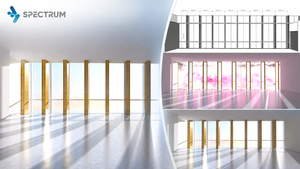
In one customized project, the architect requested a screen that was 13.5 meters wide and 3.12 meters high.
When open, it needed to become a seamless giant display.
When closed, it needed to look like an ordinary window.
No standard cabinet could directly match such a non-standard requirement.
The project had to be customized from zero.
The engineering team customized 180 × 240mm LED modules with a P2 pixel pitch for each 900mm-wide folding display section.
The total resolution reached 6750 × 1560 pixels — approximately 10.53 million pixels — with every pixel placed exactly where it needed to be.
This is the essential difference between standardization and customization:
standardization means using what already exists; customization means building what the project truly needs.
▶Video · YouTubeWhere Creative Vision Meets Engineering Excellence — large-scale 3D kinetic LED wallsWatch on YouTube →
3. Dimension 2: Motion Control Customization — Letting Content Drive the Physical World
If the mechanical structure is the skeleton of a 3D Kinetic LED Screen, then the motion control system is its nervous system.
It determines whether thousands of moving units can receive commands and execute synchronized movement within the same millisecond.
From Content to Motion
The core value of a 3D Kinetic LED System is that it allows changes in content to drive changes in physical form.
The complete process is:
video design → control data generation → motion module execution → kinetic visual effect
This requires the control system to translate brightness, color, rhythm, and visual information into displacement commands for each motion unit.
Customization Capability of the Control System
Large-scale 3D Kinetic LED systems usually contain a large number of motion modules.
They must solve three key problems:
precise control of each module, synchronized movement across multiple modules, and stable long-term operation.
Spectrum Display avoids unstable serial communication protocols commonly used in traditional systems.
A single channel supports peer-to-peer communication for 48 units, while the entire network supports up to 65,536 motion units online simultaneously.
Whether the project involves thousands or tens of thousands of motion nodes, commands can still be delivered with high synchronization.
The control system also supports international standard protocols including DMX512, Art-Net, and sACN.
Lighting designers do not need to learn a dedicated mechanical control platform. They can control the rise and fall of the screen directly from a professional lighting console, just as they would control moving-head lights.
Precision at the Extreme
For precision motion control, Spectrum Display uses a self-developed bus-type servo motor system instead of traditional stepper solutions.
The core power system combines a 32-bit MCU chip with a high-precision magnetic encoder.
The system enables absolute position control, preventing position drift and step loss during high-frequency movement.
For indoor models, the full-stroke motion time is less than 0.5 seconds, allowing precise, smooth, and ultra-quiet movement.
▶Video · YouTubeWhen Content Moves Beyond the Screen — Infoview × SPKI-250Watch on YouTube →
4. Dimension 3: Surface and Material Customization — Turning the Screen into a Spatial Language
Surface customization determines whether a mechanical screen looks like an industrial device or becomes part of the architecture.
Customization Flexibility of Spectrum Flip Matrix
The Spectrum Flip Matrix, or SPFM Series, gives each mechanical flipping unit three physical display surfaces. Switching from one side to another takes only 0.15 seconds.
These three surfaces can be customized in color, pattern, and texture according to project needs.
Colors, materials, and finishes can be tailored for brand spaces, exhibition themes, and art installations.
Supported processes include:
plastic self-color, UV printing, electroplating, and color film application.
Available finishes include:
glossy, matte, mirror, and color-shifting effects.
In SPFM-100, all three physical display surfaces can be customized in color, pattern, and texture, making it suitable for boutique storefronts and high-end retail spaces with close viewing distances.
In SPFM-138L, one side uses RGB full-color lighting, while the other two sides can be customized with different colors, patterns, or materials.
By day, it can function as a wall.
By night, it becomes light.
In SPFM-138P, one side is a P10.42 LED display surface with a resolution of 14 × 14 pixels, while the other two sides can be customized with colors, patterns, or materials.
This means the same product can appear as a refined matte surface in a luxury storefront or as a futuristic mirror finish in a science museum.
It all depends on the spatial language the brand wants to express.
▶Video · YouTubeSpectrum Flip Matrix: The Future of Kinetic Display TechnologyWatch on YouTube →
5. Dimension 4: Content Ecosystem Customization — Making It Easy for Creative Teams to Use
Whether a mechanical LED project can operate successfully in the long term ultimately depends on one question:
Can the content team create and update content easily?
From “Programming Required” to “Drag and Create”
Traditional mechanical screen content production often requires a professional programming team to write control code line by line.
The debugging process can be painful, and every change can be expensive.
Spectrum Display’s self-developed content creation ecosystem breaks this barrier.
With Spectrum Display’s dedicated plug-in, visual designers can generate physical Z-axis motor commands directly in After Effects using the grayscale values of a 2D video.
The visual output becomes the physical movement of the screen.
If an area of the video is pure black, the corresponding module fully retracts.
If an area is pure white, the module fully extends.
If an area is gray, the module stops somewhere in the middle.
Designers do not need to write code.
They do not need to understand motor control or extension stroke.
They only need to know how to create video content.
Multi-Platform Interaction Customization
Mshow4 supports fast 3D PPT-style content creation, allowing non-technical operators to create dynamic presentation content.
The TouchDesigner plug-in integrates deeply with interactive development environments and supports interaction methods such as radar sensing, depth cameras, and facial recognition.
At ISLE 2026, precise sensor input allowed the screen to move in real time according to the outline of the visitor’s body movement.
The UE5 plug-in supports game-engine-based development, enabling realistic lighting, physical collision effects, and interactive gaming experiences.
When a mechanical screen is combined with a game engine, the screen itself becomes part of the game.
The audience is no longer just watching the screen.
They are entering the screen experience.
This complete “hardware + software + content” ecosystem transforms content creation from programming-heavy work into a drag-and-create process.
The freedom of content creation determines the long-term operational value of the project.
▶Video · YouTubeThe Ultimate Zero-Code Kinetic Screen — content creation without programmingWatch on YouTube →
6. Dimension 5: Installation Customization — Making Maintenance Less of a Nightmare
Installation and maintenance are often the most underestimated costs in a 3D Kinetic LED Screen project.
This is especially true for high-altitude projects, where every maintenance task can become a difficult and risky operation.
Front Maintenance vs. Rear Maintenance: Two Customization Paths
Front Maintenance — SPKI-128 / SPKI-160
For space-limited indoor projects, SPKI-128 and SPKI-160 support front maintenance.
The LED modules and key internal mechanical components can be removed and replaced directly from the front of the screen.
No rear maintenance corridor is required.
The screen can be installed close to a wall, embedded into a wall, or placed where rear access is impossible.
For SPKI-160, the front-maintenance architecture allows installation within approximately 350mm of finished wall depth.
In premium commercial spaces where every millimeter matters, this 350mm difference can decide whether the project is possible or impossible.
Rear Maintenance — SPKI-250 / SPKO Series
For large fixed installations such as high-rise shopping mall atriums, airports, and outdoor landmarks, SPKI-250 and the SPKO Series use rear maintenance architecture.
During the early planning stage, a standard internal maintenance corridor of 600mm to 800mm can be reserved behind the screen.
Technicians can complete maintenance work without relying on additional high-altitude equipment.
Installation Flexibility of Spectrum Flip Matrix
The Spectrum Flip Matrix also supports multiple installation methods, including downward-facing ceiling installation, wall mounting, upward-facing installation, and irregular installations.
It can be used on walls, ceilings, door openings, L-shaped corners, and other spatial structures.
Customized Maintenance Paths for Different Projects
| Installation Scenario | Recommended Model | Maintenance Method | Reason |
|---|---|---|---|
| Boutique storefront / showroom interior wall | SPKI-160 | Front maintenance | Wall-mounted installation with no rear space |
| Shopping mall atrium ceiling | SPKI-128 | Front maintenance | High-altitude ceiling installation with no rear access |
| Large fixed installation / rental application | SPKI-250 | Rear maintenance | Independent maintenance corridor available |
| Outdoor building facade | SPKO-320 / SPKO-500 | Rear maintenance | High-altitude outdoor environment requiring safe maintenance access |
The logic of installation customization is simple:
the building should not adapt to the screen’s maintenance method. The screen’s maintenance method should adapt to the building’s spatial conditions.
7. Conclusion: From Hardware Supplier to Creative Engineering Partner
A customized 3D Kinetic LED project is never just about buying a screen.
| Customization Dimension | Core Question | What Spectrum Display Can Do |
|---|---|---|
| Mechanical Structure Customization | Can the screen become part of the building? | Non-standard module sizes, ultra-thin body at 330mm, large-unit simplification at 248.5mm, and large extension stroke up to 600mm |
| Motion Control Customization | Can thousands of units move in sync? | CAN bus architecture, support for up to 65,536 motion units, and compatibility with DMX512 / Art-Net / sACN |
| Surface and Material Customization | Can the screen blend into the space? | Three-sided flipping surfaces, multiple finishing processes such as painting, electroplating, and UV printing, plus glossy, matte, and mirror finishes |
| Content Ecosystem Customization | Can the creative team use it easily? | AE plug-in, Mshow4, TouchDesigner plug-in, and UE5 plug-in |
| Installation Customization | Will maintenance become a problem? | Dual maintenance paths: front maintenance for SPKI-128 / SPKI-160 and rear maintenance for SPKI-250 / SPKO Series |
Key Takeaways
- Customization is not just changing the size.
True customization covers mechanical structure, motion control, surface materials, content ecosystem, and installation design. - Spectrum Display is not simply a screen supplier.
It is a mechanical LED system manufacturer providing full-process engineering services, from requirement analysis and system design to product development, manufacturing, and professional consultation. - Every customized project starts where standard solutions fail.
That is the real value of customization. - The goal of customization is to make the solution feel inevitable.
Not “good enough,” but as if the screen was always meant to be part of the building, the language of the space, and the carrier of the creative idea.
Recommendations for Project Owners
Mechanical LED systems should be discussed at the early stage of architectural and spatial design, rather than being added later as a display device.
Clarify the core project requirement:
Do you need extreme visual precision with SPKI-128?
Spatial integration with SPKI-160?
Or large-scale stable operation with SPKI-250 or the SPKO Series?
Communicate architectural constraints clearly with the engineering team, including wall structure, installation depth, load-bearing capacity, and maintenance access.
For more customization details or a tailored proposal, contact the Spectrum Display team through: