Moving Content Is No Longer Enough: Why Should Next-Generation LED Walls Move Too?
One-sentence definition:
The next generation of LED displays is evolving from “moving content” to “moving walls.” A standard LED display is like content moving inside a canvas, while a 3D Kinetic LED Screen makes the canvas itself move with the content. This shift turns the screen from a simple content player into a spatial participant.
Contents
- From Moving Content to Moving Walls: A Shift in Display Philosophy
- Why Is Moving the Wall Much Harder Than Moving the Content?
- Three New Experience Dimensions Created by Moving Walls
- How Do Content and Wall Movement Work Together? The Logic of Synchronization
- Real Project Cases: When Walls Learn to Respond
- Conclusion: The Next Generation of LED Displays Is Not Just About Playback, But Movement
1. From Moving Content to Moving Walls: A Shift in Display Philosophy
The logic of a traditional LED display is simple:
the content moves, but the wall does not.
A fixed screen plays a moving video. The image changes, but the screen itself remains still. What the audience sees is “content in motion,” not “space in motion.”
This has been the mainstream logic of LED display over the past decade. But a problem is becoming increasingly clear: when screens are everywhere, audiences gradually become visually fatigued.
A fixed screen may feel impressive the first time, familiar the second time, and invisible the third time.
The logic of next-generation LED displays is changing: the content moves, and the wall moves with it.
The emergence of the 3D Kinetic LED Screen gives the wall itself the ability to move.
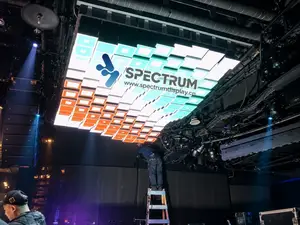
Built on an ultra-high-definition LED display, each display module is assigned an independent physical Z-axis position. This allows the screen to physically extend and retract in sync with the visual rhythm of the content.
When a video shows a rising motion, the screen surface can physically rise with it.
This is not just a visual effect.
It is physical reality.
In traditional LED displays, content movement is virtual. The image moves, but the screen remains lifeless.
In a 3D Kinetic LED Screen, content movement becomes physical. The image moves, and the screen moves with it.
The difference is like watching a documentary about the ocean versus standing by the sea.
One is viewing.
The other is experiencing.
▶Video · InstagramNot just content on a screen — the screen itself becomes part of the visualWatch on Instagram →
2. Why Is Moving the Wall Much Harder Than Moving the Content?
Making content move is relatively easy.
A video file and a playback system are enough.
But making the wall itself move is a completely different level of engineering. It involves three layers of complexity.
Challenge 1: The Mechanical Structure Must Keep Up with the Rhythm of the Content
Video rhythm is designed in seconds.
Mechanical motion is designed in millimeters per second.
A scene transition in a video may take only 0.3 seconds, but a kinetic LED module may need two seconds to move from its closed position to its fully extended position.
What should the audience see during the remaining 1.7 seconds?
According to Spectrum Display’s internal project experience, more than 70% of the time spent during the early commissioning stage of 3D Kinetic LED Screen projects is related to one issue:
content and motion are not synchronized.
If the visual content and the mechanical movement do not match, even a 0.5-second delay can be clearly felt by the audience.
Challenge 2: The Control System Must “Understand” the Content
Video files and mechanical control commands are two different languages.
Without early alignment between the content timeline and the control system, video playback and mechanical movement will run separately.
Spectrum Display’s project experience shows that when an “action-first” workflow is used, the matching accuracy between content and mechanical movement can be controlled within 0.1 seconds.
When the process is reversed, the average deviation can exceed 0.8 seconds, creating visible misalignment.
Challenge 3: Thousands of Units Must Move as One
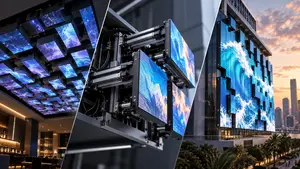
Large 3D Kinetic LED Screen systems often contain a large number of moving modules.
The system needs to solve several problems at the same time:
- precise control of each module
- synchronized movement across multiple modules
- stable long-term operation
Any delay or loss of synchronization in a single unit can damage the overall visual effect.
Moving content tests video production capability. Moving the wall tests the combined capability of mechanical engineering, motion control, and content management.
3. Three New Experience Dimensions Created by Moving Walls
Dimension 1: Physical Depth — From Flat Surface to Spatial Volume
A traditional LED display is a flat combination of the X-axis and Y-axis.
No matter how refined the visuals are, they remain on a flat plane.
There is no real depth, no physical volume, and no tangible spatial presence.
The audience sees content, but they do not feel the space.
A 3D Kinetic LED Screen gives pixels a physical Z-axis for the first time.
When the LED modules physically extend and retract with the content, the image is no longer flat. It becomes three-dimensional, physical, and perceptible.
Spectrum Display describes this integration of software and hardware as a dual 3D effect: the image has depth, and the screen itself physically moves toward the viewer.
Dimension 2: Physical Rhythm — From Playback to Performance
A standard LED display can only play content.
Whatever rhythm the video has, the screen simply displays it.
A 3D Kinetic LED Screen can perform the content.
The screen’s physical movement becomes part of the performance itself.
At ISE 2026, Spectrum Display’s 3D Kinetic LED Screen used physical Z-axis movement to transform the exhibition experience from viewing to participation.
The screen was no longer a background.
It became part of the performance.
Dimension 3: Physical Interaction — From Watching to Playing
When the wall can move, interaction becomes natural.
At ISE 2026, Spectrum Display’s 3D Kinetic LED Screen integrated radar sensors and depth cameras to create immersive spatial interaction.
Visitors did not need to press a button.
They did not need to scan a QR code.
Simply standing in front of the screen could trigger a response.
▶Video · InstagramISE 2026 Barcelona: Live Interactive Kinetic ScreenWatch on Instagram →
4. How Do Content and Wall Movement Work Together? The Logic of Synchronization
The integration of moving content and a moving wall depends on one key concept:
synchronization.
In the article How Should Content Be Designed for a 3D Kinetic LED Screen?, Spectrum Display proposed a core methodology:
the correct process is the opposite of what most people instinctively do.
❌ Wrong process:
Create the video first → make the mechanical system follow the visuals
✅ Correct process:
Define mechanical motion parameters first — speed, stroke, and timing → design the visual rhythm around those motion parameters
This “action-first” workflow requires the content team and mechanical engineering team to work together from the beginning of the project.
They jointly create a motion-content timeline.
When should the modules extend?
When should they retract?
What content should appear at each moment?
All key time points are defined at the project planning stage, instead of adding motion after the video has already been completed.
Spectrum Display’s dedicated MotionMatrix4 plug-in makes this process more intuitive.
Designers can use grayscale values in After Effects to generate Z-axis motor movement commands directly:
black means retract,
white means extend,
gray means stop somewhere in between.
Designers do not need to write code.
They only need to understand one thing:
the image they design will become physical movement on the wall.
5. Real Project Cases: When Walls Learn to Respond
ISE 2026: An Industry-Recognized Next-Generation Display
At ISE 2026, one of the world’s most influential professional audiovisual exhibitions, the 3D Kinetic LED Screen was selected as one of the top creative LED installations.
Industry discussion has moved beyond whether LED technology works.
The new focus is how LED can work better in real-world spaces, where portability, sustainability, and architectural flexibility are becoming increasingly important.
Professional media outlet Pixel Inspiration described Spectrum Display’s kinetic screen panels as being able to physically extend and retract according to touch or content commands, creating depth and focus without mechanical system noise.
Canton Fair: The Traffic-Driving Power of the Dual 3D Effect
At the Canton Fair, Spectrum Display created a large 3D Kinetic LED wall.
When dazzling fireworks and 3D visuals of the Canton Tower appeared on the screen, Spectrum Display’s closed-loop servo motor system ensured that hundreds and even thousands of modules moved smoothly and without delay.
Precise physical extension and retraction worked in perfect sync with customized video content, creating a unique kinetic visual effect.
Many international visitors were impressed by this dual 3D effect — the image appeared three-dimensional, while the screen itself physically moved toward the audience — and stopped to film the installation.
▶Video · YouTubeSpectrum Display in the Spotlight: Featured on Guangzhou News at Canton Fair 2026Watch on YouTube →
6. Conclusion: The Next Generation of LED Displays Is Not Just About Playback, But Movement
The direction of next-generation LED display is becoming clear:
moving content is only the starting point. Moving walls are the future.
| Traditional LED Display | 3D Kinetic LED Screen | |
|---|---|---|
| What Moves? | Only the content moves | Both the content and the wall move |
| Motion Dimension | Virtual visual effects | Real physical displacement |
| Experience Mode | Watching | Participating |
| Technical Barrier | Video production | Mechanical engineering + motion control + content management |
| Spatial Experience | Flat | Three-dimensional and perceptible |
Key Takeaways
- From moving content to moving walls
Traditional LED displays only move the content while the screen itself remains still. Next-generation LED displays give the wall itself the ability to move. - Moving the wall is much harder than moving the content
It requires close coordination between mechanical structure, motion control, and content management. In many projects, the biggest commissioning challenge is content-motion synchronization. - Three new experience dimensions
Moving walls create physical depth, physical rhythm, and physical interaction, transforming the audience experience from flat viewing to active participation. - Synchronization is the key
An action-first workflow can align content and mechanical movement much more accurately than trying to add motion after the video has already been produced. - The industry direction is clear
From ISE 2026 to the Canton Fair, 3D Kinetic LED Screens are showing that the next stage of LED display is not just about playing content, but about making the space move.
Recommendations for Brands and Space Operators
When selecting an LED display, do not only ask:
“What content can it play?”
Ask instead:
Can the wall itself move?
If you choose a 3D Kinetic LED Screen, content-motion synchronization should be planned from the very beginning of the project, not added after the video is finished.
Moving content is now standard.
A moving wall is what creates differentiation.
In a world full of similar LED screens, the wall that moves is the wall people remember.
For more content design details or a customized project proposal, contact the Spectrum Display team through: