Why “Can It Move?” Is the Wrong Question for a 3D Kinetic LED Screen — Engineering Adaptation Is What Really Matters
One-sentence definition:
The real competitive advantage of a 3D Kinetic LED Screen has never been simply making the screen move. The real challenge is making thousands of motion units operate accurately, reliably, and safely across non-standard spaces, extreme environments, and complex architectural structures. Behind that is a complete engineering system involving mechanical design, motion control, environmental adaptation, installation, and maintenance.
Contents
- “It Moves” Is Only the Entry Ticket
- Engineering Challenge 1: Mechanical Structure — Precision, Lifespan, Noise, and Speed
- Engineering Challenge 2: Environment — Outdoor Is Not Simply a Larger Indoor Installation
- Engineering Challenge 3: Space — It Must Be Installable and Maintainable
- Engineering Challenge 4: Control — Turning Digital Content into Physical Motion
- Conclusion: Choosing a 3D Kinetic LED Screen Means Choosing Engineering Capability
1. “It Moves” Is Only the Entry Ticket
In the 3D Kinetic LED Screen industry, being able to move is the minimum requirement.
Almost every kinetic LED product on the market can move.
But once the system starts operating, the differences become obvious. Some systems remain smooth after three years of operation, while others begin to jam after only one year.
Why?
A 3D Kinetic LED System is an integrated visual engineering solution combining LED display technology, precision mechanical structures, motion control systems, and content management.
It is far more complicated than simply “adding motors behind an LED screen.”
In a conventional LED project, buyers rarely need to think about mechanical structure. The screen is fixed. Once it is installed, it stays there.
For a 3D Kinetic LED Screen, however, the mechanical structure is the foundation of everything.
Can the screen move?
Can it move consistently?
Does the movement feel smooth and refined?
All of these depend on the design and manufacturing quality of the mechanical system.
A supplier with genuine engineering capability must be able to answer clearly across multiple dimensions:
module-gap control, operating lifespan, noise control, response speed, and environmental adaptability.
Being able to move is only the entry ticket. The real barrier is engineering adaptation.
2. Engineering Challenge 1: Mechanical Structure — Precision, Lifespan, Noise, and Speed
The gap between modules directly affects the visual integrity of a 3D Kinetic LED Screen.
During dynamic movement, excessive gaps create visible dark separation lines across the surface, disrupting the visual continuity of the content.
A high-quality indoor kinetic LED system should control module gaps to ≤1.5mm.
Achieving this depends on high-precision industrial linear guides and mature cabinet engineering, not simply mechanical assembly.
Take Spectrum Display’s SPKI Series as an example:
| Model | Module Gap | Visual Gap | Motion Units per m² | Maintenance |
|---|---|---|---|---|
| SPKI-128 | 0.5mm (0.3–0.7mm) | 0mm visual gap with 0.25mm LED offset | 60.6 units/m² | Front maintenance |
| SPKI-160 | 1.0mm (0.5–1.5mm) | 0.8mm with 0.1mm LED offset | 38.6 units/m² | Front maintenance |
| SPKI-250 | 1.5mm (1.0–2.0mm) | 0.9mm with 0.3mm LED offset | 16 units/m² | Rear maintenance |
SPKI-128 uses proprietary LED offset technology, moving edge LEDs outward to minimize the perceived seam and create a visually seamless surface.
SPKI-160 maintains a module gap of approximately 1.0mm.
Behind these numbers are precision die-cast aluminum manufacturing, industrial-grade linear guides, and strict factory inspection.
Another factor that is often overlooked is operating lifespan.
A kinetic LED screen is a high-stress electromechanical system.
A short service life means higher maintenance costs, more frequent component replacement, and a greater risk of failure at critical moments.
A professional manufacturer should design the system for a service life of more than 50,000 hours. That requires not only quality materials, but also structural design validated through systematic fatigue testing.
Noise Control Matters Too
In exhibitions, stages, luxury retail stores, and other relatively quiet environments, motor noise can destroy a carefully designed atmosphere.
Professional solutions therefore require quiet drive systems and noise-reduction structures.
Compared with traditional open-loop stepper systems, closed-loop servo systems can provide greater power while reducing operating noise and energy consumption.
Response Speed Defines the Upper Limit of the Experience
Slow or delayed mechanical movement cannot keep up with fast music or dynamic video content.
When the physical response lags behind the visuals, the kinetic effect feels weak and disconnected.
For high-performance indoor applications, full-stroke motion cycles may need to be completed in less than 0.5 seconds.
That requires high-performance servo motors and optimized motion-control algorithms.
▶Video · YouTubeFrom Automated Craftsmanship to Stunning Visual Reality — how precision is built inWatch on YouTube →
3. Engineering Challenge 2: Environment — Outdoor Is Not Simply a Larger Indoor Installation
When clients first encounter outdoor 3D Kinetic LED Screens, they often ask:
“Isn’t it just the indoor version moved outside?”
The answer is no.
Indoor kinetic LED systems primarily need to solve problems related to visual performance and installation efficiency.
Outdoor kinetic LED systems face an entirely different set of challenges:
high temperatures, high humidity, heavy rain, typhoons, intense UV exposure, salt spray, dust, and corrosion.
Every variable places additional stress on the mechanical system.
According to Spectrum Display’s project experience, around 80% of the effort in a successful outdoor kinetic LED project can be concentrated on the engineering side — structure, protection, control, and maintenance — rather than the display itself.
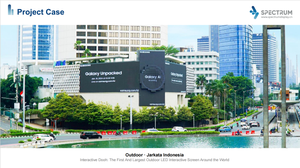
Mandarin Oriental Jakarta Project
In the Mandarin Oriental Jakarta project, Spectrum Display deployed an SPKO-500 outdoor 3D Kinetic LED Screen.
The overall facade measured approximately 27 × 9 meters, with the core dynamic mechanical area measuring 8 × 16 meters.
The project had to operate in Jakarta’s challenging climate:
high temperatures, humidity above 80%, annual rainfall exceeding 2,000mm, strong UV exposure, salt-laden air, and sudden heavy rain.
Spectrum Display addressed these conditions through a complete engineering system.
The SPKO Series uses industrial-grade die-cast structures, semi-enclosed self-cooling systems within the motion units, and comprehensive waterproofing and anti-corrosion treatment for the underlying structure.
The goal is to keep the critical drive components operating reliably through both intense sun and heavy rain.
Coastal cities bring typhoons, storms, and salt-spray corrosion.
Middle Eastern environments bring extreme heat and airborne dust.
These are conditions under which many conventional mechanical display solutions cannot operate reliably.
Outdoor engineering is not about whether the screen can display content. It is about whether the system can survive.
▶Video · YouTubeOutdoor Kinetic Screen in Motion — engineering for sun, rain and salt airWatch on YouTube →
4. Engineering Challenge 3: Space — It Must Be Installable and Maintainable
Limited installation space is one of the most common engineering challenges in kinetic LED projects.
In premium retail stores, luxury storefronts, and immersive commercial showrooms, designers and system integrators often face the same problem:
there simply is not enough installation depth.
Traditional mechanical screens may require more than one meter of rear maintenance space, immediately making many projects impossible.
Spectrum Display’s SPKI-160 addresses this problem with an ultra-thin body of approximately 330mm and a full front-maintenance design.
The total finished installation depth can be kept at around 350mm, allowing the screen to sit close to the wall like a high-resolution digital artwork.
For space-limited technology showrooms, this gives designers much greater freedom without sacrificing valuable floor area or compromising the visual design of the space.
Large High-Altitude Installations Create the Opposite Problem
Shopping mall atriums, international airports, and other large fixed installations can easily reach hundreds of square meters and sit tens of meters above the ground.
In these environments, every maintenance operation on a front-maintenance screen may require expensive and risky work at height.
Replacing a single module could mean waiting until the mall closes, building scaffolding, or renting an aerial work platform.
Spectrum Display’s SPKI-250 takes a different approach:
rear maintenance architecture.
By reserving a standard maintenance corridor behind the display during the initial project design stage, technicians can later access modules, motors, and internal components from the rear in a safer and more comfortable working environment.
Being able to install the screen is one thing. Being able to maintain it properly is what proves the engineering.
▶Video · YouTubeFrom Installation to Motion — installation and serviceability in practiceWatch on YouTube →
5. Engineering Challenge 4: Control — Turning Digital Content into Physical Motion
The core value of a 3D Kinetic LED System is its ability to make digital content drive physical change.
The complete workflow is:
video design → control data generation → motion module execution → kinetic visual effect
This requires the control system to convert information such as brightness, color, rhythm, and timing into displacement commands for individual motion units.
Large mechanical LED systems may contain thousands of moving modules.
The system must solve three major challenges simultaneously:
- precise control of each module
- synchronized operation across multiple modules
- long-term system stability
Spectrum Display uses a CAN-bus communication architecture instead of relying on less stable traditional serial communication methods.
A single channel can support peer-to-peer communication for up to 48 units, while the full network can support up to 65,536 motion units online simultaneously.
Whether a project contains several thousand or tens of thousands of motion nodes, commands still need to be delivered with precise synchronization.
The control system also supports international standard protocols including DMX512, Art-Net, and sACN.
This means lighting designers do not need to learn a completely separate mechanical control system.
They can use a professional lighting console to control the movement of the screen much like they control moving-head fixtures.
For precision motion control, Spectrum Display uses a self-developed bus-type servo motor system combined with a 32-bit MCU and high-precision magnetic encoders.
This enables precise position control and helps prevent position drift or step loss during high-frequency operation.
▶Video · YouTubeWhen Content Moves Beyond the Screen — Infoview × SPKI-250Watch on YouTube →
6. Conclusion: Choosing a 3D Kinetic LED Screen Means Choosing Engineering Capability
Whether a kinetic LED screen can move is easy to see.
What is much harder to evaluate is whether it can:
fit into a non-standard space,
operate reliably in an extreme environment,
maintain precision under high-frequency use,
and remain easy to service when something eventually needs maintenance.
These invisible engineering capabilities are what ultimately determine whether a project succeeds.
Key Takeaways
- “It moves” is only the entry ticket.
The real threshold is engineering adaptation across module-gap control, operating lifespan, noise, motion speed, and environmental resistance. - Mechanical structure determines motion quality.
Module gaps of ≤1.5mm, full-stroke response below 0.5 seconds, and a design life beyond 50,000 hours are the kinds of engineering indicators that matter. - Outdoor is not simply an enlarged indoor solution.
High temperature, humidity, storms, salt spray, and dust can make engineering protection more important than the display itself. - Spatial adaptation determines whether the project can actually be built.
Front maintenance supports shallow wall-mounted installations, while rear maintenance can make large high-altitude systems easier and safer to service. - The control system determines whether content can drive the physical world.
CAN-bus architecture, support for up to 65,536 motion units, and compatibility with DMX512, Art-Net, and sACN determine the upper limit of synchronization and creative control.
Recommendations for Project Owners
When evaluating a 3D Kinetic LED Screen supplier, do not simply ask:
“Can it move?”
Ask instead:
What is the module-gap tolerance?
What is the designed operating lifespan?
What is the operating noise level?
What is the full-stroke response time?
For outdoor projects, require proven engineering cases and clear environmental protection strategies.
Before installation, confirm whether the project requires front or rear maintenance. This directly affects long-term operating cost and serviceability.
Also evaluate protocol compatibility and synchronization capability. The closer the integration between content and motion, the higher the potential quality of the final experience.
For more information about engineering adaptation or a customized project solution, contact the Spectrum Display team through: