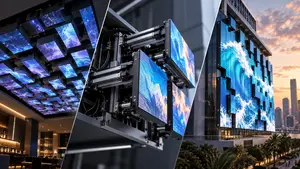
One-Sentence Definition: When a client comes to Spectrum Display with a creative idea, they do not simply receive a quotation for a screen. They receive a complete engineering path from concept validation and structural design to motion control and onsite delivery. Spectrum Display is not here to “sell screens,” but to help clients turn the “impossible” into something that feels as if it was always meant to be there.
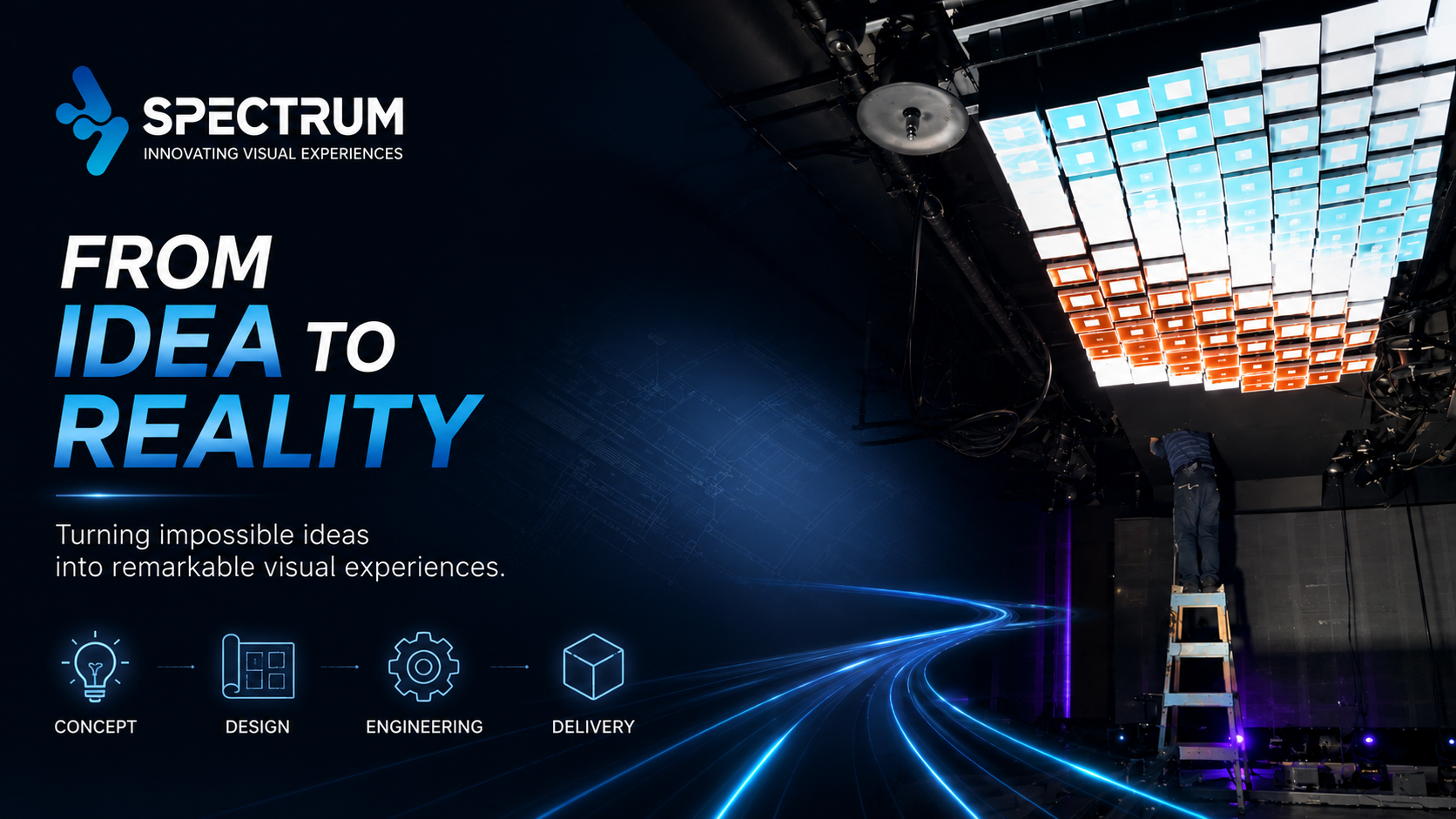
When a Client Only Has a Creative Idea, How Far Can a Mechanical LED Manufacturer Take It?
Contents
Every Project Starts Somewhere Other Than a Specification Sheet
Step 1: Understanding the Creative Idea — Designer Imagination vs Engineering Feasibility
Step 2: Site Survey — Buildings Can Be “Uncooperative” in Many Ways
Step 3: Customized Design — From Mechanical Structure to Motion Control
Step 4: Manufacturing and Testing — A Full Rehearsal Inside the Factory
Step 5: Installation and Commissioning — The Final 100 Meters Onsite
Conclusion: A Complete Closed Loop from Idea to Reality
1. Every Project Starts Somewhere Other Than a Specification Sheet
In the mechanical LED industry, many projects begin with a quotation request:
“I need a screen of this size. Please quote.”
But projects that truly require customization never begin with a specification sheet. They usually begin with a question, a description, or even just one sentence:
“I want a wall that usually looks like a normal wall, but can become a screen when needed.”
“My ceiling is empty. Can we make it move?”
“Our brand needs a space that makes people say ‘wow’ the moment they walk in.”
There is no screen size, pixel pitch, or power parameter in these questions.
There is only a creative idea.
What Spectrum Display does is turn that creative idea into a real mechanical LED wall that can operate, perform, and work reliably for years.
This is not about selling a screen.
It is a complete engineering path from idea to reality.
As a national high-tech enterprise, Spectrum Display integrates design, manufacturing, installation, and service, focusing on deep customization and system integration for creative LED display systems.
2. Step 1: Understanding the Creative Idea — Designer Imagination vs Engineering Feasibility
When a client says, “I want a moving wall,” Spectrum Display’s engineers do not immediately ask, “What size?”
They first ask three questions.
“What is this space used for?”
Is it a brand showroom, a product launch stage, or the ceiling of a bar?
Different scenarios require completely different motion rhythms, amplitudes, and textures.
A brand showroom needs restraint and precision.
A product launch needs impact and ceremony.
A bar needs rhythm and immersion.
“What do you want the audience to feel?”
This is the most important question.
The ultimate goal of a creative project is not that “the screen moves,” but that the audience remembers it.
Spectrum Display’s engineering team spends significant time in the early stage communicating with clients about emotional and experiential expectations.
Is the desired feeling futuristic or premium?
Is it surprise or impact?
These seemingly abstract descriptions eventually become specific motion parameters and material choices.
“What limitations does this idea need to work within?”
Budget, timeline, and site conditions are not enemies of creativity. They are the boundaries of creativity.
Spectrum Display’s value lies in finding the best possible solution within those boundaries.
Understanding the creative idea is the first step in building trust with the client.
A true creative engineering partner does not simply “do whatever the client says.”
It helps the client turn a vague idea into a clear solution.
3. Step 2: Site Survey — Buildings Can Be “Uncooperative” in Many Ways
After understanding the creative idea, Spectrum Display’s engineering team does something many screen sellers do not do:
they go to the site.
A building can be “uncooperative” in many ways.
Limited Space
In commercial spaces where every centimeter matters, even a small amount of installation depth can determine whether a project succeeds or fails.
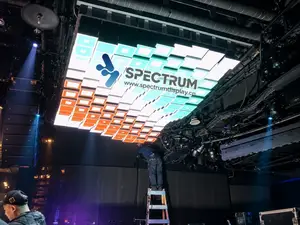
A high-end bar in Singapore wanted to install a kinetic LED screen on the ceiling. However, the ceiling height was limited, and there was no space for a rear maintenance corridor.
Conventional mechanical screen solutions all failed in this condition.
After onsite measurement, Spectrum Display’s engineers found that only the SPKI-160, with its 330mm ultra-thin body and front-maintenance structure, could fit the site.
Non-Standard Dimensions
In one customized project, the architect required a screen 13.5 meters wide and 3.12 meters high.
No standard cabinet could directly match this non-standard size.
Spectrum Display’s engineering team started from the architectural drawings and customized 180 × 240mm LED modules for each 900mm-wide folding screen.
Structural Constraints
Can the wall carry the load?
Can the ceiling support suspension?
Are power and signal cables reserved?
These invisible constraints often become the biggest problems in the later stages of a project.
The value of a site survey is simple:
a solution that looks feasible on drawings may be completely unworkable onsite.
Spectrum Display’s engineers work onsite with clients, designers, and construction teams to put all limitations on the table.
The earlier a limitation is exposed, the earlier a solution can be found.
4. Step 3: Customized Design — From Mechanical Structure to Motion Control
Once the creative idea is understood and the site has been surveyed, Spectrum Display’s engineering team begins the real customized design process.
This is not about selecting a model.
It is about designing a solution from the ground up for this space, this idea, and this brand.
Mechanical Structure Design: Making the Screen Grow Into the Architecture
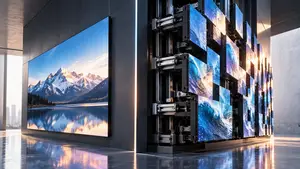
For space-constrained scenarios, SPKI-160 compresses the body thickness to 330mm, with the overall finished wall-mounted thickness reduced to 350mm, allowing it to fit the wall like a high-definition digital mural.
For large-scale high-altitude projects, SPKI-250 enlarges each physical moving unit to 248.5 × 248.5mm, with only 16 units per square meter, greatly reducing the electrical control complexity of ultra-large-area system integration.
Motion Control Design: Letting Content Drive the Physical World
Spectrum Display adopts an automotive-grade CAN bus communication architecture.
A single channel supports peer-to-peer communication for 48 units, while the entire network supports up to 65,536 moving units online simultaneously.
The control system supports international standard protocols such as DMX512, Art-Net, and sACN.
Lighting designers do not need to learn dedicated mechanical control software. They can control the movement of the screen directly through professional lighting consoles, just like controlling moving-head lights.
Appearance and Material Design: Making the Screen Part of the Space
Colors, materials, and textures can all be customized.
In a customized folding screen project, the closed screen was designed to blend perfectly into the architecture through customized surface materials.
A black surface with a wood-grain finish created a harmonious dialogue with the exhibition hall’s white main tone.
5. Step 4: Manufacturing and Testing — A Full Rehearsal Inside the Factory
After the design is completed, the real engineering work begins.
Spectrum Display’s Huizhou R&D base, located in the intelligent manufacturing hub of the Greater Bay Area, enables a full closed-loop process: from independent design and prototyping of core PCB boards, mold customization of high-precision mechanical structures, to automatic module SMT and complete machine assembly.
Every component must go through strict testing.
Let the Screen “Come Alive” in the Factory First
Before official delivery, every customized mechanical wall is assembled and pre-commissioned in the factory.
This is not a spot check.
It is a full inspection.
Every moving unit must go through thousands of cycle tests to ensure the 0.15-second switching speed remains stable and reliable.
Every assembled matrix wall must pass linkage testing through DMX512 and Art-Net protocols to ensure seamless integration with onsite lighting and control systems.
18,000 Hours of Extreme Testing
Core motion components, including linear guides, timing belts, and flexible cables, must pass continuous high-speed fatigue testing before leaving the factory.
The equipment has completed more than 18,000 hours of cumulative fault-free high-intensity operation testing, with an overall design life of more than 50,000 hours.
Digital Twin Simulation Verification
With MShow4 digital twin simulation software, all physical movement and interference prevention tests can be fully simulated on a computer before onsite installation.
This helps compress onsite commissioning time as much as possible.
Before the project team enters the site, the entire system’s motion path and safety have already been verified in a virtual environment.
The “rehearsal” inside the factory helps ensure fewer surprises onsite.
6. Step 5: Installation and Commissioning — The Final 100 Meters Onsite
When the equipment arrives onsite, Spectrum Display’s engineering team participates in installation guidance and system commissioning.
Customized Installation Landing
For space-constrained indoor projects, SPKI-128 and SPKI-160 support front maintenance.
LED modules and internal core mechanical components can be removed and replaced directly from the front of the screen, with no rear maintenance corridor required.
For high-altitude fixed installations, SPKI-250 and SPKO series adopt a rear-maintenance structure.
During early project planning, only a standard internal maintenance corridor of 600mm to 800mm needs to be reserved behind the screen. Technicians can complete maintenance without using aerial work equipment.
System Commissioning: Synchronizing Content and Motion
Installation is only the first step.
The real challenge is making the screen’s movement precisely synchronize with the displayed content.
Spectrum Display’s engineering team completes motion calibration, display-motion synchronization, and parameter optimization based on the onsite environment.
Training and Delivery: Helping the Client Truly “Own” the Wall
The final stage of project delivery is training.
Spectrum Display provides complete training for the client’s content team, including how to use MShow4 to create 3D presentation content, how to use the After Effects plugin to create motion videos, and how to control device power and playback progress through a mobile app.
Only when the client can operate the system and create content independently is the project truly delivered.
7. Conclusion: A Complete Closed Loop from Idea to Reality
When a client comes to Spectrum Display with a creative idea, they do not receive only a quotation for a screen.
They receive a complete path:
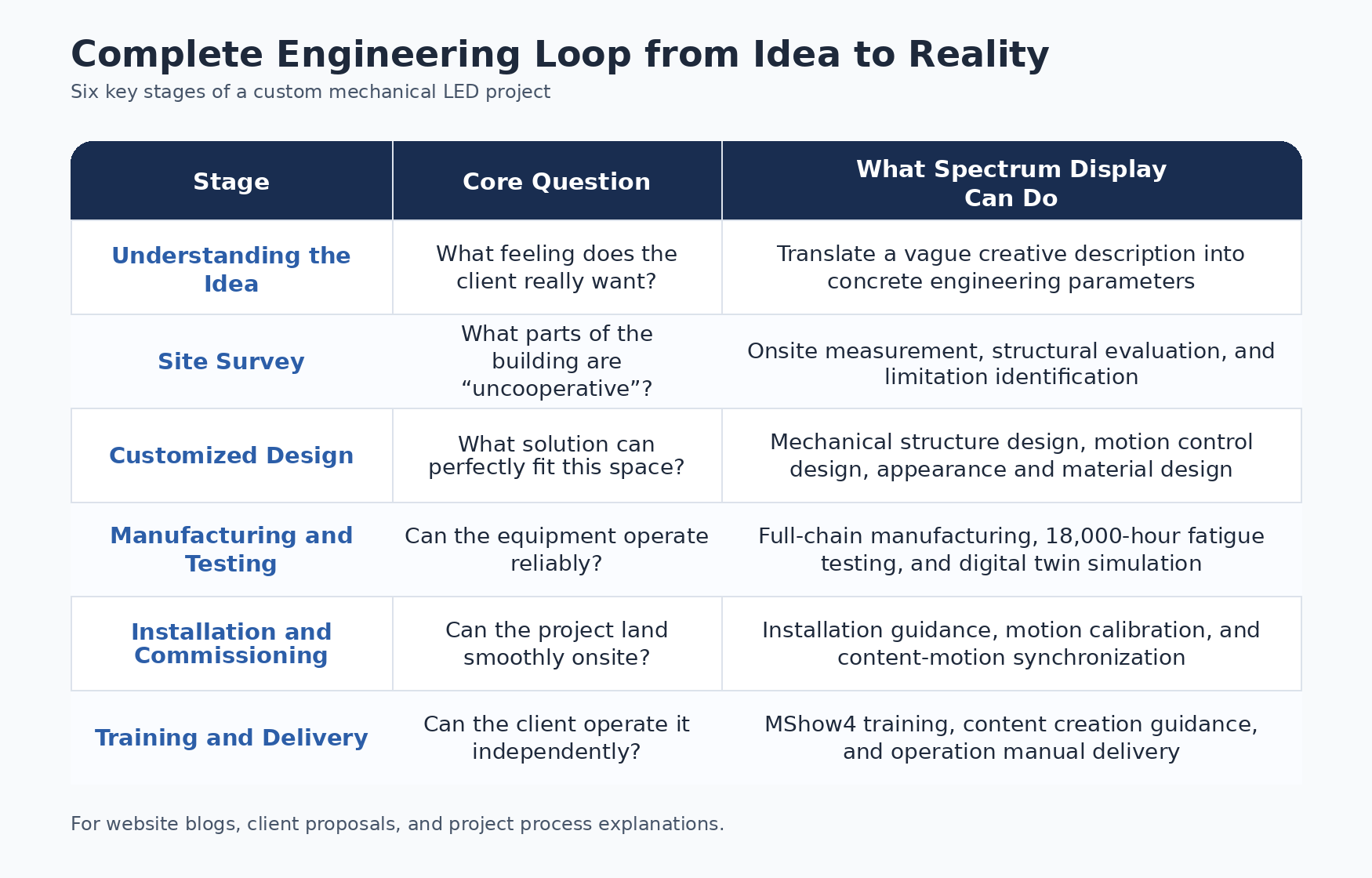
understanding the idea → site survey → customized design → manufacturing and testing → installation and commissioning → training and delivery
None of these six steps can be skipped.
Key Takeaways
Every customized project starts not with a specification sheet, but with a creative idea.
Spectrum Display’s role is to turn a vague idea into a clear solution.Understanding the creative idea is the first step.
It is not about doing whatever the client says, but helping the client turn an idea into a workable plan.Site survey cannot be skipped.
Buildings can be “uncooperative” in many ways. The earlier limitations are exposed, the earlier solutions can be found.Customized design starts from the ground up.
Mechanical structure, motion control, appearance, and materials are all tailored to the specific space.The factory rehearsal reduces onsite surprises.
Full-chain manufacturing, 18,000-hour testing, and digital twin simulation help ensure a smoother project landing.The endpoint of delivery is independent operation.
Training is not an add-on service. It is part of delivery.
Recommendations for Project Owners
At the beginning of a project, do not rush to ask, “How much does it cost?” First ask, “What do we want people to feel?” That answer is the real starting point of customization.
Involve the engineering team in the site survey as early as possible. Dimensions on drawings and real onsite conditions are often different.
Reserve time and budget for content creation. The value of a customized mechanical wall ultimately depends on what runs on it.
When choosing a supplier, do not only look at the product. Look at the path. Who can accompany you from creative idea to onsite delivery?
To learn more about the customization process or request a tailored solution, contact Spectrum Display through:
www.spectrumdisplay.cn