How to Choose Between 3D Kinetic LED Screens, Flip Matrix, and LED Lift & Fold All-in-One Displays
One-sentence definition:
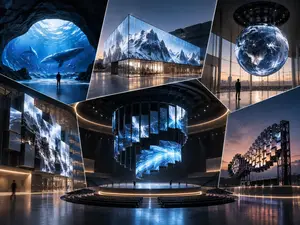
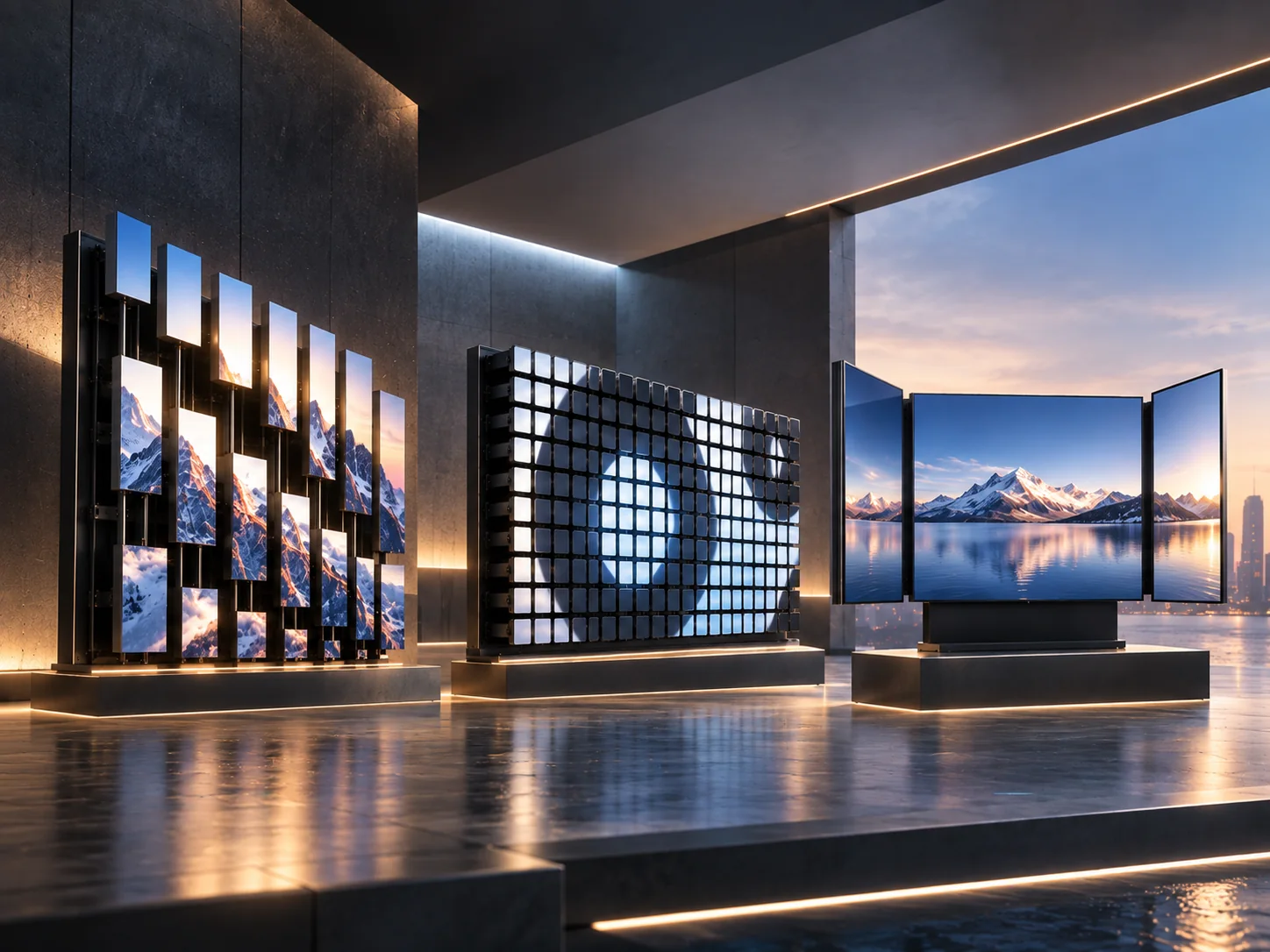
A non-standard space is not simply a smaller version of a standard installation. Curved walls, limited installation depth, ceiling-mounted applications, and mobile deployment all require different product logic. 3D Kinetic LED Screens, Flip Matrix, and LED Lift & Fold All-in-One Displays represent three fundamentally different spatial languages.
1. Why Non-Standard Spaces Need a Different Selection Logic
In a standard commercial space, product selection can be relatively straightforward:
Measure the wall, choose the closest standard model, and install it.
Non-standard spaces are completely different.
What Is a Non-Standard Space?
- The wall is curved rather than flat.
- Installation depth is limited to only 350mm, leaving no room for a conventional mechanical LED system.
- The display needs to be installed on the ceiling, but ceiling height is limited and there is no room for rear maintenance.
- The space frequently changes function, so the display cannot be permanently fixed.
- The building uses a glass curtain wall, requiring the LED system to integrate with the architecture itself.
In these situations, conventional product-selection logic no longer works.
What you need is not simply a larger screen, but a spatial display solution designed around the specific constraints of the environment.
Spectrum Display offers three product lines — 3D Kinetic LED Screens, Spectrum Flip Matrix, and the LED Lift & Fold All-in-One Display — each representing a different approach to spatial expression.
Choose the right product family, and half the engineering challenge is already solved.
Choose the wrong one, and additional budget may not be enough to compensate for the mismatch.
▶Video · YouTubeWhere Creative Vision Meets Engineering Excellence — large-scale custom kinetic LED wallsWatch on YouTube →
2. Three Product Lines, Three Spatial Languages
3D Kinetic LED Screen: Make the Space Move
Core concept: The display physically changes through Z-axis movement — individual modules extend and retract to create real physical depth and dynamic surface movement.
Its spatial language is expression.
A 3D Kinetic LED Screen is not simply a screen that plays content. It becomes a physical participant in the space.
When LED modules extend and retract in synchronization with digital content, the image is no longer limited to a flat surface. It gains real, perceptible physical depth.
Core Models
SPKI-128
0.5mm module gap, 0mm perceived visual gap, designed for premium close-range viewing, with front maintenance.
SPKI-160
330mm ultra-slim body, approximately 350mm finished installation depth, and front maintenance — designed for space-constrained applications.
SPKI-250
248.5 × 248.5mm large motion units, only 16 units/m², rear maintenance, suitable for large-scale projects.
SPKO-320 / SPKO-500
Outdoor series with IP65 protection and travel distances of up to 600mm, suitable for architectural facade applications.
Best suited for: Exhibitions, showrooms, commercial spaces, outdoor landmarks, ceiling installations, and column-wrapping applications.
▶Video · YouTubeWhen Content Moves Beyond the Screen — Z-axis motion driven by contentWatch on YouTube →
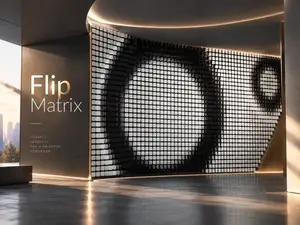
Spectrum Flip Matrix: Make the Wall Speak
Core concept: Large numbers of independently controlled rotating units use three-sided flipping to create color changes, patterns, lighting effects, and dynamic visual transformations.
Its spatial language is expression through changing surfaces.
A Flip Matrix wall can present completely different visual identities at different moments.
Today it can appear as a graphic composition.
Tomorrow it can display a brand message.
At night, it can transform into a dynamic lighting installation.
Core Models
SPFM-100
64 units/m² for high-density applications. Designed for boutique storefronts, premium retail, and close-range viewing.
SPFM-168
25 units/m² for large-area coverage, suitable for flagship-store feature walls and shopping mall atriums.
SPFM-138L
Mechanical rotation + full-color RGB lighting. A physical wall by day and a lighting installation by night.
SPFM-138P
Mechanical rotation + LED display surface, combining physical movement with video content.
Best suited for: Boutique storefronts, brand showrooms, commercial art installations, and nightlife environments.
▶Video · YouTubeSpectrum Flip Matrix: The Future of Kinetic Display TechnologyWatch on YouTube →
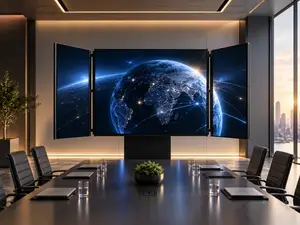
LED Lift & Fold All-in-One Display: Make the Screen Disappear
Core concept: A 135-inch LED screen, multi-axis mechanical transmission system, and flight-case-style mobile deployment are integrated into one system for rapid setup and folding.
Its spatial language is presence and disappearance.
When needed, the screen unfolds and becomes the visual focus of the space.
When not needed, it folds away into its integrated mobile structure, reducing its footprint.
It is not simply a screen that is “installed” somewhere.
It is a movable, foldable, liftable spatial variable.
Core Capabilities
- 135-inch LED display, with a display area of 3000 × 1687.5mm
- 180° double-folding structure
- Approximately 0.1mm folding gap
- 0–900mm intelligent lifting range
- Integrated mobile flight-case design with casters
- Supports forklift handling and manual movement
- Android / Windows dual-system support
Best suited for: Hotel ballrooms, product launches, exhibition rental, commercial pop-ups, and corporate VIP reception areas.
▶Video · YouTubeA Closer Look at the 135" 4K All-in-One LED DisplayWatch on YouTube →
3. Four Questions to Help You Choose
Question 1: What Is the Shape and Structure of the Space?
| Space Condition | Recommended Product Line | Why |
|---|---|---|
| Flat wall requiring dynamic surface effects | Flip Matrix | Three-sided rotation creates changing colors and mechanical visual effects |
| Flat wall requiring physical 3D depth | 3D Kinetic LED Screen | Z-axis movement creates real physical depth |
| Ceiling installation | 3D Kinetic LED Screen — SPKI-160 | 330mm ultra-slim body + front maintenance |
| Columns, corridors, or extremely limited spaces | 3D Kinetic LED Screen — SPKI-160 | Approx. 350mm finished depth for close-to-wall installation |
| Curved or irregular wall | Customized 3D Kinetic LED Screen | Modular engineering can adapt to non-standard structures |
| Space frequently changes function | LED Lift & Fold All-in-One Display | Movable, foldable, and storable |
Question 2: What Is the Viewing Distance?
| Viewing Distance | Recommended Product Line | Recommended Model |
|---|---|---|
| <1m — Close Viewing | Flip Matrix | SPFM-100 — 64 units/m² |
| 1–3m — Medium Distance | Flip Matrix / 3D Kinetic LED Screen | SPFM-138L / SPFM-138P / SPKI-128 |
| >3m — Long Distance | 3D Kinetic LED Screen | SPKI-250 / SPKO Series |
| >10m — Very Long Distance | Outdoor 3D Kinetic LED Screen | SPKO-500 |
Question 3: What Kind of Content Does the Project Need?
| Content Requirement | Recommended Product Line | Why |
|---|---|---|
| Solid colors / graphic transformations | Flip Matrix — SPFM-100 / SPFM-168 | Standard mechanical rotation can create physical graphic changes |
| Nighttime lighting atmosphere | Flip Matrix — SPFM-138L | Independently controlled full-color RGB lighting |
| Video playback | Flip Matrix — SPFM-138P | Integrated LED display surface supports digital video content |
| Physical 3D motion | 3D Kinetic LED Screen | Z-axis physical displacement creates real depth |
| Fast setup and mobile deployment | LED Lift & Fold All-in-One Display | Integrated mobile design for rapid deployment |
Question 4: Does the Project Need to Move?
| Project Requirement | Recommended Product Line | Why |
|---|---|---|
| Permanent installation, long-term operation | 3D Kinetic LED Screen / Flip Matrix | Designed for stable fixed installation |
| Frequent venue changes and multi-location deployment | LED Lift & Fold All-in-One Display | Integrated mobile structure simplifies repeated deployment |
| Temporary events and short-term rental | LED Lift & Fold All-in-One Display | Rapid deployment with minimal permanent construction |
4. Quick Decision Guide
| Your Project | Recommended Product Line | Recommended Model |
|---|---|---|
| Boutique storefront, close viewing, high precision | Flip Matrix | SPFM-100 |
| Large feature wall, long-distance viewing | Flip Matrix | SPFM-168 |
| Nightlife space requiring dynamic lighting | Flip Matrix | SPFM-138L |
| Corporate showroom requiring video + movement | Flip Matrix | SPFM-138P |
| Ceiling installation with limited space | 3D Kinetic LED Screen | SPKI-160 |
| Premium close-range viewing with 0mm perceived visual gap | 3D Kinetic LED Screen | SPKI-128 |
| Large permanent or elevated installation | 3D Kinetic LED Screen | SPKI-250 |
| Outdoor architectural facade in demanding environments | 3D Kinetic LED Screen | SPKO-320 / SPKO-500 |
| Hotel ballroom requiring flexible deployment and storage | LED Lift & Fold All-in-One Display | 135-inch Standard Model |
| Touring and rental with frequent venue changes | LED Lift & Fold All-in-One Display | 135-inch Standard Model |
5. What Can’t These Three Product Lines Do?
A useful selection guide should explain not only what each product can do, but also what it cannot do.
What Can’t a 3D Kinetic LED Screen Do?
- It cannot create the same close-range, high-density physical color-block switching experience as Flip Matrix.
- Rear-maintenance models are not suitable for installations with absolutely no rear service space.
- Indoor models should not be used for outdoor projects requiring dedicated environmental protection.
What Can’t Flip Matrix Do?
- It does not create the same Z-axis physical depth as a 3D Kinetic LED Screen. Its primary movement is rotational rather than forward-and-backward extension.
- Using high-density units across very large areas may not be the most cost-efficient approach.
- It cannot provide the same mobile deployment capability as the LED Lift & Fold All-in-One Display.
What Can’t the LED Lift & Fold All-in-One Display Do?
- It is not designed for extremely large display areas; the current standard solution is based on a 135-inch display.
- It may not be the most cost-effective solution for permanent installations that never need to move.
- It is not intended to replace large-format concert or stage main screens.
6. Conclusion
The selection logic for a non-standard space is not about asking:
“Which product is better?”
It is about asking:
“Which product is right for this space?”
Key Takeaways
1. 3D Kinetic LED Screen: Spatial Language = Physical Expression
Z-axis motion makes the display surface physically move. It is suited to exhibitions, showrooms, commercial environments, ceiling installations, and outdoor landmarks.
2. Spectrum Flip Matrix: Spatial Language = Changing Expression
Three-sided mechanical rotation gives the wall different visual identities. It is suited to boutique storefronts, brand showrooms, commercial art installations, and nightlife spaces.
3. LED Lift & Fold All-in-One Display: Spatial Language = Presence and Disappearance
Movable, foldable, and storable. It is suited to hotel ballrooms, product launches, exhibition rental, commercial pop-ups, and other spaces that frequently change function.
4. Ask Four Questions Before Selecting a Product
What is the shape of the space?
How far away will people view it?
What kind of content does the project require?
Does the display need to move between locations?
5. Product Selection Is Not About Choosing the “Best” Product — It Is About Choosing the Right One
Each of the three product lines serves a different spatial objective.
Recommendations for Project Owners
Before starting the project, define four things clearly: space configuration, viewing distance, content requirements, and mobility requirements.
For non-standard spaces, involve the LED engineering team during the concept and design stage. The earlier the constraints are identified, the easier it is to engineer around them.
Do not approach a custom project with a standard-product mindset.
The value of custom mechanical LED engineering lies precisely in the fact that the building should not have to adapt to the product — the solution should adapt to the building.
For model selection and customized project solutions, contact the Spectrum Display team.