From Product Manufacturer to Engineering Partner: Why Clients Need More Than a Quotation
One-sentence definition:
In an era when LED products are becoming increasingly similar, a quotation can tell you “how much the screen costs,” but it cannot answer “whether it will fit the space,” “whether it can operate reliably for the next ten years,” or “who will take responsibility when something goes wrong.” That is exactly why complex projects need an engineering partner, not just a product manufacturer.
Contents
- The Questions a Quotation Cannot Answer
- Why Complex LED Projects Cannot Be Procured Like Standard Products
- Product Manufacturer vs. Engineering Partner: Four Fundamental Differences
- The Role of an Engineering Partner Throughout the Project Lifecycle
- Case Study: When the Client Has Only a Creative Idea
- Conclusion: Choosing an Engineering Partner Means Investing in Long-Term Project Security
1. The Questions a Quotation Cannot Answer
In the LED display industry, an RFQ is often where the conversation begins.
A buyer sends a specification sheet:
“I need an LED screen of this size and this pixel pitch. Please send me a quotation.”
The supplier responds:
“Price per square meter: XX. Lead time: XX days.”
The transaction appears straightforward.
But once a project involves a non-standard space, special mechanical movement, or architectural integration, the questions that matter most can no longer be answered by a quotation alone.
A Quotation Can Tell You:
- How much the screen costs per square meter
- How long production will take
- How many years of warranty are included
A Quotation Cannot Tell You:
- Can the wall withstand the dynamic loads generated by mechanical movement?
- If there is only 350mm of installation depth, will the system actually fit?
- When a module fails, how will technicians access and replace it?
- Will the content team need to write code to create new motion content?
- Who will support the system years after installation?
In complex 3D kinetic LED projects, many problems are not caused by the display hardware itself.
They come from a mismatch between the system and the installation environment.
A project team may discover only after the equipment arrives that the wall cannot support the structure, maintenance access is insufficient, or the available power infrastructure does not meet the system requirements.
At that stage, redesign becomes significantly more expensive.
A quotation answers “What are we buying?” An engineering partner answers “How do we make it work?”
▶Video · YouTubeWhere Creative Vision Meets Engineering Excellence — Large-Scale Custom Kinetic LED WallsWatch on YouTube →
2. Why Complex LED Projects Cannot Be Procured Like Standard Products
The procurement logic for a conventional LED screen is relatively simple:
Compare specifications. Compare prices. Compare lead times.
That works because conventional LED displays are highly standardized.
The screen is fixed. Installation methods are familiar. Control systems are mature.
Complex LED projects change that logic completely.
A 3D Kinetic LED Screen is an integrated visual engineering system combining:
LED display technology + precision mechanical engineering + motion control + content management.
It is not simply a conventional LED display with motors added behind it.
In a complex project, the real differences between suppliers are often found in capabilities that do not appear on a standard specification sheet:
- Mechanical engineering
- Motion control
- Content ecosystem
- Installation planning
- Maintenance architecture
- Project delivery capability
The success of a complex LED project is heavily influenced by decisions made during the early planning and design stages.
And a quotation is often issued before many of those engineering questions have even been answered.
3. Product Manufacturer vs. Engineering Partner: Four Fundamental Differences
| Comparison | Product Manufacturer | Engineering Partner |
|---|---|---|
| Core Capability | Manufacturing efficiency, cost control | Mechanical engineering, motion control, content ecosystem, installation, maintenance, project delivery |
| When They Get Involved | After receiving an RFQ | During the project concept stage |
| Delivery Model | Manufacture, ship, install, power on | Full lifecycle from design and engineering to commissioning and long-term support |
| Long-Term Value | Equipment | Equipment + content + service + sustainable operation |
Difference 1: They Get Involved at Different Stages
A product manufacturer becomes involved when it receives an RFQ.
An engineering partner becomes involved during the concept stage.
The manufacturer answers:
“How much will it cost?”
The engineering partner asks:
“Can it be installed? How should it be installed? And how will the client operate and maintain it afterward?”
Difference 2: Their Capability Boundaries Are Different
A product manufacturer’s expertise is concentrated primarily on manufacturing.
An engineering partner operates across design, manufacturing, delivery, commissioning, and long-term operation.
The former sells a product.
The latter provides greater certainty from creative concept to real-world implementation.
Difference 3: They Approach Project Risk Differently
A product manufacturer is primarily responsible for the equipment it supplies.
An engineering partner considers the performance of the complete installed system.
The objective is not simply:
“The screen turns on.”
It is:
“The system can be installed properly, operated effectively, maintained efficiently, and used reliably over time.”
Difference 4: The Relationship Continues After Delivery
For a conventional product transaction, the relationship may become limited once the equipment has been delivered.
For an engineering partnership, delivery marks the beginning of the operational phase.
Maintenance, system optimization, technical support, and content updates may all require continued collaboration.
That is particularly important for mechanical LED systems because their long-term value depends on more than the hardware alone.
▶Video · YouTubeFrom Automated Craftsmanship to Stunning Visual Reality — SpectrumDisplay Kinetic ScreenWatch on YouTube →
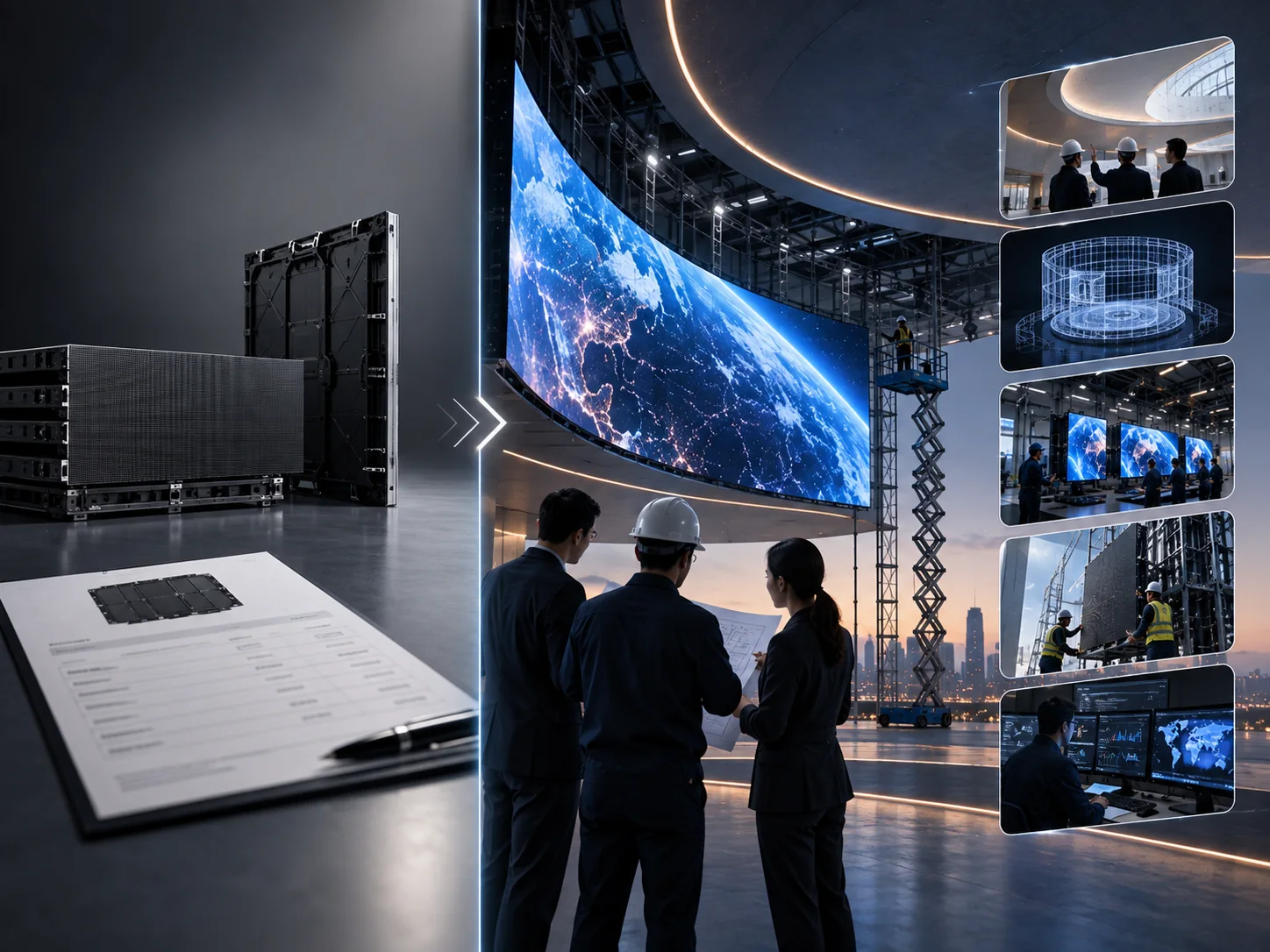
4. The Role of an Engineering Partner Throughout the Project Lifecycle
Stage 1: Requirements Analysis — Understanding the “Feeling,” Not Just the Dimensions
When a client says:
“I want a wall that moves.”
An engineering partner does not immediately respond:
“What size?”
Instead, the first questions are more likely to be:
“What is this space used for?”
“What do you want the audience to feel?”
These questions may sound abstract, but their answers eventually become specific engineering decisions involving motion speed, travel distance, materials, control logic, and content.
Understanding the creative intention is the first step toward translating an idea into an engineered system.
Stage 2: Site Survey — Discovering Architectural Constraints Before They Become Problems
Buildings rarely cooperate perfectly with a creative concept.
There may be:
- Limited installation depth
- Non-standard dimensions
- Structural load restrictions
- Insufficient maintenance access
- Limited power capacity
- Complicated signal routing
An engineering partner identifies these constraints at the beginning of the project rather than waiting until the equipment arrives onsite.
The earlier a limitation is discovered, the earlier a solution can be engineered around it.
Stage 3: Solution Design — Starting with the Space, Not Just Selecting a Model
Engineering design for a custom project is not simply about choosing a standard product from a catalog.
It begins with the architectural conditions.
Mechanical structure, movement logic, module configuration, maintenance access, and control architecture may all need to be adapted to the project.
In one custom folding LED project, for example, Spectrum Display developed 180 × 240mm LED modules for 900mm-wide folding sections, creating an overall resolution of 6750 × 1560 pixels.
Instead of forcing the architecture to adapt to a standard cabinet, the display system was engineered around the space.
Stage 4: Manufacturing & Testing — Rehearsing the Installation in the Factory
Before formal delivery, a custom mechanical LED system should be assembled and pre-commissioned in the factory.
The objective is to test the system as a complete installation rather than treating every component in isolation.
Motion units, LED modules, mechanical structures, and control systems need to work together before the equipment reaches the venue.
Digital simulation can also be used to preview physical movement, check clearances, and identify potential interference before onsite commissioning begins.
Every problem solved in the factory is one less problem to solve under pressure onsite.
Stage 5: Installation & Commissioning — The Final 100 Meters
Completing the physical installation is only the beginning.
The real challenge is ensuring that the LED content and physical movement operate as one coordinated system.
During commissioning, the engineering team may need to complete:
- Motion calibration
- Position verification
- Display and movement synchronization
- Control-system integration
- Site-specific parameter optimization
- Safety testing
This final stage determines whether the installation simply works or delivers the intended spatial experience.
Stage 6: Training & Handover — True Delivery Means the Client Can Operate Independently
An engineering partner also considers what happens after the commissioning team leaves.
The client’s technical and content teams need to understand how to operate the system, manage motion sequences, update content, and perform routine checks.
Depending on the project, the workflow may include tools such as MShow4, After Effects-based motion-content creation, and other control interfaces.
A project is truly handed over when the client can operate it independently and continue creating new experiences with it.
Stage 7: Long-Term Maintenance — Delivery Is Not the End
The lifecycle of a complex LED project is measured in years.
That makes maintenance architecture part of the original engineering problem.
For large systems using rear-maintenance architecture, safe service access needs to be planned into the structure.
For space-constrained indoor applications, front-maintenance designs can allow technicians to access modules and key components from the display side.
The goal is not merely to make the system serviceable today.
It is to ensure that it remains practical to maintain throughout its operational life.
For an engineering partner, delivery is not the end of the relationship. It is the beginning of long-term operation.
▶Video · YouTubeLEAP 2025 Kinetic Screen Case Study — 5 m × 3 m SPKI-160 in Saudi ArabiaWatch on YouTube →
5. Case Study: When the Client Has Only a Creative Idea
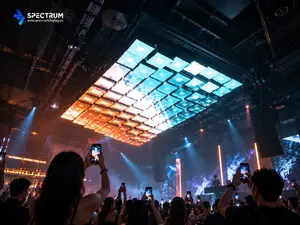
A premium bar in Singapore wanted to install a kinetic LED screen on the ceiling.
There were two major constraints:
limited ceiling depth and no space for a rear maintenance corridor.
If the project had been approached purely as a standard product procurement exercise, the conclusion could easily have been:
“It cannot be installed.”
Spectrum Display approached the problem from an engineering perspective.
After evaluating the installation conditions, the team selected the SPKI-160, whose 330mm ultra-slim body and front-maintenance architecture were suited to the restricted ceiling environment.
The final kinetic LED installation measured approximately 1440 × 3840mm.
Instead of occupying another wall, the display transformed the ceiling into a dynamic architectural surface — a ceiling that appears to “breathe” as the physical modules move.
The project demonstrates the fundamental value of an engineering partner:
not simply telling the client what cannot be done, but engineering a practical way to make the idea work.
▶Video · YouTubeInside SpectrumDisplay: Revolutionizing 3D Kinetic LED Screens & Going Global | Founder InterviewWatch on YouTube →
6. Conclusion: Choosing an Engineering Partner Means Investing in Long-Term Project Security
In the LED display industry, getting a quotation is easy.
Successfully delivering a complex project is not.
Key Takeaways
1. A Quotation Answers “What Are We Buying?” An Engineering Partner Answers “How Will We Make It Work?”
Complex projects require planning long before manufacturing begins.
2. Product Manufacturers and Engineering Partners Differ in Four Fundamental Ways
They differ in when they become involved, the scope of their capabilities, how they approach project risk, and how they support the client after delivery.
3. An Engineering Partner Supports the Entire Project Lifecycle
Requirements analysis → site survey → solution design → manufacturing and testing → installation and commissioning → training and handover → long-term maintenance.
4. The Singapore Ceiling Project Shows the Difference
A difficult installation constraint was transformed into a distinctive kinetic ceiling by engineering the solution around the architecture.
Recommendations for Project Owners
Bring the engineering partner into the project during the concept stage rather than waiting until the equipment has already been manufactured and asking:
“Now how do we install it?”
When evaluating suppliers, look beyond the quotation.
Ask whether they can answer three more important questions:
Can it be installed?
Can it be maintained?
Can it continue operating reliably over the long term?
For a complex LED project, choosing an engineering partner is ultimately about reducing uncertainty throughout the project lifecycle — from the first concept sketch to years of operation after delivery.
For customized mechanical LED engineering and project solutions, contact the Spectrum Display team.