The Five Most Underestimated Risks in Non-Standard LED Projects
One-sentence definition:
The most dangerous risks in a non-standard LED project are rarely about whether the screen can turn on. They are the hidden risks that remain invisible during quotation, emerge during installation, and become increasingly costly throughout operation and maintenance. Structure, maintenance access, signal integrity, power distribution, and environmental adaptation — underestimating any one of these five factors can turn a project from “operational” into “too expensive to operate.”
1. Why “Non-Standard” Also Means “Higher Risk”
Standard LED projects usually follow mature engineering patterns: standardized installation methods, established control systems, and relatively predictable operating environments.
Non-standard LED projects are completely different.
A non-standard space may involve:
- Irregular or curved walls
- Limited installation depth
- Ceiling-mounted displays
- Integration with building facades
- Mobile deployment
- Custom mechanical movement
Every architectural constraint pushes the engineering system beyond standard assumptions.
More importantly, risk is distributed differently.
In a standard LED project, many risks are concentrated around the equipment itself.
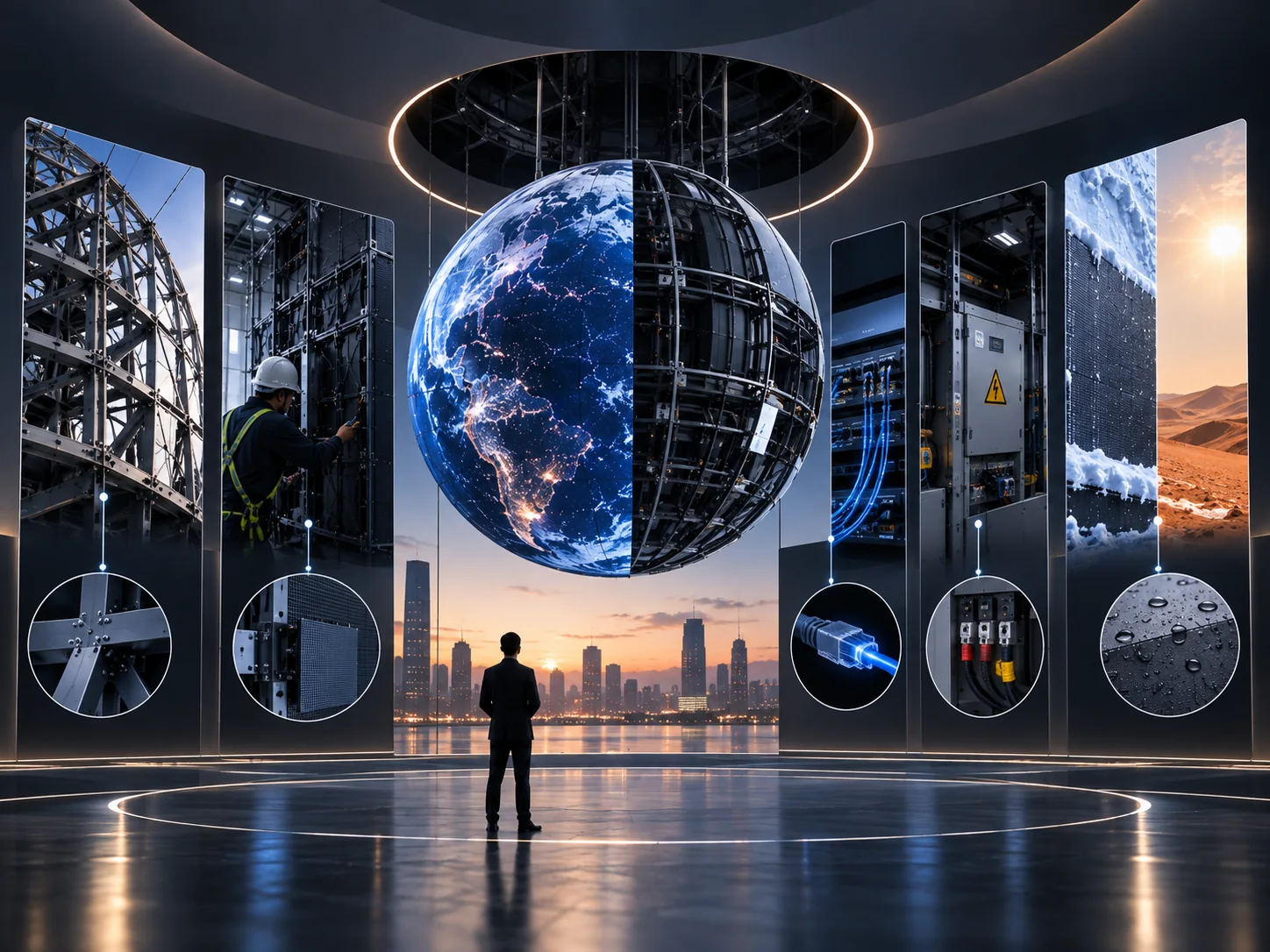
In a non-standard project, many of the most serious risks arise from the interaction between the equipment and the building:
Can the structure carry the load?
Will the system physically fit?
Can technicians access it for maintenance?
Can power and signals reach the system reliably?
Can the equipment survive the operating environment for years?
Many project problems become visible only after the equipment reaches the site. By then, structural modifications, electrical redesign, or additional maintenance access can become significantly more expensive.
The following five risks are among the most easily underestimated — and potentially the most costly — in a non-standard LED project.
▶Video · YouTubeFrom Automated Craftsmanship to Stunning Visual Reality — SpectrumDisplay Kinetic ScreenWatch on YouTube →
2. Risk 1: Structural Load — Calculating Static Weight but Forgetting Dynamic Loads
This is one of the least visible and potentially most serious risks in a non-standard mechanical LED project.
During project planning, engineering teams normally calculate the static weight of the display.
But a mechanical LED screen does not simply hang in one position.
It moves.
When large numbers of modules extend and retract, the supporting structure experiences dynamic forces in addition to static weight.
If the structural design considers only the weight of the display itself, repeated mechanical movement may affect structural stability, module alignment, and long-term durability.
Why This Risk Is Underestimated
Dynamic load is an invisible parameter.
It may not appear clearly on a conventional LED specification sheet or quotation.
But for a mechanical display, structural engineering cannot stop at asking:
“How much does it weigh?”
It must also ask:
“What forces will the system generate when it moves?”
The Right Approach
Dynamic loading should be evaluated during the early engineering stage.
The display supplier should provide the relevant mechanical and loading information, while a qualified structural engineer should assess the supporting wall, ceiling, facade, or independent steel structure according to the actual project conditions.
If the existing building structure cannot safely support the system, an independent load-bearing structure may need to be designed.
The key principle: calculate the structure for the system in motion, not just the system at rest.
▶Video · YouTubeWhere Creative Vision Meets Engineering Excellence — SpectrumDisplay Kinetic LEDWatch on YouTube →
3. Risk 2: Maintenance Accessibility — The Screen Fits, but Technicians Cannot Reach It
This is one of the most common long-term problems in non-standard LED projects.
During the concept stage, everyone asks:
“Does the screen look good?”
“Is the movement impressive?”
But several years later, when an LED module or mechanical component needs to be replaced, a much more practical question becomes critical:
How does the technician reach it?
For elevated permanent installations in shopping mall atriums, airports, or large public spaces, poor maintenance planning can turn even a routine service operation into a complicated access project.
For space-constrained indoor installations, the challenge is different.
A conventional rear-maintenance system may require substantial service space behind the display. In many premium commercial environments, that space simply does not exist.
Why This Risk Is Underestimated
On an architectural drawing, a maintenance corridor may look like a minor detail.
During long-term operation, however, it becomes critical infrastructure.
And maintenance access is difficult to add afterward.
Once walls are closed, structural frames are completed, and architectural finishes are installed, creating new access can become dramatically more difficult and expensive.
The Right Approach
The maintenance strategy should be defined during project planning.
For space-constrained applications, front-maintenance models such as the SPKI-160, with its approximately 330mm body depth, can reduce the need for rear access.
For large installations using rear-maintenance architecture, sufficient internal service space should be incorporated into the structural design before construction is finalized.
The key principle: if technicians cannot reach it, it is not truly maintainable.
▶Video · YouTubeKinetic Screen Meets Robotics — The Ultimate Collision of Mechanical AestheticsWatch on YouTube →
4. Risk 3: Signal Integrity — Long-Distance Transmission Can Determine Whether Motion and Visuals Stay Synchronized
A mechanical LED project involves two critical information layers:
display signals and motion-control signals.
The display system determines what the audience sees.
The motion-control system determines where the physical modules move.
These two systems need to work together.
If digital content changes while the physical surface responds too late, the audience may perceive a disconnect between the image and the movement.
As project scale increases, signal architecture becomes more complicated.
Long cable runs, large numbers of devices, network topology, communication capacity, and redundancy all need to be considered.
Why This Risk Is Underestimated
Signal problems may never appear in a small demonstration system.
A small installation with short cable runs is fundamentally different from a large architectural installation distributed across a building.
As the system grows, issues such as transmission distance, network capacity, synchronization, and failure points become increasingly important.
The Right Approach
Signal architecture should be designed according to project scale rather than copied from a small installation.
For longer transmission distances, fiber-optic infrastructure may be required instead of relying entirely on copper Ethernet.
Large show-control environments can also benefit from Ethernet-based control architectures where appropriate.
For kinetic motion control, Spectrum Display uses a distributed architecture that can support 48 motion axes per communication channel, with the overall network architecture scalable to as many as 65,536 motion terminals.
For mission-critical large-scale installations, redundancy should also be considered so that a single cable or communication failure does not disable the entire system.
The key principle: signal architecture needs to scale with the physical size and complexity of the project.
▶Video · YouTubeLEAP 2025 Kinetic Screen Case Study — 5 m × 3 m SPKI-160 in Saudi ArabiaWatch on YouTube →
5. Risk 4: Power & Distribution — Total Power Is Correct, but Voltage Drop Is Ignored
Large mechanical LED installations can create more complex electrical requirements than conventional LED displays.
Power is required not only for the LED display system, but also for motion drives, motors, control electronics, and other system components.
Calculating total connected load is therefore only the beginning.
Another important consideration is voltage drop.
When power needs to travel over long distances between the distribution point and the display, cable length, conductor size, current, and system architecture can affect the voltage available at the load.
If this is not considered during electrical design, the system may experience unstable operation or other electrical problems during commissioning.
Why This Risk Is Underestimated
Voltage drop is invisible on an architectural drawing.
A cable may simply appear as a line connecting the distribution system to the display.
In reality, the length and specification of that cable matter.
The problem may not become obvious until the equipment has already been installed and powered on.
The Right Approach
Large projects should use a distributed power architecture designed around the actual building and installation.
Rather than feeding an entire large-scale installation from one distant point, power distribution can be divided according to floors, zones, or display sections where appropriate.
Electrical engineers should calculate:
- Connected load
- Demand load
- Cable length
- Conductor size
- Voltage drop
- Phase balance
- Circuit protection
- Grounding
- Local electrical-code requirements
The key principle: total wattage tells you how much power the system needs; electrical engineering determines whether that power can reach the system safely and reliably.
▶Video · YouTubeSpectrum Display 4.8 m, 70㎡ 3D Spherical LED Landmark at Siam Paragon, BangkokWatch on YouTube →
6. Risk 5: Environmental Adaptation — The Slow Damage Caused by Heat, Humidity, and Salt
Environmental risk is the slowest of these five risks.
It may not cause the project to fail on opening day.
Instead, it can gradually reduce reliability over several years.
High Temperature
In hot climates, elevated ambient temperatures place additional thermal stress on LEDs, power supplies, electronics, motors, and control components.
For an outdoor mechanical LED system, the engineering challenge is greater because the system needs to dissipate heat while still maintaining environmental protection and allowing physical movement.
Thermal management therefore needs to be designed as part of the complete system rather than treated as an isolated cooling problem.
Humidity and Salt Exposure
Coastal environments introduce another challenge.
Humidity and airborne salts can accelerate corrosion of exposed metals, connectors, electronic components, and mechanical assemblies.
For a mechanical LED system, protection becomes particularly complex because movement requires clearances and moving interfaces.
The system therefore needs to balance:
movement, ventilation, sealing, drainage, and corrosion resistance.
Wind Loads
For displays integrated into high-rise facades, wind pressure changes according to height, terrain, building geometry, and location on the facade.
A system installed near ground level and another installed dozens of floors above ground cannot simply use the same supporting structure.
Mounting systems, structural frames, and connections need to be engineered according to the actual building conditions.
Why This Risk Is Underestimated
Environmental degradation may not appear during acceptance testing.
A display can operate perfectly on its first day while long-term heat, moisture, salt, and structural exposure gradually affect components over time.
By the time the degradation becomes visible, remediation may be far more expensive than designing the protection correctly from the beginning.
The Right Approach
Environmental conditions should be defined during the project-planning stage.
This includes evaluating:
- Maximum and minimum temperature
- Humidity
- Rain exposure
- Salt or corrosive environments
- Wind conditions
- Solar exposure
- Drainage
- Ventilation and thermal management
- Required ingress protection
- Maintenance frequency
For demanding outdoor projects, environmental protection cannot simply be added after the mechanical system has been designed.
It needs to be part of the engineering architecture from the beginning.
7. Conclusion: Non-Standard Project Risks Must Be Eliminated at the Drawing Stage
Structural load, maintenance accessibility, signal integrity, power distribution, and environmental adaptation share one important characteristic:
many of these risks remain invisible during quotation but become expensive once construction and installation have already begun.
The best time to solve them is not onsite.
It is during engineering.
| Risk | Why It Is Underestimated | Recommended Approach |
|---|---|---|
| Structural Load | Static weight is considered while dynamic forces are overlooked | Evaluate dynamic loads and design dedicated supporting structures where required |
| Maintenance Accessibility | Service access looks like a minor detail on drawings | Define front/rear maintenance architecture during early project planning |
| Signal Integrity | Problems may not appear in small installations | Design scalable network architecture, use appropriate long-distance transmission and redundancy |
| Power & Distribution | Voltage drop and cable conditions are invisible on simple drawings | Use engineered distributed power architecture and calculate voltage drop |
| Environmental Adaptation | Degradation may appear years after acceptance | Design thermal management, corrosion protection, weather protection, and structural adaptation from the beginning |
Key Takeaways
1. Structural Load
Do not calculate only how much the system weighs. Evaluate what happens when the system moves.
2. Maintenance Accessibility
Service access cannot be treated as an afterthought. It needs to be part of the architecture from the beginning.
3. Signal Integrity
Large projects require a signal architecture designed for scale, transmission distance, synchronization, and redundancy.
4. Power & Distribution
Total power is only one part of the electrical design. Cable length, voltage drop, circuit distribution, and phase balance also matter.
5. Environmental Adaptation
Heat, humidity, salt exposure, rain, and wind create long-term engineering challenges that should be addressed at the design stage.
Recommendations for Project Owners
Bring the engineering team into the project during the early planning stage rather than waiting until manufacturing is complete and then asking how the equipment can be installed.
Ask potential suppliers for more than a product specification sheet. For a non-standard project, they should be able to discuss structural loading, maintenance architecture, signal topology, electrical distribution, and environmental engineering.
Treat maintenance access as invisible infrastructure. Every centimeter reserved for safe and efficient servicing during the design stage can reduce operational complexity for years to come.
Ultimately, the biggest risks in a non-standard LED project are often the ones you cannot see in the quotation.
The objective of good engineering is to identify them before they ever reach the installation site.
For non-standard LED engineering and customized project solutions, contact the Spectrum Display team.