How to Evaluate Whether an LED Supplier Can Deliver Complex Projects
One-sentence definition:
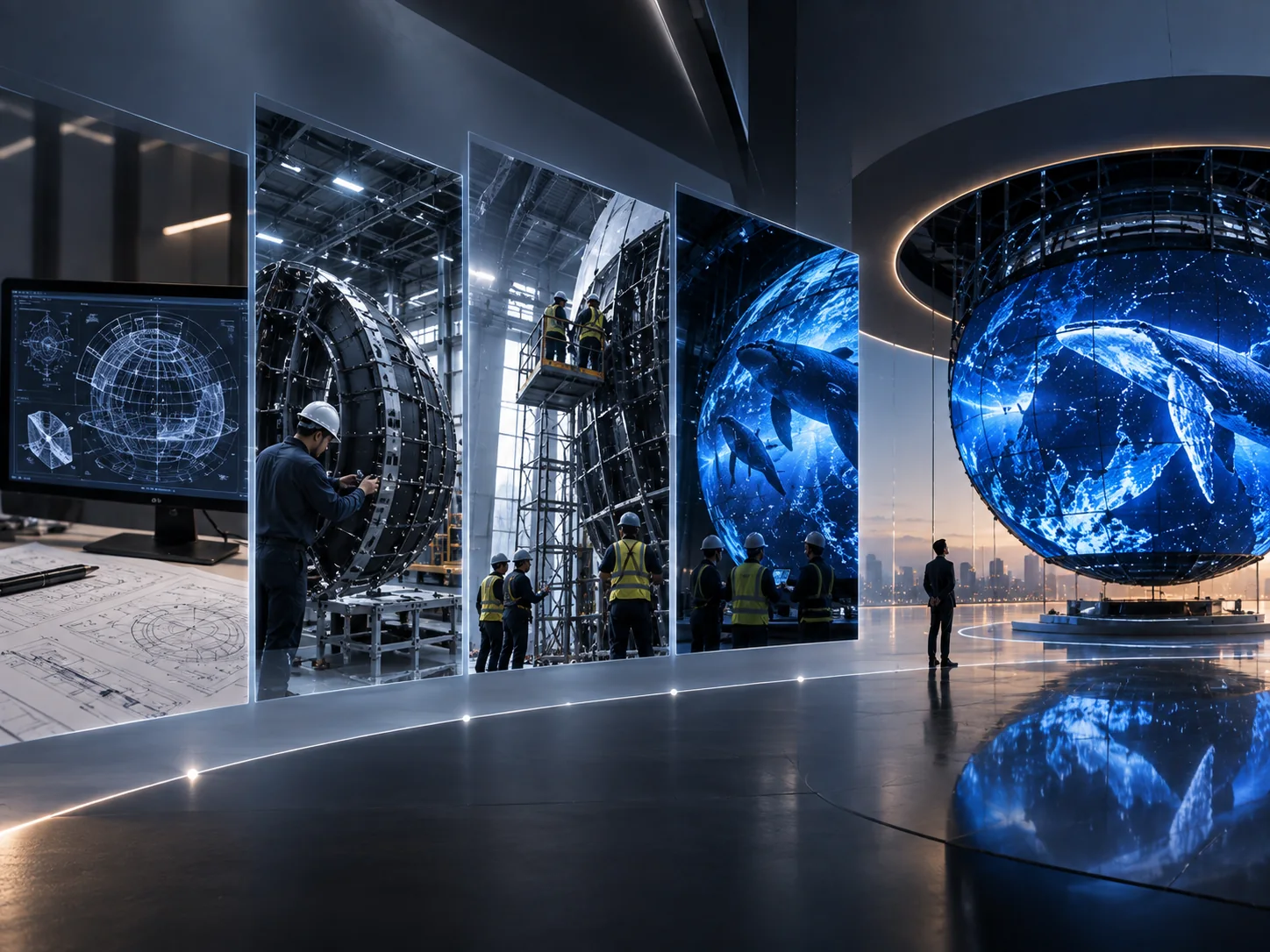
The best way to determine whether an LED supplier can deliver complex projects is not by looking at how extensive its product catalog is. The real test is whether it can turn an electromechanical system from engineering drawings into a working installation — and from initial delivery into long-term stable operation — under the challenges of non-standard spaces, extreme environments, and multi-system integration.
Contents
- Why “Can You Build It?” and “Can You Deliver It?” Are Two Different Questions
- Dimension 1: Mechanical Engineering — It Is Not as Simple as “Adding a Motor”
- Dimension 2: Motion Control — Synchronizing Thousands of Moving Units
- Dimension 3: Content Ecosystem — Enabling Creative Teams to Work Without Coding
- Dimension 4: Installation & Maintenance — It Must Be Installable and Serviceable
- Dimension 5: Complex Project Experience — Real Projects Are the Best Engineering Proof
- Evaluation Checklist: Five Dimensions and Key Questions
- Conclusion
1. Why “Can You Build It?” and “Can You Deliver It?” Are Two Different Questions
In the LED display industry, almost every supplier can present an impressive product catalog.
Pixel pitch, brightness, refresh rate — the numbers on a specification sheet can all look professional.
But successful delivery of a complex project is rarely determined by the specification sheet alone.
In many 3D kinetic LED projects, the real problems do not come from whether the display can turn on. They emerge when the equipment reaches the site and the project team discovers that the wall cannot support the system, there is insufficient maintenance access, or the available power infrastructure does not match the system requirements.
By that stage, redesign becomes much more expensive.
For a complex LED project, early-stage planning and engineering can have a greater impact on success than the final installation itself.
A supplier’s ability to anticipate these problems determines whether a system merely works on opening day or continues to operate reliably over the long term.
So how should buyers evaluate whether an LED supplier genuinely has complex-project delivery capabilities?
The following five engineering dimensions provide a practical framework for looking beyond the specification sheet.
▶Video · YouTubeFrom Automated Craftsmanship to Stunning Visual Reality — SpectrumDisplay Kinetic ScreenWatch on YouTube →
2. Dimension 1: Mechanical Engineering — It Is Not as Simple as “Adding a Motor”
The mechanical structure of a conventional LED display is relatively straightforward:
build a fixed supporting structure and install the LED modules and cabinets.
A mechanical LED system is fundamentally different.
Its mechanical architecture determines whether the screen can move, whether it moves consistently, and whether that movement feels precise and refined.
What to Evaluate
Module Gap Control
The gap between modules directly affects the visual integrity of a 3D Kinetic LED Screen.
During physical movement, excessive gaps can create visible dark lines that break the continuity of the image.
For high-quality indoor kinetic LED applications, module gaps should be tightly controlled.
Spectrum Display’s SPKI-128, for example, uses an LED positioning approach designed to reduce the perceived visual gap at module edges, creating a more continuous visual surface for close-range viewing.
Motion System Lifespan
A 3D Kinetic LED Screen is a high-duty electromechanical system.
A short mechanical lifespan means higher maintenance costs, more frequent component replacement, and a greater risk of failure during important events.
Buyers should therefore ask how the supplier validates the durability of critical components such as linear guides, belts, cables, bearings, and motion assemblies.
A claimed service life means little without an engineering validation process behind it.
System Depth
In space-constrained commercial environments, system depth can determine whether the project is feasible at all.
The SPKI-160, for example, has a body depth of approximately 330mm, with a finished installation depth of around 350mm.
For ceiling installations, storefronts, and close-to-wall applications, those few hundred millimeters can make the difference between a concept that fits and one that cannot be installed.
Questions to Ask
- What are the static and dynamic module gaps?
- What is the designed lifespan of the critical motion components, and how has it been validated?
- What is the depth of the thinnest model, including the final installed depth?
▶Video · YouTubeKinetic Screen Meets Robotics — The Ultimate Collision of Mechanical AestheticsWatch on YouTube →
3. Dimension 2: Motion Control — Synchronizing Thousands of Moving Units
A conventional LED control system essentially has one primary task:
send video data to the display.
A mechanical LED system has another layer of complexity.
It must deliver visual content while simultaneously coordinating large numbers of physical motion units with precision.
What to Evaluate
Motion-Control Capacity
Large kinetic LED installations may contain hundreds or thousands of independently controlled motion units.
Spectrum Display’s control architecture can support 48 motion axes on a single communication channel, while the overall network architecture can scale to as many as 65,536 motion terminals.
For large installations, scalability is critical because control complexity increases rapidly as the number of moving elements grows.
Closed-Loop vs. Open-Loop Control
An open-loop system sends a command without continuously confirming whether the intended position has actually been reached.
A closed-loop system uses real-time position feedback to monitor and correct movement.
Spectrum Display’s motion architecture combines a 32-bit MCU, magnetic encoder, and FOC-based motor control, enabling closed-loop position feedback and more precise motion control.
For kinetic displays, this directly affects consistency, positioning accuracy, smoothness, and the ability of multiple units to remain synchronized.
Protocol Compatibility
A professional kinetic system should also be able to integrate with the broader control environment of the project.
Compatibility with industry-standard show-control workflows allows mechanical movement to work alongside lighting, media, and interactive systems rather than functioning as an isolated system.
For project owners, the important question is not simply:
“Does the screen move?”
It is:
“Can its movement become part of the entire show-control system?”
Questions to Ask
- How many motion units can the control architecture support?
- Does the system use open-loop or closed-loop motion control?
- Which standard control protocols and third-party control environments can it integrate with?
▶Video · YouTubeDon't Sweat the Content ProductionWatch on YouTube →
4. Dimension 3: Content Ecosystem — Enabling Creative Teams to Work Without Coding
This is one of the biggest differences between conventional LED suppliers and experienced mechanical LED solution providers.
For a standard LED screen, content can simply be a video file.
For a mechanical LED screen, content needs to coordinate pixels and physical movement.
If a supplier delivers only the hardware and leaves the client to develop the motion workflow independently, the project may end up with impressive equipment but very little usable content.
What to Evaluate
Content Creation Barrier
Spectrum Display provides tools designed to reduce the technical barrier between visual design and physical motion.
For example, an After Effects-based workflow can allow visual designers to use grayscale information in 2D content as a basis for generating physical Z-axis movement.
Instead of manually programming individual motors, designers can focus on the visual content and motion concept.
The goal is simple:
creative teams should be able to design experiences without becoming motion-control engineers.
Multi-Platform Content Ecosystem
A more complete kinetic LED workflow may include different tools for different creative requirements.
MShow4 can support rapid motion-content creation and preview.
TouchDesigner integration can support interactive development involving external sensors and real-time data.
Unreal Engine 5 integration can support more advanced real-time and interactive content workflows.
For sophisticated projects, this ecosystem matters because the screen is not a one-time installation.
It is a content platform that may need to generate new experiences for years.
Questions to Ask
- What skills does the content team need?
- Does the supplier provide dedicated motion-content creation tools?
- Is programming required for routine content production?
- Can the system support interactive workflows using cameras, radar, LiDAR, or other external sensors?
5. Dimension 4: Installation & Maintenance — It Must Be Installable and Serviceable
This is one of the most overlooked issues in large mechanical LED projects — and one of the factors with the greatest impact on long-term operating costs.
During the design stage, everyone focuses on questions such as:
“How impressive will it look?”
“How far will it move?”
“How bright will it be?”
Three years later, a much more practical question becomes important:
“How do we replace a failed module?”
What to Evaluate
Front Maintenance vs. Rear Maintenance
For space-constrained indoor projects, models such as SPKI-128 and SPKI-160 can use front-maintenance architecture.
LED modules and key internal mechanical components can be accessed from the display side, reducing the need for a dedicated rear maintenance corridor.
With its approximately 330mm body depth, the SPKI-160 is particularly suited to installations where every centimeter matters.
For larger installations using rear-maintenance architecture, sufficient service space needs to be incorporated into the project design from the beginning.
Maintenance Access Cannot Be an Afterthought
A maintenance corridor is not something that should be “added later.”
Once walls have been closed, supporting structures completed, and architectural finishes installed, creating additional maintenance access can become extremely expensive or even impossible.
Maintenance planning therefore needs to begin alongside structural planning.
Questions to Ask
- Is the display front-maintenance or rear-maintenance?
- Which components can be replaced individually?
- How long does a typical maintenance operation take?
- Are special tools or lifting equipment required?
- What service access must be reserved before construction begins?
▶Video · YouTubeLEAP 2025 Kinetic Screen Case Study — 5 m × 3 m SPKI-160 in Saudi ArabiaWatch on YouTube →
6. Dimension 5: Complex Project Experience — Real Projects Are the Best Engineering Proof
3D Kinetic LED is a highly customized engineering field.
Every project may involve a different screen size, motion requirement, architectural structure, operating environment, or maintenance strategy.
That makes real project experience one of the most direct indicators of engineering capability.
What to Evaluate
Projects in Demanding Environments
Outdoor projects expose the system to challenges that cannot be fully reproduced by indoor demonstrations.
High temperature, humidity, rain, dust, wind, long operating hours, and maintenance constraints all affect the design.
A supplier that claims to handle complex outdoor projects should be able to explain not only which product was installed, but also how the system was engineered for the environment.
Non-Standard Space Projects
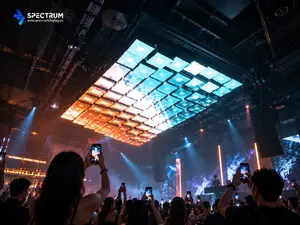
In a premium bar project in Singapore, Spectrum Display installed an SPKI-160 3D Kinetic LED Screen on the ceiling, measuring approximately 1440 × 3840mm.
The project required a solution that could fit within limited ceiling depth while remaining maintainable from below.
The SPKI-160’s 330mm ultra-slim architecture and front-maintenance design addressed these constraints.
This type of case demonstrates more than product capability.
It demonstrates engineering adaptation.
Large and High-Requirement Projects
When reviewing a supplier’s portfolio, buyers should look beyond brand names and project photos.
Ask what made the project difficult.
Was the installation environment unusual?
Were there structural constraints?
Did the project require customized control, mechanical engineering, or maintenance access?
How were those problems solved?
A strong case study should demonstrate the engineering process, not simply the finished appearance.
Questions to Ask
- What projects have you delivered with a similar scale or installation environment?
- Have you completed projects involving high temperature, high humidity, salt exposure, facades, or other demanding conditions?
- Can you provide engineering details rather than only finished-project photos?
- Can you explain what the main technical challenge was and how it was solved?
7. Evaluation Checklist: Five Dimensions and Key Questions
| Dimension | Key Questions |
|---|---|
| Mechanical Engineering | What are the static and dynamic module gaps? What is the designed lifespan of critical motion components? What is the minimum system depth? |
| Motion Control | How many motion units can the system support? Is it open-loop or closed-loop? Which control protocols and external systems can it integrate with? |
| Content Ecosystem | Does content creation require coding? What creative tools are provided? What interactive technologies can be integrated? |
| Installation & Maintenance | Is the system front- or rear-maintenance? How are individual components replaced? What service access must be reserved? |
| Complex Project Experience | What comparable projects has the supplier delivered? Does it have experience with non-standard spaces and demanding environments? Can it provide detailed engineering case studies? |
8. Conclusion
The real question when evaluating an LED supplier is not simply:
“What can they manufacture?”
It is:
“What can they successfully deliver when the conditions are difficult?”
Key Takeaways
1. Mechanical Engineering
Gap control, mechanical lifespan, and system depth determine whether the display merely moves or moves with precision and visual quality.
2. Motion Control
System capacity, closed-loop feedback, and control integration determine whether hundreds or thousands of motion units can operate accurately and consistently.
3. Content Ecosystem
Creative tools and workflow accessibility determine whether the project becomes a sustainable content platform or ends up as impressive hardware with limited usable content.
4. Installation & Maintenance
Front/rear maintenance architecture and service-access planning have a direct impact on operating costs over the next five to ten years.
5. Complex Project Experience
Projects involving non-standard architecture and demanding environments provide much stronger evidence of engineering capability than a product catalog alone.
Recommendations for Buyers
When evaluating a supplier, do not stop at the specification sheet.
Ask detailed engineering questions about mechanics, control architecture, content workflow, maintenance, and real project experience. The quality of the answers will reveal much more than the numbers in a brochure.
Request detailed examples of complex projects rather than only product specifications or polished renderings.
If possible, visit the manufacturing facility or an operating project. Mechanical design quality, assembly consistency, maintenance architecture, and manufacturing processes are much easier to evaluate when seen in person.
Ultimately, selecting a supplier for a complex LED project is not about finding the company with the longest product catalog.
It is about finding a partner that can turn a difficult concept into an engineered system — and keep that system operating reliably after delivery.
For complex LED engineering and customized project solutions, contact the Spectrum Display team.