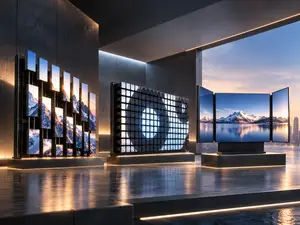
Where Does Flip Matrix Work Best? From Retail Windows and Showrooms to Commercial Art Installations
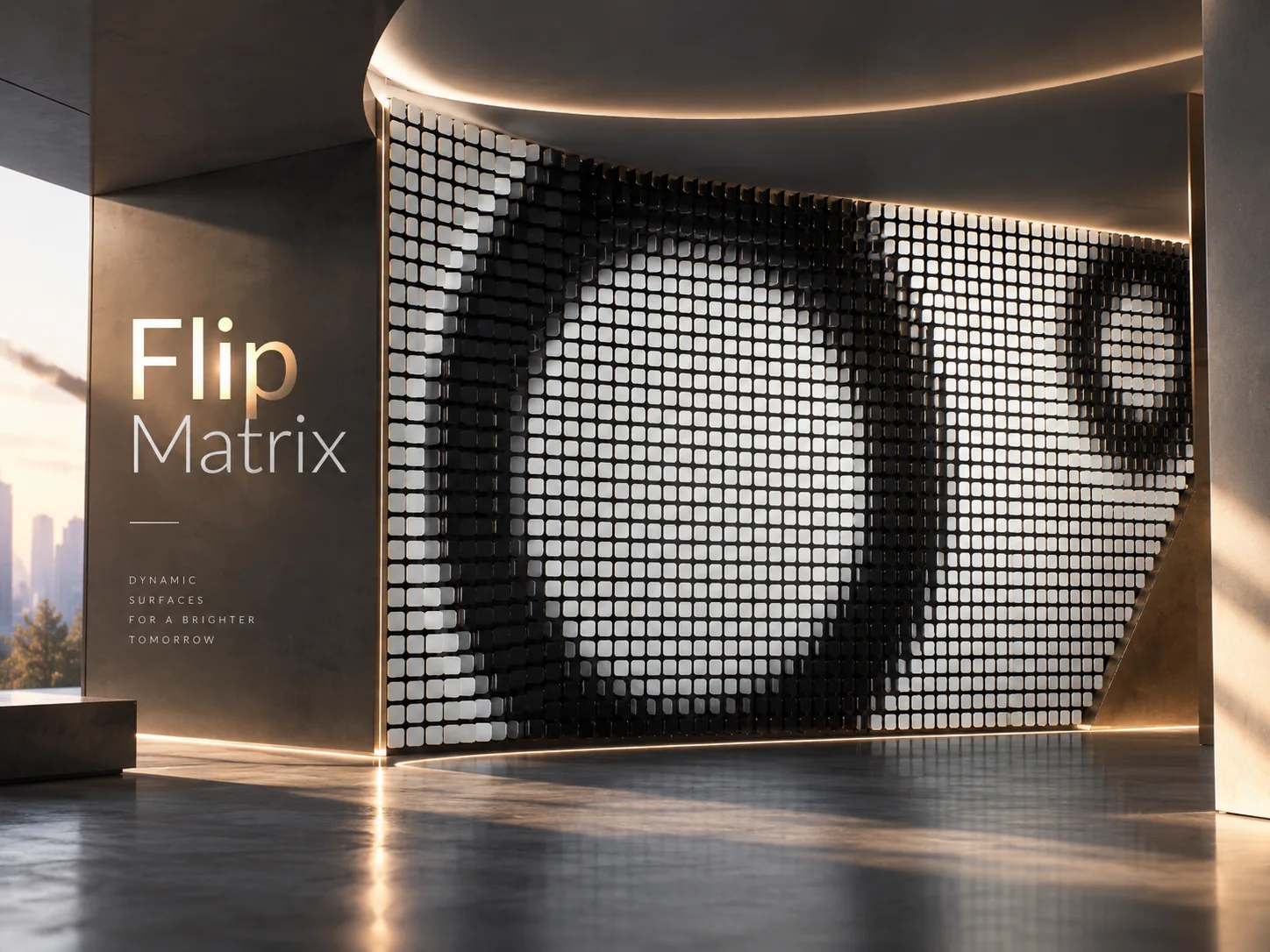
One-sentence definition:
Flip Matrix is a dynamic mechanical display product within Spectrum Display’s SPFM Series. By using physical rotating units, it transforms mechanical movement itself into a form of spatial expression. From boutique storefront windows to large-scale commercial art installations, different spaces call for different Flip Matrix configurations.
Why Can the Same “Moving Wall” Feel Completely Different in Different Spaces?
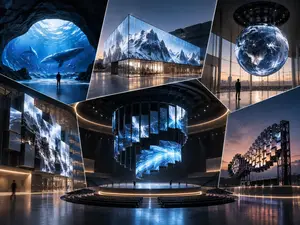
The same Flip Matrix wall can create entirely different experiences when installed in a luxury retail window versus a shopping mall atrium.
The reason is simple: viewing distance, spatial scale, and content requirements are different.
In a storefront window, customers may stand only 50cm from the wall, where every flipping unit can be examined in detail.
In a shopping mall atrium, viewers may pass by from more than ten meters away, where only large-scale coordinated movement is likely to catch their attention.
Flip Matrix is a product family rather than a single product.
The SPFM Series includes four models — SPFM-100, SPFM-168, SPFM-138L, and SPFM-138P — each designed for different applications and spatial requirements.
Choose the right model, and the space comes alive.
Choose the wrong one, and you may either overspend or compromise the visual effect.
Flip Matrix is not a one-size-fits-all “moving wall.” It is a system that needs to respond to the space around it.
▶Video · YouTubeMeet the Spectrum Flip Matrix — a dynamic mechanical display system, not a single productWatch on YouTube →
1. Boutique Storefront Windows: Creating a Brand Experience at 50cm
Luxury retail windows are among the most demanding applications for Flip Matrix.
Customers may stand only a few dozen centimeters away from the display surface.
At this distance, every gap, every visible unit, and every imprecise movement can affect the premium feel of the brand experience.
Conventional mechanical displays often require physical clearances between moving units to prevent interference. In a close-viewing retail environment, excessive gaps can make the mechanical structure visually distracting.
SPFM-100 is designed for this type of application.
With a density of 64 units/m² and a panel size of 100 × 100mm, it offers the highest density among the four SPFM models.
At close viewing distances, the denser configuration produces a more refined dynamic surface, while individual color transitions remain clearly defined.
SPFM-100 also provides a 0.15-second side-switching time and a maximum rotation speed of 3 Rev/s, enabling fast, precise transitions.
Its quick-install cabinet weighs only 6kg, making installation and adjustment easier in compact retail environments.
Best suited for: Luxury storefront windows, premium retail entrances, boutique showroom feature walls.
Selection signal: If customers will typically view the wall from less than one meter away, SPFM-100 is the most suitable option within the SPFM Series.
▶Video · YouTubeAre people always just passing by your storefront? Turning a window into a reason to stopWatch on YouTube →
2. Corporate Showrooms: When a Wall Becomes Part of the Brand Story
Corporate showrooms are another increasingly important application for Flip Matrix.
The traditional showroom experience is straightforward:
Visitors follow a guide, and the guide points at screens to explain the company.
The display delivers information, but it rarely becomes part of the story itself.
Flip Matrix changes that relationship.
A wall that physically transforms can become part of the brand’s visual language.
For showroom applications, the challenge is twofold:
The installation needs enough visual impact to capture attention, while also providing enough content capability to communicate a brand story.
SPFM-138P is particularly well suited to this requirement.
It combines mechanical flipping with a P10.42 LED display surface.
One side of each rotating unit integrates an LED display surface with a resolution of 14 × 14 pixels, supporting video, animation, brand graphics, and dynamic digital content.
When the LED side is switched off, it presents a clean black appearance, creating a strong visual contrast with the other two physical surfaces.
This gives one wall two different modes of expression.
One moment, it can display brand video content.
The next, the units can rotate to reveal customized colors, finishes, or materials.
The combination of physical movement and digital content creates a stronger memory point than video alone.
Best suited for: Technology museums, corporate showrooms, planning exhibition halls, and brand experience centers.
Selection signal: If a space needs both the sculptural quality of a kinetic installation and the storytelling capability of video, SPFM-138P combines both in one system.
▶Video · YouTubeHow Can You Enhance the Visual Impact of Your Showroom Space?Watch on YouTube →
3. Commercial Art Installations: Turning Large Walls into Landmarks
When Flip Matrix moves from smaller indoor environments into large public spaces, the main challenge shifts from precision to scale.
Shopping mall atriums, airport halls, pedestrian streets, and public art walls share several characteristics:
large surface areas, longer viewing distances, and high pedestrian traffic.
In these environments, smaller high-density units may not always provide an advantage.
From a distance, the audience perceives the overall physical movement rather than the detail of each individual unit.
SPFM-168 is designed for large-area applications.
It uses 25 units/m² with a panel size of 168 × 168mm.
The lower unit density allows a larger area to be covered with fewer mechanical units, while power consumption is approximately 120W/m², the lowest among the four models.
The design balances large-scale visual impact with engineering cost.
At longer viewing distances, the larger 168 × 168mm panels create stronger and more readable physical movement.
SPFM-168 also offers flexible surface customization, including natural plastic finishes, UV printing, electroplating, and colored films.
Glossy, matte, mirror, and other visual treatments can be selected to match different architectural environments and brand identities.
Best suited for: Large flagship-store feature walls, shopping mall atriums, airports, pedestrian streets, and commercial art installations.
Selection signal: For projects larger than approximately 50m² with viewing distances beyond three meters, SPFM-168 is generally the most suitable option within the series.
▶Video · YouTubeSpectrum Flip Matrix: The Future of Kinetic Display TechnologyWatch on YouTube →
4. Nightlife and Evening Commercial Spaces: A Wall by Day, Light by Night
There is another application for Flip Matrix that is often underestimated:
spaces that need different visual identities during the day and at night.
Traditional commercial interiors often follow one visual logic.
The space looks largely the same during daytime and evening operation.
Flip Matrix can create two distinct expressions within one system.
SPFM-138L is designed for this type of application.
It combines three-sided mechanical rotation with full-color RGB lighting.
Each square meter contains 36 units.
One surface incorporates RGB lighting, while the other two surfaces can be customized with different colors, patterns, or materials.
Together, physical movement, surface changes, and lighting create multiple layers of spatial expression.
During the day, the installation can function primarily as a mechanical feature wall, using physical color and surface changes to create brand graphics and visual patterns.
At night, the RGB lighting can take over as the dominant visual element, transforming the wall into a dynamic lighting installation.
One mechanical system can therefore support two very different spatial identities.
Best suited for: Nightlife venues, bars and clubs, atmospheric feature walls, art installations, and interactive lighting environments.
Selection signal: If the space is most active at night or needs a restrained daytime appearance and a more dramatic nighttime identity, SPFM-138L is the most suitable option within the series.
5. SPFM Series: Quick Selection Guide by Space
| Space | Core Requirement | Recommended Model | Key Reason |
|---|---|---|---|
| Boutique Storefront | Close viewing, high precision, premium appearance | SPFM-100 | 64 units/m² for a more refined close-viewing experience |
| Corporate Showroom | Visual impact + content storytelling | SPFM-138P | Integrated LED surface supports video and digital content |
| Commercial Art Installation | Large-area coverage, long-distance visual impact | SPFM-168 | 25 units/m² for efficient large-scale coverage |
| Nightlife / Evening Commercial Space | Day-and-night transformation, lighting atmosphere | SPFM-138L | Full-color RGB lighting + mechanical rotation |
A Three-Step Selection Method
Step 1: Consider the viewing distance.
For distances under 1 meter, consider SPFM-100. For 1–3 meters, SPFM-138L or SPFM-138P may be more suitable. For distances beyond 3 meters, SPFM-168 is generally the better fit.
Step 2: Define the content requirement.
For physical color-block transformations, consider SPFM-100 or SPFM-168. For nighttime lighting effects, choose SPFM-138L. For video playback and digital storytelling, choose SPFM-138P.
Step 3: Consider the installation area.
For smaller installations under 10m², SPFM-100 is well suited. For medium-sized installations between 10 and 50m², consider SPFM-138L or SPFM-138P. For large installations above 50m², SPFM-168 offers better scalability.
6. From Commercial Spaces to Public Art: The Boundaries of Flip Matrix Are Still Expanding
The potential applications of kinetic surfaces extend far beyond these four categories.
Around the world, dynamic mechanical walls are moving from commercial interiors into public art and architectural installations.
One example is Wind Arbor at Marina Bay Sands in Singapore.
The installation consists of approximately 260,000 aluminum flappers covering around 6,800m².
Driven by wind, the individual elements move freely to create constantly changing patterns of reflected light while also functioning as a shading system.
The installation demonstrates an important idea:
a moving wall can become an architectural landmark in its own right.
In China, kinetic mechanical walls have also appeared in commercial and corporate environments, including projects associated with Starbucks, Huawei, Tencent, and other major brands.
The underlying logic is similar:
when a wall is no longer static, the space gains another reason to be remembered.
Spectrum Display’s SPFM Series takes this concept of dynamic spatial expression and turns it into a standardized, modular system.
With four models covering applications from boutique retail windows to large-scale commercial art installations, the series provides different tools for different spatial requirements.
Not every space needs Flip Matrix.
But for spaces that want the wall itself to become part of the experience, Flip Matrix offers a new form of physical storytelling.
7. Conclusion
Where does Flip Matrix work best?
The answer is:
any space where the wall needs to evolve from background into a focal point.
Key Takeaways
- Boutique Storefront → SPFM-100
64 units/m² for high-density, close-range visual expression. - Corporate Showroom → SPFM-138P
LED display surface + mechanical rotation for both digital storytelling and physical transformation. - Commercial Art Installation → SPFM-168
25 units/m² for efficient large-area coverage and stronger long-distance visual impact. - Nightlife & Evening Commercial Spaces → SPFM-138L
Full-color RGB lighting + mechanical rotation for different daytime and nighttime identities. - Three-Step Selection Method
Viewing distance → Content requirements → Installation area.
Recommendations for Project Owners
Before selecting a Flip Matrix model, answer three questions:
How far will viewers typically stand from the wall?
Will the installation be experienced mainly during the day or at night?
Does the wall need to display video content?
Higher density is not automatically better.
Using a high-density system for a long-distance installation may add unnecessary cost, while using a low-density system for close viewing may compromise the experience.
For SPFM Series specifications and customized project solutions, contact the Spectrum Display team.