For the Same Creative LED Project, When Should You Choose a 3D Kinetic LED Screen, and When Should You Choose an Immersive LED System?
One-Sentence Definition:
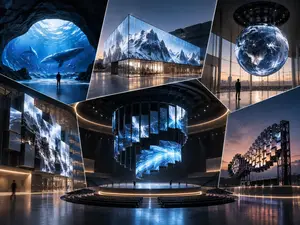
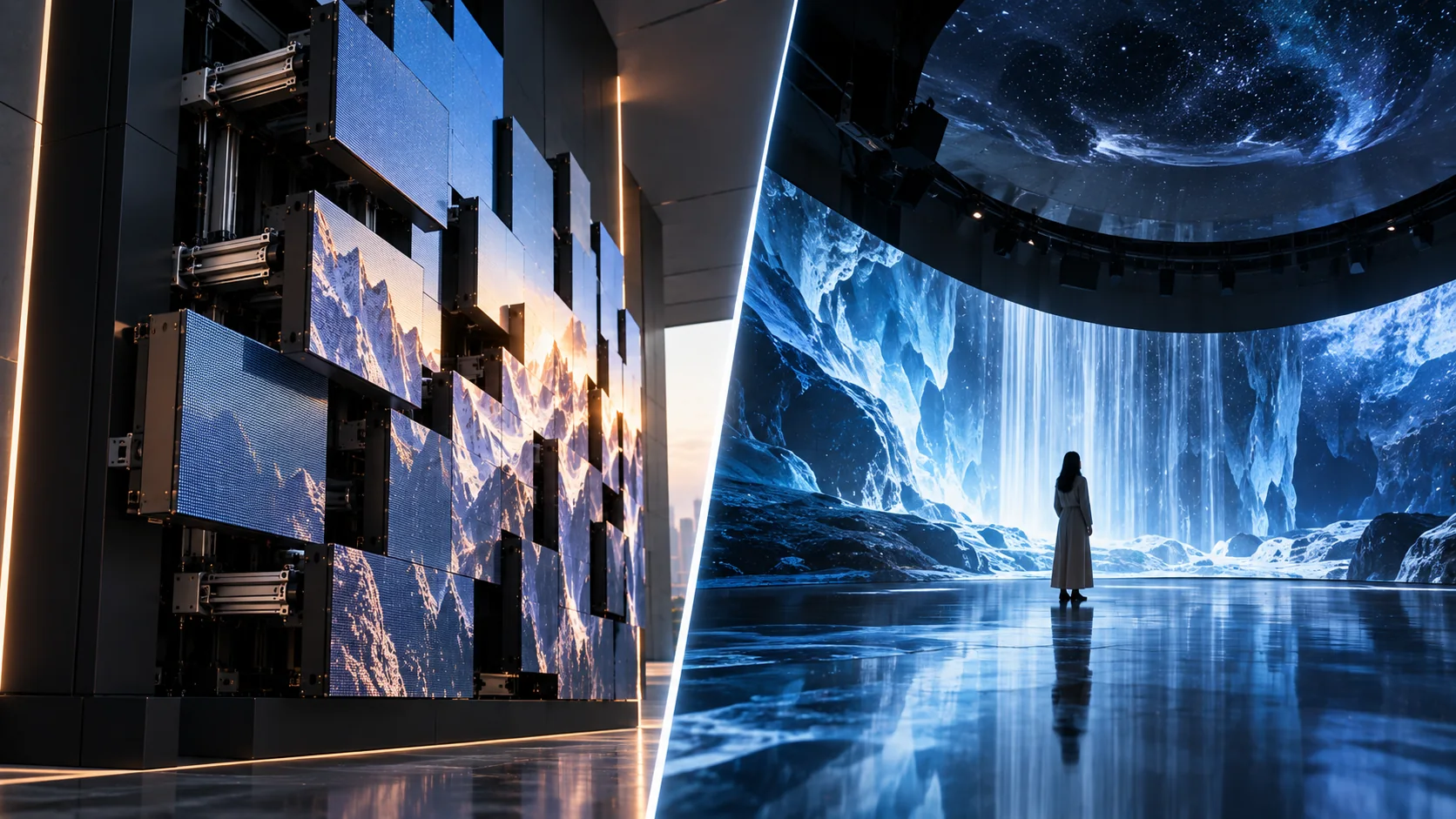
A 3D Kinetic LED Screen creates immersion through physical Z-axis movement, making the screen itself move, while an Immersive LED System surrounds the audience through multi-surface displays and content design, making people feel as if they have stepped inside the scene. The former is about “the screen moving,” while the latter is about “the audience being inside the visual world.”
Contents
- Two Technologies, Two Completely Different Ways to Create Motion
- What Is a 3D Kinetic LED Screen? — The Screen Moves
- What Is an Immersive LED System? — The Audience Is Inside the Scene
- Six Dimensions to Understand the Difference
- Sayram Lake as an Example: How Immersive LED Creates a “Step-In” Experience
- Selection Guide: Four Questions to Help You Decide
- Conclusion: There Is No Better Solution, Only the Right One
1. Two Technologies, Two Completely Different Ways to Create Motion
In creative LED display, the meaning of “dynamic” is being redefined.
Traditional dynamic content means the image moves: videos play, graphics change, and content flows. But the screen itself remains fixed.
The new generation of creative LED projects offers two completely different paths.
Path 1: The Screen Moves
The screen itself changes through physical movement — extending, retracting, rising, and forming different depths.
The audience sees the physical shape of the display change.
This is the logic of a 3D Kinetic LED Screen.
Path 2: The Audience Is Inside the Scene
The screen itself remains fixed, but through multi-surface layouts, curved displays, and immersive content design, the audience feels as if they have entered the visual world.
This is the logic of an Immersive LED System.
Both technologies can create immersion.
But their implementation methods, suitable applications, cost structures, and project timelines are completely different.
Choosing the wrong solution may lead to wasted budget — or even project failure.
A 3D Kinetic LED Screen deeply integrates ultra-high-definition LED display with precision mechanical movement, turning a fixed content player into a spatial participant that can rise, retract, transform, and “breathe.”
An Immersive LED System, by contrast, transforms physical space into a dynamic digital environment through combinations such as ceiling displays, wraparound screens, curved LED walls, and floor LED screens.
2. What Is a 3D Kinetic LED Screen? — The Screen Moves
The defining feature of a 3D Kinetic LED Screen is physical movement.
Based on an ultra-high-definition LED display, each display module is given an independent physical Z-axis position.
This allows the screen to physically extend or retract according to the visual content.
Unlike conventional LED displays, a 3D Kinetic LED Screen does not rely solely on visual effects to create the illusion of naked-eye 3D.
Instead, it uses real front-to-back physical movement to transform a flat image into a display with actual depth.
Its immersive quality comes from the physical dimension:
the screen itself moves.
At ISE 2026, Spectrum Display’s 3D Kinetic LED Screen used physical Z-axis displacement to create real-time interaction with visitors.
When visitors waved, the screen moved in response.
When they approached, the modules retracted.
This kind of physical, real-time feedback is redefining the boundaries of offline visual experiences.
Typical Applications
- Brand launch events, such as the Coca-Cola World Cup launch using SPKI-250, 5m × 3m
- Exhibition and rental applications, such as ISE 2026 and the Digital China Summit
- Commercial-space art installations, such as the Singapore bar ceiling project
- Outdoor landmarks, such as the Mandarin Oriental Jakarta project
Core Value
The screen itself becomes the performer.
Physical movement creates visual impact, depth, and interaction.
▶Video · YouTubeTouch It. Watch It React. — the screen responds to the visitor in real timeWatch on YouTube →
3. What Is an Immersive LED System? — The Audience Is Inside the Scene
The defining feature of an Immersive LED System is spatial enclosure.
It usually consists of multiple LED surfaces, such as ceiling displays, wraparound walls, curved screens, and floor LED screens.
Through multi-surface layouts or curved structures, the audience is surrounded by visual content.
No headset is required.
The audience simply stands inside the space and becomes visually enclosed by the content.
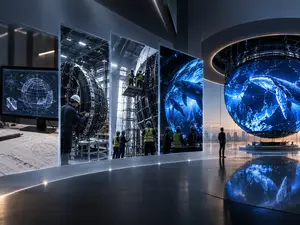
Spectrum Display has accumulated project experience in immersive LED applications and provides complete LED display system solutions covering requirement analysis, system design, product development, equipment manufacturing, and project delivery.
Typical Applications
- Museums and science centers
- Cultural tourism performances
- Immersive theaters and flying theaters
- Brand experience centers
- Corporate showrooms
Core Value
The audience steps into the image.
Spatial enclosure creates a strong sense of presence.
▶Video · YouTubeP2.5 LED Immersive Room — the audience surrounded by multi-surface contentWatch on YouTube →
4. Six Dimensions to Understand the Difference
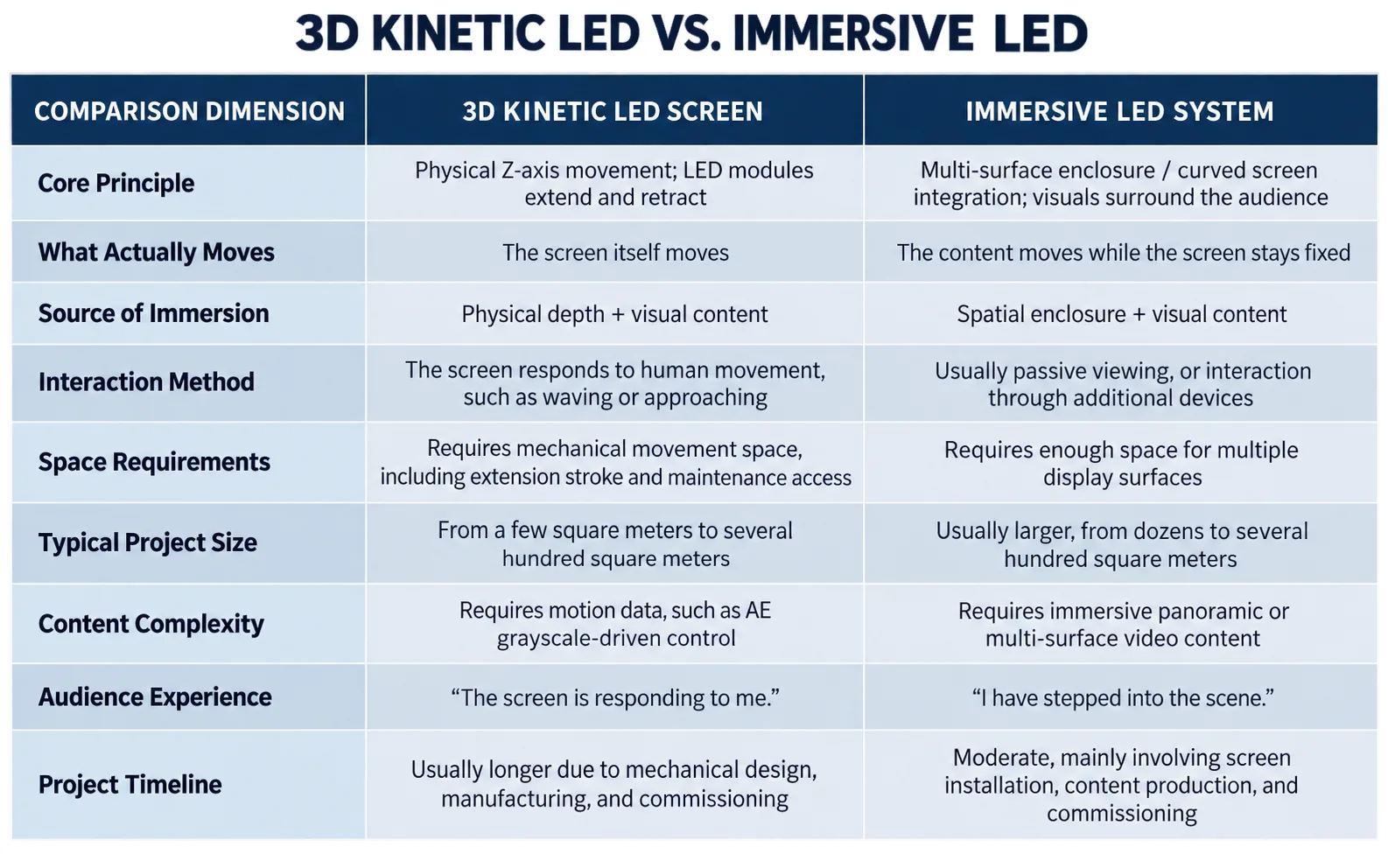
Key Difference 1: The Source of Immersion
The immersion of a 3D Kinetic LED Screen comes from physical reality.
The movement is real.
The audience can see the physical depth changing and perceive that the screen itself is moving.
The immersion of an Immersive LED System comes from visual enclosure.
The visuals fill the audience’s field of view until the boundaries of the screens become less noticeable.
Key Difference 2: The Interaction Logic
A 3D Kinetic LED Screen is naturally suited to interaction.
A visitor approaches, and the screen can move back.
A visitor waves, and the screen can respond.
This physical interaction creates a direct relationship between people and the screen.
An Immersive LED System usually requires additional sensors or interactive devices if real-time interaction is needed.
The display surfaces themselves remain fixed.
Key Difference 3: Space Requirements
A 3D Kinetic LED Screen requires reserved space behind or around the display for mechanical movement and maintenance.
For example, SPKI-160 has a body thickness of 330mm, with an overall finished thickness of around 350mm.
An Immersive LED System requires multiple display surfaces and therefore usually needs more open spatial conditions.
5. Sayram Lake as an Example: How Immersive LED Creates a “Step-In” Experience
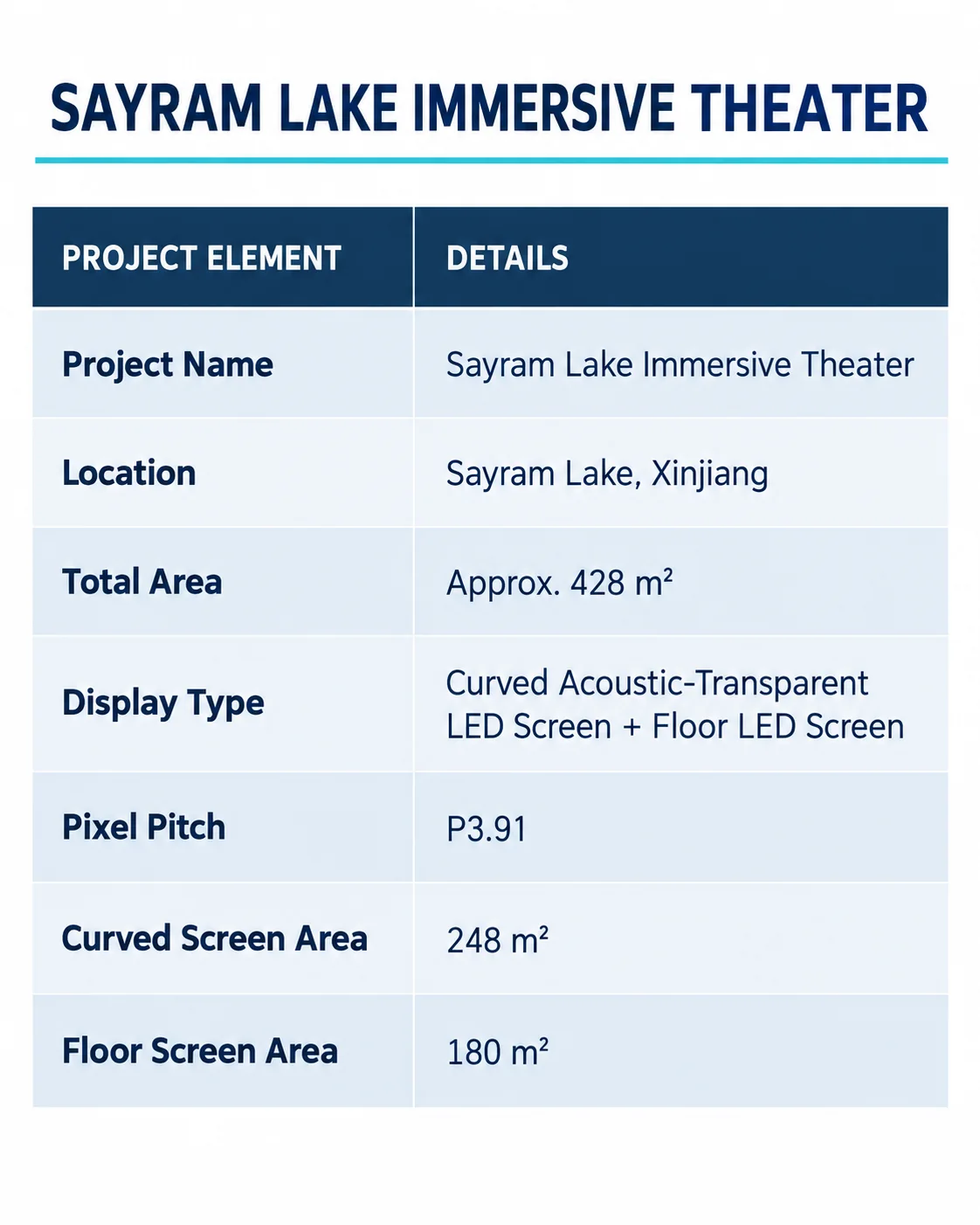
The Sayram Lake Immersive Theater in Xinjiang is one of Spectrum Display’s representative immersive LED projects.
The project uses a combination of a curved acoustic-transparent LED screen and a floor LED screen.
According to the project material, the system includes a 248㎡ curved screen and a 180㎡ floor screen, creating a total display area of approximately 428㎡.
The curved screen and floor display work together to surround the audience and create a stronger sense of spatial continuity.
Project Overview
Core Engineering Challenge 1: Acoustic Transparency
In a large immersive space, hard display surfaces can create unwanted sound reflections.
The project therefore uses an Acoustic Transparent LED Screen so sound can pass through the display surface more effectively, helping the audio system work together with the visual system.
Core Engineering Challenge 2: Curvature and Alignment
The project required careful control of curvature, flatness, module gap alignment, and overall screen surface consistency.
The project material specifically identifies curvature calibration, module gap control, and high-precision customized modules as important engineering challenges.
Core Engineering Challenge 3: Floor Screen Load and Integration
The floor LED system needed to support high load-bearing requirements while maintaining visual continuity with the curved screen.
The floor display specification in the project material includes load-bearing capacity, friction coefficient, IP protection, and 7680Hz refresh rate.
The Sayram Lake project shows how an Immersive LED System can create a “step-in” experience through spatial enclosure, acoustic coordination, curved display engineering, and floor-screen integration.
▶Video · YouTubeStep inside a 3D Immersive LED Screen — the "step-in" experience in motionWatch on YouTube →
6. Selection Guide: Four Questions to Help You Decide
Question 1: Do You Want the Audience to Watch or Participate?
If you want the audience to actively interact with the display, a 3D Kinetic LED Screen is usually the better choice.
Physical movement naturally encourages people to approach, explore, and interact.
If you want the audience to feel surrounded by visual content, an Immersive LED System is usually more suitable.
Question 2: What Are Your Space Conditions?
If the space is constrained, such as a wall-mounted or ceiling-mounted installation, a 3D Kinetic LED Screen may offer more flexibility.
SPKI-160, for example, can achieve an overall finished thickness of around 350mm.
If the space is open enough for multiple display surfaces, both solutions can be considered.
If the goal is strong spatial enclosure, an Immersive LED System is usually more appropriate.
Question 3: What Is the Main Application?
For:
- brand launches
- exhibition rental
- commercial art installations
- interactive spatial installations
a 3D Kinetic LED Screen is usually the preferred direction.
For:
- museums
- science centers
- cultural tourism theaters
- immersive exhibition environments
an Immersive LED System is usually more suitable.
Question 4: What Is Your Project Timeline?
If the timeline is relatively tight, an Immersive LED System may be easier to standardize because the project mainly involves display installation, content production, and commissioning.
If the project has more time and differentiation is a priority, a 3D Kinetic LED Screen can provide a more distinctive result, but it usually requires additional time for mechanical structure design, manufacturing, and commissioning.
▶Video · YouTubeKinetic Screen Explained: Creative LED Display for Events, Exhibitions and VenuesWatch on YouTube →
7. Conclusion: There Is No Better Solution, Only the Right One
3D Kinetic LED Screens and Immersive LED Systems represent two different directions in creative LED display.
A 3D Kinetic LED Screen brings the screen itself to life.
Physical movement creates depth, rhythm, and interaction.
It is suitable for projects where the screen is expected to become the performer and where audience participation matters.
An Immersive LED System brings the entire space to life.
Through visual enclosure, it creates the feeling of being inside the content.
It is suitable for projects that prioritize spatial immersion, large-scale visual storytelling, and cultural or exhibition experiences.
Key Takeaways
- 3D Kinetic LED Screen:
The screen moves. Physical motion creates immersion. It is suitable for interactive, differentiated projects. - Immersive LED System:
The audience is inside the visual world. Spatial enclosure creates immersion. It is suitable for large-scale cultural tourism and exhibition applications. - Sayram Lake Case:
The approximately 428㎡ immersive theater combines a curved acoustic-transparent LED screen and a floor LED display, demonstrating Spectrum Display’s capability in immersive LED system integration. - Selection Logic:
Ask four questions:
Do you want the audience to watch or participate?
What are the space conditions?
What is the application scenario?
How much time is available? - There Is No Better Solution, Only the Right One.
The two technologies serve different project goals.
Recommendations for Project Owners
- Before starting the project, define the experience you want the audience to have: “The screen is responding to me,” or “I have stepped into the scene.”
- Evaluate wall depth, installation height, maintenance access, and available display surfaces before choosing the solution.
- For museums and cultural tourism projects, Immersive LED Systems offer strong advantages in spatial enclosure.
- For brand launches, exhibitions, and interactive commercial installations, 3D Kinetic LED Screens offer stronger physical interaction and visual differentiation.
- To learn more about solution selection or request a tailored proposal, contact Spectrum Display through:
www.spectrumdisplay.cn