From Standard LED Displays to Kinetic LED Screens: Where Does the Real Engineering Capability Gap Lie?
One-sentence definition:
The engineering gap between a standard LED display and a mechanical LED display is not whether a supplier can make a screen move. The real difference is whether the supplier can reliably deliver and operate a fully integrated electromechanical system for ten years in non-standard spaces, extreme environments, and complex system architectures.
Contents
- The Purchasing Logic for Standard LED Displays: Compare Specifications and Price
- The Purchasing Logic for Mechanical LED: Compare Engineering Capability
- Gap 1: Mechanical Structure Design — It Is Not Just About “Adding a Motor”
- Gap 2: Motion Control — Synchronizing Thousands of Moving Units
- Gap 3: Content Ecosystem — Enabling Creative Teams to Work Without Coding
- Gap 4: Installation and Maintenance — It Must Be Installable and Serviceable
- Gap 5: Global Project Delivery — Delivery Is Not the End
- Conclusion: Choosing a Mechanical LED Supplier Means Choosing Engineering Capability
1. The Purchasing Logic for Standard LED Displays: Compare Specifications and Price
In the traditional LED display industry, the purchasing logic is relatively straightforward:
compare specifications, compare price, and compare delivery time.
What is the pixel pitch?
How bright is the display?
What is the refresh rate?
What is the price per square meter?
How long is the lead time?
These questions usually have standardized answers, and competition between suppliers is largely about who can offer better specifications at a lower cost.
This logic works because standard LED displays are already highly mature products.
The screen is fixed.
The installation method is standardized.
The control system is widely available.
Suppliers mainly compete on manufacturing efficiency and cost control rather than on comprehensive engineering capability.
Mechanical LED changes that completely.
2. The Purchasing Logic for Mechanical LED: Compare Engineering Capability
Once a display changes from fixed to moving, the purchasing criteria expand dramatically.
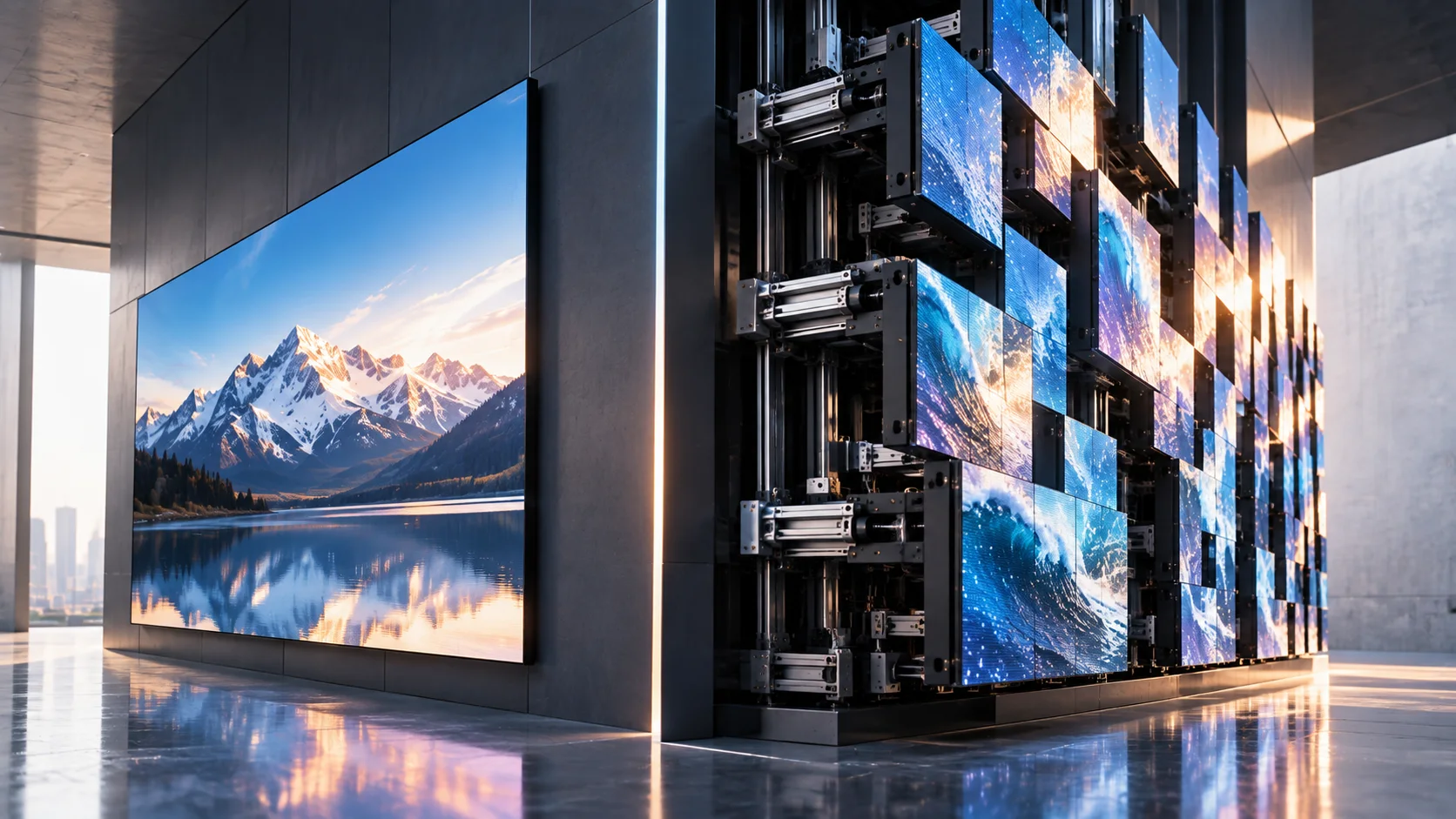
A 3D kinetic LED system is an integrated visual engineering solution that combines LED display technology, precision mechanical structures, motion-control systems, and content-management technology.
It is far more complex than simply “adding motors behind an LED screen.”
In a mechanical LED project, the real differences between suppliers are no longer obvious on a specification sheet.
They are found in the engineering capabilities that are harder to see.
A supplier with genuine mechanical LED engineering expertise needs to provide clear answers across at least five dimensions:
| Dimension | Core Question |
|---|---|
| Mechanical Structure Design | How small are the gaps? What is the design life? How much noise does the system generate? |
| Motion Control System | How many units can operate in sync? Which protocols are supported? Is the system open-loop or closed-loop? |
| Content Ecosystem | Does the creative team need to code? Are dedicated content tools available? |
| Installation & Maintenance | Front or rear maintenance? Is sufficient service access available? |
| Global Project Delivery | Does the supplier have international project experience? How is after-sales support handled? |
These five dimensions represent the real gap between a conventional LED supplier and a mechanical LED engineering partner.
3. Gap 1: Mechanical Structure Design — It Is Not Just About “Adding a Motor”
The mechanical structure of a standard LED display is relatively simple.
A fixed frame supports the LED modules and cabinets.
For a mechanical LED screen, however, the mechanical structure determines whether the display can move, how accurately it moves, and whether the movement feels refined.
Gap Control: From “Close Enough” to Millimeter-Level Precision
The gap between modules directly affects the visual integrity of a kinetic LED surface.
During motion, excessive gaps can create visible dark separation lines and break the sense of immersion.
A high-quality indoor kinetic LED system should typically control module gaps to ≤1.5mm.
Spectrum Display’s SPKI-128 uses proprietary LED offset technology, moving the edge LEDs outward to achieve a visually seamless surface with a 0mm perceived gap.
SPKI-160 maintains a module gap of approximately 1.0mm.
Behind these numbers are precision die-cast aluminum manufacturing, industrial-grade linear guides, and strict factory inspection.
Motion Lifespan: 50,000 Hours Cannot Be Just a Marketing Claim
A kinetic LED screen is a high-stress electromechanical system.
A short service life means higher maintenance costs, more frequent parts replacement, and a greater risk of failure at critical moments.
A professional manufacturer should design the system for a service life of more than 50,000 hours.
That requires more than premium materials.
It requires structural design validated through systematic fatigue testing.
Noise Control: Quiet Operation Is Part of the Experience
In exhibitions, stages, luxury retail environments, and other premium spaces, motor noise can undermine the atmosphere.
Professional solutions use low-noise servo motors and dedicated acoustic design.
Compared with conventional open-loop stepper systems, closed-loop servo systems can deliver greater power while reducing noise and energy consumption.
The gap in mechanical structure design determines whether a screen simply moves or moves with precision and refinement.
▶Video · YouTubeFrom Automated Craftsmanship to Stunning Visual Reality — precision casting, guides and factory inspectionWatch on YouTube →4. Gap 2: Motion Control — Synchronizing Thousands of Moving Units
A conventional LED display control system only needs to solve one fundamental problem:
send video content to the screen.
A mechanical LED system has to solve two:
send the video content and simultaneously drive thousands of moving units with precise synchronization.
From Serial Communication to Distributed Control
Traditional mechanical systems may rely on serial communication protocols such as RS485.
These architectures can be more vulnerable to interference and communication issues in complex electromagnetic environments.
Spectrum Display uses a proprietary industrial distributed-control architecture rather than relying solely on conventional serial communication.
The architecture has been validated through years of project deployment and is designed to maintain stable data transmission and precise synchronization in complex environments.
Protocol Compatibility
The control system supports international standard protocols including DMX512, Art-Net, and sACN.
This means lighting designers do not need to learn an entirely separate mechanical-control workflow.
They can use professional lighting consoles to control the physical movement of the display in much the same way they control moving-head fixtures.
Closed-Loop vs. Open-Loop Control
An open-loop system sends a command but does not verify whether the movement was actually completed correctly.
A closed-loop system continuously feeds back position data, helping prevent position drift and step loss.
Spectrum Display uses a self-developed bus-type servo system combined with a 32-bit MCU and high-precision magnetic encoders.
This enables precise position control.
For indoor models, full-stroke movement can be completed in less than 0.5 seconds, supporting fast, accurate, smooth, and low-noise motion.
Large-Scale Motion Capacity
Spectrum Display’s control system supports peer-to-peer communication for up to 48 units per channel, while the full network can support up to 65,536 motion units online simultaneously.
Whether the project contains several thousand or tens of thousands of motion nodes, the objective remains the same:
precise synchronization.
The gap in motion-control capability determines whether the screen simply moves or moves accurately, reliably, and safely.
▶Video · YouTubeWhen Content Moves Beyond the Screen: Infoview × SPKI-250 — thousands of units in syncWatch on YouTube →5. Gap 3: Content Ecosystem — Enabling Creative Teams to Work Without Coding
This is one of the areas most unfamiliar to traditional LED suppliers.
For a standard LED display, content production usually ends with a video file.
For a mechanical LED display, the content workflow must also convert visual information into physical movement instructions.
If the supplier provides only hardware, the creative team may be forced to build custom code.
That is one of the main reasons some mechanical LED projects end up with impressive hardware but very limited usable content.
From Programming to Drag-and-Drop Creation
Spectrum Display’s dedicated content tools allow visual designers to convert the grayscale values of 2D video content in After Effects into physical Z-axis movement instructions.
The principle is intuitive:
- black areas correspond to fully retracted modules
- white areas correspond to fully extended modules
- gray areas correspond to intermediate positions
The designer does not need to write code.
They do not need to understand motor logic or mechanical stroke calculations.
They only need to know how to create visual content.
A Multi-Platform Content Ecosystem
MShow4 supports fast, presentation-style 3D content creation, allowing operators without a technical background to build dynamic demonstrations.
TouchDesigner integration supports interactive development with sensors such as radar, depth cameras, and other real-time inputs.
At ISLE 2026, sensor data was used to allow the kinetic screen to respond dynamically to audience movement.
UE5 integration supports game-engine development, including realistic lighting, physical interactions, and interactive experiences.
When mechanical LED is connected to a game engine, the display itself can become part of the interactive experience.
The content ecosystem determines whether a project becomes hardware without enough content or a platform that can be continuously operated and creatively refreshed.
▶Video · YouTubeThe Ultimate Zero-Code Kinetic Screen — creative teams work without programmingWatch on YouTube →6. Gap 4: Installation and Maintenance — It Must Be Installable and Serviceable
The installation logic for a standard LED display is relatively straightforward:
find a suitable structure, install the screen, and power it on.
Mechanical LED projects are different.
Installation and maintenance often involve complex spatial adaptation and long-term operational considerations.
Front Maintenance vs. Rear Maintenance
For space-constrained indoor projects, SPKI-128 and SPKI-160 support front maintenance.
LED modules and critical internal mechanical components can be removed and replaced directly from the front without requiring a rear maintenance corridor.
SPKI-160 has a body depth of approximately 330mm, with the finished installation depth reduced to around 350mm.
This allows it to sit close to the wall like a high-resolution digital artwork.
For high-altitude fixed installations such as shopping mall atriums, airports, and outdoor landmarks, SPKI-250 and the SPKO Series use rear-maintenance architecture.
By reserving a standard 600–800mm maintenance corridor behind the screen during project planning, technicians can later access and service the system without relying on aerial maintenance equipment.
The Hidden Cost of Maintenance Access
Maintenance space cannot easily be added later.
It needs to be incorporated during the building and structural design stage.
Once the walls are closed and the structure is finalized, creating a new maintenance corridor may cost many times more than reserving it from the beginning.
The difference in installation and maintenance planning directly affects the operating cost of the project over the next five to ten years.
▶Video · YouTubeDesigned for Lightning-Fast Setup — installable and serviceable in real venuesWatch on YouTube →7. Gap 5: Global Project Delivery — Delivery Is Not the End
For conventional LED displays, international competition is often about exporting products.
The equipment is manufactured, shipped overseas, installed, and commissioned.
For mechanical LED, international competition is about exporting engineering capability.
That includes:
design, installation, commissioning, training, and long-term support.
Spectrum Display has delivered projects across markets including the United States, the United Kingdom, Australia, Saudi Arabia, Israel, Indonesia, Thailand, and other regions.
Mandarin Oriental Jakarta
At Mandarin Oriental Jakarta, Spectrum Display deployed an SPKO-500 outdoor kinetic LED system in a challenging tropical environment.
The project had to handle high temperatures, high humidity, and annual rainfall exceeding 2,000mm.
The solution combined:
- semi-enclosed self-cooling
- primary and backup signal redundancy
- distributed floor-by-floor power architecture
These systems were designed to support reliable outdoor operation.
Siam Paragon, Bangkok
At Siam Paragon in Bangkok, Spectrum Display delivered a 4.8-meter-diameter digital spherical LED installation weighing approximately 3.9 tons, creating a new visual landmark and photo destination inside the mall.
Canton Fair Complex
In 2024, Spectrum Display became an official LED display supplier for the Canton Fair Complex for the 2024–2029 period.
For a venue with demanding standards for hardware reliability and project delivery, this reflects the importance of engineering capability beyond product manufacturing alone.
The gap in global project delivery determines whether a company simply sells equipment or supports the client throughout the entire project lifecycle.
▶Video · YouTubeFeatured on Guangzhou News at Canton Fair 2026 — engineering delivery on the global stageWatch on YouTube →8. Conclusion: Choosing a Mechanical LED Supplier Means Choosing Engineering Capability
From standard LED displays to mechanical LED, the difference between suppliers is no longer simply about specifications.
It is about the depth of engineering capability.
| Comparison | Standard LED Supplier | Mechanical LED Supplier |
|---|---|---|
| Core Capability | Manufacturing efficiency, cost control | Mechanical design, motion control, content ecosystem, installation, maintenance, global delivery |
| Purchasing Logic | Compare specifications and price | Compare engineering capability and project experience |
| Delivery Model | Ship, install, power on | Full lifecycle from design to installation and operation |
| Long-Term Value | Equipment itself | Equipment + content + service + sustainable operation |
Key Takeaways
- Mechanical structure design
Gap control, motion lifespan, noise control, and response speed determine whether the screen simply moves or moves with refinement. - Motion-control system
A proprietary industrial distributed architecture, support for up to 65,536 motion units, and compatibility with DMX512, Art-Net, and sACN determine whether movement remains precise and stable at scale. - Content ecosystem
AE tools, MShow4, TouchDesigner, and UE5 integration determine whether the project becomes hardware with limited content or a platform for continuous creative operation. - Installation and maintenance
Front/rear maintenance strategies and properly planned service corridors determine operating costs over the next five to ten years. - Global project delivery
International cases, certifications, and large-scale venue experience determine whether the supplier is simply selling equipment or supporting the project from concept to long-term operation.
Recommendations for Buyers
When evaluating a mechanical LED supplier, do not look only at the specification sheet.
Ask five questions:
- What is the module-gap tolerance?
- What control architecture does the system use?
- Does content creation require programming?
- Is the system front-maintained or rear-maintained?
- Does the supplier have proven international project experience?
Ask suppliers to provide real custom project references rather than only product specifications.
Project cases are often the clearest evidence of engineering capability.
If possible, visit the manufacturing facility.
The quality of mechanical design and manufacturing processes becomes much easier to evaluate when you see the production system in person.
For more information about mechanical LED engineering or customized project solutions, contact the Spectrum Display team through: