How to Choose a Kinetic LED Screen Supplier? Five Engineering Factors That Determine Project Success
One-Sentence Definition
Choosing a Kinetic LED Screen supplier is not simply about buying a screen. It is about choosing an engineering partner who can support your project from concept to delivery.
Mechanical precision, motion control, content workflow, installation and maintenance, and real project experience are five essential factors that cannot be ignored.
How to Choose a Kinetic LED Screen Supplier? Five Engineering Factors That Determine Project Success
Contents
The Shift in Purchasing Decisions: From Buying a Screen to Choosing an Engineering Partner
Factor 1: Mechanical Structure Precision — Motion Quality Starts at the Millimeter Level
Factor 2: Motion Control System — Making Thousands of Units Move in Perfect Synchronization
Factor 3: Content Workflow — Can the Creative Team Easily Get Started?
Factor 4: Installation and Maintenance — Installation Is Only the Beginning
Factor 5: Global Project Experience — Real Cases Are the Best Proof of Engineering Capability
Conclusion: Five Factors, One Decision Checklist
1. The Shift in Purchasing Decisions: From Buying a Screen to Choosing an Engineering Partner
In the past, purchasing an LED screen usually involved three simple questions:
How much does it cost?
How bright is it?
How fast can it be delivered?
But in the world of Kinetic LED Screens, these three questions are far from enough.
A Kinetic LED Screen is a comprehensive system that integrates LED display technology, precision mechanics, motion control, and content management. It is no longer just about selecting a screen. It involves mechanical engineering, electronic engineering, and software engineering working together as one system.
As a result, the purchasing decision has expanded from three basic dimensions to five or more engineering dimensions.
More importantly, the failure of a kinetic LED project is often not that “the screen does not light up.”
It is that the movement does not perform well.
The modules may fail to synchronize.
The noise may increase over time.
The system may start to lag or jam after several months of operation.
These problems are often difficult to discover from a product specification sheet during the purchasing stage.
That is why this article matters:
Five engineering factors can help buyers look beyond the specification sheet and evaluate the real capability of a supplier.
2. Factor 1: Mechanical Structure Precision — Motion Quality Starts at the Millimeter Level
The visual impact of a Kinetic LED Screen depends on two dimensions:
LED display quality and mechanical motion precision.
Mechanical precision is also one of the most easily overlooked factors for buyers.
Why Does Mechanical Precision Matter?
Imagine a mechanical LED wall made of hundreds of independent moving modules.
If the gaps between modules are inconsistent during high-speed motion, visible black lines may appear across the display surface. The image becomes fragmented, and the immersive effect is immediately weakened.
For indoor Kinetic LED screens, module gaps should generally be controlled within ≤1.5mm.
This is not only about visual appearance.
Excessive gaps may also allow dust to enter, affect heat dissipation, and accelerate wear on mechanical components.
What Should Buyers Ask?
A practical question to ask is:
“What is the gap between modules during high-speed motion? Is there any difference between static gaps and dynamic gaps?”
A professional supplier should be able to provide a specific numerical range, instead of vague answers such as “very small” or “almost seamless.”
For example, SpectrumDisplay’s SPKI-128 uses LED bead offset technology to push edge LED beads outward, achieving a 0mm visual gap.
Behind this result are precision die-cast aluminum processes, industrial-grade linear guides, and refined mechanical engineering.
Other Mechanical Indicators to Evaluate
Full-stroke cycle time
How long does it take for the module to fully retract, extend, and return? For indoor models, the full-stroke cycle should be less than 0.5 seconds.
Motion lifetime
What is the designed lifespan of the core mechanical structure? A strong supplier should be able to provide tested data of 50,000 hours or more.
Noise level
Is the mechanical noise acceptable in quiet commercial environments? Silent servo motors are critical for premium spaces.
3. Factor 2: Motion Control System — Making Thousands of Units Move in Perfect Synchronization
If the mechanical structure is the “skeleton” of a Kinetic LED Screen, the motion control system is the “nervous system.”
It determines whether thousands of moving units can receive instructions and execute actions at the same moment.
Why Is the Control System a Core Competency?
In large-scale kinetic LED projects, a system may include hundreds or even tens of thousands of independent moving units.
If the control system is not strong enough, the result may be awkward and damaging to the visual experience:
Some modules have started moving.
Some modules are still waiting for instructions.
Some modules are delayed.
The entire visual effect collapses instantly.
What Should Buyers Ask?
A key question is:
“What communication protocol does the control system use? How many moving units can it support online at the same time? How does it ensure synchronization across multiple units?”
Traditional mechanical screens often use serial protocols such as DMX512 or RS485. These can be more vulnerable to interference and may experience signal delays or data loss in complex electromagnetic environments.
By contrast, automotive-grade CAN bus technology offers stronger anti-interference capability and data error correction mechanisms.
SpectrumDisplay’s control system adopts a CAN bus architecture, supporting up to 65,536 moving units online in a single system.
Other Control Capabilities to Evaluate
Frame-level synchronization between master and slave controllers
In multi-screen linkage scenarios, can all displays execute motion under the same time reference?
Protocol compatibility
Does the system support international standard protocols such as DMX512, Art-Net, and sACN? This determines whether the system can connect with existing lighting consoles and control platforms.
Closed-loop control vs open-loop control
Open-loop systems send commands without confirming execution results. Closed-loop systems provide real-time position feedback, helping prevent position errors and step loss.
4. Factor 3: Content Workflow — Can the Creative Team Easily Get Started?
One of the biggest challenges of Kinetic LED Screens is content creation.
Traditional mechanical display content often requires a professional programming team to write control code line by line.
The process is painful.
Debugging is time-consuming.
Modification costs are high.
Creative ideas are often limited by technical barriers.
This is one of the key reasons why many projects end up with a strong physical screen but weak content operation.
What Should Buyers Ask?
A practical question is:
“What skills does our content team need to create content for the screen? Are there dedicated content creation tools?”
A strong Kinetic LED Screen supplier should provide a complete content creation ecosystem, not only hardware.
SpectrumDisplay’s Content Creation Ecosystem
SpectrumDisplay has developed a full-dimensional creative workflow that helps reduce the barrier of mechanical programming.
MotionMatrix4 for After Effects
Visual designers can use grayscale values in After Effects to generate physical Z-axis motor instructions. What they design is what the screen moves.
TD2Matrix for TouchDesigner
Supports real-time interactive content and can connect with inputs such as facial recognition, wind sensors, or audience motion.
UE2Matrix for Unreal Engine 5
Supports immersive interactive development at the game-engine level.
This means the content team does not need to learn traditional programming from scratch.
If they can use AE, TouchDesigner, or UE5, they can directly create kinetic LED content.
The freedom of content creation determines the long-term operational value of the project.
5. Factor 4: Installation and Maintenance — Installation Is Only the Beginning
A Kinetic LED Screen contains a large number of mechanical moving parts.
Long-term maintenance is unavoidable.
The design of installation and maintenance solutions directly affects the long-term operating cost of the project.
What Should Buyers Ask?
A practical question is:
“Does the screen use front maintenance or rear maintenance? How long does a single maintenance operation take? Are special tools or equipment required?”
Front maintenance and rear maintenance are two very different engineering approaches.
Front Maintenance
Front maintenance is suitable for:
Wall-mounted installations
Ceiling-mounted installations
Spaces where no rear maintenance area can be reserved
Its advantage is that technicians do not need to enter the back of the screen. It saves space and is suitable for compact environments.
However, it also requires a higher level of module structure design.
Rear Maintenance
Rear maintenance is suitable for:
High-altitude outdoor projects
Large fixed installations
Projects with sufficient maintenance access
Its advantage is that the maintenance space is more comfortable, and technicians can operate with better access.
However, it usually requires a reserved maintenance corridor, often ≥60cm depending on the project design.
SpectrumDisplay’s SPKI-160 supports pure front maintenance, allowing technicians to replace modules without entering the rear side of the screen.
For high-altitude outdoor projects, SPKI-250 and SPKO series adopt rear maintenance structures with independent maintenance access.
Other Maintenance Factors to Evaluate
Modular design
Can a single faulty unit be replaced independently without affecting the whole display?
Spare parts supply
Are key spare parts available in stock? How long does replacement take?
Remote diagnosis
Does the system support remote troubleshooting to reduce onsite maintenance frequency?
6. Factor 5: Global Project Experience — Real Cases Are the Best Proof of Engineering Capability
Kinetic LED Screens belong to a highly customized engineering field.
Every project has different:
screen dimensions
motion requirements
installation environments
content goals
A supplier’s project experience is one of the most direct ways to evaluate its real engineering capability.
What Should Buyers Ask?
A practical question is:
“What similar projects have you completed? Can you provide case details and onsite photos?”
A strong supplier should be able to demonstrate real cases across different project types and scales.
Project Types to Review
Exhibitions and events
Examples may include industry exhibitions such as ISLE and ISE.
Commercial spaces
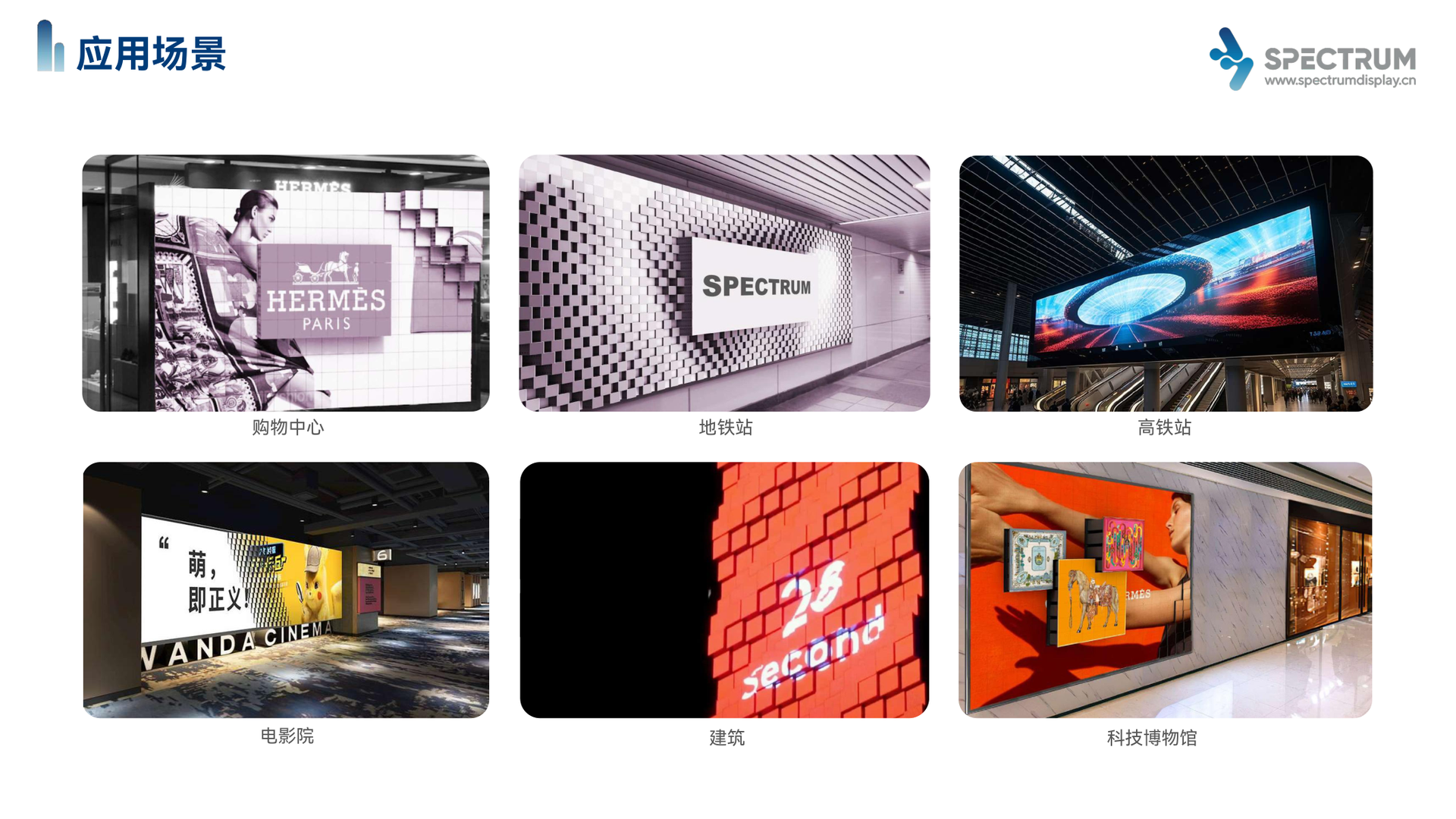
High-end retail stores, brand showrooms, and shopping mall atriums.
Outdoor architecture
Building facades, landmark projects, and outdoor advertising installations.
SpectrumDisplay has developed project experience across North America, Europe, the Middle East, and Southeast Asia.
Representative references include:
the outdoor landmark project at Mandarin Oriental Jakarta
the spherical LED art installation at Siam Paragon in Bangkok
becoming the official LED display supplier for the Canton Fair Complex from 2024 to 2029
These cases demonstrate not only product capability, but also engineering delivery capability.
Other Experience Indicators to Evaluate
Industry certifications
Has the supplier obtained certifications such as ISO9000, CE, and UL?
Customization capability
Can the supplier handle non-standard dimensions, irregular spaces, and special motion requirements?
Engineering team structure
Does the company have independent mechanical, electrical, and software engineering teams?
7. Conclusion: Five Factors, One Decision Checklist
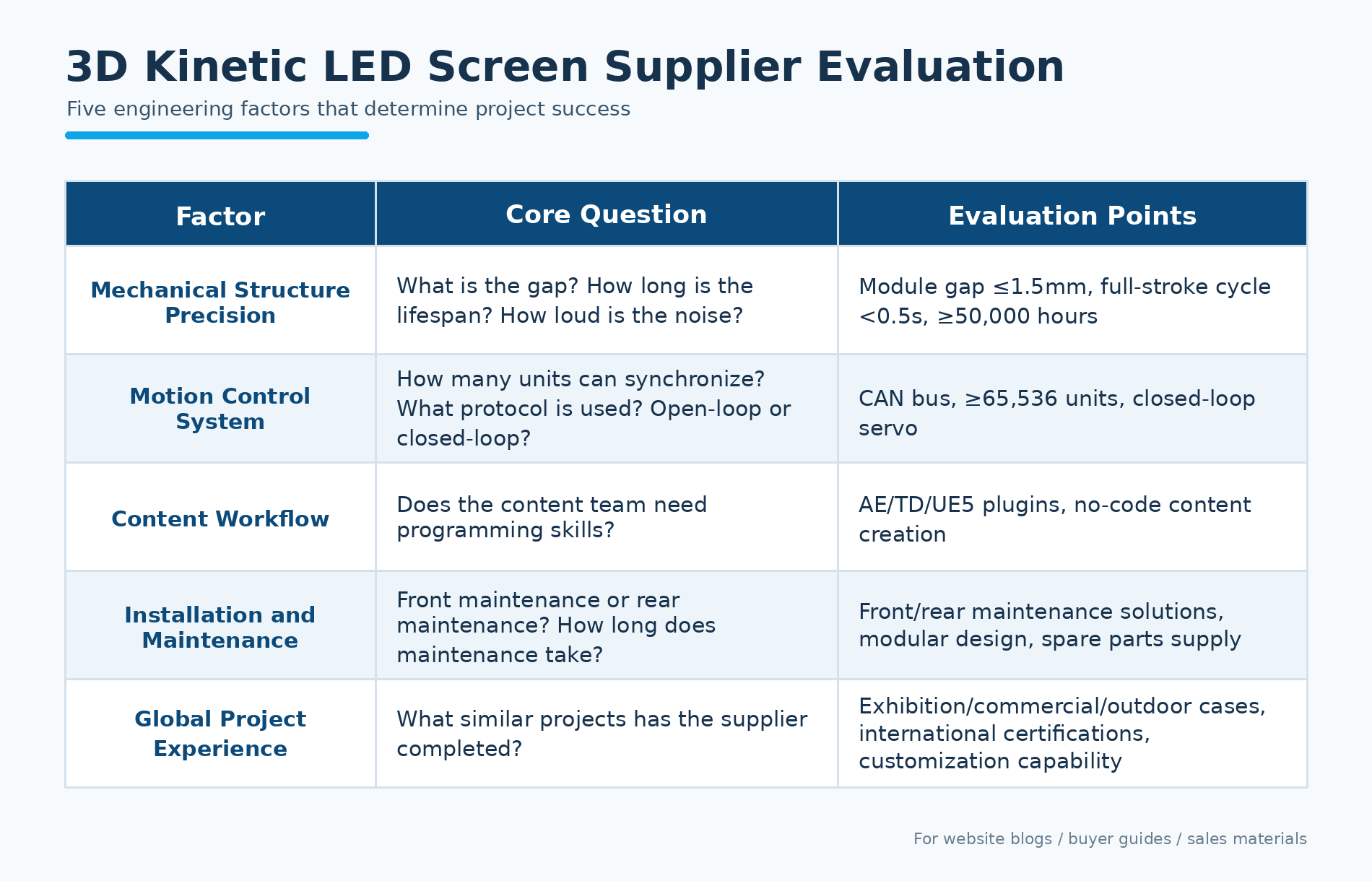
When evaluating a Kinetic LED Screen supplier, use these five factors as a checklist:
Three Final Recommendations for Buyers
1. Do Not Only Read Specification Sheets. Ask Engineering Questions.
Specifications can be polished.
Engineering questions reveal real capability.
2. Visit the Factory or Review Real Project Sites Whenever Possible.
Mechanical structure design and manufacturing quality are much easier to evaluate onsite.
3. Do Not Only Compare Price. Compare Total Cost of Ownership.
Installation, maintenance, spare parts, and downtime losses are hidden costs that may far exceed the initial purchase price.