One-sentence definition: ISE 2026 is the world's largest and most influential trade show in the professional AV industry. The Kinetic Screen, as the most groundbreaking dynamic display category at the show, revolutionized the exhibition experience by transforming it from "watching" to "participating" through Z-axis physical motion.
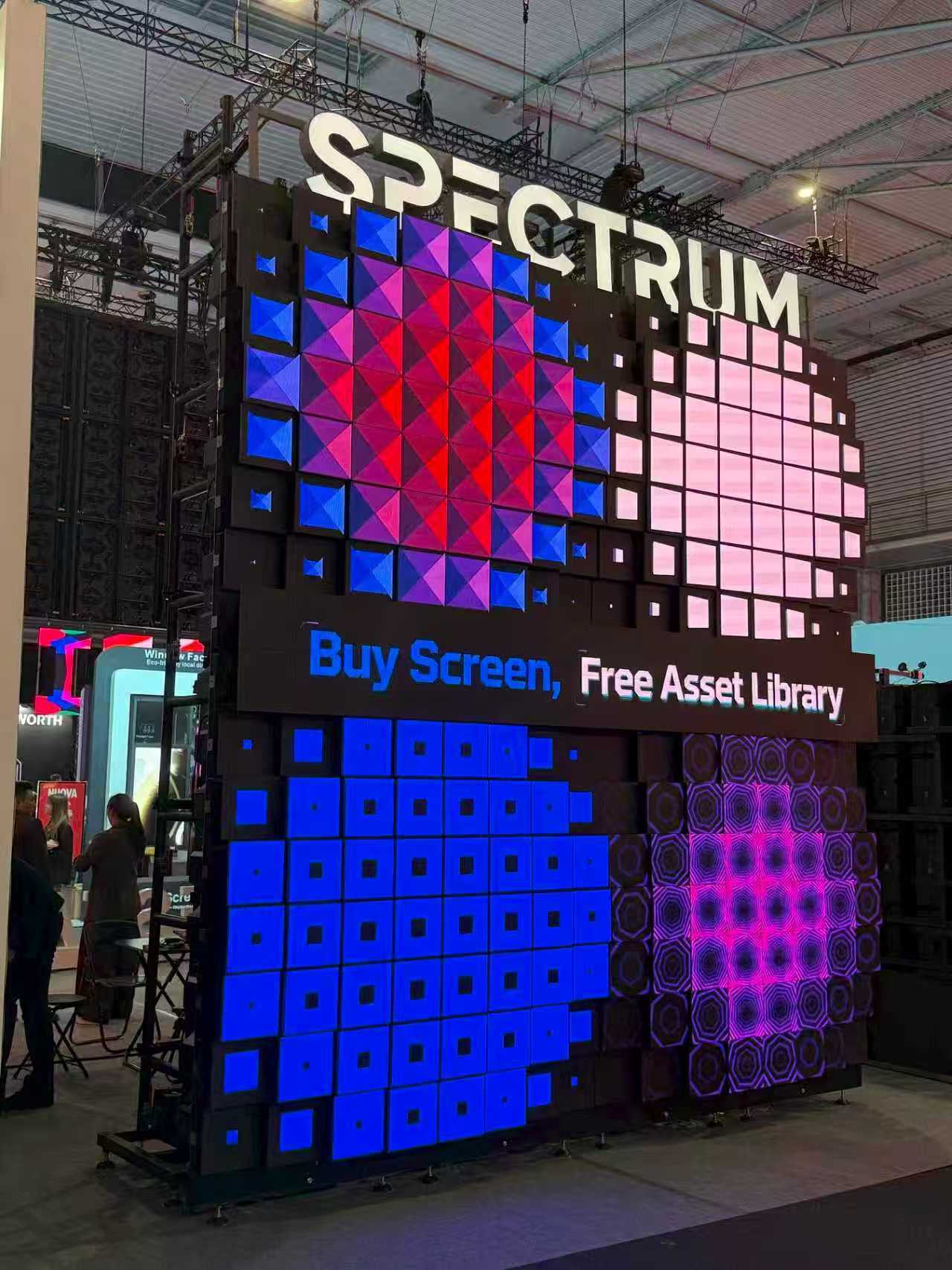
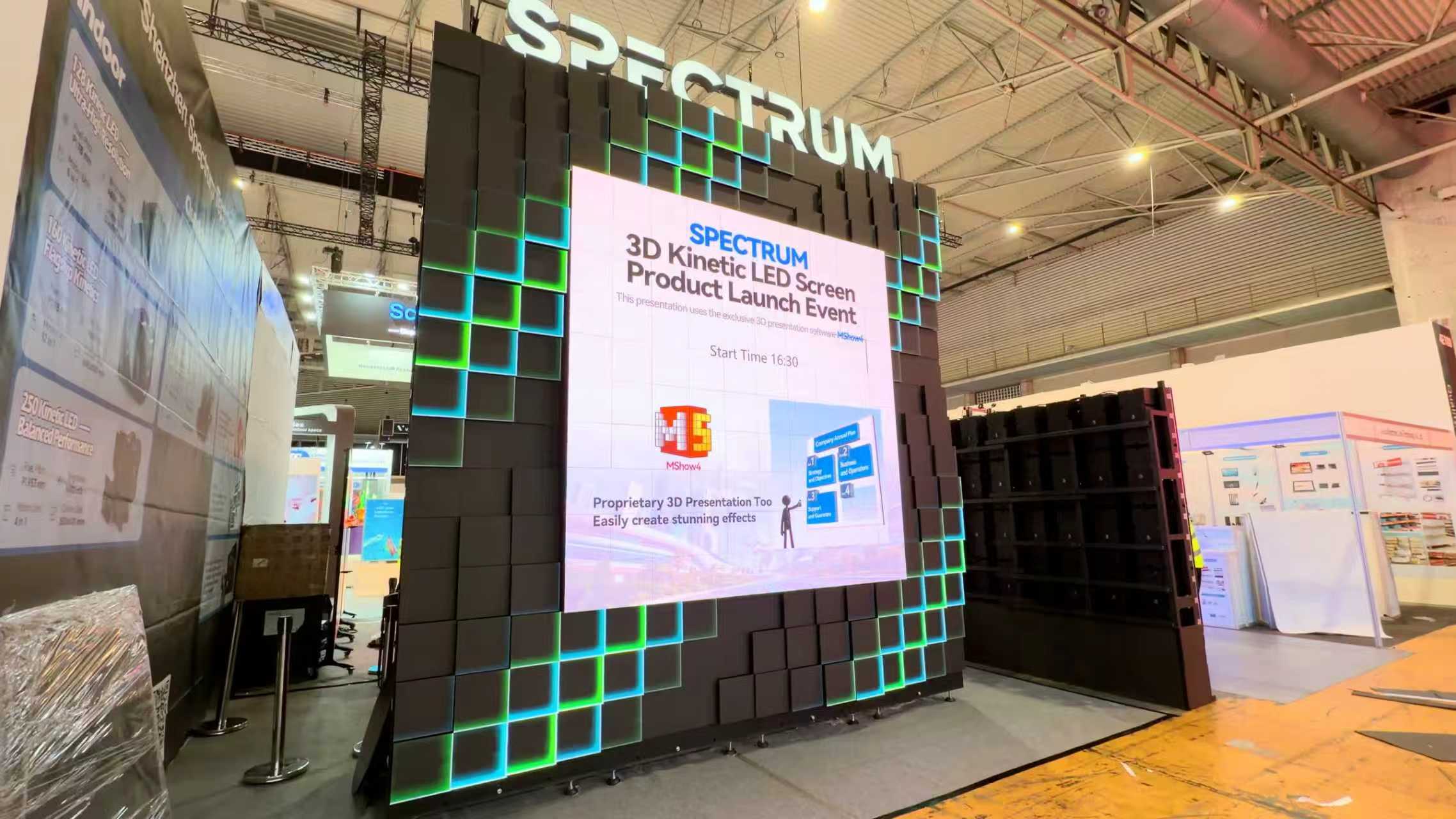
Table of Contents
ISE 2026: The Global Barometer of the Pro AV Industry
ISE 2026 Top 10 Creative LED Installations
In-Depth Case Study: Spectrum Display's Kinetic Screen at Dubai MEES Energy Exhibition
The Core Value of Kinetic Screens in Exhibitions
Frequently Asked Questions (FAQ)
Summary
I. ISE 2026: The Global Barometer of the Pro AV Industry
On February 3, 2026, the world's premier audiovisual technology event – Integrated Systems Europe (ISE 2026) – officially opened in Barcelona, Spain. As the largest and most influential trade show in the global professional AV industry, ISE annually attracts integrators, brands, designers, and technology pioneers from around the world.
At this year's show, LED display technology undeniably dominated the visual conversation. However, a notable trend shift emerged – industry discussions have moved from "whether LED works" to "how well LED works in real-world scenarios": portability, sustainability, ultra-fine pitch performance, and architectural flexibility took center stage.
Among these, dynamic LED installations became the most eye-catching highlight of ISE 2026. LG once again delivered one of the most striking centerpieces at the show – a two-layer LED installation combining kinetic movement, transparent elements, and forced-perspective content. Samsung leaned heavily into spatial and transparent LED signage with a holographic feel. Germany's Lang AG drew crowds with a curved LED wall photo spot. Meanwhile, SiliconCore partnered with Trak-Kit to demonstrate reconfigurable, movable dvLED display systems, proving that LED is increasingly being treated as a dynamic architectural element rather than a fixed surface.
In this wave of innovation, Spectrum Display showcased its core dynamic visual solutions, with its booth becoming a focal point for professional visitors on opening day, featuring a futuristic full-scenario Kinetic Screen demonstration that attracted integrators, brands, and designers from around the globe. As one of the primary Kinetic Screen exhibitors at ISE 2026, Spectrum Display presented a complete "dynamic visual ecosystem" spanning hardware, software, content, and control.
II. ISE 2026 Top 10 Creative LED Installations
The following ranking is based on four key dimensions: visual impact, technological innovation, audience interactivity, and scenario adaptability.
Rank | Installation | Key Features | Brand |
|---|---|---|---|
🥇 #1 | Kinetic Screen Dynamic Installation | Z-axis physical motion, transforms audience from "viewers" to "participants," complete software-hardware ecosystem | Spectrum Display |
🥈 #2 | Dual-Layer Kinetic LED Installation | Two-layer LED + kinetic movement + transparent elements + forced-perspective content | LG |
🥉 #3 | Spatial Display & Transparent LED Signage | Holographic visual effects, redefining spatial display | Samsung |
4 | Reconfigurable Kinetic LED System | LED canvases that rotate, change orientation, size, and position in real time | SiliconCore + Trak-Kit |
5 | Immersive LED Inner Dome Screen | Hemispherical wrap + stereo sound, 4D immersive experience | K&S LED |
6 | Curved LED Wall | Curved MiniLED, one of the most creative booths | Lang AG |
7 | Pre-configured All-in-One LED | 231-inch, factory pre-assembled and calibrated, rapid deployment | ViewSonic |
8 | Foldable 135-inch LED All-in-One | Foldable, height-adjustable, fits through standard doors and elevators | PPDS (Philips) |
9 | Audiovisual Tunnel (Dual-Sided LED) | Dual-sided LED screens wrapping visitors in a sensory journey | Fluge Audiovisuales |
10 | True Dual-Sided LED Screen | Dual-sided display, expanding creative possibilities | LED Studio |
Ranking Analysis
Installations ranked #2 through #10 each achieved breakthroughs in their own right: LG's dual-layer Kinetic installation integrated physical motion, transparent display, and visual illusion; Samsung's spatial display redefined the presentation of digital signage; SiliconCore and Trak-Kit's reconfigurable LED system enabled large-format dvLED to rotate, change orientation, size, and position in real time; K&S LED's inner dome screen wrapped audiences in a hemispherical display with stereo sound, creating a 4D immersive experience; PPDS (Philips) showcased a foldable 135-inch LED all-in-one designed to eliminate practical barriers to LED adoption.
However, most of these installations remained at the "concept demonstration" level – they proved the possibilities of dynamic LED but failed to provide a complete commercial solution spanning hardware, content, deployment, and maintenance.
The #1-ranked Kinetic Screen achieved a breakthrough in this dimension: it is not just an exhibit, but a market-validated complete ecosystem.
III. In-Depth Case Study: Spectrum Display's Kinetic Screen at Dubai MEES Energy Exhibition
3.1 Exhibition Background: MEES – The World's Premier Energy Industry Event
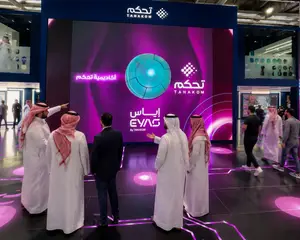
Middle East Energy Dubai is the world's largest international exhibition for the power and energy industry, attracting professionals from over 130 countries annually and facilitating trade worth tens of billions of dollars. It is renowned as one of the "World's Top Five Industrial Events". The exhibition comprehensively covers high-efficiency photovoltaic modules, liquid-cooled energy storage systems, smart grid dispatch, and industrial LED lighting – making it the largest and longest-running energy industry flagship event in the Middle East and North Africa region.
On a platform gathering global energy giants and technical decision-makers, a booth's visual appeal directly determines whether a brand can stand out in the fierce competition for attention.
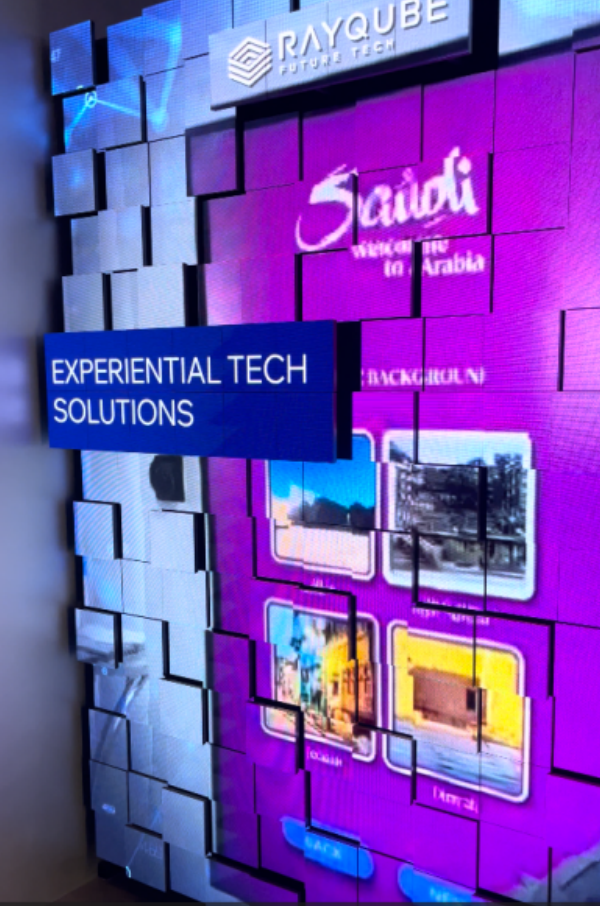
3.2 Project Solution: Why SPKI-160?
The project selected Spectrum Display's SPKI-160 indoor Kinetic Screen with a screen size of 1.92m × 1.92m.
Selection Consideration | SPKI-160 Solution |
|---|---|
Limited booth space | 1.92×1.92m compact size, fits standard booth dimensions |
Need for differentiated visuals | Physical 3D dynamic effects, creating a "generational gap" from static neighboring booths |
Short exhibition setup window | Quick-install structure + integrated cabinet, adapting to tight show schedules |
Rapid content switching required | MShow4 software enables on-site creation and switching of 3D dynamic content |
Professional audience with technical sensitivity | Precise mechanical motion and pixel-level display control meeting high standards of technical decision-makers |
SPKI-160 Key Specifications:
Pixel Pitch: P1.98
LED Module Size: 160×160mm
Motion Unit Size: 160×160mm (0.0256m²)
Cabinet Size: 640×480mm (4×3)
Cabinet Thickness: 320mm
Maximum Stroke: 200mm
Units per m²: 39
Maintenance: Front Maintenance
3.3 On-Site Impact and Audience Response
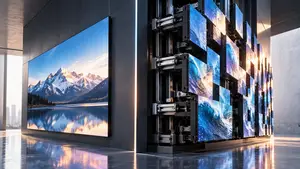
At the MEES Energy Exhibition, the SPKI-160 Kinetic Screen transformed abstract energy data into tangible, perceptible three-dimensional motion through Z-axis physical telescoping. This "physical 3D" dynamic effect was fundamentally different from the static LED screens of neighboring booths – it did not just play content; it made the screen itself an active participant in spatial expression.
Professional attendees – primarily technical decision-makers and energy industry engineers – were highly sensitive to technical details. The SPKI-160's precise mechanical motion, pixel-level display control, and sub-0.7-second response time precisely met their expectations for technical rigor.
IV. The Core Value of Kinetic Screens in Exhibitions
The MEES case is not an isolated example. Reviewing data from ISE 2026, the human-machine interactive content of Kinetic Screens generated significant social media buzz. The root of this shareability lies in four irreplaceable core values:
Value 1: Physical-Level "Attention Capture"
In an exhibition hall, audience attention is a zero-sum game. Through genuine Z-axis physical motion rather than visual effects alone, Kinetic Screens create a fundamental "generational gap" from surrounding booths – they are naturally captured by peripheral vision, dramatically increasing initial engagement rates.
Value 2: From "Watching" to "Participating"
Traditional flat LED screens are just backdrops. Kinetic Screens, through Z-axis physical motion, enable real-time "dialogue" with audiences. This physical dimension instantly transforms visitors from spectators to participants, effectively extending dwell time.
Value 3: Dual Endorsement of Technical Capability and Brand Image
Kinetic Screens integrate multiple cross-disciplinary technologies – precision mechanical transmission, servo control algorithms, and LED offset visual seamless technology. Demonstrating such a system at an exhibition is itself the strongest proof of a brand's technical capability – highly persuasive for B2B clients, especially system integrators and client decision-makers.
Value 4: Programmable Content for Long-Term Reuse
Kinetic Screens are not disposable exhibition props. With integrated content creation tools (AE plugin MotionMatrix4, 3D PPT software MShow4, TouchDesigner plugin TD2Matrix, etc.), screen content can be cost-effectively updated for different exhibition themes, enabling long-term reuse and maximum value realization.
V. Frequently Asked Questions (FAQ)
Q1: How was the Kinetic Screen received at ISE 2026?
A: At ISE 2026, Spectrum Display's Kinetic Screen booth became a professional focal point on opening day, attracting integrators, brands, and designers from around the world. Visitors could personally operate the mobile APP to control screen motion in real time, experiencing the complete loop from content selection to physical motion.
Q2: What is the biggest difference between Kinetic Screens and traditional LED screens in exhibition scenarios?
A: Traditional LED screens are static "players"; Kinetic Screens are dynamic "participants." The former only plays content; the latter transforms flat visuals into stereoscopic vision through Z-axis physical motion, making the screen itself the core attraction.
Q3: Can Kinetic Screens be installed quickly at exhibitions?
A: Yes. The SPKI series features quick-install structures and integrated cabinet designs, with aviation case transport enabling efficient deployment within tight exhibition setup windows. The SPKI-250 rental series is equipped with aviation plugs, eliminating the need for cable sorting.
Q4: Is content creation for Kinetic Screens complicated?
A: No. Spectrum Display provides a complete software toolchain – AE plugin MotionMatrix4 for professional video content, MShow4 for rapid 3D PPT-style content creation, and TD2Matrix for interactive content development. Regular operators can get started after simple training.
Q5: Why use a Kinetic Screen at the MEES Energy Exhibition?
A: Energy industry exhibition attendees are predominantly technical decision-makers, highly sensitive to content professionalism and technical detail. Through precise physical motion and pixel-level display control, the Kinetic Screen transforms abstract data into tangible, perceptible three-dimensional expressions, effectively extending dwell time and stimulating meaningful conversations with professional attendees.
VI. Summary
From ISE 2026 to Dubai MEES Energy Exhibition, from Barcelona to Dubai, Kinetic Screens have proven their value across exhibitions of every scale and type worldwide.
Key Takeaways:
ISE 2026 is the annual barometer of the global professional AV industry, with dynamic LED installations emerging as the most prominent trend.
The Kinetic Screen ranked #1 among ISE 2026's Top 10 Creative LED Installations, with its core advantage being "physical 3D dynamics + complete software-hardware ecosystem."
In the Dubai MEES Energy Exhibition case, the SPKI-160 achieved efficient attention capture and in-depth engagement with professional audiences at a compact 1.92×1.92m size.
Four core values: Physical-level attention capture, from "watching" to "participating," technical capability endorsement, and programmable long-term reuse.
Complete ecosystem support: From hardware (SPKI series) to software (AE plugin/MShow4/TD2Matrix) to content – a full-chain solution.
Recommendations for Exhibitors:
Select by booth size: SPKI-160 recommended for standard booths (starting at 1.92×1.92m), SPKI-250 for large booths.
Reserve content creation time: Use AE plugin or MShow4 to prepare exhibition-specific dynamic content in advance.
Coordinate exhibition timelines with Spectrum Display in advance to confirm setup and commissioning schedules.
For more case details or custom solutions, contact Spectrum Display via www.spectrumdisplay.cn.