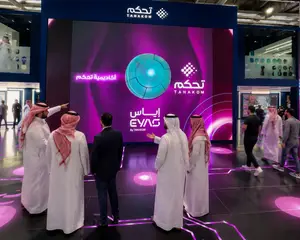
One-Sentence Definition
A Foldable Mechanical LED System is a customized visual engineering solution that deeply integrates ultra-high-definition LED display technology, precision folding mechanical structures, and intelligent motion control.
It transforms the screen from a fixed “canvas” into a dynamic spatial element — one that can open, disappear, and interact with architecture.
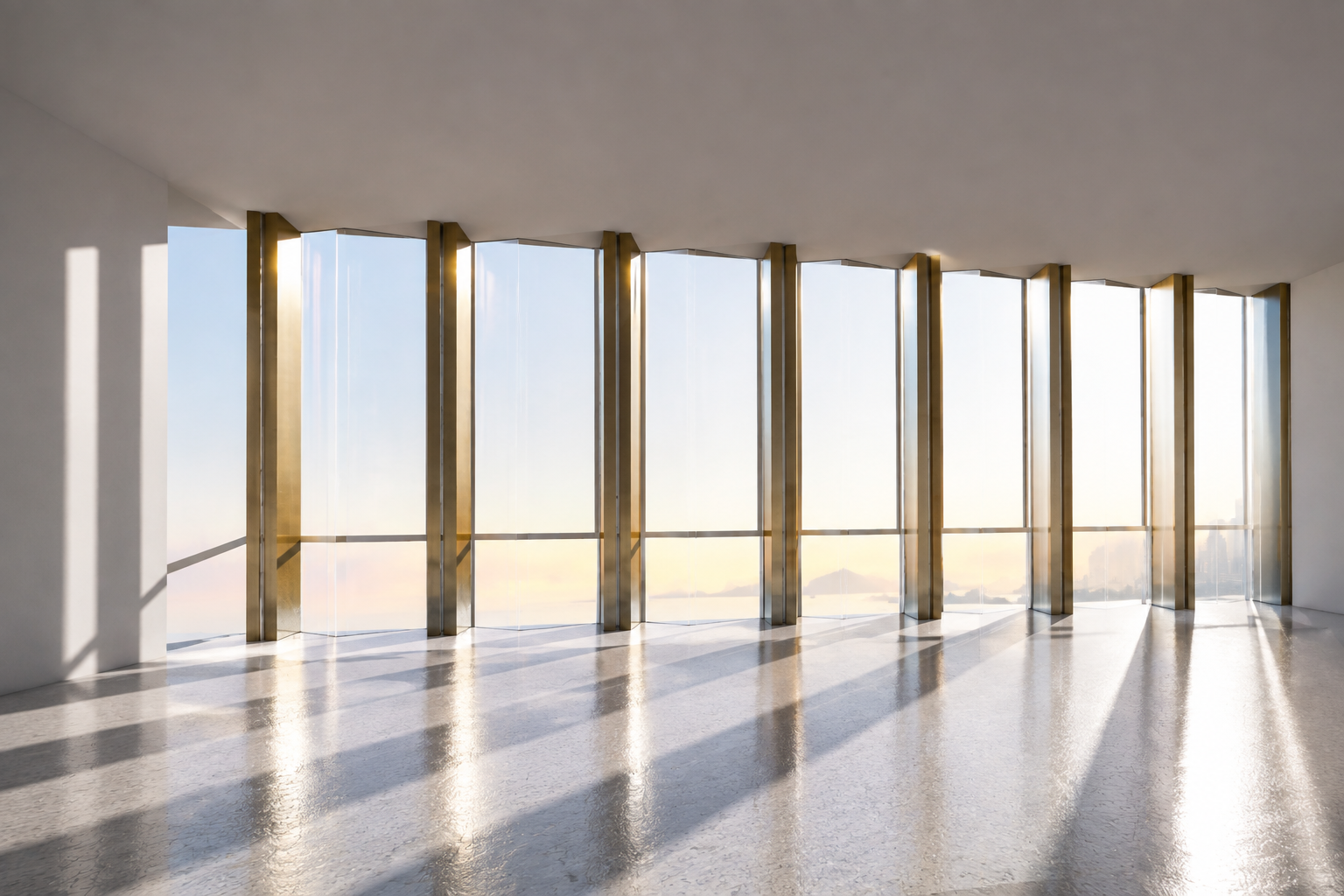
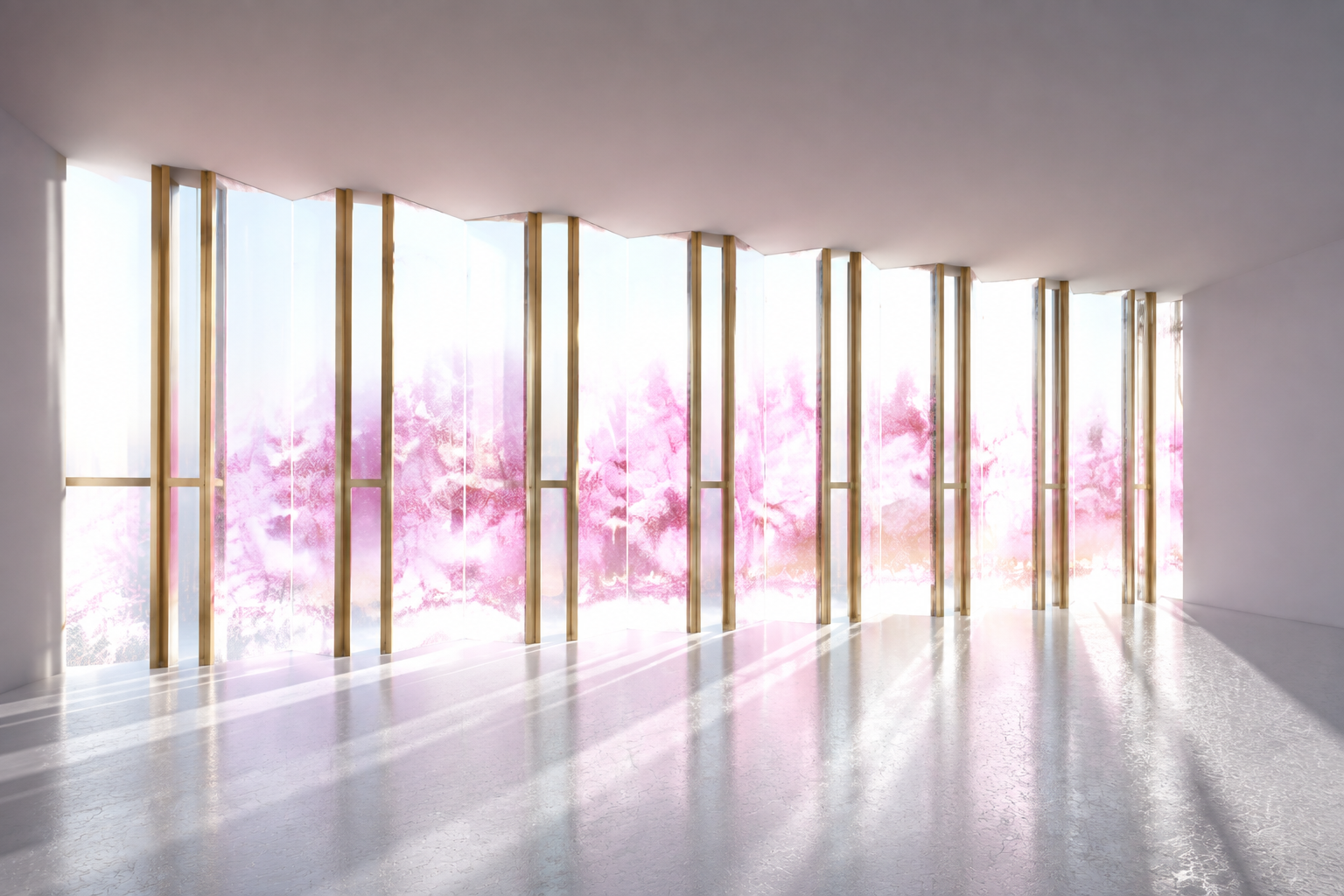
Contents
The Challenge of Space: When a Wall Becomes the “Enemy” of Architecture
The Breakthrough: When Screens Learn to Fold
Project Case: The Birth of a 13.5-Meter Visual Wall
Technical Highlights: The Invisible Engineering Behind the System
Commercial Value: Who Needs a Foldable Screen?
FAQ
Conclusion
01 The Challenge of Space: When a Wall Becomes the “Enemy” of Architecture
In premium commercial spaces and exhibition design, there is a contradiction that is difficult to solve:
Clients want a large display that can create a powerful visual impact.
But at the same time, they want the space to remain:
open,
transparent,
flexible,
and visually uninterrupted when the display is not needed.
This is not simply an aesthetic challenge.
It is an engineering challenge.
Traditional LED display installation follows one basic logic:
Occupation.
The screen occupies:
wall space,
visual space,
architectural presence.
Once installed, it permanently becomes part of the environment.
A banquet hall loses the possibility of having a complete wall.
A showroom loses the ability to transform between different spatial experiences.
A building loses its flexibility.
The challenge becomes even greater in non-standard architectural spaces.
Imagine a 13.5-meter-wide glass facade in an architectural design.
A standard LED cabinet cannot directly fit such an environment.
Traditional solutions usually require:
additional steel structures in front of the glass,
compromises in architectural aesthetics,
or abandoning the creative concept entirely.
This is exactly the question that a Customized Foldable Mechanical LED System aims to answer:
When a wall becomes the “enemy” of space, how can it become an “ally” of architecture?
02 The Breakthrough: When Screens Learn to Fold
The core innovation of a Foldable Mechanical LED System is that it breaks a decades-old assumption:
Screen = Fixed Flat Surface
From Occupying Space to Releasing Space
Traditional displays occupy space permanently.
A Foldable Mechanical LED System introduces a different approach:
The screen appears when needed.
The screen disappears when not needed.
This allows the same space to switch freely between:
visual presentation mode,
transparent architectural mode.
The space gains a level of flexibility that traditional displays cannot provide.
From Playback Device to Visual Expression
Traditional screens are excellent at one thing:
Playing content.
A Foldable Mechanical LED System creates something more:
Expression.
Through opening and closing movements, the system communicates:
ceremony,
surprise,
anticipation,
creativity.
A screen that can fold becomes part of the content itself.
From Industrial Product to Architectural Element
This is not simply a screen installed inside a building.
It becomes part of the architecture.
When closed:
it aligns with the wall,
preserves the view,
maintains architectural harmony.
When opened:
it becomes a seamless large-format visual surface,
illuminating millions of pixels instantly.
The screen is no longer an architectural “patch”.
It becomes part of the building’s “skin”.
03 Project Case: The Birth of a 13.5-Meter Visual Wall
The Starting Point: An “Impossible” Requirement
This project did not begin with a standard specification sheet.
It began with a challenge that many LED suppliers would consider extremely difficult:
“We need a 13.5-meter-wide and 3.12-meter-high display. When opened, it should become a seamless large-format screen. When closed, it should look like a normal window, aligned with the surrounding architecture without blocking the outdoor view.”
The architectural challenges were obvious:
non-standard dimensions,
precise alignment with existing glass structures,
no visible “screen feeling” when closed.
No standard LED cabinet could directly satisfy these requirements.
Traditional installation methods could not solve the problem.
This was a project where customization had to start from zero.
SpectrumDisplay, as a manufacturer specializing in mechanical LED display systems, combines:
mechanical engineering,
intelligent control,
visual design,
to create customized visual engineering solutions for complex architectural environments.
Its capability is not simply manufacturing screens.
It provides complete engineering services from:
requirement analysis,
system design,
product development,
manufacturing,
technical support.
Customized Solution: Designing the Screen Around the Architecture
Customized Mechanical Structure
Facing a non-standard architectural environment, SpectrumDisplay’s engineering team did not modify the building to fit the screen.
Instead:
The screen was redesigned around the building.
Starting from architectural drawings, the team developed a customized mechanical structure.
Customized LED Modules
Each 900mm-wide folding panel uses customized:
180 × 240mm LED modules
P2 pixel pitch
This means:
Every pixel.
Every connection point.
Every structural detail.
Exists specifically for this wall, this space, and this creative concept.
The total resolution reaches:
6750 × 1560 pixels
with approximately:
10.53 million pixels.
Every pixel is positioned exactly where it needs to be.
This is the fundamental difference between standardization and customization:
Standardization asks:
“What product can fit?”
Customization asks:
“What solution needs to be created?”
Precision Motion Design: A 5-Second Transformation
Making a screen display content is one challenge.
Making a screen move correctly is another.
The two folding sections need to transform from closed to fully open within approximately:
5 seconds.
This is not an arbitrary number.
Too slow:
The visual impact disappears.
Too fast:
The sense of ceremony disappears.
The movement process is carefully engineered:
smooth startup,
controlled acceleration,
soft stopping.
Every opening and closing movement needs to be:
stable,
quiet,
safe.
Project Results: Engineering Precision Behind the Numbers
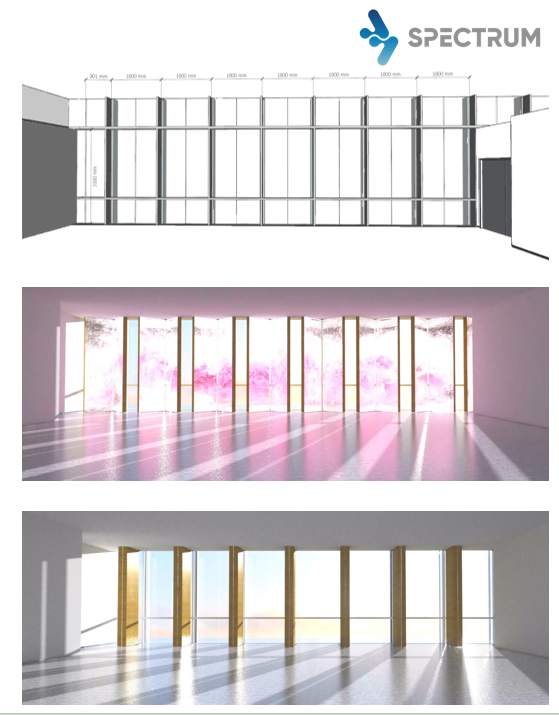
Key project specifications:
Display size: 13.5m × 3.12m
Pixel pitch: P2
Total resolution: 6750 × 1560 pixels
Pixel count: 10.53 million pixels
Opening/closing transformation: 5 seconds
Closing accuracy: approximately 1mm
Transmission precision: ≤8 arcmin
Safety protection:
infrared light curtain sensing
motion resistance feedback
emergency stop system
04 Technical Highlights: The Invisible Engineering Behind the System
Highlight 1: Customized Mechanical Structure — Making the Screen Part of Architecture
Unlike standardized products, SpectrumDisplay designs mechanical structures from the beginning for each project.
For this project:
Each 900mm-wide folding panel underwent independent mechanical analysis and motion simulation.
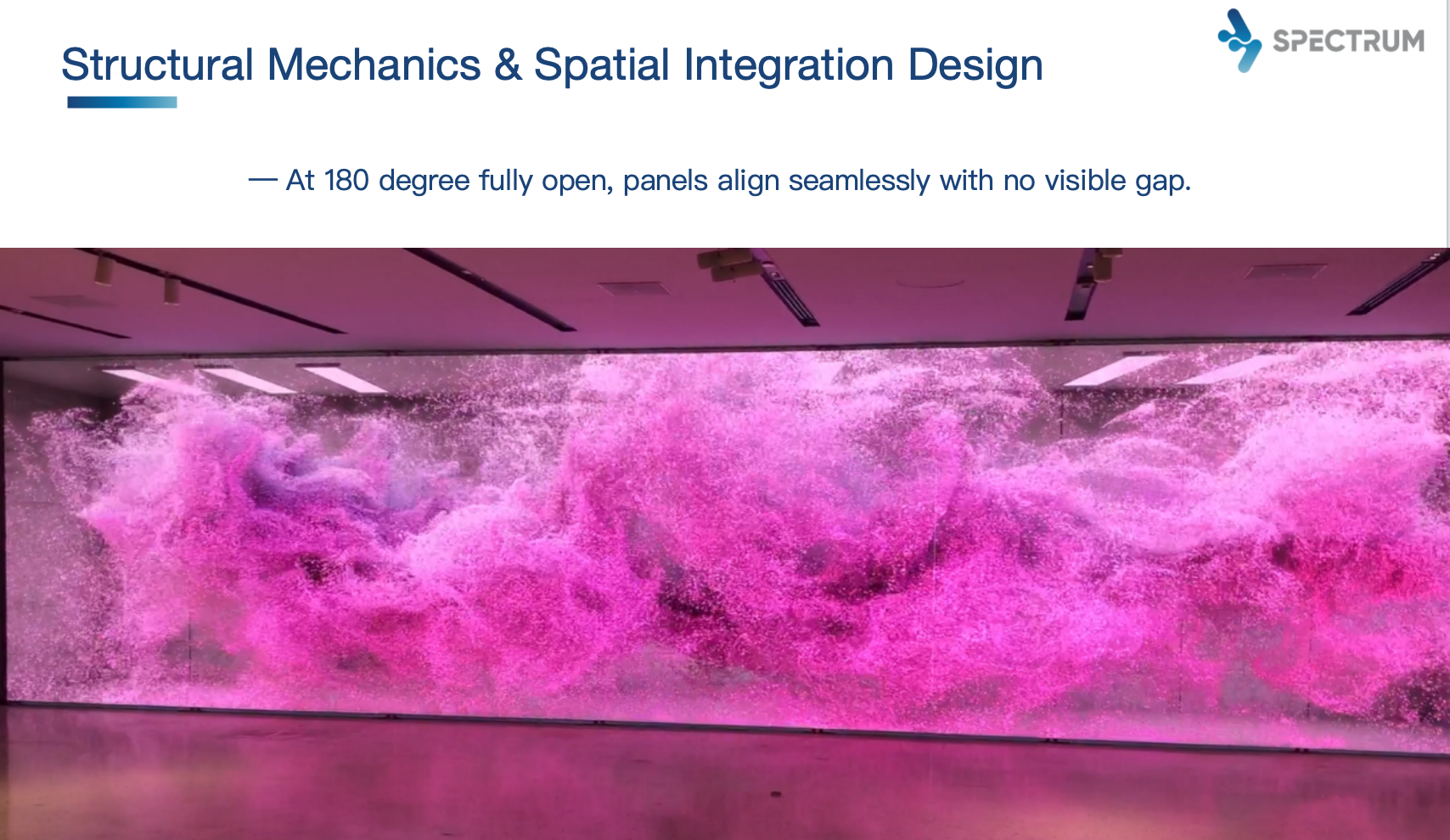
When fully opened at 180 degrees:
panels align seamlessly,
no visible gaps appear.
When closed:
the screen aligns with the glass facade,
outdoor views remain unobstructed.
This is not a screen installed onto architecture.
It is a system designed with architecture.
Highlight 2: Precision Motion Control — 5 Seconds, 1mm, ≤8 Arcmin
Behind:
5-second transformation,
1mm closing accuracy,
≤8 arcmin transmission precision,
is a complete precision motion control system.
A multi-axis motion controller creates a flexible distributed control architecture.
The system can be programmed according to project requirements.
PROFIBUS-DP fieldbus communication ensures real-time response and millisecond-level synchronization between both screen sections.
More importantly, the movement experience itself is carefully designed:
smooth startup,
uniform acceleration,
soft stopping.
The goal is not simply making the system move.
The goal is making every movement feel natural.
Highlight 3: Infrared Safety Protection — When People Approach, The Machine Responds
The challenge of mechanical LED systems is not only:
“How to make machines move?”
It is:
“How to make machines know when to stop?”
SpectrumDisplay integrates multiple safety systems:
Infrared Light Curtain Sensor
Installed approximately one meter in front of the display, creating an invisible safety protection zone.
Motion Resistance Feedback
When abnormal resistance is detected, the system responds immediately.
Emergency Stop System
Operators can stop all movement instantly in emergency situations.
Adjustable torque control ensures rapid braking when people or objects enter the movement area.
The most impressive visual experience should never compromise safety.
Highlight 4: Architectural Integration — Making Technology Disappear
The greatest challenge is often not making technology visible.
It is making technology disappear.
When closed, the 13.5-meter-wide display needs to integrate naturally with the architecture.
The black surface combined with wood-texture finishing creates harmony with the exhibition environment.
It should not look like:
a screen.
It should look like:
a wall.
a window.
a part of the building.
This is not only an aesthetic requirement.
It is an engineering challenge.
Material selection.
Surface treatment.
Closing alignment.
Every detail must be considered during mechanical design.
The screen is no longer an architectural “patch”.
It becomes part of the architecture itself.
05 Commercial Value: Who Needs a Foldable Screen?
Foldable Mechanical LED Systems create the greatest value in scenarios where space transformation and visual impact are equally important.
Brand Launch Events
A launch event does not need only a screen that plays videos.
It needs a stage where important moments can be remembered.
The opening and closing movement itself becomes a visual ceremony.
The screen opens.
The product appears.
The moment is revealed.
Premium Showrooms
The core purpose of a showroom is helping visitors remember a brand.
A screen that can disappear becomes a powerful memory point.
Visitors may not remember every video.
But they remember:
“The wall that disappeared.”
Commercial Spaces
In commercial environments, spatial flexibility directly influences customer engagement.
A Foldable Mechanical LED System allows one space to switch between:
presentation mode,
open architectural mode.
The space itself becomes part of the experience.
Immersive Experience Projects
The core of immersive experiences is making audiences forget the boundary between technology and environment.
Through:
opening,
closing,
folding,
transformation,
mechanical LED systems create spatial experiences impossible for traditional flat displays.
The screen is no longer the background.
It becomes part of the experience.
06 FAQ
Q1: What is the biggest difference between a Foldable Mechanical LED System and a traditional LED display?
Traditional LED displays are fixed.
Once installed, they permanently occupy space.
Foldable Mechanical LED Systems are transformable.
They can switch between open and closed states.
When open:
They become a large-format visual display.
When closed:
They integrate with the architecture.
Q2: How long does a customized mechanical LED project take?
The timeline depends on project complexity.
From:
requirement analysis,
structural design,
prototype validation,
manufacturing,
the process may take several weeks to several months.
Q3: How is safety guaranteed?
SpectrumDisplay integrates:
infrared light curtain sensing,
motion resistance feedback,
emergency stop systems.
When people or objects enter the movement area, the system can stop immediately.
Q4: How closely can the screen integrate with architecture?
Through customized:
surface materials,
structural design,
closing precision,
the system can blend into architectural environments.
The closed display can align with surrounding structures without blocking views.
Q5: Can the system integrate with existing building control systems?
Yes.
SpectrumDisplay solutions support professional control protocols including:
DMX512,
Art-Net,
sACN.
They can integrate with:
stage lighting systems,
intelligent building systems,
third-party control platforms.
Q6: What projects need Foldable Mechanical LED Systems?
They are ideal for projects requiring:
non-standard space adaptation,
special movement requirements,
architectural integration,
unique visual experiences.
07 Conclusion
The value of a Foldable Mechanical LED System is not only what it achieves.
It is what it makes possible.
Key Takeaways
1. The limitation of traditional LED displays
Fixed screens permanently occupy space and struggle to adapt to complex architectural environments.
2. The breakthrough of mechanical LED technology
Mechanical LED transforms the screen from a fixed surface into a spatial element that can:
open,
close,
disappear,
interact with architecture.
3. Project achievement
A customized folding display system:
13.5m × 3.12m
5-second transformation
1mm closing precision
10.53 million pixels
4. Four Engineering Highlights
Customized mechanical structure
Making the screen adapt to architecture.
Precision motion control
Achieving stable transformation and millimeter-level accuracy.
Infrared safety protection
Ensuring safe operation.
Architectural integration
Allowing technology to become part of the building.
Final Thought
SpectrumDisplay does not simply provide a screen.
It provides the engineering capability to transform complex spatial ideas into reality.
From concept development,
to system design,
to product manufacturing,
SpectrumDisplay delivers end-to-end customized mechanical LED solutions.
Because the future of LED is not only about displaying content.
It is about creating spaces that can transform, adapt, and inspire.