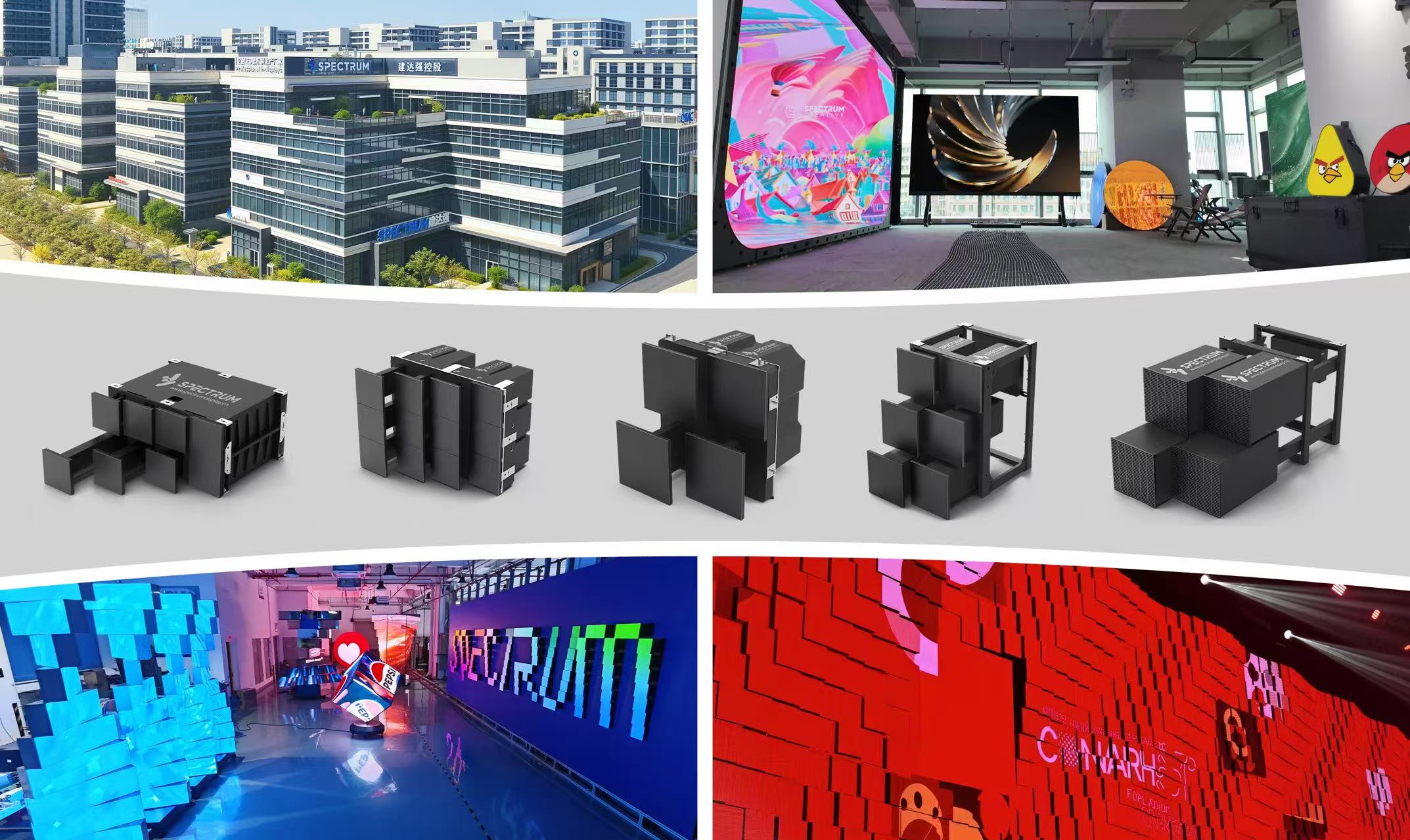
One-sentence definition: There are two golden rules for selecting a kinetic screen – first, look at "spatial depth," second, look at "maintenance method." The three flagship indoor models – SPKI-128, SPKI-160, and SPKI-250 – are the ultimate answers for three distinct scenarios: "ultimate precision," "ultra-thin spaces," and "rental-ready quick-install" respectively.
Table of Contents
Why 2026 Is the "Year of Selection" for Kinetic Screens
Kinetic Screen Brand and Technology Comparison
SPKI Series Three Models In-Depth Comparison
Three-Step Selection Method: From Scenario to Model
Frequently Asked Questions (FAQ)
Summary and Action Recommendations
I. Why 2026 Is the "Year of Selection" for Kinetic Screens
In 2026, the global LED display market is undergoing a profound transformation. Industry data shows that the global LED rental screen market reached approximately $1.3-1.4 billion in 2025, with a projected CAGR of 5.9% from 2026 to 2032. Meanwhile, the global LED modular display market is expected to reach $12.2 billion in 2026, growing at a CAGR of 16.2%. Across North America and globally, commercial spaces, exhibition halls, and stage performances are experiencing a massive leap from "flat displays" to "3D kinetic vision."
But opportunity comes with challenges. Because kinetic screens contain motors, rails, and telescopic modules, their thickness is far greater than conventional LED screens. How much space you have, how maintenance is handled, and how the budget is allocated – these engineering-level questions directly determine the success or failure of your selection.
It is against this backdrop that a clear selection guide has become an industry necessity. As a comprehensive service provider of dynamic display systems and spatial digital equipment, SPECTRUM DISPLAY's SPKI indoor series and SPKO outdoor series offer complete solutions for different scenarios.
II. Kinetic Screen Brand and Technology Comparison
Before diving into SPKI series selection, it is worth examining kinetic screens within the broader LED display industry landscape.
Industry Leading Brand Landscape
Among the top 10 LED display brands of 2026, Leyard, Unilumin, Absen, LianTronics, and Ledman occupy the top tier. Leyard is a benchmark enterprise in global small-pitch LED, with long-term market share leadership and deep technology reserves in Hi-Micro, COB, and MicroLED. Unilumin, Absen, and other leading companies are also technologically advanced in small-pitch, COB, outdoor displays, and stage rental.
However, kinetic screens, as an emerging sub-category, are fundamentally different from traditional LED displays. Traditional LED giants have deep accumulation in static display, but in the cross-disciplinary field of "display + mechanical motion," the technological barriers are entirely different – precision mechanical transmission, servo control algorithms, LED offset visual seamless technology, and automotive-grade CAN bus communication are not natural strengths of traditional LED display manufacturers.
Spectrum Display's Differentiated Positioning
As a leading Kinetic LED manufacturer and the officially authorized 2026 Canton Fair LED Supplier, SPECTRUM DISPLAY's core competitiveness lies in deep hardware-software integration. Its SPKI indoor series adopts a highly modular "digital building material" design concept, with ultra-precise cabinet splicing significantly lowering the technical requirements for on-site construction personnel.
Technology Comparison Dimensions:
Dimension | Traditional LED Leaders | Spectrum Display (Kinetic Screens) |
|---|---|---|
Core Domain | Static LED display | Display + Precision Mechanical Transmission |
Visual Seamless Tech | Relies on module splicing precision | LED Offset Technology, 0mm visual seam |
Motion Control | Not applicable | Self-developed servo system + FOC closed-loop control |
Communication Protocol | Standard video signals | Automotive-grade CAN Bus, 65,536-unit capacity |
Software Ecosystem | Third-party content creation | Self-developed AE plugin + Mshow4 + TD/UE5 plugins |
Maintenance | Mostly rear maintenance | Front maintenance / Rear maintenance options |
III. SPKI Series Three Models In-Depth Comparison
Spectrum Display's indoor kinetic screen lineup includes three models – SPKI-128, SPKI-160, and SPKI-250 – covering everything from luxury show windows to large-scale product launches.
Core Specification Comparison Table
Specification | SPKI-128 | SPKI-160 | SPKI-250 |
|---|---|---|---|
Positioning | Ultimate Precision | Balanced Performance | Rental-Ready |
LED Module Spec | Indoor-P1.78 | Indoor-P1.98 | P1.5625/P1.945/P2.604/P3.91 |
Module Size | 128×128mm | 160×160mm | 248.5×248.5mm |
Module Gap | 0.5mm (0.3~0.7) | 1.0mm (0.5~1.5) | 1.5mm (1.0~2.0) |
Visual Seam | 0mm (LED offset 0.25) | 0.8mm (LED offset 0.1) | 0.9mm (LED offset 0.3) |
Unit Resolution | 72×72 | 80×80 | 160×160/128×128/96×96/64×64 |
Cabinet Size | 514×257mm (4×2) | 640×480mm (4×3) | 500×500mm (2×2) |
Cabinet Depth | 380mm | 330mm | 330mm (+service aisle) |
Cabinet Weight | 20kg | 23.3kg | 13kg |
Units per m² | 60.6 | 38.6 | 16 |
Weight per m² | 152kg | 75kg | 48kg |
Max Stroke | 300mm | 200mm | 200mm |
Max Speed | 600mm/s | 600mm/s | 500mm/s |
Fastest Cycle | 0.5s | <0.7s | 0.5s |
Maintenance | Front | Front | Rear |
Anti-Pinch | 3kg | 3kg | 3kg |
SPKI-128 – Ultimate Precision, Best for Close-Range Viewing
SPKI-128 is the longest-lasting and highest-precision model in the series, featuring linear guide rail design. Through 0.25mm LED offset technology, physical gaps between modules are completely eliminated, achieving 0mm visual seam.
Key Strengths:
0mm visual seam: LED offset technology shifts edge LEDs outward by 0.25mm, delivering silk-smooth imagery
60.6 high-density units per m²: Ultimate delicate dynamic effects at close range
300mm max stroke: Longest stroke in the series for maximum dynamic impact
Front maintenance: No rear access required – flush wall mounting
Best for: Science museums, luxury brand stores, museums, premium exhibition halls where audiences view the screen up close and demand ultimate image quality.
Selection Signal: If you demand "zero visual seam" and "ultimate close-range image quality," SPKI-128 is the only choice.
SPKI-160 – Balanced Performance, the Only Solution for Space-Constrained Scenarios
SPKI-160 achieves the best balance between cost and performance. It features a 160×160mm golden-size module and a lightweight cabinet of just 23.3kg.
Key Strengths:
330mm ultra-thin chassis: Thinnest in the series – flush wall mounting like a standard display
Only 75kg per m²: Lowest structural load requirements
Front maintenance: No rear access required
Four installation methods: Ceiling, stacking, wall, upward – adapts to any spatial configuration
Best for: High-end shopping mall windows, corporate showrooms, column wraps, ceiling installations – any "space is premium" scenario.
Selection Signal: If your project has limited spatial depth (corridors, show windows, column wraps), SPKI-160 is the only viable solution.
SPKI-250 – Rental-Ready, the "Mega Impact" for Large-Scale Projects
SPKI-250 is designed specifically for exhibition rental and large-scale projects, featuring 248.5×248.5mm large-format units with just 16 units per m².
Key Strengths:
Four pixel pitch options: P1.5625/P1.945/P2.604/P3.91 for flexible deployment
Just 13kg per cabinet: Lightest in the series – single-person portable
Rear maintenance: Independent servicing during operation – ideal for high-frequency rental
Over 100m² in stock: P1.945 and P2.604 models ready for rapid response
Best for: Large-scale product launches, museum main screens, exhibition rentals, stage performances – any project requiring rapid setup and teardown.
Selection Signal: If your project requires frequent transport and reassembly or covers massive display areas, SPKI-250 is the optimal choice.
IV. Three-Step Selection Method: From Scenario to Model
Step 1: Look at "Spatial Depth"
Kinetic screens are far thicker than conventional LED displays – available space directly determines which model you can install.
Available Depth | Recommended Model | Explanation |
|---|---|---|
<350mm | SPKI-160 | Only option – 330mm ultra-thin chassis + front maintenance |
350-400mm | SPKI-160 / SPKI-128 | Both viable – decide based on image quality requirements |
>400mm | Full series available | Ample space – select by scenario |
Step 2: Look at "Maintenance Method"
Maintenance method determines installation position and long-term operational costs.
Maintenance | Available Models | Applicable Scenarios |
|---|---|---|
Front | SPKI-128 / SPKI-160 | Flush wall mounting, ceiling installation, no rear access |
Rear | SPKI-250 | Dedicated service aisle, large-scale projects, rental |
All SPKI indoor models come standard with 3kg anti-pinch fail-safe protection – when resistance exceeds 3kg, the motor instantly cuts power, pauses, and gently resets. Whichever model you choose, safety standards never compromise.
Step 3: Look at "Visual Requirements"
Visual Requirement | Recommended Model | Reason |
|---|---|---|
Ultimate seamless (0mm visual seam) | SPKI-128 | LED offset technology – silk-smooth imagery |
High-precision display | SPKI-128 / SPKI-160 | High-density units, delicate close-range presentation |
Large-scale long-distance | SPKI-250 | Large units deliver greater impact at distance |
V. Frequently Asked Questions (FAQ)
Q1: What are the core differences between SPKI-128, SPKI-160, and SPKI-250?
A: SPKI-128 focuses on ultimate precision (0mm visual seam, 60.6 units/m²) – best for close-range high-image-quality scenarios. SPKI-160 focuses on ultimate thinness (330mm chassis, 75kg/m²) – the only solution for space-constrained scenarios. SPKI-250 focuses on rental-ready quick-install(13kg lightweight, rear maintenance) – best for large-scale projects and frequent transport.
Q2: Can I install a kinetic screen with only 350mm of spatial depth?
A: Yes. SPKI-160 has a chassis depth of just 330mm with a finished surface ≤350mm – the only solution for space-constrained scenarios. With front maintenance, no rear service aisle is required.
Q3: What is the difference between front and rear maintenance?
A: Front maintenance means all servicing is done from the front of the screen – no rear access required, ideal for flush wall and ceiling mounting. Rear maintenance requires a service aisle behind the screen – ideal for large-scale projects and rental.
Q4: Do the gaps between modules affect the visual experience?
A: No. Spectrum Display's patented "LED Offset Technology" shifts edge LEDs outward – SPKI-128 achieves 0mm visual seam, SPKI-160 achieves 0.8mm, and SPKI-250 achieves 0.9mm. At normal viewing distances, the image is smooth without fragmentation.
Q5: Why does SPKI-250 offer four pixel pitch options?
A: SPKI-250 is positioned for rental and large-scale projects – different scenarios require different pixel densities. Choose P1.5625 for close-range high density, or P3.91 for cost-effective large-area coverage. P1.945 and P2.604 are kept in stock with over 100m² for rapid response.
Q6: Is the anti-pinch safety standard consistent across all three models?
A: Yes. All SPKI indoor models come standard with 3kg anti-pinch fail-safe protection – when resistance exceeds 3kg, the motor instantly cuts power. Whatever model you choose, safety standards never compromise.
VI. Summary and Action Recommendations
Key Takeaways:
Two golden rules for kinetic screen selection: First, look at spatial depth (determines which model fits), second, look at maintenance method (determines installation position and operational costs)
SPKI-128: 0mm visual seam, 60.6 units/m² high density, front maintenance – ultimate close-range image quality
SPKI-160: 330mm ultra-thin, 75kg/m² lightweight, front maintenance – only solution for space-constrained scenarios
SPKI-250: 13kg lightweight cabinet, four pixel pitch options, rear maintenance – first choice for rental and large-scale projects
Standard 3kg anti-pinch across all models: Unified safety standards – no compromise regardless of selection
Next Steps:
Measure spatial depth: Confirm available installation depth – <350mm means SPKI-160 is the only option
Confirm maintenance access: Can you reserve a rear service aisle? If not, choose front-maintenance models (SPKI-128/160)
Clarify visual requirements: Ultimate close-range quality → SPKI-128; large-scale long-distance → SPKI-250
For selection guidance or custom solutions, contact Spectrum Display via www.spectrumdisplay.cn