Jeddah KRT Project: How Spectrum Display Delivered a Complex LED Project with Building-Grade Engineering
One-sentence definition:
The Jeddah KRT project in Saudi Arabia is a complex LED engineering project delivered by Spectrum Display under extreme outdoor conditions and building-grade curtain-wall requirements. It demonstrates that even under the combined challenges of temperatures above 50°C, salt-spray corrosion, and the thermal expansion and contraction of glass curtain walls, a mechanical LED system can still operate with precision, stability, and safety.
Contents
- Jeddah’s Engineering Threshold: Why LED Projects Here Are Different
- Project Challenges: Extreme Heat, Salt Spray, and Building Structure
- Solution 1: Thermal Balance Engineering — From Heat Dissipation to Thermal Control
- Solution 2: Signal and Motion Control — Keeping Every Unit Precisely Synchronized
- Solution 3: Architectural Integration — The Screen Is Not Simply “Mounted on the Building”
- Project Significance: From Jeddah to the Global Market
- Frequently Asked Questions
- Conclusion
1. Jeddah’s Engineering Threshold: Why LED Projects Here Are Different
Jeddah sits on the coast of the Red Sea.
It is one of the Middle East’s most active commercial cities — and also one of the most demanding environments for outdoor LED systems.
Summer temperatures can exceed 50°C. The coastal atmosphere carries high concentrations of salt spray from the Red Sea. Annual rainfall may be relatively low, but when rain does arrive, it can be intense.
Under these conditions, almost any outdoor LED display faces a serious test of long-term reliability.
But Jeddah’s engineering challenges go far beyond climate.
The city has become an important market for architectural-scale LED media.
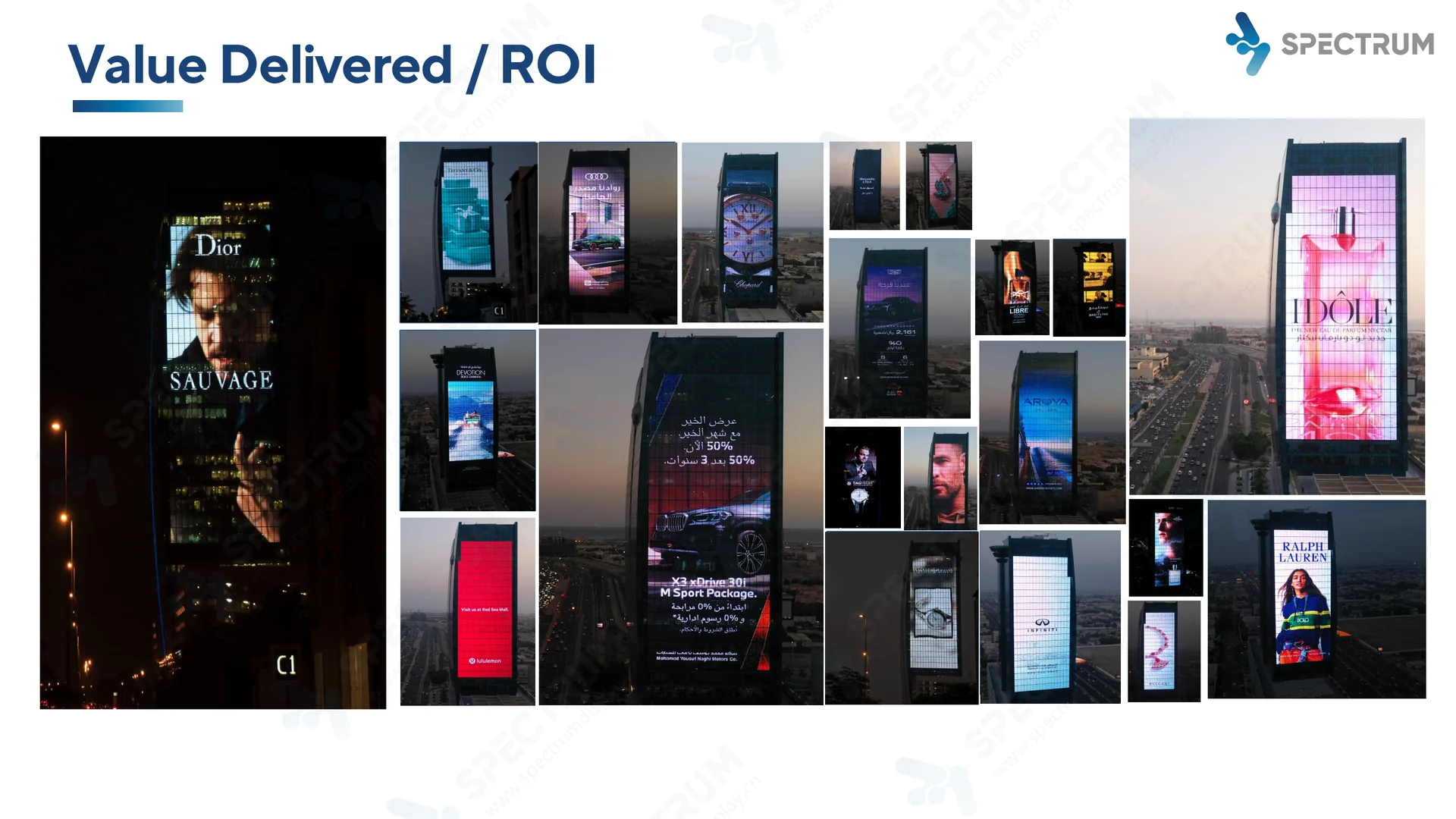
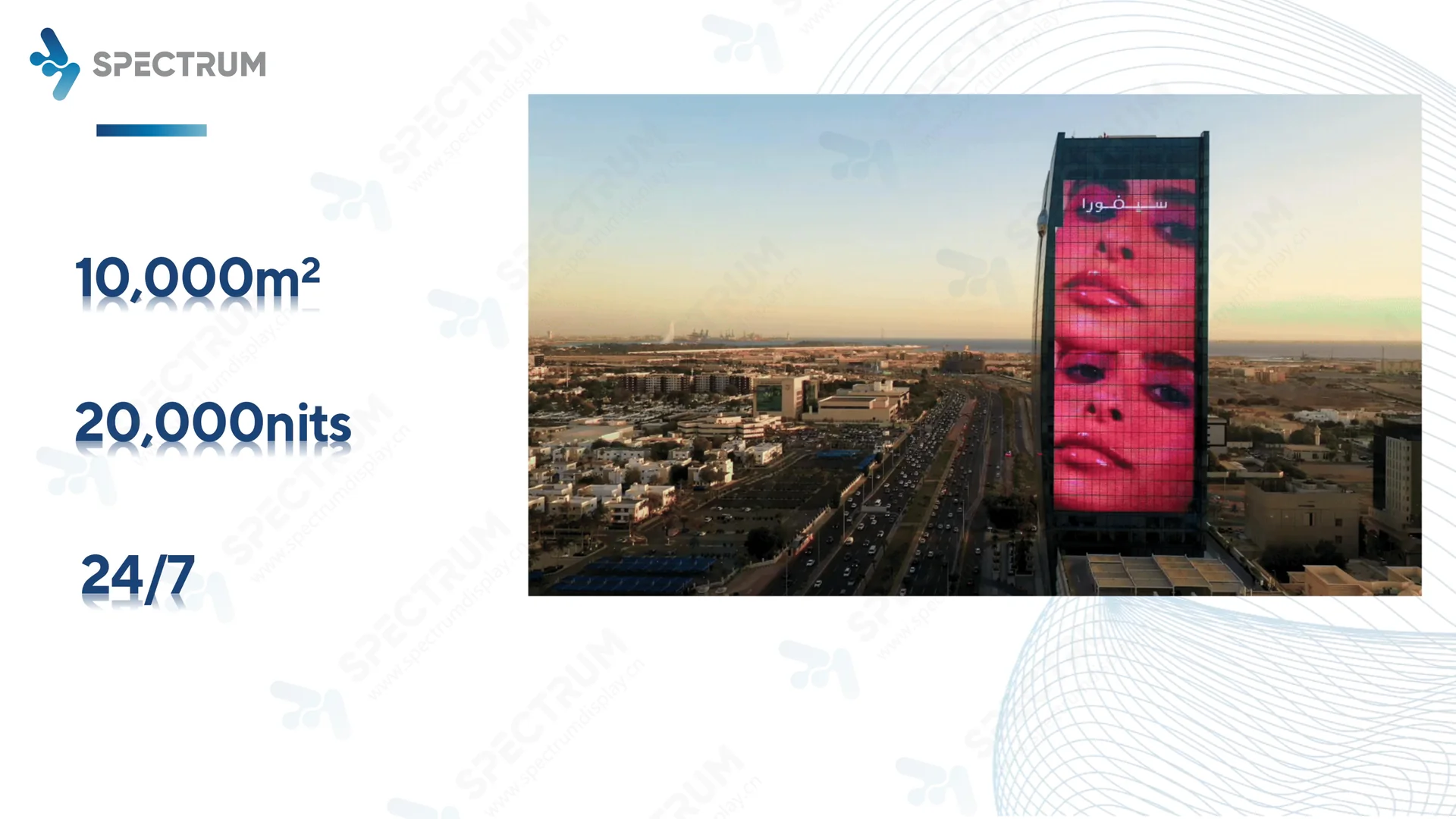
King’s Road Tower features one of the world’s largest advertising LED facades, covering its north, south, and west elevations with a total display area of more than 9,850 square meters and over five million LEDs.
Stars Avenue Mall features a curved glass-facade LED display approximately 77.6 meters wide and 12.6 meters high, covering nearly 1,000 square meters and supporting glasses-free 3D content.
Projects like these establish a clear benchmark:
In Jeddah, an LED display is not simply equipment attached to a building. It becomes part of the architecture itself.
It must integrate with the curtain-wall system.
It must accommodate thermal expansion and contraction.
It must remain stable under temperatures above 50°C.
And it must resist long-term exposure to a salt-laden coastal environment.
The KRT project was developed within exactly this engineering context.
The question was not simply whether an LED screen could be installed.
The real question was:
How can a mechanical LED system survive, move accurately, and remain reliable under building-grade engineering requirements?
2. Project Challenges: Extreme Heat, Salt Spray, and Building Structure
Challenge 1: Thermal Stress — When Ambient Temperature Approaches the System’s Limits
Outdoor temperatures in Jeddah can exceed 50°C.
For a mechanical LED system, this means the junction temperature of LED components may approach critical limits — often around 125°C.
Once excessive thermal stress occurs, packaging materials can deform, thermal expansion can increase, solder joints can fail, and circuits may eventually become damaged.
The result can be irreversible component failure.
A less visible problem is accelerated aging.
Heat is one of the major drivers of lumen depreciation — the irreversible loss of LED brightness.
Prolonged thermal stress can accelerate phosphor degradation and silicone yellowing, causing brightness and color consistency to deteriorate more quickly.
For mechanical LED systems, however, heat threatens far more than the LED modules.
Servo motors, drivers, control electronics, and sensors all have their own operating temperature limits.
Without effective thermal management, a system that once moved smoothly may begin to lose performance, become unstable, or eventually stop operating altogether.
Challenge 2: Salt-Spray Corrosion — The Invisible Threat on the Red Sea Coast
Jeddah’s coastal location means constant exposure to salt-laden air.
Salt-spray corrosion affects precision mechanical systems gradually and systematically.
It can attack the metal surfaces of linear guides, corrode motor housings, and oxidize solder joints on circuit boards.
For a conventional outdoor LED display, some of these risks can be addressed through appropriate IP protection.
For a mechanical LED system, the challenge is more complex.
The system needs to move.
Movement requires clearances.
And those clearances can create pathways for corrosive air, moisture, and particles.
Achieving effective environmental protection without restricting mechanical movement is therefore one of the fundamental engineering challenges of an outdoor kinetic LED system.
Challenge 3: Architectural Integration — Buildings “Breathe,” and the Screen Must Adapt
Many architectural LED projects in Jeddah are integrated with glass curtain walls.
One characteristic of curtain-wall systems is often underestimated:
they are constantly moving.
Thermal expansion and contraction cause facade materials to deform slightly as temperatures change between day and night.
Large buildings are designed with expansion joints to accommodate this natural movement.
If an LED system is rigidly attached without allowing for structural movement, those forces can be transferred directly into the display-support system.
At best, this can change module alignment and gaps.
At worst, it can cause structural damage.
Facade LED systems must also withstand significant wind loads.
As a coastal city, Jeddah experiences wind pressures that vary according to height, terrain, building geometry, and installation position.
A display installed high on a curtain wall therefore requires a structural solution specifically calculated for that environment.
A mounting method designed for a ground-level installation cannot simply be copied onto a high-rise facade.
▶Video · YouTubeOutdoor Kinetic Screen in Motion — built for heat, salt spray and constant exposureWatch on YouTube →
3. Solution 1: Thermal Balance Engineering — From Heat Dissipation to Thermal Control
To address Jeddah’s extreme temperatures, Spectrum Display’s engineering approach goes beyond simply adding more fans.
The goal is thermal balance.
Spectrum Display uses die-cast aluminum cabinets combined with thermally optimized structural and airflow design to create efficient heat-conduction paths and low-resistance airflow channels.
The objective is not simply to remove heat faster.
It is to keep critical components within a safe operating temperature range during sustained high-temperature operation.
Key components are selected to industrial-grade or automotive-grade standards, supporting a rated service life of more than 50,000 hours under appropriate operating conditions.
This thermal-management philosophy has already been applied in another demanding environment at the Mandarin Oriental Jakarta project.
The SPKO Series kinetic units use a semi-enclosed self-cooling architecture designed for challenging tropical conditions.
Even in an environment with humidity above 80% and annual rainfall exceeding 2,000mm, the core drive system was engineered for stable operation.
Jeddah presents an even more extreme thermal challenge.
But the engineering principle remains the same:
build thermal balance into the system from the beginning rather than trying to solve overheating after installation.
▶Video · YouTubeFrom Automated Craftsmanship to Stunning Visual Reality — die-cast cabinets and factory inspectionWatch on YouTube →
4. Solution 2: Signal and Motion Control — Keeping Every Unit Precisely Synchronized
Motion control faces additional challenges in high-temperature environments.
Heat can affect the electrical characteristics of electronic components, increasing resistance drift, signal attenuation, and communication error rates.
In an environment such as Jeddah, a large mechanical LED installation therefore needs a robust underlying control architecture.
Spectrum Display has developed a high-reliability bus-based control system designed for large-scale motion applications.
Its core capabilities include:
Interference resistance and error handling.
Integrated isolation technologies help protect signal integrity in electrically challenging environments.
Unique device identification and automatic networking.
Each motion unit has its own unique ID. When the system powers on, units can be identified and organized automatically, reducing configuration issues associated with changing serial-port assignments.
Large-scale synchronized control.
A single system can support more than 65,000 independent motion units, providing the scalability required for very large installations.
The value of this architecture becomes particularly clear in an extreme environment such as Jeddah.
When heat and electrical interference are both placing additional stress on communication links, the reliability of the underlying control architecture becomes critical to keeping every movement accurate and synchronized.
▶Video · YouTubeWhen Content Moves Beyond the Screen: Infoview × SPKI-250 — thousands of units in syncWatch on YouTube →
5. Solution 3: Architectural Integration — The Screen Is Not Simply “Mounted on the Building”
The standard for architectural LED projects in Jeddah requires the display to become part of the building rather than simply an object attached to its facade.
This means the engineering team must answer several questions during the planning stage:
How will thermal expansion and contraction of the curtain wall be accommodated?
How will wind loads be calculated?
How will the supporting structure connect with the existing building system?
How can maintenance access be provided without compromising the curtain wall?
Spectrum Display’s approach to large-scale projects is:
start with the architectural drawings, not the product specification sheet.
The structural solution is not simply a matter of selecting a standard mounting bracket.
It needs to be designed according to the curtain-wall material, structural configuration, loading conditions, and installation environment.
Likewise, installation is not simply about drilling holes and fixing equipment to the facade.
The mechanical LED system and the curtain wall need to work together, allowing the building envelope to accommodate natural movement while still providing stable support for the display.
At the control-system level, large facade LED projects may also require Ethernet-based protocols such as Art-Net and sACN to support larger channel counts and more scalable signal distribution.
Spectrum Display’s control architecture supports standard integration protocols, allowing the mechanical LED system to connect with broader lighting, media, and building-control workflows.
Maintenance access is equally important.
Without a dedicated maintenance route, servicing a large mechanical LED system installed on a facade may require aerial work platforms or other high-altitude equipment every time maintenance is needed.
That increases both cost and risk.
Spectrum Display therefore considers maintenance accessibility during the initial engineering stage so that the system can be serviced safely and efficiently throughout its operating life.
▶Video · YouTubeFrom Installation to Motion — how a kinetic system adapts to the building it lives onWatch on YouTube →
6. Project Significance: From Jeddah to the Global Market
The significance of the Jeddah KRT project goes far beyond the delivery of a single LED installation.
It demonstrates a critical engineering capability:
the ability to transform a mechanical LED system from a standalone product into an integrated architectural system under the combined constraints of an extreme environment and building-grade engineering requirements.
This capability reflects Spectrum Display’s broader positioning as a custom mechanical LED solution provider.
Thermal management, motion control, structural engineering, architectural integration, project planning, and long-term maintenance all require engineering judgment that cannot be reduced to a list of product specifications.
Spectrum Display has delivered projects across markets including the United States, the United Kingdom, Australia, Saudi Arabia, Israel, Indonesia, Thailand, and other regions.
In 2024, Spectrum Display also became an official LED display supplier for the Canton Fair Complex for the 2024–2029 period.
From Jeddah to Jakarta and Riyadh, these projects reflect how Chinese LED engineering is increasingly moving beyond equipment manufacturing toward complex, architectural-scale system integration.
▶Video · YouTubeFeatured on Guangzhou News at Canton Fair 2026 — engineering delivery on the global stageWatch on YouTube →
7. Frequently Asked Questions
Q1: What were the main engineering challenges of the Jeddah KRT project?
The project faced three major challenges simultaneously: temperatures above 50°C, salt-spray corrosion from the Red Sea coastal environment, and the structural movement and wind loads associated with architectural curtain walls.
The complexity comes from managing all three factors within a precision electromechanical system.
Q2: How does Spectrum Display address thermal management in extremely hot environments?
Spectrum Display’s approach moves from basic “heat dissipation” toward thermal balance.
Die-cast aluminum structures and thermally optimized airflow paths are used to transfer and remove heat efficiently, helping critical components remain within a safe operating temperature range during prolonged high-temperature operation.
Q3: How can a mechanical LED system accommodate the thermal expansion and contraction of a curtain wall?
The structural design begins with the building drawings.
Allowance is made for the natural movement of the curtain-wall system, while the display support structure is engineered to maintain stability.
This requires coordinated structural, facade, electrical, and display engineering during the planning stage.
Q4: What are the advantages of Spectrum Display’s control system in extreme environments?
Spectrum Display uses a proprietary high-reliability bus-based control architecture with interference resistance, error handling, unique unit identification, and automatic networking.
A single system can support more than 65,000 motion units, making it suitable for large-scale kinetic installations where synchronization and communication stability are critical.
Q5: What other project experience does Spectrum Display have in Saudi Arabia?
Spectrum Display has delivered kinetic LED and spherical immersive display solutions for the LEAP exhibition in Saudi Arabia, as well as an SPKI-160 indoor kinetic LED installation for Mobily’s corporate showroom.
These projects cover exhibition, commercial, and corporate environments.
Q6: How can buyers evaluate whether a supplier has building-grade LED engineering capability?
Focus on five areas:
Does the supplier have proven experience in extreme environments?
Can it provide end-to-end engineering from structural design to signal planning?
Does it have its own motion-control technology?
Does it have experience integrating LED systems with architectural facades?
Can it provide long-term maintenance and technical support?
For more information, contact the Spectrum Display team through www.spectrumdisplay.cn.
8. Conclusion
The Jeddah KRT project demonstrates Spectrum Display’s ability to deliver complex mechanical LED engineering under extreme environmental and architectural conditions.
Key Takeaways
- Jeddah’s engineering challenges
Temperatures above 50°C, Red Sea salt spray, curtain-wall thermal movement, and wind loads all act simultaneously on a precision electromechanical system. - Thermal balance engineering
The strategy moves beyond simply dissipating heat toward controlling operating temperatures through die-cast aluminum construction and optimized thermal and airflow design. - High-reliability motion control
Spectrum Display’s proprietary bus-based control system supports more than 65,000 synchronized motion units and is designed to maintain stable communication under demanding operating conditions. - Architectural integration
Engineering starts with the building drawings. Structural solutions accommodate curtain-wall movement while providing stable support for the mechanical LED system. - Proof of engineering capability
From Jeddah to other international projects, Spectrum Display is demonstrating how advanced Chinese manufacturing can extend into building-scale LED engineering and system integration.
Recommendations for Project Owners
For projects in extreme environments, do not evaluate suppliers solely by product specifications. Look for proven engineering experience under comparable environmental conditions.
For architectural LED projects, structural, curtain-wall, electrical, control, and maintenance requirements should be coordinated from the early planning stage.
For high-temperature installations, evaluate whether the supplier is simply adding cooling components or designing a complete thermal-management system from the beginning.
For more information about building-grade LED engineering and customized solutions, contact the Spectrum Display team through www.spectrumdisplay.cn.