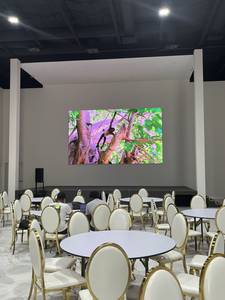
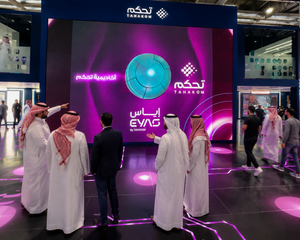
One-Sentence Definition: Mechanical LED is redefining the way brands connect with audiences. It is no longer about playing content, but about turning the space itself into a living, breathing participant in the experience.
From Trade Shows to Commercial Spaces: How Mechanical LED Creates Immersive Brand Experiences
Contents
The Attention Crisis: Why Static Displays Are Losing Effectiveness
Trade Show Sites: Why Mechanical LED Attracts More Attention Than Conventional LED
Brand Launches: Why Dynamic Visuals Are More Shareable
Entertainment Venues: How to Upgrade Spatial Experience
The Shared Answer: From “Watching” to “Participating”
FAQ
Conclusion
1. The Attention Crisis: Why Static Displays Are Losing Effectiveness
Walk into any large trade show. Every booth has a screen. Every screen is playing a video. The result is clear: audience attention is evenly diluted.
In today’s information-overloaded exhibition environment, audience dwell time has become one of the scarcest resources. Traditional booths often fall into the competition of “sound, light, and video”: louder audio, brighter screens, and more dazzling lighting.
But these methods are rapidly losing effectiveness.
When every booth is playing high-definition videos, the audience’s attention threshold keeps rising. Ordinary large-screen displays are no longer enough to create a memorable impression.
The fundamental problem is this:
Traditional LED screens can only “play” content. They cannot “express.”
Playing is one-way information output.
Expression is two-way emotional communication.
This is where mechanical LED enters the field of brand display. It does not solve the problem with a “bigger screen,” but with a completely different visual language.
If traditional static decoration is the “outer layer” of a commercial space, then interactive installations with real-time sensing capabilities are becoming the “physical engine” that drives offline traffic.
2. Trade Show Sites: Why Mechanical LED Attracts More Attention Than Conventional LED
The ISE 2026 Phenomenon
At the recently concluded ISE 2026, Integrated Systems Europe, the SpectrumDisplay booth became one of the most eye-catching highlights of the show and stood out as the only exhibitor presenting a 3D kinetic LED screen.
What made it so different?
While other exhibitors were still competing on brightness and resolution, SpectrumDisplay offered something others could not match:
physical interaction.
Post-show observations showed that among all the displayed content, one “human-machine interactive kinetic screen” video triggered phenomenal social media sharing. When the audience waved, the screen moved in rhythm. When the audience approached, the modules retracted precisely.
This kind of physical, real-time feedback is redefining the boundaries of offline marketing.
Professional media Pixel Inspiration accurately captured the essence of SpectrumDisplay’s mechanical screen:
“Invisible when static, spectacular when activated.”
The screen, composed of matrix panels, can physically extend and retract according to touch or content commands, creating depth and focus without noticeable mechanical system noise.
The Essential Shift from “Watching” to “Participating”
A traditional flat LED screen is only a background.
SpectrumDisplay’s 3D kinetic LED screen uses physical Z-axis displacement to create real-time “dialogue” with the audience.
The introduction of this physical dimension instantly turns visitors from observers into participants.
The popularity of the ISE showcase proves one thing:
Human-machine interaction is natural short-video material.
When audiences “play with the advertisement,” they voluntarily record and share it on social media. For brands, this is not only onsite traffic attraction, but also low-cost, high-efficiency secondary communication.
ISLE 2026 Shenzhen: “Where People Walk, Waves Rise; Where Hands Move, Wind Forms”
At ISLE 2026 in Shenzhen, the SpectrumDisplay booth attracted phenomenal queues and crowds.
A giant wall composed of hundreds of independent modules seemed to come alive. When visitors approached, the wall automatically moved back like waves. When visitors waved, the screen pixels and physical module movement accurately recreated the outline of human motion.
The audience did not need to wear heavy VR or AR devices. They simply walked, waved, or stopped naturally, and the large mechanical surface responded immediately.
This immersive experience—“where people walk, waves rise; where hands move, wind forms”—completely broke the limitation of traditional exhibition equipment that could only be viewed from a distance.
It transformed the audience from passive receivers into co-creators of digital art. This not only greatly extended booth dwell time, but also triggered spontaneous viral sharing on social media.
At ISLE 2026, SpectrumDisplay became a focus of the show with its revolutionary integrated mechanical screen ecosystem combining hardware and software.
3. Brand Launches: Why Dynamic Visuals Are More Shareable
Coca-Cola World Cup Launch Event
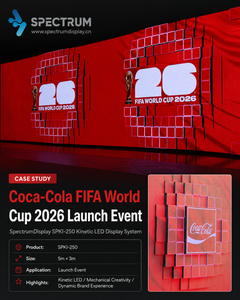
When one of the world’s most influential brands needed to create a visual moment that would be remembered, not merely seen, Coca-Cola chose mechanical LED.
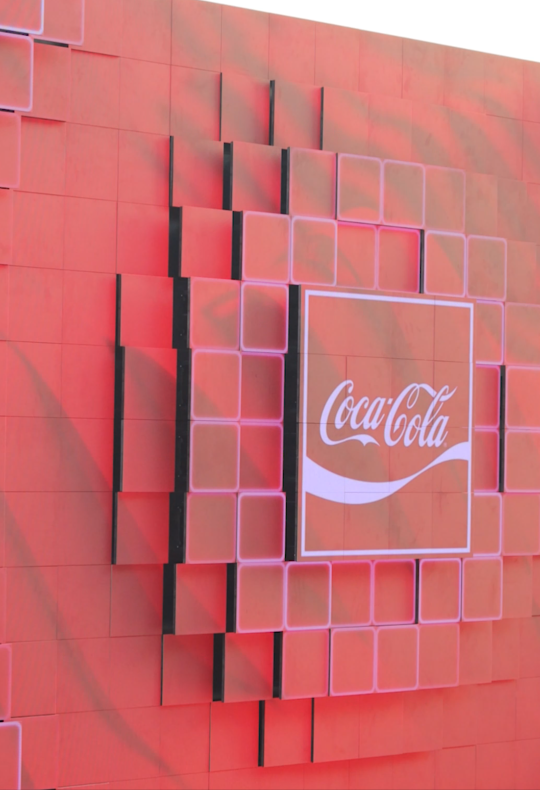
At the World Cup launch event, SpectrumDisplay’s SPKI-250 3D kinetic LED screen appeared in a 5m × 3m format.
The result was not a screen that simply played content.
It was a screen that became the content itself.
When Coca-Cola brand elements were presented through physical undulating motion, the screen was no longer a background. It became part of the performance.
The dynamic 3D surface was deeply integrated with the brand launch content, becoming one of the most memorable visual moments of the event and attracting extensive media coverage and social media sharing.
Why did it work?
Because human-machine interaction is natural social currency.
When a brand stops “playing advertising” and invites the audience to “play with advertising,” people voluntarily record and share the experience.
For the brand, this means not only traffic at the event site, but also high-efficiency, low-cost global secondary communication.
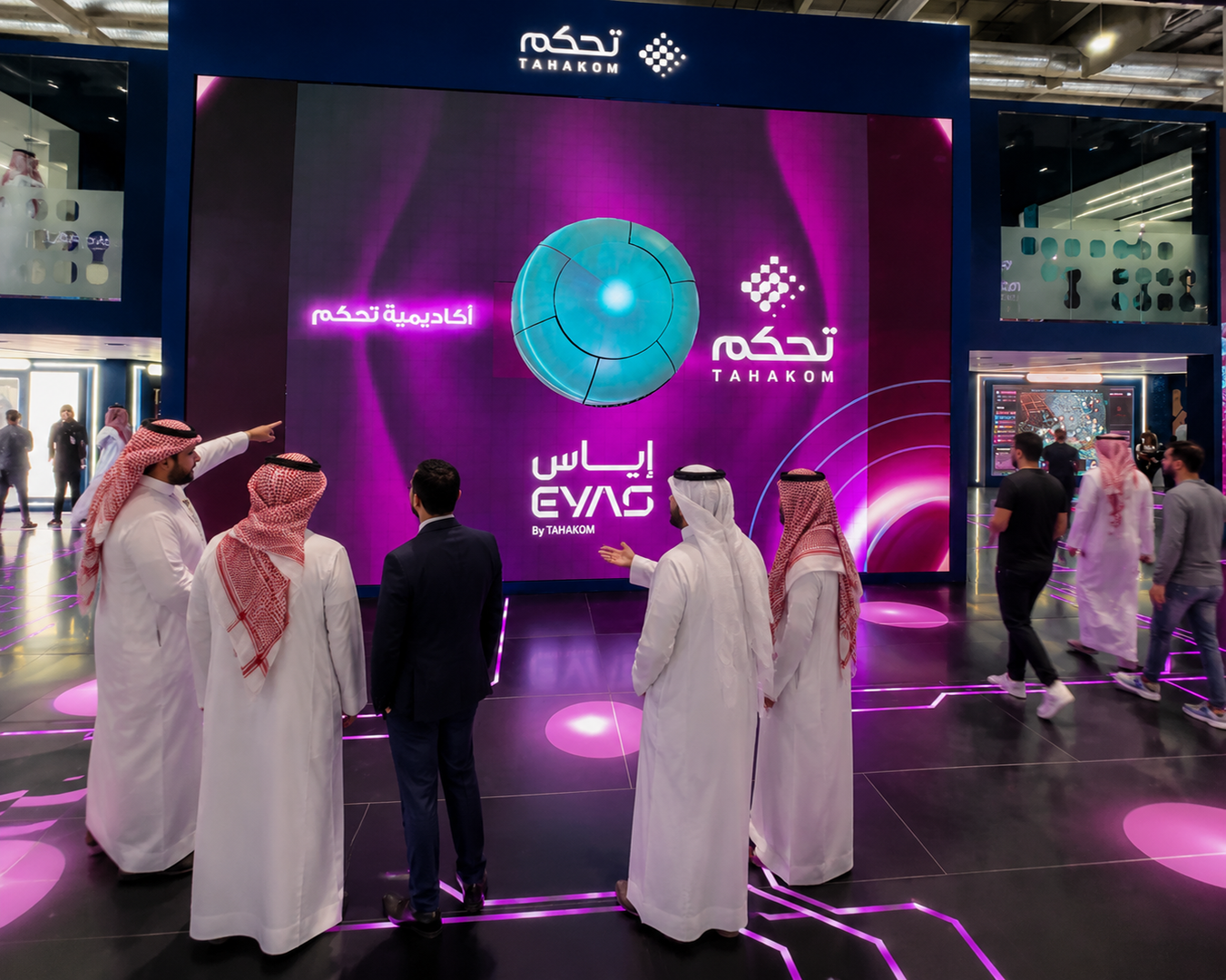
LEAP Technology Exhibition in Saudi Arabia
LEAP is one of the largest technology events in the Middle East, often described as the “Digital Davos.” Held annually in Riyadh, Saudi Arabia, it brings together leading global technology companies and investment institutions.
The event attracts more than 200,000 professional visitors and over 1,800 exhibitors each year.
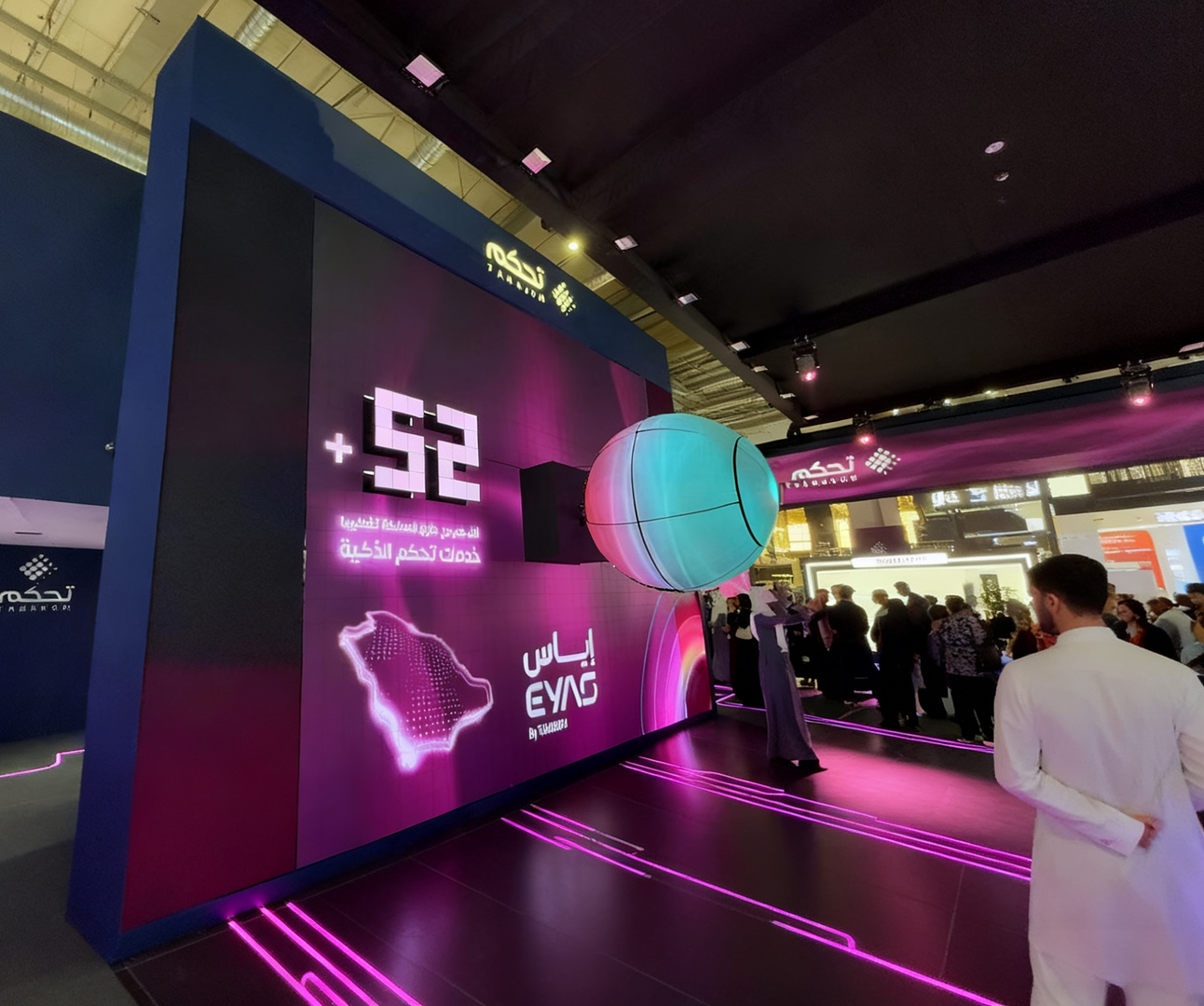
In such an environment, where thousands of booths compete for audience attention, SpectrumDisplay’s combined solution of SPKI-250 + LED sphere created two different forms of dynamic visual expression within the same booth.
The 3D kinetic LED screen delivered the main visual impact, while the LED sphere created an immersive surrounding atmosphere.
As one of the exhibitors presenting a 3D kinetic LED screen at the event, this combined solution became one of the most popular booth experiences at LEAP. Visitors were drawn by the physical movement of the screen and stayed far longer than they would at a conventional booth.
4. Entertainment Venues: How to Upgrade Spatial Experience
Singapore Bar Ceiling: A Breathing Ceiling
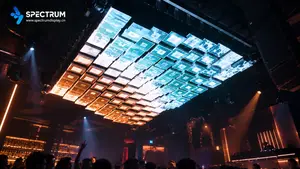
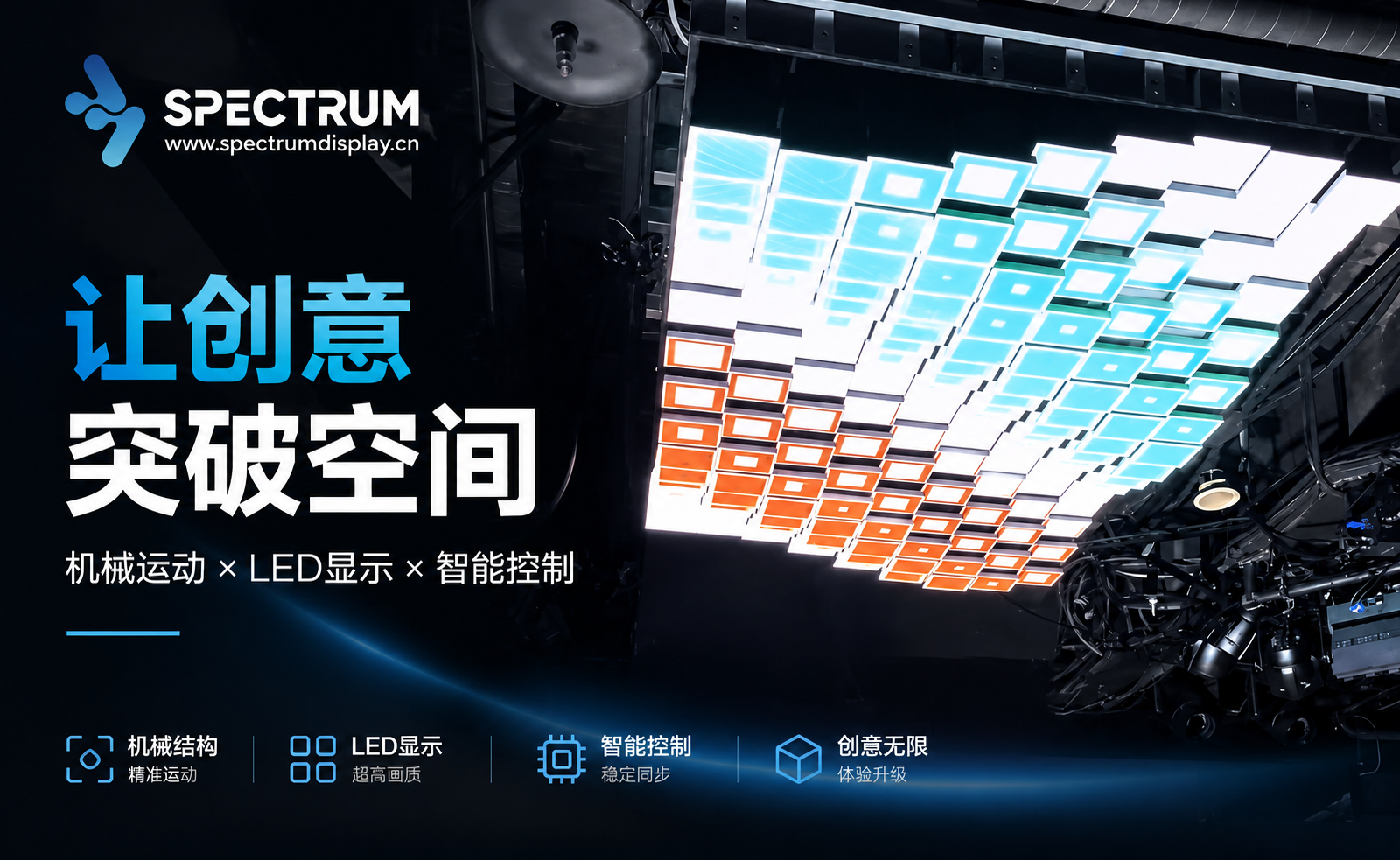
In a high-end bar in Singapore, SpectrumDisplay’s SPKI-160 3D kinetic LED screen was installed on the ceiling with a size of 1440 × 3840mm.
The result was a “breathing ceiling.”
It pulsed, extended, retracted, and moved in rhythm with the music.
When the screen units moved with the beat, the entire ceiling seemed to come alive. This physical 3D dynamic effect is fundamentally different from projection or flat LED visual effects.
It is real, spatial, and physically present.
For entertainment venues, the value is clear:
The more photogenic a space is, the more likely it is to trigger social sharing.
The kinetic LED ceiling became one of the most recognizable spatial features of the bar. Customer photo-taking and short-video sharing increased significantly, generating secondary communication on social platforms.
The Core Logic of Immersive Experience Spaces
The core of immersive experience is to make audiences forget where they are.
Through opening, lifting, retracting, and other forms of mechanical movement, mechanical LED creates a sense of spatial transformation that traditional flat screens cannot achieve.
The screen itself is no longer a background.
It becomes part of the immersive experience.
SpectrumDisplay’s SPKI series 3D kinetic LED screens use precision multi-axis mechanical transmission design and intelligent algorithms to allow previously static LED modules to achieve rhythmic physical extension and retraction along the Z axis.
For indoor models, the full-stroke motion time is less than 0.5 seconds. The movement is precise, smooth, and ultra-quiet, meeting the demanding spatial experience requirements of high-end entertainment venues.
5. The Shared Answer: From “Watching” to “Participating”
Across all scenarios—trade shows, brand launches, and entertainment venues—the same pattern appears again and again:
Mechanical LED does not simply display content. It invites participation.
A traditional flat LED screen is only a background.
SpectrumDisplay’s 3D kinetic LED screen uses physical Z-axis displacement to create real-time dialogue with audiences.
This physical dimension instantly transforms visitors from observers into participants.
When the screen becomes interactive, the audience becomes advocates.
And advocates share.
Three Reasons Mechanical LED Wins
1. Physical Movement Captures Attention
The human brain is naturally wired to notice moving objects first.
A screen that moves is almost impossible to ignore.
2. Participation Creates Memory
People remember what they do more strongly than what they merely see.
When they interact with the screen, they remember the experience itself.
3. Shareability Drives Communication
Interactive content is naturally suitable for short videos and social media sharing.
Every participant becomes a communication node for the brand.
6. FAQ
Q1: Why is mechanical LED more effective than conventional LED at trade shows?
Conventional LED screens are fixed and passive. They easily blend into the background.
Mechanical LED screens physically move and respond to audiences, creating a clear generational difference in visual experience.
At ISE 2026, SpectrumDisplay stood out as the only exhibitor presenting a 3D kinetic LED screen, and this difference made its booth one of the focal points of the event.
Q2: How does mechanical LED drive social media sharing?
Human-machine interaction is natural social currency.
At ISE 2026, visitors voluntarily recorded and shared videos of their interaction with the mechanical screen.
When audiences shift from viewers to participants, they become free communication nodes for the brand.
Q3: Why is mechanical LED suitable for brand launches?
A brand launch needs a memorable moment, not just content playback.
Mechanical LED turns the screen itself into a performance.
At the Coca-Cola World Cup launch event, the physical movement of the screen became one of the most memorable visual moments of the entire event.
Q4: Can mechanical LED be used in entertainment venues?
Yes.
In a bar in Singapore, a ceiling-mounted SPKI-160 3D kinetic LED screen created a “breathing ceiling” that moved with the rhythm of the music, significantly increasing customer dwell time and photo-sharing behavior.
This physical 3D effect is fundamentally different from flat projection or conventional LED visuals.
Q5: What does “invisible when static, spectacular when activated” mean?
As Pixel Inspiration described in its ISE 2026 coverage, SpectrumDisplay’s mechanical screen panels can physically extend and retract according to touch or content commands.
When idle, the screen blends into the environment.
When activated, it becomes the focal point.
This “disappear when not needed, appear when activated” characteristic is especially valuable in retail and corporate environments.
Q6: How does mechanical LED create immersive experiences?
Through multi-sensor integration—such as depth cameras, LiDAR, and facial recognition—the screen can sense human presence and respond in real time.
At ISLE 2026, when visitors waved, the system mapped human posture data through dedicated TD2Matrix nodes and converted it into Z-axis displacement commands for the mechanical modules in real time.
The result was a physical reshaping effect similar to a digital mirror.
This completely breaks the traditional limitation of exhibition equipment that can only be viewed from a distance.
7. Conclusion
The future of commercial display is not about larger screens, but smarter experiences.
Key Takeaways
Static displays are losing effectiveness.
When every booth is playing HD video, audience attention thresholds continue to rise.Mechanical LED creates physical participation.
At ISE 2026, human-machine interaction triggered phenomenal social media sharing.Brand launches benefit from physical storytelling.
The Coca-Cola World Cup launch used a 3D kinetic LED screen to create an unforgettable visual moment.Entertainment venues gain spatial transformation power.
The Singapore bar ceiling installation turned a static ceiling into a breathing experience.The core shift is from watching to participating.
When audiences become participants, they become the brand’s most loyal communication nodes.
Recommendations for Brands and Event Organizers
At trade shows, do not only compete on brightness. Compete on interactivity. A screen that responds is a screen that will be remembered.
At product launches, move beyond video playback. The screen itself can become a performance.
In entertainment venues, spatial transformation power is the new competitive advantage. A ceiling that “breathes” with music is hard to forget.
Investment in mechanical LED is not merely investment in hardware. It is investment in experiences worth remembering.
To learn more about case details or request a customized solution, contact SpectrumDisplay through: