Ceiling-Mounted 3D Kinetic LED Screen | Everyone Who Visited This Singapore Bar Took a Photo of the Ceiling
One-sentence definition:
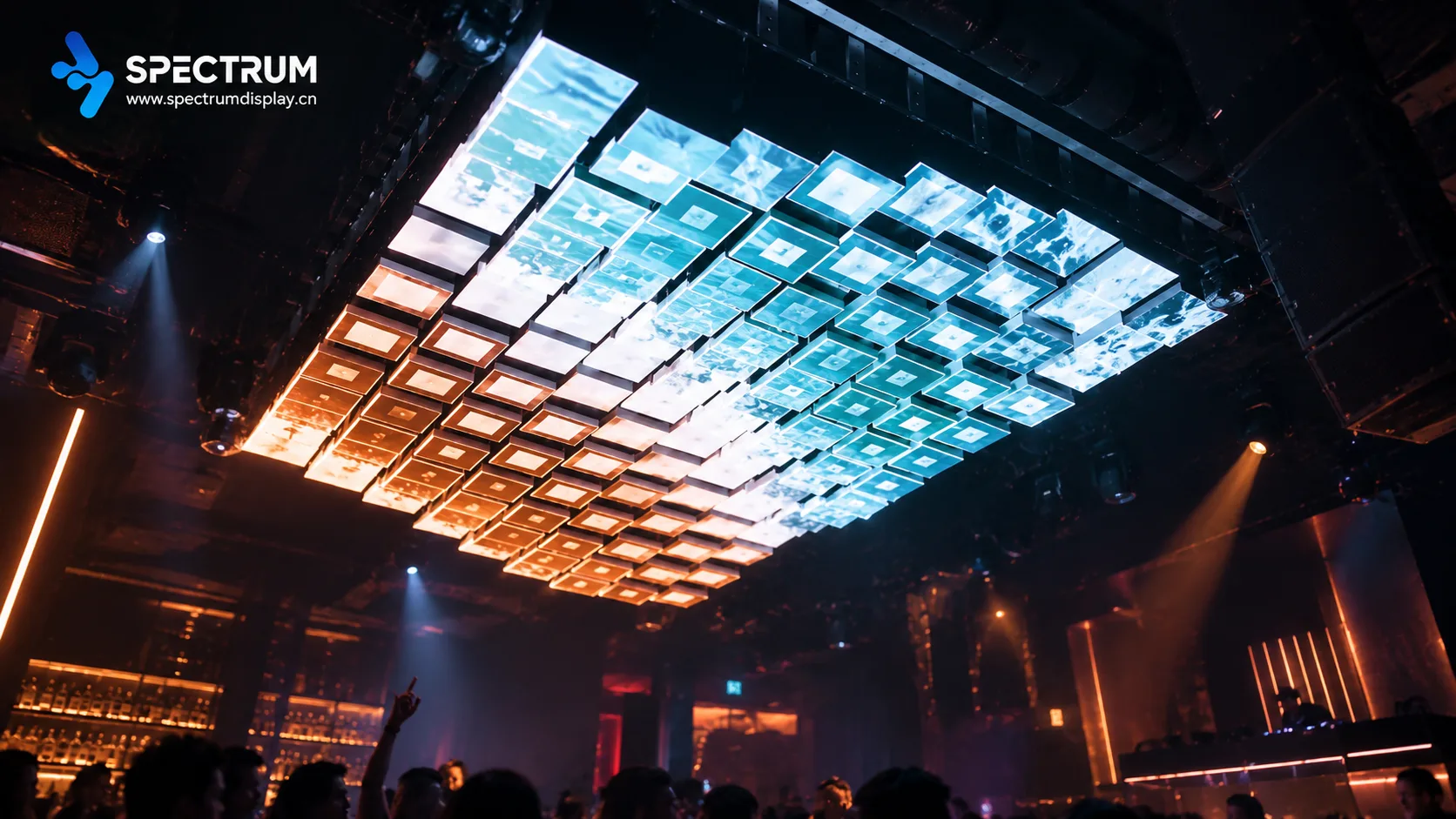
By installing Spectrum Display’s SPKI-160 3D Kinetic LED Screen on the ceiling, a high-end bar in Singapore transformed an ordinary ceiling into a breathing, rhythm-responsive dynamic art installation. With a 1440 × 3840mm physical 3D matrix, the project redefined the visual experience of nightlife spaces.
Contents
- Project Background: A High-End Bar in Singapore Needed a Spatial Upgrade
- Why Choose a Ceiling-Mounted 3D Kinetic LED Screen?
- Project Solution in Detail
- Project Impact and Value
- More Applications for Ceiling-Mounted 3D Kinetic LED Screens
- Frequently Asked Questions
- Conclusion
1. Project Background: A High-End Bar in Singapore Needed a Spatial Upgrade
As one of Southeast Asia’s key hubs for nightlife and premium consumption, Singapore has seen top bars and clubs compete far beyond drinks and service alone.
Atlas Bar has become one of the world’s most Instagrammable destinations with its 15-meter-high gin tower and Art Deco ceiling. Newly opened venues such as Xava Skybar are also using custom LED ceiling installations as living digital canvases to present rotating digital artworks.
In a market where the ceiling itself has become part of the competition, one high-end bar decided to go further.
They wanted the ceiling to be more than something people looked at.
They wanted it to respond.
Traditional light strips, projection, and static LED screens could no longer meet the expectations of a new generation of consumers who seek immersion and shareable moments.
The bar’s requirements were clear:
Create a strong spatial memory point.
The moment guests entered, the space needed to deliver visual impact and encourage spontaneous photo and video sharing.
Build a dynamic atmosphere.
The screen needed to change its physical form with the rhythm of the music and work together with lighting and sound.
Avoid sacrificing usable space.
As a ceiling-mounted solution, the installation could not occupy valuable floor or seating area.
Support long-term content updates.
The installation needed to support different party themes and atmosphere settings instead of remaining unchanged.
What they needed was not just a screen.
They needed an installation that could bring the ceiling to life.
2. Why Choose a Ceiling-Mounted 3D Kinetic LED Screen?
The Limitations of Traditional Ceiling Decoration
Most bar ceilings use static design elements: plaster shapes, light strips, mirrors, or even simple LED displays.
These solutions have obvious limitations.
They lack variation.
They are easy to imitate.
They struggle to create a true “wow” moment.
In a design-intensive city like Singapore, the freshness of static decoration is becoming shorter and shorter. Competitors can reproduce a similar effect within a few months.
The 3D Kinetic LED Screen Solution
A 3D Kinetic LED Screen combines display and motion, opening up new possibilities for ceiling design.
Physical 3D visual movement.
The screen units physically extend and retract with the rhythm of the music, creating depth, motion, and dynamic surface changes that go far beyond flat visual effects.
Look up, feel immersed.
Ceiling installation creates an immersive experience from above. When guests look up, the ceiling feels like it is breathing. This creates a completely different visual experience compared with eye-level or floor-level installations.
Programmable, ever-changing forms.
Through DMX512 and Art-Net protocol integration, the screen movement can be connected to the lighting console and synchronized with music, lighting effects, and show rhythm in real time.
3. Project Solution in Detail
Product Selection: SPKI-160
The project selected Spectrum Display’s SPKI-160 indoor 3D Kinetic LED Screen.
For a bar ceiling with two strict constraints — limited ceiling height and no available rear maintenance space — SPKI-160 was the practical solution.
| Selection Factor | SPKI-160 Solution |
|---|---|
| Ceiling load limit | Lightweight die-cast aluminum cabinet, only 52kg/㎡ |
| Limited ceiling height | Body thickness of only 330mm, finished thickness ≤350mm |
| Convenient maintenance | Full front maintenance, no top-side maintenance corridor required |
| Quiet operation | Self-developed bus-type servo power system for quiet movement without disturbing the music experience |
| Fast response | Full-stroke motion time <0.5s, enabling precise synchronization with music beats |
The 330mm ultra-thin body was the decisive factor.
Conventional 3D kinetic LED screens are often more than 600mm thick, making them impossible to install within a limited ceiling cavity.
SPKI-160’s 330mm body thickness, combined with full front maintenance, allows the screen to fit into the ceiling of most standard commercial spaces.
Project Specifications
| Project Item | Details |
|---|---|
| Installation Method | Ceiling-mounted installation |
| Screen Size | 1440mm high × 3840mm wide |
| Total Screen Area | Approx. 5.53㎡ |
| Motion Units | Approx. 88 independent motion units, 39 units/㎡ |
| Module Gap | <1.5mm |
| Maximum Extension Stroke | 200mm |
| Control Solution | Integrated into the bar lighting control system via DMX512 |
Control and Content Solution
Music synchronization.
Through DMX512 protocol integration, the screen movement was connected with the live DJ music rhythm. The lighting designer could directly use a professional lighting console to control the movement rhythm of the screen.
Preset scene modes.
Welcome mode: slow and gentle motion.
Warm-up mode: faster rhythmic movement.
Peak mode: full-range kinetic impact.
Different time periods and different atmospheres could be switched with one command.
Content updates.
Modes could be switched through a mobile app or lighting console, supporting customized experiences for different themed parties.
Halloween could use mysterious rising and falling movements.
Christmas could use warm, slow rhythms.
New Year’s Eve could use high-impact kinetic motion.
One ceiling, unlimited expressions.
▶Video · YouTubeSpectrum Display SPKI-160 Kinetic Screen — the model behind this ceiling projectWatch on YouTube →
4. Project Impact and Value
Visual Impact: A Breathing Ceiling
When the screen units extend, retract, and move with the rhythm of the music, the entire ceiling seems to come alive.
This physical 3D effect is fundamentally different from projection or flat LED visual effects.
It is real spatial movement.
In slow mode, the ceiling rises and falls gently like breathing, creating a calm and immersive atmosphere.
In fast rhythm mode, the screen moves with the music and works together with lighting and sound, surrounding the space with energy from above.
This “look up, feel immersed” experience allows guests to feel as if the sky itself is breathing above them.
Spatial Memory: Guests Share It Spontaneously
In the age of social media-driven consumption, the photogenic value of a bar directly influences its popularity.
The dynamic visual effect of the ceiling-mounted 3D Kinetic LED Screen became the most recognizable spatial signature of the bar.
Guests were more likely to take photos and record short videos.
Every movement and every rhythm became a moment worth capturing.
These photos and videos created secondary exposure on platforms such as Instagram and TikTok, turning the bar from a place to drink into a destination worth visiting.
A moving ceiling becomes a free traffic entrance.
Atmosphere Design: Deep Integration with Music, Lighting, and Performance
The greatest value of a 3D Kinetic LED Screen is not simply that it moves.
It is that it can move together with the environment.
Through seamless DMX512 protocol integration, the rhythm, extension range, and movement frequency of the screen can be synchronized with live music, lighting, and even performer movements in real time.
The screen is no longer a background.
It becomes part of the performance.
It makes music visible.
▶Video · YouTubeWhen the Screen Starts Moving — physical motion you can see from belowWatch on YouTube →
5. More Applications for Ceiling-Mounted 3D Kinetic LED Screens
The success of the Singapore bar ceiling project shows that this solution can be applied to many other scenarios.
| Scenario | Application Value | Recommended Model |
|---|---|---|
| High-end bar / nightclub | Dynamic ceiling installation creating a “breathing ceiling” | SPKI-160 |
| Shopping mall atrium | Suspended dynamic art installation to attract foot traffic and extend dwell time | SPKI-128 / SPKI-160 |
| Brand showroom | Ceiling-mounted dynamic matrix supporting changing brand narratives | SPKI-128 |
| Product launch stage | Overhead kinetic screen enhancing product reveal moments | SPKI-250 |
| Airport / high-speed rail station | Large-scale ceiling public art installation | SPKO-320 / SPKO-500 |
▶Video · InstagramKinetic Screens in real-world projects — from commercial spaces to exhibitionsWatch on Instagram →
6. Frequently Asked Questions
Q1: How is the load-bearing issue solved for ceiling installation?
SPKI-160 uses a lightweight die-cast aluminum cabinet design, with a weight of only 52kg/㎡. The ceiling system can be supported by a conventional steel structure, reducing the need for major architectural reinforcement and lowering the engineering threshold for ceiling installation.
Q2: Can it be installed if the bar ceiling height is limited?
Yes. SPKI-160 has a body thickness of only 330mm, with a finished thickness of ≤350mm. Compared with traditional kinetic LED screens that are often more than 600mm thick, it greatly reduces the required ceiling depth and can be installed in most standard-height commercial spaces.
Q3: Will the mechanical noise interfere with the music experience?
No. The SPKI Series uses a self-developed bus-type servo power system designed for quiet operation. Combined with FOC algorithms and 100% closed-loop control, the mechanical movement is difficult to notice even during quieter periods in the bar.
Q4: How is maintenance handled? Does the ceiling need to be dismantled?
No dismantling is required. SPKI-160 supports full front maintenance. LED modules and core mechanical components can be removed and replaced from the front side of the screen. Maintenance staff do not need to enter the ceiling cavity, which significantly reduces maintenance difficulty and cost.
Q5: Can the 3D Kinetic LED Screen synchronize with music?
Yes. The SPKI Series is compatible with standard stage protocols such as DMX512, Art-Net, and sACN, and can be connected directly to a lighting console. Lighting designers can translate music rhythm into screen movement through professional console control, creating integrated coordination between sound, light, display, and physical motion.
Q6: How can the screen content be changed? Is programming required?
No programming is required. Preset modes can be switched through a mobile app, enabling quick content changes for different themed parties. Operators do not need a technical background.
7. Conclusion
The Singapore bar ceiling project is a representative commercial entertainment case for Spectrum Display’s SPKI-160 3D Kinetic LED Screen.
Project Value Summary
- Precise product selection:
The 330mm ultra-thin body and full front-maintenance design make SPKI-160 highly suitable for ceiling spaces with limited installation depth. - Efficient installation:
The lightweight cabinet design, at 52kg/㎡, reduces the need for major structural reinforcement and eliminates the need for a rear maintenance corridor. - Strong visual impact:
The physical 3D kinetic matrix creates a breathing ceiling that becomes the visual signature of the space. - Flexible operation:
DMX512 integration enables music-synchronized movement, while app-based mode switching supports different atmosphere settings. - Long-term usability:
The installation supports continuous content updates and can adapt to different party themes and operating needs.
Recommendations for Bar and Nightclub Owners
A ceiling-mounted 3D Kinetic LED Screen can be considered for spaces with a ceiling height of 3.5m or above.
For the best result, the kinetic ceiling should be designed together with the lighting and audio systems from the beginning of the project.
A DMX512 control chain should be reserved to support future content updates and show programming.
For more project details or a customized proposal, contact the Spectrum Display team through: