Why Install a Screen on the Ceiling? Inside a Singapore Bar’s 3D Kinetic LED Ceiling Project
One-sentence definition:
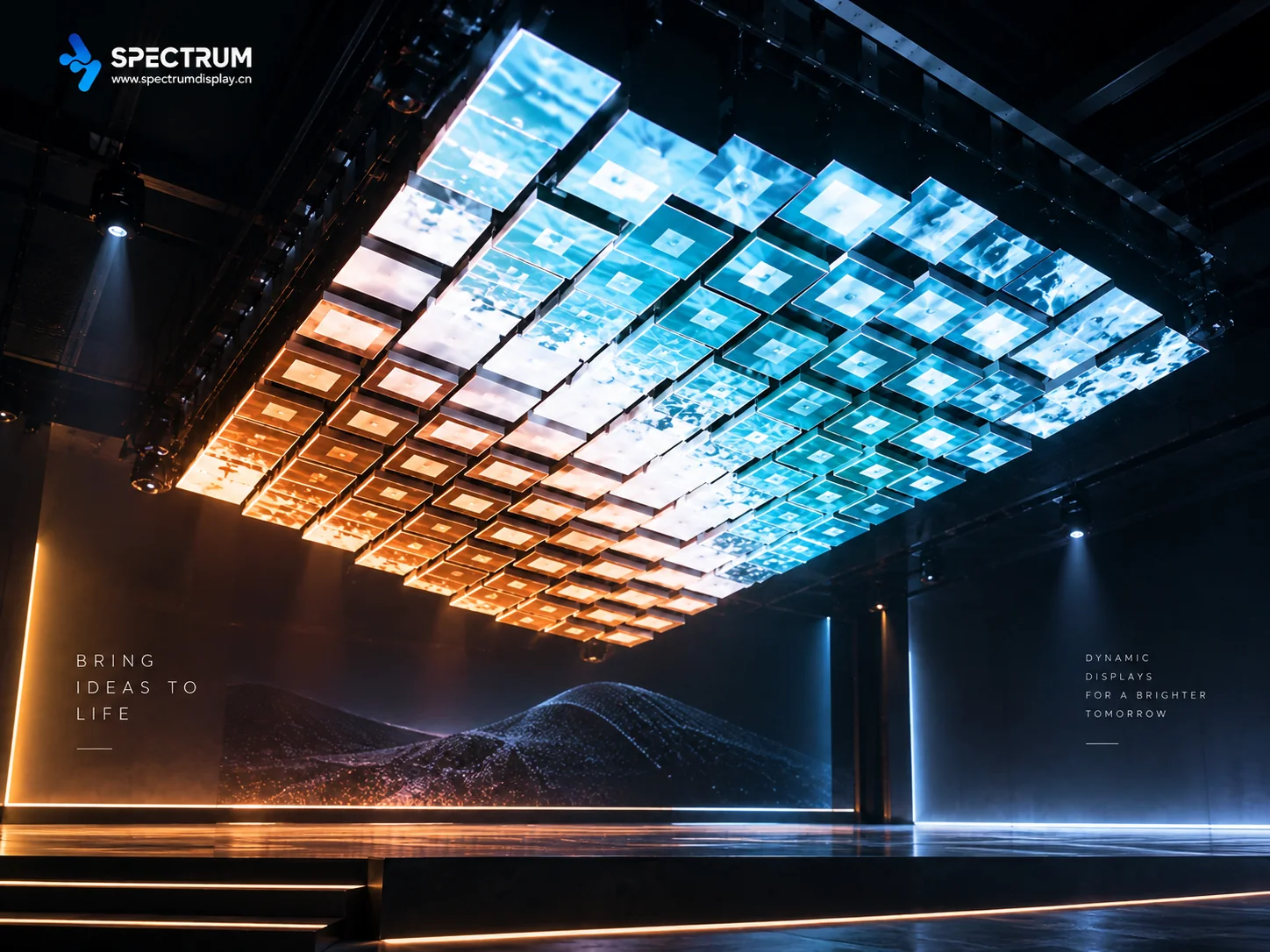
A premium bar in Singapore installed an SPKI-160 3D Kinetic LED Screen on the ceiling because the floor and walls were already fully utilized, leaving the ceiling as the only untapped visual surface. The 1440 × 3840mm kinetic display transformed an otherwise unused ceiling into a dynamic surface that appears to “breathe” with the space.
1. When the Floor and Walls Are Full, Look Up
How competitive is Singapore’s nightlife market?
In a city-state covering just over 700 square kilometers, premium bars and clubs compete for a highly experienced audience. Their customers have visited sophisticated venues, experienced high-end hospitality, and are no longer impressed by something that is simply “good.”
Traditional competitive advantages are becoming less distinctive.
Better drinks, more expensive interiors, and well-known DJs may once have been differentiators. Today, they are increasingly the price of entry.
What creates a real distinction is the spatial experience itself.
That was exactly the challenge facing this premium bar in Singapore.
The floor was already occupied by seating. The walls were already filled with interior features.
The only major visual surface still available was the ceiling.
In most commercial spaces, the ceiling is one of the most underestimated pieces of visual real estate.
People are used to looking up and seeing a flat white or black surface — somewhere to conceal fire-safety systems, air-conditioning vents, pipes, and cables.
It is rarely treated as the main character of the interior.
But what if the ceiling could come alive?
2. Why the Ceiling? Sometimes the Most Valuable Space Is Overhead
Competition in commercial interiors is, in many ways, a competition for visual surfaces.
Floors are used for movement. Walls are used for displays and decoration.
Together, they carry most of the visual functions of a space.
The ceiling is usually treated as background.
In entertainment venues such as bars and clubs, however, the ceiling has enormous potential. When customers sit down, have a drink, and look up, the ceiling is directly above them.
The Unique Advantages of a Ceiling Installation
No floor or wall space required.
In premium commercial environments, every square meter of usable floor and wall space has value. A ceiling installation activates a visual surface that would otherwise remain underused.
A stronger sense of immersion.
When a kinetic display extends, retracts, and moves directly above the audience, visual energy comes from overhead and surrounds the space in a way that a conventional wall-mounted screen cannot easily reproduce.
A distinctive visual memory.
While many bars compete over the size and brightness of their wall-mounted LED screens, a venue that moves the visual experience onto the ceiling immediately creates something different.
For this Singapore bar, the ceiling was not simply an alternative mounting position.
It became the foundation of the entire spatial experience.
3. Why SPKI-160? 330mm Ultra-Slim Body + Front Maintenance
Product selection can determine whether a non-standard installation succeeds or fails.
For this Singapore bar project, SPKI-160 was selected not simply because of its visual performance, but because the physical constraints of the ceiling ruled out more conventional mechanical LED configurations.
Challenge 1: Limited Ceiling Height
Bar ceilings rarely provide generous installation depth.
Conventional kinetic LED systems can require more than 600mm of depth, making them difficult to fit inside a restricted ceiling cavity.
The SPKI-160 has a body depth of only 330mm, with the finished installation depth controlled to approximately 350mm.
This ultra-slim structure allowed the kinetic LED system to fit within the limited ceiling space.
Challenge 2: No Rear Maintenance Corridor
The space above the bar ceiling was enclosed.
There was no practical way to reserve a conventional rear maintenance corridor.
SPKI-160 supports front maintenance.
LED modules and key internal mechanical components can be removed and replaced directly from the display side without requiring technicians to enter the ceiling cavity.
For a ceiling-mounted system, this significantly simplifies long-term maintenance.
Challenge 3: Noise Control in an Entertainment Environment
A bar needs atmosphere — not unwanted mechanical noise.
The SPKI-160 uses Spectrum Display’s proprietary bus-based servo drive system, designed to provide smooth and quiet mechanical movement.
This allows the kinetic effect to become part of the visual experience without distracting from the venue’s music and atmosphere.
Selection conclusion: Under the combined constraints of limited ceiling depth, no rear maintenance access, and strict operational noise requirements, SPKI-160 provided the most suitable engineering solution for this project.
▶Video · YouTubeSPKI-160 Kinetic Screen for Luxury Events — the model used in this ceiling projectWatch on YouTube →
4. Project Solution and Technical Specifications
| Item | Specification |
|---|---|
| Product Model | SPKI-160 |
| Installation | Ceiling-mounted |
| Display Size | 1440mm (H) × 3840mm (W) |
| Total Area | Approx. 5.53m² |
| Module Size | 160 × 160mm |
| Pixel Pitch | P1.98 |
| Motion Units | Approx. 88 independently controlled units |
| Unit Density | 39 units/m² |
| Module Gap | <1.5mm |
| Body Depth | 330mm |
| Finished Installation Depth | ≤350mm |
| Maximum Travel | 200mm |
| Maintenance | Front maintenance |
| Control Integration | Integrated with the bar’s lighting control system via DMX512 |
Technical Highlights
330mm ultra-slim body.
SPKI-160 reduces the main body depth to 330mm. With the supporting installation structure, the finished depth can be controlled to approximately 350mm.
In a ceiling with extremely limited installation space, those few hundred millimeters can determine whether the concept is physically achievable.
Front-maintenance architecture.
LED modules and key mechanical components can be accessed from the display side.
For maintenance, technicians do not need to enter the ceiling cavity, greatly simplifying servicing in an enclosed overhead installation.
39 motion units/m².
The relatively high unit density creates a more detailed kinetic surface for close- and medium-distance viewing, allowing individual extension and retraction movements to remain visually clear.
5. The Result: When the Ceiling Begins to “Breathe”
The moment the screen comes to life, the atmosphere of the entire space changes.
As the music begins, individual LED units extend and retract in coordinated sequences.
The ceiling appears to rise, fall, and breathe with the rhythm.
This is not projection.
It is not a visual effect simulated on a conventional flat LED screen.
It is real physical movement — visible in the changing depth of the display surface and perceptible throughout the space.
A Ceiling That Breathes
In slower sequences, the modules move gradually in and out, creating a calm, immersive atmosphere.
During faster sections, the movement can become more energetic and work together with lighting and audio to create a stronger overhead visual experience.
Movement Integrated with Music and Lighting
Through DMX512 integration, the kinetic display can be incorporated into the venue’s wider show-control workflow.
Motion sequences can therefore be coordinated with lighting cues and music-driven programming.
The screen is no longer simply the background.
It becomes part of the performance — turning sound and rhythm into physical movement.
A Different Experience for Different Events
The movement content is programmable.
Different kinetic sequences can be created for different parties, events, or themes, allowing the same physical installation to generate different spatial experiences over time.
▶Video · YouTubeWhen Content Moves Beyond the Screen — motion driven by music and contentWatch on YouTube →
6. Commercial Value: Creating a Space People Want to Photograph
In the social-media-driven hospitality market, a venue’s ability to create memorable, shareable moments can directly affect its visibility.
A “Look Up” Moment
When customers enter the bar and look upward, they do not see an ordinary flat ceiling.
They see a kinetic LED surface physically changing above them.
That unexpected moment gives the ceiling a new role:
it becomes one of the venue’s defining visual signatures.
Naturally Shareable Visual Content
The physical movement of the ceiling creates a strong visual subject for photography and short-form video.
Instead of adding another decorative wall, the venue creates an experience that encourages visitors to point their cameras upward.
A Differentiated Spatial Experience
In a competitive nightlife market such as Singapore, a kinetic ceiling creates a spatial identity that is difficult to reproduce with conventional decorative materials or flat LED screens alone.
The result is not simply another display.
It is an architectural experience associated with the venue itself.
▶Video · YouTubeWhen the Screen Starts Moving — the visual energy guests photographWatch on YouTube →
7. Frequently Asked Questions
Q1: How Is the Structural Load of a Ceiling-Mounted Kinetic LED Screen Managed?
A: The SPKI-160 uses a lightweight cabinet design, with the display system weighing approximately 52kg/m². The supporting structure must be engineered according to the actual building conditions and the combined weight of the display and mounting system. Structural load capacity should always be verified before installation.
Q2: Can SPKI-160 Be Installed in a Bar with Limited Ceiling Space?
A: The SPKI-160 has a body depth of approximately 330mm, with a finished installation depth of around 350mm depending on the project structure. This makes it particularly suitable for ceiling applications where installation depth is limited. Final feasibility should still be confirmed through a site survey and structural assessment.
Q3: Will Mechanical Noise Interfere with the Music Experience?
A: The SPKI Series uses a bus-based servo drive architecture designed for smooth, controlled movement. Motion sequences can be programmed according to the venue’s operational requirements, helping the kinetic system integrate naturally into the overall entertainment environment.
Q4: How Is the Ceiling Display Maintained? Does the Ceiling Need to Be Removed?
A: SPKI-160 supports front maintenance. LED modules and key mechanical components can be accessed from the display side, reducing the need to enter the enclosed ceiling cavity or dismantle surrounding ceiling structures for routine servicing.
Q5: Can a 3D Kinetic LED Screen Be Synchronized with Music?
A: Yes. The system can be integrated into show-control and lighting workflows, allowing kinetic movement to be coordinated with music, lighting cues, and programmed event sequences. For this project, DMX512 was used to integrate the display with the bar’s lighting control system.
Q6: How Can the Kinetic Content Be Changed?
A: Motion sequences can be created and managed through Spectrum Display’s control workflow. Preset movement patterns can be prepared for different events and themes, allowing venue operators to update the experience without physically changing the installation.
8. Conclusion
The Singapore bar ceiling project demonstrates how Spectrum Display’s SPKI-160 3D Kinetic LED Screen can transform an underused architectural surface into a central part of the entertainment experience.
Key Project Value
1. Engineering Fit
The 330mm ultra-slim body and front-maintenance design address the two major constraints of ceiling installations: limited depth and restricted rear access.
2. Installation Adaptability
The compact system architecture makes it possible to integrate physical kinetic movement into a ceiling environment where conventional mechanical LED systems may be too deep.
3. Physical 3D Experience
Real Z-axis movement transforms the ceiling into a dynamic surface that appears to breathe and respond to the space.
4. Show-Control Integration
DMX512 integration allows the kinetic display to work alongside the venue’s lighting and entertainment systems.
5. Long-Term Content Flexibility
Programmable motion sequences allow the same installation to support different events, themes, and visual experiences over time.
Recommendations for Bar and Nightclub Owners
For a ceiling-mounted kinetic LED project, evaluate available ceiling depth, structural load capacity, maintenance access, viewing distance, and show-control integration before selecting the display model.
Lighting, audio, and kinetic LED systems should ideally be planned together from the design stage so that physical movement becomes part of the overall spatial experience rather than an isolated visual effect.
For project details and customized kinetic LED solutions, contact the Spectrum Display team.