Rain, Heat and High Humidity: What Does a Kinetic Screen Need to Survive Outdoors?
One-Sentence Definition: “Outdoor protection” for a kinetic screen is far more complex than simply adding a rain cover. It is a multidisciplinary electromechanical and thermal engineering challenge that must balance extreme temperature fluctuations (-10°C to 60°C), high humidity and condensation (≤95% RH), heavy rain, and continuous internal heat generation.
1. An Outdoor Project Destroyed by the Weather
Imagine an outdoor kinetic screen installed in a commercial district in a coastal city.
It has just survived its first rainy season—or so the project team thinks.
After weeks of heavy rain and high humidity, moisture begins entering through gaps around the moving modules. Then summer arrives. Under intense sunlight, the temperature inside the enclosed structure rises toward 70°C.
The trapped moisture turns into hot vapor.
Control boards begin to short-circuit. Precision guide rails corrode and jam. Motors can no longer move properly.
A screen that was supposed to create a constantly moving architectural surface becomes an expensive piece of static hardware.
Many manufacturers assume that if the enclosure is waterproof, the product can be called an “outdoor display.”
But a kinetic screen is fundamentally different from a conventional fixed LED screen.
Because it moves, it needs mechanical clearances. And wherever there are moving gaps, moisture and dust become much more difficult to control.
A true Outdoor Kinetic Screen therefore needs to turn “outdoor” from a marketing label into a complete engineering capability capable of withstanding real environmental conditions.
2. Challenge 1: Rain and Condensation — Keeping Water Away from a Moving System
A conventional outdoor LED cabinet can rely heavily on seals to isolate internal electronics from the environment.
A kinetic screen cannot be treated in exactly the same way.
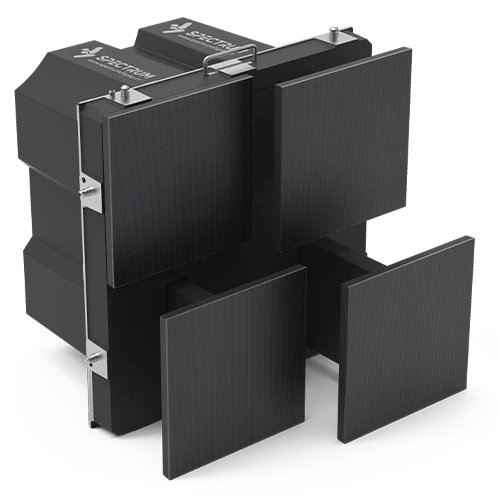
Its modules may extend and retract hundreds of times during daily operation. The SPKO-250, for example, provides a 200mm physical motion stroke.
Absolute sealing around every moving component is therefore much more difficult.

The Engineering Challenges
1. Dynamic Water Protection
Rainwater can potentially travel along the paths, gaps, and guide structures associated with moving units.
2. Temperature-Induced Condensation
Outdoor temperatures can change dramatically between day and night.
After a hot day, a rapid drop in temperature can cause condensation to form inside the system—similar to the water droplets that appear on a cold beverage can taken out of a refrigerator on a summer day.
How the SPKO-250 Addresses It
IP65 Protection + Internal Drainage Design: The SPKO-250 uses outdoor-oriented protective structures around its motion units. If water reaches the outer areas of the cabinet, internal drainage paths are designed to guide it downward and away from motors and critical PCBAs.
Condensation Management: The internal airflow structure is designed to reduce the risk of moisture accumulating on sensitive electronic components, helping protect the control system against condensation-related electrical failures.
3. Challenge 2: Heat and Extreme Cold — Surviving from -10°C to 60°C
There is no air conditioning on an outdoor façade.
Under direct summer sunlight, the surface temperature of an outdoor display can become extremely high. In colder climates, the same system may have to operate at temperatures around or below freezing.
The Engineering Challenge
A kinetic screen contains large numbers of motors and electronic components operating simultaneously.
Add the thermal load generated by an outdoor display running at ≥5,000 nits, and heat management becomes critical.
If heat cannot escape efficiently, LED degradation can accelerate and motors or electronics may trigger thermal protection.
Cold weather creates a different problem.
At low temperatures, unsuitable lubricants can thicken or lose their intended performance, increasing mechanical resistance and potentially interfering with smooth movement.
How the SPKO-250 Addresses It
Wide-Temperature Components and Materials: The SPKO-250 is designed for an operating temperature range of -10°C to 60°C. Lubricants and key components are selected around the thermal requirements of outdoor operation so that the mechanical system can maintain stable movement across a wide temperature range.
Thermal Management for High-Brightness Operation: The system is engineered to manage the heat generated by ≥5,000-nit LED output and its internal electronics, transferring heat away from critical components to reduce excessive internal temperature buildup.
4. Challenge 3: High Humidity and Salt Spray — The Invisible Enemy of Mechanical Systems
For installations in coastal cities such as Jakarta or Jeddah, humidity is only part of the challenge.
Salt-laden air can be highly corrosive to exposed metal components.
The Engineering Challenge
A kinetic screen contains numerous mechanical and structural components, including steel supports, aluminum guide structures, screws, fasteners, and other precision parts.
In high-humidity and salt-spray environments of up to ≤95% RH, corrosion can gradually affect these components.
As corrosion increases, friction can increase as well, potentially placing additional loads on motors and other moving components.
For a static LED screen, corrosion is already a serious reliability issue.
For a kinetic screen with thousands of repeated physical movements, it becomes even more critical.
How the SPKO-250 Addresses It
System-Level Corrosion Protection: The cabinet uses die-cast aluminum and precision-machined components, combined with anodizing or corrosion-resistant surface treatments for relevant metal structures.
Conformal Coating for Electronics: Internal control boards, receiving cards, and power modules use protective conformal coating designed to improve resistance to moisture, salt spray, and mold.
This provides an additional layer of protection for operation in demanding high-humidity environments of up to ≤95% RH.
5. The Core Solution: Why Use a Semi-Enclosed Self-Cooling System?
A natural question follows:
If rain and moisture are such serious problems, why not make the kinetic screen system completely sealed?
Because heat still has to escape.
A completely enclosed structure can trap the heat generated by high-brightness LEDs, drivers, power electronics, and continuously operating motors.
With ≥5,000-nit brightness combined with mechanical movement, poor thermal management could effectively turn the inside of the system into an oven.
So why not use a completely open structure?
Because an open system may dissipate heat effectively, but heavy rain and airborne dust could gain direct access to critical internal components.
The SPKO-250 therefore uses a semi-enclosed self-cooling structure with auxiliary fan-assisted ventilation.
It is an engineering balance between environmental protection and thermal management:
- Airflow paths allow heat generated by the LED modules and internal electronics to escape.
- Internal air channels and water-blocking structures are designed to prevent rainwater and dust from directly reaching critical electronics.
- The system balances effective heat dissipation with the requirements of IP65 outdoor protection.
For an outdoor kinetic screen, waterproofing and cooling cannot be engineered independently.
They have to be designed as one integrated thermal and environmental protection system.
6. SPKO-250 Outdoor Engineering Protection at a Glance
| Harsh Environment | Key Requirement | SPKO-250 Engineering Approach |
|---|---|---|
| Heavy Rain | IP65 protection | Dynamic protective structure + internal drainage channels |
| Extreme Temperature Changes | -10°C to 60°C | Wide-temperature lubricants/components + thermal management for high-brightness operation |
| High Humidity & Salt Spray | ≤95% RH | Conformal coating + corrosion-resistant treatment for metal structures |
| High Internal Heat Load | ≥5,000-nit operation | Semi-enclosed self-cooling + auxiliary fan-assisted airflow |
| High-Altitude Wind Exposure | Structural wind-load requirements | 17kg high-rigidity die-cast aluminum cabinet + planned maintenance access |
▶Video · YouTubeDifferent Forms. Endless Display Possibilities.Watch on YouTube →
7. Frequently Asked Questions (FAQ)
Q1: Can the SPKO-250 be installed in coastal environments with high salt-spray exposure?
A: Yes. The SPKO-250 incorporates corrosion-protection measures for both its electronic and structural components.
Internal circuit boards are treated for improved resistance to moisture and salt spray, while relevant metal components use corrosion-resistant surface treatments.
For long-term operation in severe coastal environments, periodic preventive maintenance is still recommended. This may include inspecting and relubricating guide mechanisms with appropriate outdoor corrosion-resistant lubricants.
Q2: What happens if wind-driven rain enters the gaps during a typhoon?
A: The SPKO-250’s motion structure incorporates physical water-management measures designed to reduce the risk of wind-driven rain reaching critical internal components.
As long as the external supporting structure and sealing system remain correctly installed and undamaged, the system is designed for demanding outdoor weather conditions.
For extreme weather events beyond normal operating conditions, project-specific emergency procedures may include retracting the motion units and shutting down power before the event reaches the site.
Q3: Can the kinetic screen still operate when winter temperatures fall below -10°C?
A: The standard SPKO-250 is specified for operation down to -10°C.
For locations where extreme temperatures regularly fall below this range, a customized low-temperature solution should be evaluated based on actual site conditions.
Low-temperature projects may require additional consideration of lubricants, materials, electrical components, and startup procedures.
Q4: Does a semi-enclosed cooling system allow dust to enter the motors?
A: A semi-enclosed design allows controlled airflow while using protective structures to reduce direct dust ingress.
However, outdoor kinetic systems still require periodic maintenance. Regular inspection and cleaning of accumulated dust are important parts of maintaining long-term mechanical and thermal performance.
8. Conclusion
Indoors, kinetic screen engineering often focuses on image quality, motion precision, noise, and speed.
Outdoors, another requirement comes first:
The system has to survive the environment.
Key Takeaways
- Rain and Condensation: IP65 protection and internal water-management structures help prevent rain and moisture from reaching critical components.
- Heat and Cold: A -10°C to 60°C operating range requires mechanical, electrical, and thermal components designed around wide outdoor temperature variations.
- High Humidity and Salt Spray: Protective coatings and corrosion-resistant metal treatments help the system operate in demanding environments of up to ≤95% RH.
- Thermal Balance: A semi-enclosed self-cooling structure with auxiliary ventilation addresses one of the fundamental conflicts in outdoor kinetic screen engineering: keeping water and dust out while still allowing internally generated heat to escape.
A true Outdoor Kinetic Screen is therefore not simply an indoor mechanical display with a waterproof enclosure.
It is an integrated system in which mechanical motion, environmental sealing, corrosion protection, drainage, thermal management, structural engineering, and long-term maintenance must all be designed together.
For more information about SPKO-250 outdoor protection or to evaluate the environmental requirements of a specific project, contact the Spectrum Display team through its official website.