Why Does an Outdoor Kinetic Screen Need More Than 5,000 Nits? Can You See It Clearly in Daylight?
One-Sentence Definition: The ≥5,000-nit brightness of an outdoor kinetic screen is not there simply to make the specification sheet look impressive. It exists to overcome the overwhelming intensity of midday sunlight. Rather than being just another display specification, it is a fundamental requirement for ensuring that physical 3D movement remains clearly visible in daylight.
1. An Outdoor LED Project “Killed” by Sunlight
At the final acceptance stage of an outdoor LED project, there is one particularly deceptive type of failure.
During installation and commissioning in the evening, the display looks excellent. Colors are rich, images are vivid, and the client is satisfied.
Then midday arrives the next day.
Direct sunlight hits the screen, and suddenly the entire image appears to be covered by a gray-white haze. Colors become washed out, shadow details disappear, and even the outlines of the moving mechanical modules become difficult to distinguish.
The screen is not broken.
It simply is not bright enough.
Indoors, a display producing only a few hundred nits can already appear extremely bright. Outdoors, however, sunlight can be hundreds or even thousands of times more intense than typical indoor illumination.
Putting an indoor-level display outdoors is like placing a candle under a searchlight.
The candle is still burning—you just can’t see it anymore.

2. The Physics: How Ambient Light Washes Out an LED Display
To understand why an outdoor kinetic screen needs 5,000 nits or more, we first need to understand a basic physical principle:
What you see on an LED screen is the result of competition between the light emitted by the display and the ambient light reflected from its surface.
Midday sunlight can reach tens of thousands or even around 100,000 lux.
When light at this intensity strikes the surface of an LED display, ambient reflections begin to “fill in” the dark areas of the image.
Black areas that should appear deep and dark become gray or washed out, dramatically reducing perceived contrast.
For the human eye to distinguish the image clearly under these conditions, the display must generate sufficient brightness to establish strong visual contrast against the surrounding environment.
For outdoor advertising displays, brightness levels of approximately 5,000–8,000 nits are commonly used for demanding daylight conditions.
At around 10,000–15,000 lux of ambient illumination, a display that is not bright enough can quickly lose visual contrast because of glare and reflected light.
For this reason, 5,000 nits can be considered a practical baseline for maintaining strong daylight visibility, while south-facing or completely unshaded installations may require 6,000 nits or even 8,000 nits depending on actual site conditions.
3. Why 5,000 Nits Is the “Survival Threshold” for Outdoor Kinetic Screens
For a conventional outdoor flat LED display, insufficient brightness primarily means one thing:
The content becomes difficult to see.
For an Outdoor Kinetic Screen, however, insufficient brightness creates another problem:
The physical 3D effect itself can become visually weakened.
The core value of a kinetic screen comes from the real physical depth created as individual modules extend and retract.
When a module extends forward, its position, physical depth, lighting, and shadows work together to create a three-dimensional effect.
That sense of depth depends heavily on visual contrast.
If the display cannot compete with strong sunlight, the shadows created by a module extending 200mm can be visually washed out by ambient light.
Instead of seeing a strong three-dimensional surface that appears to physically emerge from the façade, viewers may see only a low-contrast moving surface.
A brightness level of ≥5,000 nits helps preserve the visibility of module outlines, image contrast, and physical depth during daytime operation.
It protects not only the readability of the image, but also the defining feature that separates a kinetic screen from a conventional flat display:
real physical 3D movement.
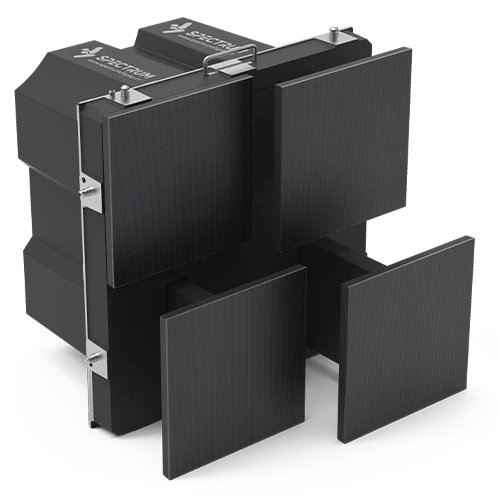
This is why the SPKO-250 uses ≥5,000 nits of outdoor brightness as one of its fundamental display specifications.
4. Beyond Brightness: How the SPKO-250 Balances Image Quality and Service Life
Achieving high brightness outdoors is never as simple as “turning up the LEDs.”
Higher brightness means more heat, greater thermal stress, and potentially faster LED degradation.
This means an outdoor kinetic screen must balance two competing requirements:
It needs to be bright enough to remain visible, but thermally stable enough for long-term operation.
The SPKO-250 addresses this balance through several system-level specifications.
High Refresh Rate: Reducing Flicker on Camera
Outdoor displays are frequently photographed and filmed by smartphones, professional cameras, and broadcast equipment.
At low refresh rates, visible scan lines or flicker can appear in recorded footage.
The SPKO-250 uses a high refresh rate to help maintain stable, clean images when the display is photographed or recorded.
For outdoor advertising and landmark installations, this matters because the screen is increasingly experienced not only by people standing in front of it, but also through social media videos, livestreams, and digital content.
Fine Grayscale: Preserving Detail at High Brightness
High-brightness output still requires smooth grayscale transitions.
The SPKO-250 supports fine grayscale processing, helping preserve gradation and shadow detail even when operating at high brightness.
This is particularly important for kinetic screen content.
As modules extend and retract, gradients between light and dark areas contribute to the perception of physical depth. Sufficient grayscale performance helps maintain these visual transitions.
Semi-Enclosed Self-Cooling: Managing Heat at High Brightness
Thermal management is one of the critical engineering challenges of any outdoor high-brightness display.
The SPKO-250 uses a semi-enclosed self-cooling structure designed to balance outdoor environmental protection with effective heat dissipation.
While helping protect the system against rain and dust, the structure also provides a thermal path for heat generated by the LEDs, drivers, and mechanical components.
This helps reduce excessive heat accumulation during high-brightness operation.
5. What Does High Brightness Mean for Physical 3D?
On an outdoor kinetic screen, 5,000 nits of brightness and 200mm of physical travel are two specifications that work together.
The motion stroke creates the shape. Brightness makes that shape visually readable.
When an LED module extends by 200mm, it creates real physical depth.
But that physical depth becomes visually powerful only when the display produces enough contrast for the viewer to distinguish the changing surface, shadows, and contours against the surrounding ambient light.
If brightness is insufficient, the visual impact of the 200mm stroke can appear compressed even though the mechanical movement itself has not changed.
The hardware still moves 200mm.
The audience simply perceives less of that depth.
Why P3.9 Makes Sense Outdoors
The P3.9 pixel pitch is also part of this engineering balance.
For long-distance outdoor viewing, P3.9 provides sufficient image density while avoiding the additional power consumption and thermal load that can come with unnecessarily high pixel density.
The objective is not to maximize every specification independently.
It is to find the right balance between:
viewing distance, brightness, pixel density, thermal performance, physical motion, and long-term reliability.
▶Video · YouTubeDifferent Forms. Endless Display Possibilities.Watch on YouTube →
6. Frequently Asked Questions (FAQ)
Q1: Is 5,000 nits really enough under direct midday sunlight?
A: 5,000 nits can be considered a practical baseline for maintaining strong visibility in demanding daylight conditions.
Under cloudy conditions or when the screen is not facing direct sunlight, this brightness level can provide excellent visibility.
However, a south-facing installation with no shading—particularly in a region with intense solar exposure—may face more demanding conditions around midday and in the afternoon.
For these projects, a customized solution above 6,000 nits may be worth evaluating, together with high-contrast content designed specifically for outdoor viewing.
Q2: Can I reduce the brightness to save power? Will that affect the kinetic effect?
A: Yes, but not mechanically.
Reducing LED brightness does not damage or reduce the physical motion stroke of the system.
However, it can weaken the perceived 3D impact.
Lower brightness reduces visual contrast, making shadows and physical depth less pronounced. If the content itself also has low contrast, viewers may barely notice the physical movement from a distance.
A better approach is to adjust brightness dynamically according to ambient light rather than keeping the display unnecessarily dim at all times.
Q3: Is 5,000 nits on the SPKO-250 the same as 5,000 nits on a conventional outdoor LED screen?
A: The numerical brightness value may be the same, but the engineering context is different.
The SPKO-250 must deliver high brightness while its LED modules repeatedly extend and retract through a 200mm physical stroke inside a mechanical display system.
This creates additional requirements for thermal management, power distribution, structural design, and long-term operational stability.
For a kinetic screen, the challenge is not simply achieving a peak brightness figure under laboratory conditions.
It is maintaining stable display performance while the mechanical system is continuously moving.
Q4: If my project is mainly used at night, do I still need 5,000 nits?
A: Yes.
Outdoor display brightness should generally be specified according to the most demanding expected lighting conditions, not only the primary operating period.
At night, brightness can be reduced significantly.
But if the hardware itself cannot reach the brightness required for daytime conditions, the display may become ineffective whenever it needs to operate during the day.
For outdoor media and landmark projects, daytime exposure can be just as commercially important as nighttime visibility.
Q5: Does high brightness accelerate LED aging?
A: Yes. Higher brightness generally creates greater thermal load, which makes thermal management especially important.
The SPKO-250 combines its high-brightness capability with a semi-enclosed self-cooling structure and system-level power management to control operating temperatures and reduce excessive thermal stress.
However, the service life of any high-brightness LED system is closely related to its actual operating temperature and brightness settings.
Using appropriate brightness scheduling—for example, reducing output at night—is an effective way to reduce unnecessary thermal load and support longer service life.
7. Conclusion
For an outdoor kinetic screen, 5,000 nits is not a decorative number on a specification sheet. It is what allows physical 3D movement to remain visually effective in daylight.
Key Takeaways
- Sunlight is the biggest competitor: Midday ambient illumination can reach tens of thousands of lux, dramatically reducing the perceived contrast of an outdoor display.
- ≥5,000 nits provides a practical daylight baseline: It helps maintain strong visibility under bright outdoor conditions, while highly exposed installations may require 6,000–8,000 nits depending on the site.
- Brightness protects the physical 3D effect: Without sufficient contrast, the shadows and contours created by a 200mm physical motion stroke can become visually washed out, weakening the kinetic effect.
- The SPKO-250 is engineered as a system: ≥5,000 nits brightness works together with a high refresh rate, fine grayscale, P3.9 pixel pitch, and semi-enclosed self-cooling structure to balance daylight visibility, physical 3D impact, thermal management, and long-term operation.
For more information about the SPKO-250 or to discuss brightness requirements for a specific outdoor kinetic screen project, contact the Spectrum Display team through its official website.