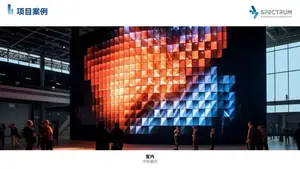
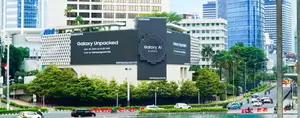
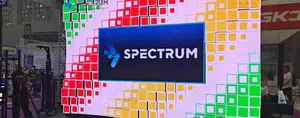
One-sentence definition: A high-end bar in Singapore transformed its ordinary ceiling into a breathing, rhythmic dynamic art installation by deploying Spectrum Display's SPKI-160 Kinetic Screen. This 1440×3840mm physical 3D matrix has redefined the visual experience of nightlife spaces.
Table of Contents
Project Background: A High-End Bar's Spatial Upgrade Needs in Singapore
Why Choose a Ceiling-Mounted Kinetic Screen
Project Solution in Detail
Project Results and Value
Extended Application Scenarios for Ceiling-Mounted Kinetic Screens
Frequently Asked Questions (FAQ)
Summary
I. Project Background: A High-End Bar's Spatial Upgrade Needs in Singapore
As Southeast Asia's core hub for nightlife and premium consumption, Singapore's top bars and clubs compete not just on beverages and service, but increasingly on visual installations. Traditional lighting strips, projections, and static LED screens no longer satisfy the new generation of consumers' demand for "immersion" and "shareability."
Against this backdrop, a high-end bar in Singapore decided to upgrade its ceiling. The project's core requirements included:
Elevating spatial memorability: Creating a visual anchor that stuns customers upon entry and drives spontaneous photo sharing
Delivering dynamic ambiance: Screen motion that changes with music rhythm, synchronized with lighting and sound effects
Preserving usable floor space: As a ceiling-mounted solution, it must not consume valuable operational area
Supporting long-term content refresh: The installation must adapt to different themed parties rather than remaining static
II. Why Choose a Ceiling-Mounted Kinetic Screen?
The Pain Points of Traditional Ceiling Decor
Most bar ceilings use static decoration — gypsum molding, light strips, mirrors, or simple LED screens. These solutions have clear limitations: lack of variation, easy to copy, and unable to create a true "wow effect."
How the Kinetic Screen Solves the Problem
By combining "screen" with "motion" into one system, the Kinetic Screen opens entirely new possibilities for ceiling spaces:
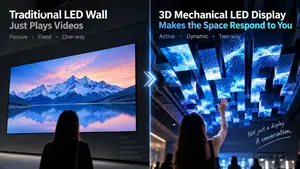
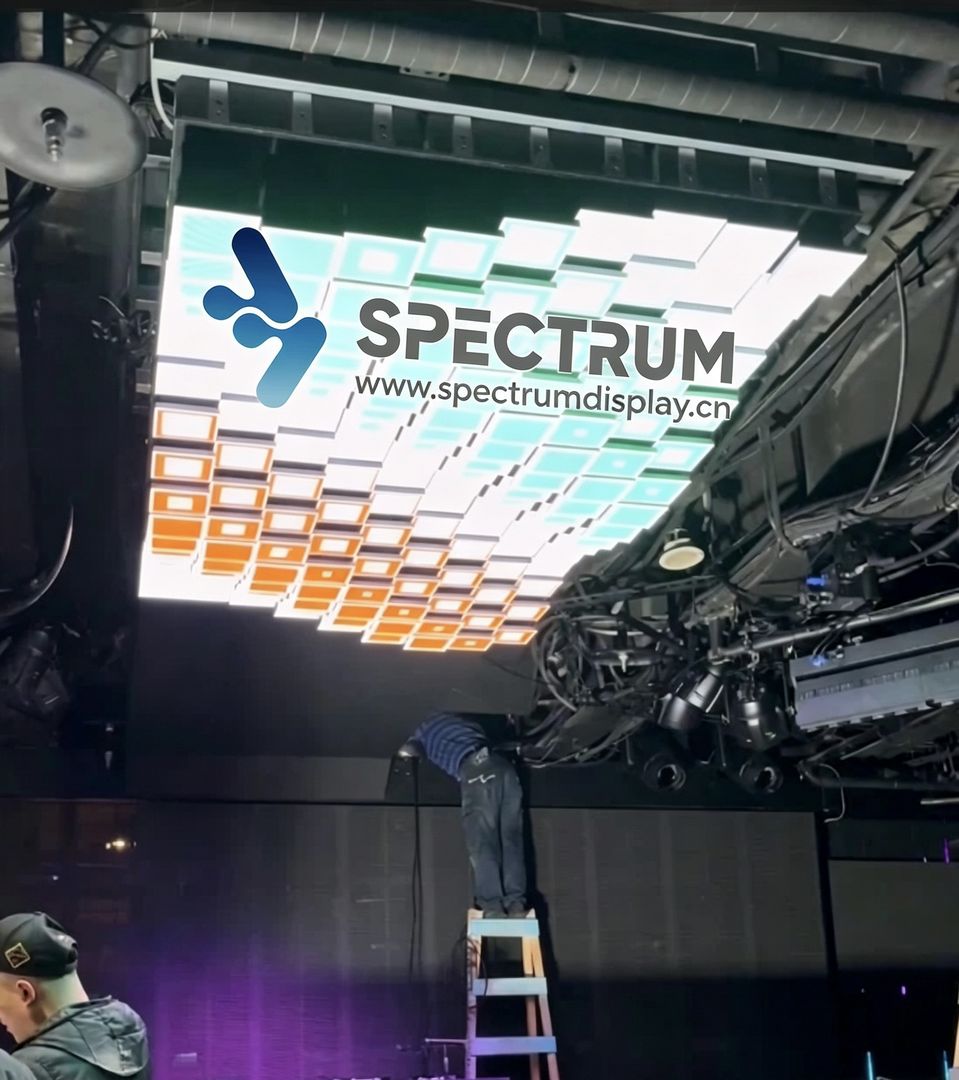
Physical 3D dynamic visuals: Screen units physically extend and retract with music rhythm, creating waves, undulations, and matrix transformations — visual impact far beyond flat displays
Looking up, immersive down: Ceiling mounting gives customers the feeling of "the sky is breathing" when they look up — differentiating from eye-level or floor-level installations
Programmable shapes: Through DMX512/ArtNet integration with lighting consoles, screen motion syncs with music rhythm and lighting effects at millisecond precision
III. Project Solution in Detail
Product Selection: SPKI-160
The project selected Spectrum Display's SPKI-160 indoor Kinetic Screen based on the following rationale:
Consideration | SPKI-160 Solution |
|---|---|
Ceiling load limits | Lightweight die-cast aluminum cabinet, only 52kg/m² |
Limited ceiling height | Chassis depth just 330mm, finished surface ≤350mm |
Easy maintenance access | Front maintenance support — no need for overhead access space |
Silent operation | Self-developed bus-type servo system, quiet operation doesn't interfere with music experience |
Rapid response | Full-stroke motion <0.5s for precise music beat synchronization |
Key selection decision: Bar ceilings typically face two challenges — "limited height" and "no rear maintenance access." SPKI-160's 330mm ultra-thin chassis + front-maintenance design makes it the only viable solution for ceiling-mounted scenarios.
Project Specifications
Item | Detail |
|---|---|
Installation Method | Ceiling mounting (upward-facing) |
Screen Dimensions | 1440mm (H) × 3840mm (W) |
Total Area | Approx. 5.53m² |
Motion Units | Approx. 88 independent units (16 units/m²) |
Module Gap | <1.5mm |
Maximum Stroke | 200mm |
Control Solution | DMX512 integration with bar lighting control system |
Control and Content Solution
Music synchronization: DMX512 protocol binds screen motion to live DJ music rhythm — "rhythm equals screen motion"
Preset scene modes: Welcome Mode (slow undulation), Warm-up Mode (fast rhythmic motion), Climax Mode (full-stroke dynamic impact)
Content updates: Switch modes anytime via mobile APP or control console, customizing for different themed parties
IV. Project Results and Value
Visual Impact: The Breathing Ceiling
When screen units extend, retract, undulate, and wave with music rhythm, the entire ceiling appears to come alive. This "physical 3D" dynamic effect is fundamentally different from projections or flat LED visual effects — it's real, tangible spatial motion.
Spatial Memorability: Customer-Driven Social Sharing
In the social media-driven consumer era, a bar's "photogenic" quality directly affects its popularity. The Kinetic Screen ceiling's dynamic visuals are striking, becoming the bar's most recognizable spatial signature. Customer photo and short-video sharing has increased significantly, generating secondary social media exposure.
Atmosphere Creation: Deep Integration with Music, Lighting, and Performance
The Kinetic Screen's greatest value lies not in "moving" alone, but in "synchronized moving." Through seamless DMX512 integration, the screen's motion rhythm, amplitude, and frequency synchronize with live music, lighting, and even performer movements at millisecond precision — delivering a truly integrated audio-visual-mechanical experience.
V. Extended Application Scenarios for Ceiling-Mounted Kinetic Screens
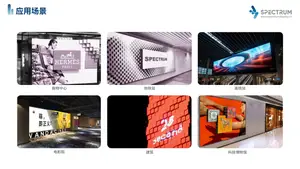
This project model can be replicated across the following scenarios:
Scenario | Application Value | Recommended Model |
|---|---|---|
High-End Bars/Nightclubs | Ceiling dynamic installation — "breathing ceiling" | SPKI-160 |
Shopping Mall Atriums | Suspended dynamic art installation, attracting foot traffic | SPKI-128/160 |
Brand Showrooms | Ceiling dynamic matrix, evolving with brand narrative | SPKI-128 |
Launch Event Stages | Overhead Kinetic Screen for product reveals, creating ceremony | SPKI-250 |
Airports/High-Speed Rail Stations | Large-scale ceiling public art installations | SPKO-320/500 |
VI. Frequently Asked Questions (FAQ)
Q1: How is the ceiling load issue addressed?
A: SPKI-160 uses a lightweight die-cast aluminum cabinet design at just 52kg/m². Standard steel structural supports can bear the load — no major structural reinforcement required, significantly lowering the engineering threshold.
Q2: Is it suitable for limited ceiling heights?
A: Yes. SPKI-160 has a chassis depth of just 330mm, with a finished surface thickness ≤350mm (including necessary ventilation clearance). Compared to traditional Kinetic Screens requiring 600mm+, this dramatically reduces ceiling height requirements. Most standard commercial spaces can accommodate it.
Q3: Will mechanical noise interfere with the music experience in a noisy bar environment?
A: No. SPKI series uses a self-developed bus-type servo system that runs significantly quieter than traditional stepper motors. Combined with FOC algorithm and 100% closed-loop control, the mechanical noise is barely perceptible even during relatively quiet off-peak hours.
Q4: How is maintenance handled without removing the ceiling?
A: No ceiling removal needed. SPKI-160 supports full front maintenance — LED modules and core mechanical components can be accessed, removed, and replaced entirely from the front. Technicians don't need to enter the ceiling cavity, preserving the ceiling structure and significantly reducing maintenance costs and complexity.
Q5: Can the Kinetic Screen synchronize with music?
A: Yes. The entire SPKI series is compatible with DMX512/ArtNet/sACN standard stage protocols out of the box. Direct integration with lighting consoles (e.g., grandMA) allows music rhythm signals to drive screen motion commands, delivering synchronized audio-visual-mechanical integration.
Q6: How is content updated? Is programming required?
A: No programming required. The bundled Mshow4 zero-code control software lets operators编排 motion sequences directly from a computer. The mobile APP also enables one-touch preset switching for rapid themed party content changes.
VII. Summary
The Singapore bar ceiling project is a landmark case for Spectrum Display's SPKI-160 Kinetic Screen in commercial entertainment spaces.
Project Core Values:
Precise selection: 330mm ultra-thin chassis + front maintenance — the only solution for space-constrained ceiling installations
Efficient installation: Lightweight cabinet design — no structural reinforcement, no reserved maintenance access required
Visual impact: Physical 3D dynamic matrix creates a "breathing ceiling"
Operational flexibility: DMX512 music synchronization, one-touch mode switching via mobile APP
Long-term viability: Supports ongoing content updates for different themed party requirements
Recommendations for Bar/Nightclub Owners:
Ceiling height ≥3.5m is sufficient for a ceiling-mounted Kinetic Screen solution
Design lighting and sound systems concurrently for maximum effect
Reserve DMX512 control pathways for future content iteration
Further Reading:
What Is a Kinetic Screen? A Complete Guide from Exhibition Rental to Outdoor Advertising
How to Install a Kinetic Screen in a Narrow Showcase Window? SPKI-160 "330mm Ultra-Thin + Front Maintenance" Is the Perfect Answer
Indoor Kinetic Screen Selection Guide: How to Choose SPKI-128, 160, 250
About this case study: This article is based on Spectrum Display's SPKI-160 ceiling-mounted Kinetic Screen project for a high-end bar in Singapore (dimensions: 1440×3840mm). Project parameters and product specifications are derived from Spectrum Display internal project records and published product documentation. Control logic and protocol compatibility descriptions are based on SPKI series product specifications. For more project details or custom solutions, please contact Spectrum Display via www.spectrumdisplay.cn.