Why Are More High-End Spaces No Longer Satisfied with Standard LED Displays?
One-sentence definition:
While standard LED displays are still playing videos, high-end spaces are already looking for screens that can do more than display — screens that can express. The next upgrade is not simply bigger size or higher brightness, but a display system that allows the space itself to become part of the experience.
Contents
- When “Having a Screen” Is No Longer an Advantage
- The Refined Dilemma of Standard LED Displays
- A New Demand in High-End Spaces: From Playback to Expression
- How Kinetic LED Screens Respond to Three Core Needs of High-End Spaces
- Which High-End Spaces Are Already Upgrading Their Screens?
- Conclusion: From Content Player to Spatial Participant
1. When “Having a Screen” Is No Longer an Advantage
Ten years ago, installing a large LED display on the wall of a high-end store was already a competitive advantage.
Large enough, bright enough, clear enough — these used to be the qualities that helped brands stand out from their competitors. Today, they have become the baseline.
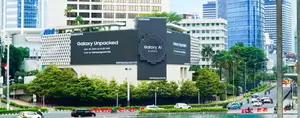
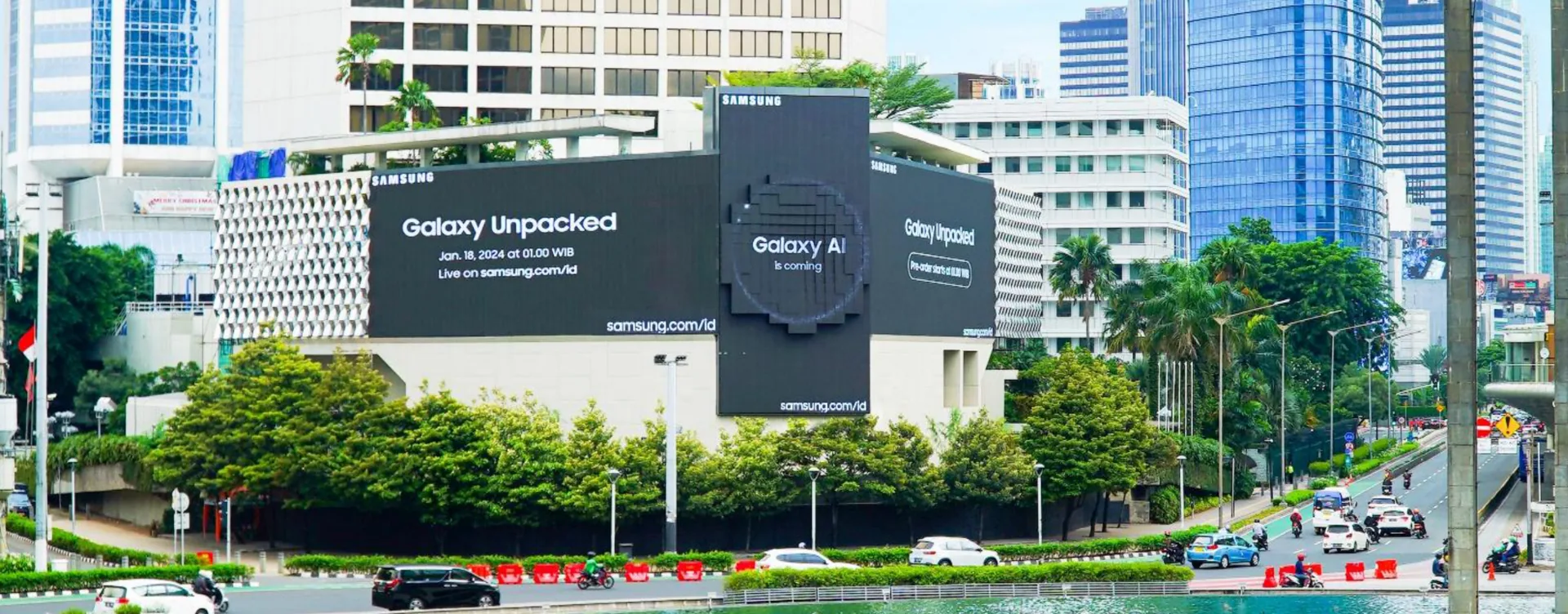
Walk into almost any premium shopping mall, and you will find that nearly every store is using a large screen to play brand videos or promotional content.
When screens are everywhere, simply having a screen is no longer an advantage.
Even worse, once screens become too similar, they begin to lose their effect.
A fixed screen may feel impressive the first time, familiar the second time, and invisible the third time.
In an overloaded commercial environment, standard LED displays are shifting from tools that attract attention to background surfaces that are easily ignored. The consumer’s brain automatically categorizes similar-looking screens as visual noise.
They are seen, but not remembered.
This is why more high-end spaces are beginning to rethink the real value of a display.
2. The Refined Dilemma of Standard LED Displays
Standard LED displays are not bad.
In fact, they have become so good, so mature, and so widely available that almost every brand can use them. As a result, audiences have become immune to them.
This “refined dilemma” appears in three ways.
Dilemma 1: Fixed, So It Is Easy to Ignore
Once a standard LED display is installed, it usually appears in the same form and in the same position.
Human attention naturally decreases toward things that do not change. No matter how refined the content is, a fixed screen becomes part of the background after people pass by it several times.
Dilemma 2: Two-Dimensional, So It Lacks Depth
A standard LED display is essentially a flat combination of the X-axis and Y-axis.
No matter how beautiful the visuals are, they still remain on a flat plane. There is no real depth, no volume, and no physical presence.
Consumers see content, but they do not feel the space.
In high-end commercial environments, spatial presence is a key part of brand identity.
Dilemma 3: One-Directional, So It Cannot Create Dialogue
The logic of a standard display is playback.
The brand outputs content, and the audience receives it passively.
This one-way communication model is becoming less effective in an age of information overload. Audience dwell time has become one of the scarcest resources, and passive playback is not enough to extend it.
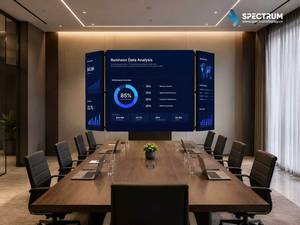
As many industry observers have noted, large flat LED displays have carried most of the visual communication in commercial and exhibition spaces over the past decade. But when screens are everywhere, audiences gradually develop visual fatigue, and the one-way model of passive visual reception starts to fail.
Today’s digital spatial design requires media that can do more than shine.
It needs to breathe.
3. A New Demand in High-End Spaces: From Playback to Expression
When standard LED displays can no longer fully meet the needs of premium spaces, high-end brands begin to look for a new answer.
By 2026, the role of LED displays in commercial spaces is changing noticeably.
In the past, display systems in brand stores were mainly used for advertising, promotional messages, and one-way brand communication. But in the next generation of immersive brand spaces and smart retail environments, LED display systems are increasingly becoming the core carrier of spatial design, content operation, user interaction, and brand experience.
Behind this shift are three new demands from high-end spaces.
Demand 1: The Screen Must Create Memory, Not Just Deliver Information
In the age of social media-driven consumption, the value of a space is not only about what it provides, but also about what people remember.
A memorable space can be shared.
A shareable space can continue to attract traffic.
Standard LED displays deliver information, but they rarely create memory. Watching a video is usually not a moment worth remembering.
Demand 2: The Screen Must Respond to People, Not Just Play Content
The new generation of consumers no longer wants to be simply informed.
They want to be invited into an experience.
When they enter a space, they expect the space to respond to them. Standard playback cannot build this connection, because playback is one-way, while response is two-way.
Demand 3: The Screen Must Belong to the Space, Not Just Occupy a Wall
In a high-end commercial space, a screen should not feel like an added patch on the wall.
It should become part of the space itself.
It should work with the architecture, lighting, materials, and atmosphere as an integrated whole, rather than appearing as something simply mounted onto the surface.
The core narrative of high-end commercial spaces is shifting:
from seeing the brand to participating in the brand.
▶Video · YouTubeTouch It. Watch It React.Watch on YouTube →
4. How Kinetic LED Screens Respond to Three Core Needs of High-End Spaces
The emergence of Kinetic LED Screens directly responds to these new demands.
They allow a screen to evolve from a fixed content player into a spatial participant that can rise, retract, transform, and breathe.
Response 1: Physical Movement Creates a Memorable Moment
The human brain is far more sensitive to movement than to stillness.
Throughout evolution, humans needed to detect moving objects quickly — whether they were prey, danger, or opportunity. This instinct still shapes visual attention today.
When a wall begins to move, extend, retract, or change its physical form, it triggers attention in a completely different way.
It is not just a brighter light.
It is a different visual signal.
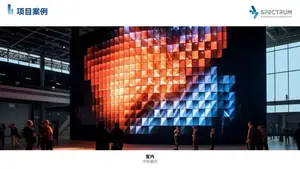
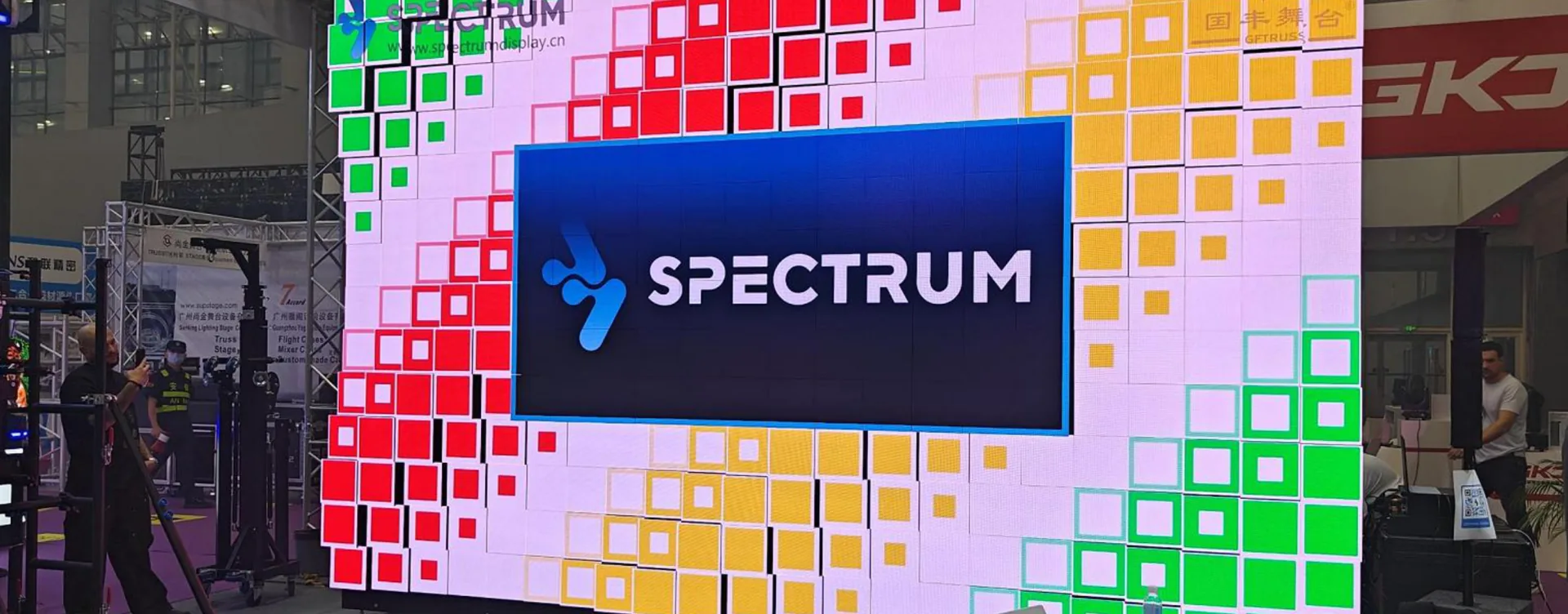
At ISLE 2026 in Shenzhen, the Spectrum Display booth attracted large crowds. A giant wall made of hundreds of independent modules seemed to come alive. When visitors approached, the wall moved back. When they waved, the screen reproduced the outline of their body movement with precision.
Response 2: Physical Interaction Creates Human-Screen Dialogue
A Kinetic LED Screen uses physical Z-axis movement to create real-time dialogue with the audience.
When a visitor approaches, the screen retreats.
When a visitor waves, the screen responds.
This physical interaction creates a conversational relationship between people and the screen.
The audience is no longer an observer.
They become a participant.
At ISE 2026, this human-screen interaction experience generated strong social media attention. While “playing with the advertisement,” visitors naturally filmed and shared the moment online.
For brands, this is more than onsite traffic attraction.
It is low-cost, high-efficiency secondary exposure.
Response 3: Refined Engineering Allows the Screen to Blend into the Space
In high-end indoor display environments, one major pain point of traditional mechanical screens has always been visible gaps.
To prevent moving modules from interfering with one another, conventional mechanical screens often require 2–3mm physical gaps. This can create a black grid across the display surface and damage the premium feel of the space.
Spectrum Display’s SPKI-128 uses proprietary LED offset technology to achieve an ultra-narrow physical gap of 0.5mm while ensuring safe high-speed module movement.
At normal viewing distance, the tiny gap is visually hidden, creating a visually seamless 0mm viewing effect.
With up to 800mm/s high-speed servo response and a visually seamless surface, the mechanical module structure becomes less like a rigid display matrix and more like a continuous digital fabric that can move naturally through space.
When the gaps disappear, the movement becomes smooth, and the response feels natural, the screen is no longer something installed onto the space.
It becomes part of the space.
▶Video · YouTubeISLE 2026 SHOWSTOPPER! The Ultimate Zero-Code Kinetic ScreenWatch on YouTube →
5. Which High-End Spaces Are Already Upgrading Their Screens?
Luxury Retail: SKP, MixC, and Premium Shopping Malls
In premium commercial spaces such as SKP and MixC, where every square meter carries high value, luxury brand stores are beginning to replace static display walls with Kinetic LED Screens.
With 0.5mm micro-gap technology, SPKI-128 delivers a near seamless visual experience at close viewing distance, meeting the high detail standards of luxury retail environments.
Brand Launch Events: Coca-Cola World Cup
At the Coca-Cola World Cup launch event, Spectrum Display created an SPKI-250 dynamic Kinetic LED display system for the venue.
Brand visual elements were presented through physical movement. The screen was no longer just a background. It became part of the performance.
The most memorable moment of the launch was not only a celebrity appearance or a product reveal.
It was the breathing Coca-Cola wall.
High-End Entertainment Spaces: Singapore Bar
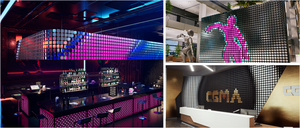
In a high-end bar in Singapore, an SPKI-160 Kinetic LED Screen was installed on the ceiling with a size of 1440 × 3840mm.
The installation transformed a standard ceiling into a dynamic art piece that could move and breathe.
As the screen units extended, retracted, and moved with the rhythm of the music, the entire ceiling seemed to come alive.
Guests naturally took photos and videos, creating secondary exposure on social media.
Industry Trend Indicator: ISE 2026
At ISE 2026, one of the most influential professional audiovisual exhibitions in the world, the Kinetic LED Screen was recognized among the top creative LED installations.
Industry discussion has moved beyond whether LED works.
The new question is how LED can work better in real-world spaces, with portability, sustainability, and architectural flexibility becoming increasingly important.
Professional media outlet Pixel Inspiration described Spectrum’s kinetic screen panels as being able to physically extend and retract according to touch or content commands, creating depth and focus. For retail and corporate environments, it was described as a compelling way to guide attention and create memorable moments.
▶Video · YouTubeSpectrum Display SPKI-160 Kinetic Screen | 3D Kinetic LED Screen for Luxury EventsWatch on YouTube →
6. Conclusion: From Content Player to Spatial Participant
While standard LED displays are still playing videos, high-end spaces are already looking for screens that can express more.
Key Takeaways
- Standard LED displays are losing impact.
When screens are everywhere, simply having a screen is no longer an advantage. Fixed, flat, one-way playback is becoming easier for audiences to ignore. - High-end spaces need expression, not just playback.
A screen must create memory, respond to people, and integrate into the space. The focus is shifting from seeing the brand to participating in the brand. - Kinetic LED Screens respond to these needs.
Physical movement creates memorable moments. Physical interaction enables human-screen dialogue. Refined engineering allows the display to become part of the space. - Real projects are proving the trend.
From luxury retail stores to the Coca-Cola World Cup launch, from the Singapore bar project to ISE 2026, high-end spaces are already investing in displays that go beyond playback.
Recommendations for Brands and Space Operators
Reconsider your space.
When consumers walk in, is the screen playing content, or is it expressing the brand?
If the answer is playback, the space may already be fading into the background.
If the answer is expression, the space is becoming an experience people can remember.
For more product details or a customized project proposal, contact the Spectrum Display team through: