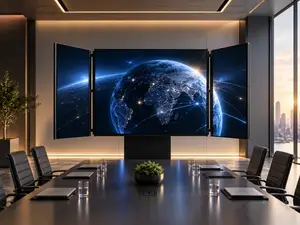
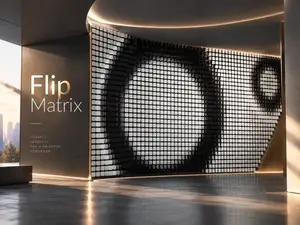
What Does It Take to Deliver a Complex LED Project from Concept to Completion?
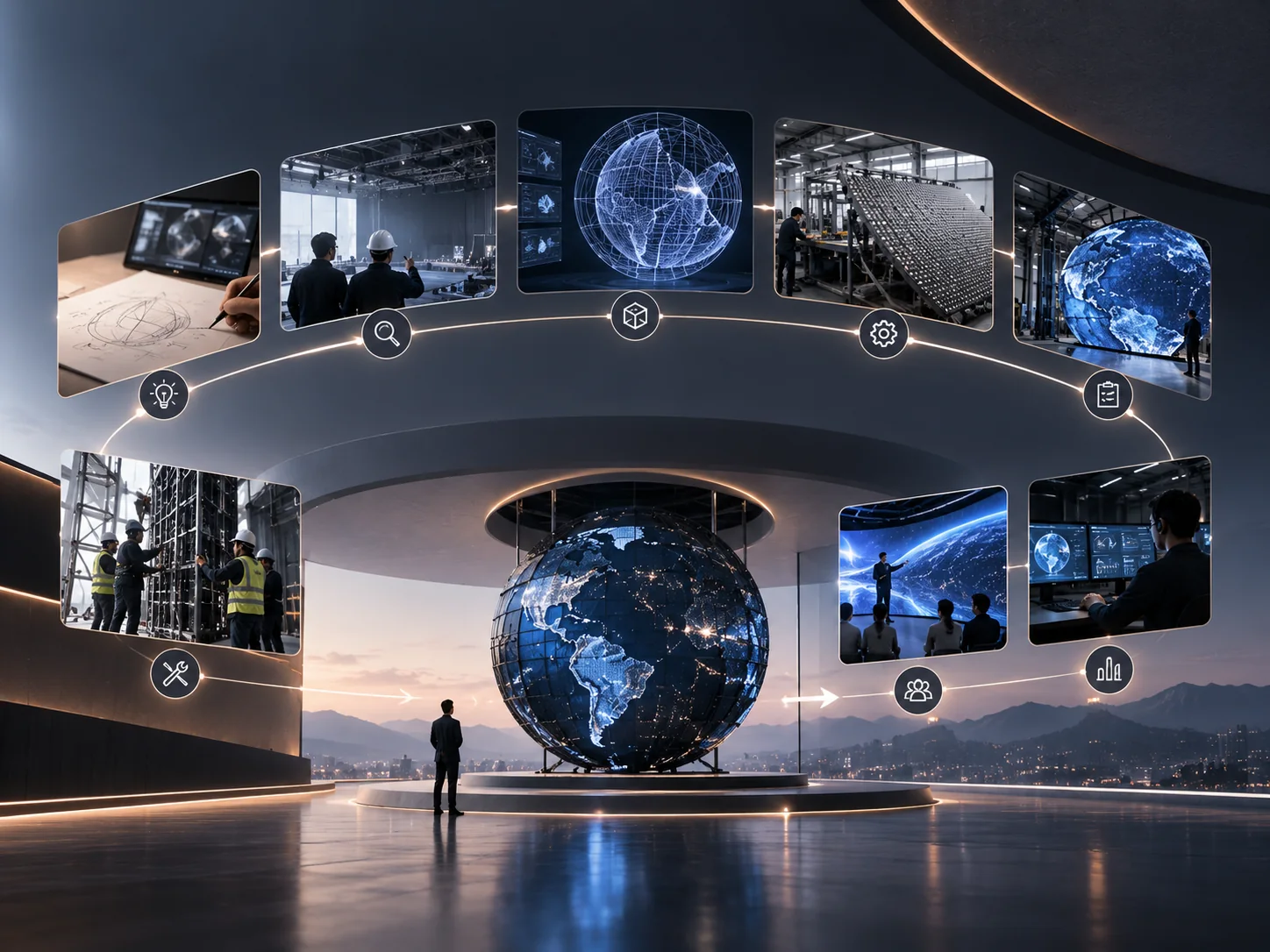
One-sentence definition: A complex LED project is not simply a transaction where you “buy a screen and install it.” It is a systematic engineering process covering requirements analysis, site survey, solution design, custom manufacturing, factory testing, onsite installation, training and handover, and long-term maintenance. In this process, Spectrum Display acts not merely as an equipment supplier, but as a full-process creative engineering partner that turns concepts into real-world installations.
Contents
- Where Complex LED Projects Begin: An Idea That Standard Solutions Cannot Deliver
- Step 1: Understanding the Concept — Translating a “Feeling” into Engineering Language
- Step 2: Site Survey — Buildings Do Not Adapt to Products, but They Can Be Understood
- Step 3: Solution Design — From Concept to Buildable Engineering Drawings
- Step 4: Custom Manufacturing — Rehearsing the Installation in the Factory
- Step 5: Installation & Commissioning — The Final 100 Meters
- Step 6: Training & Handover — True Delivery Means the Client Can Operate Independently
- Step 7: Long-Term Maintenance — Delivery Is Not the End
- Frequently Asked Questions
- Conclusion
1. Where Complex LED Projects Begin: An Idea That Standard Solutions Cannot Deliver
In the LED display industry, many projects begin with an RFQ:
“I need an LED screen of this size. Please send me a quotation.”
But projects that genuinely require complex engineering rarely begin with a specification sheet.
They often begin with a question, a description, or even a single sentence:
“I want a wall that normally looks like part of the architecture, but can transform into a display when needed.”
“The ceiling is empty. Can we make it move?”
“We want visitors to walk into our brand space and immediately say, ‘Wow.’”
There is no pixel pitch, power requirement, or cabinet specification in these requests.
There is only a creative idea.
Spectrum Display’s role is to turn that creative idea into a physical mechanical LED installation that can be manufactured, installed, operated, and maintained reliably over the long term.
This is not simply about selling a screen.
It is a complete engineering journey from concept to reality.
Based on Spectrum Display’s engineering experience, early-stage planning and design have a major influence on the success of a complex LED project. Problems discovered only during installation can be difficult and expensive to resolve, while many potential conflicts can be identified and eliminated during the design stage.
2. Step 1: Understanding the Concept — Translating a “Feeling” into Engineering Language
When a client says, “I want a wall that moves,” Spectrum Display’s engineers do not immediately ask, “What size?”
They begin with three questions.
“What is this space used for?”
Is it a brand showroom, a product-launch stage, or a kinetic ceiling inside a bar?
Different environments require completely different movement characteristics.
A corporate showroom may require restrained, precise movement.
A product launch may call for dramatic motion and a stronger sense of ceremony.
A nightlife venue may need rhythmic, immersive movement synchronized with lighting and music.
“How do you want the audience to feel?”
This is one of the most important questions.
The ultimate objective of a creative LED project is not simply:
“The screen moves.”
It is:
“The audience remembers the experience.”
Spectrum Display’s engineering team therefore spends significant time during the early project stage discussing experiential goals with the client.
Should the space feel futuristic or sophisticated?
Should the audience feel surprised or overwhelmed?
These descriptions may sound abstract, but they eventually become specific engineering decisions involving motion speed, travel distance, movement sequences, materials, lighting, and surface finishes.
“What constraints could affect the concept?”
Budget, schedule, architecture, installation depth, structural capacity, maintenance access, power, and control systems all define the boundaries of the project.
These constraints are not the enemy of creativity.
They are the conditions within which the engineering solution must work.
Understanding the concept is therefore the first step in building trust between Spectrum Display and the client.
A true creative engineering partner does not simply execute whatever the client asks for.
It helps transform an unclear idea into a clear and buildable solution.
▶Video · YouTubeWhere Creative Vision Meets Engineering Excellence — large-scale custom kinetic LED wallsWatch on YouTube →
3. Step 2: Site Survey — Buildings Do Not Adapt to Products, but They Can Be Understood
Once the concept has been defined, Spectrum Display’s engineering team moves to a stage that many conventional display suppliers may overlook:
the site survey.
Buildings can resist an LED concept in many different ways.
Limited Space
In premium commercial environments, every centimeter can determine whether an installation is feasible.
For a premium bar project in Singapore, the client wanted to install a kinetic LED screen on the ceiling.
But ceiling depth was limited, and there was no space for a rear maintenance corridor.
Conventional mechanical LED configurations were therefore unsuitable.
After evaluating the site conditions, Spectrum Display selected the SPKI-160, combining a 330mm ultra-slim body with front maintenance to address the installation constraints.
Non-Standard Dimensions
In another custom project, the architectural requirement called for a display approximately 13.5 meters wide and 3.12 meters high.
No standard cabinet configuration could directly match the required geometry.
Instead of forcing the architecture to adapt to a standard LED product, Spectrum Display worked from the architectural drawings and developed customized 180 × 240mm LED modules for each 900mm-wide folding section.
Structural Constraints
Can the wall support the system?
Can the ceiling structure carry a suspended mechanical display?
Have sufficient power and signal routes been reserved?
Where will technicians access the system for future maintenance?
These invisible constraints often become the biggest problems later in a project.
The purpose of a site survey is simple:
A solution that looks feasible on a drawing may be completely impractical onsite.
By working with the client, architect, designer, and contractor during the early stage, engineering constraints can be identified before they become installation problems.
The earlier a limitation is discovered, the earlier a solution can be engineered around it.
4. Step 3: Solution Design — From Concept to Buildable Engineering Drawings
Once the concept is understood and the site conditions are clear, the project moves into solution design.
This is not simply a matter of selecting a product model.
It means designing a complete solution around the space, creative concept, architectural conditions, and operational requirements.
Mechanical Design: Making the Display Part of the Architecture
For space-constrained installations, the SPKI-160 reduces the system body depth to 330mm, with a finished installation depth of approximately 350mm.
This allows the kinetic LED surface to sit close to the wall or ceiling rather than requiring a large mechanical cavity.
For larger projects, the SPKI-250 uses 248.5 × 248.5mm motion units, with only 16 units per square meter, helping reduce the control complexity of large-scale installations.
Motion Control Design: Connecting Digital Content with Physical Movement
Spectrum Display uses a distributed motion-control architecture designed for large numbers of independently controlled mechanical units.
A single communication channel can support 48 motion axes, while the overall network architecture can scale to as many as 65,536 motion terminals.
The system can also be integrated into professional show-control workflows, allowing kinetic movement to work alongside lighting, interactive systems, and digital content.
Instead of treating motion as a separate technical layer, the objective is to make physical movement part of the content itself.
Surface and Material Design: Making the Display Belong to the Space
Color, material, texture, and finish can all become part of the customization process.
In a custom folding LED project, the closed display was designed to visually integrate with the surrounding architecture.
A black display surface combined with a wood-grain finish created a more harmonious relationship with the predominantly white interior.
The display therefore did not look like an independent piece of equipment added later.
It became part of the spatial design.
Digital Simulation: Installing the Project Virtually Before Going Onsite
Digital simulation allows motion paths, extension sequences, clearances, and potential mechanical interference to be evaluated before installation.
Using Spectrum Display’s content and motion-control workflow, the project team can preview how the physical surface will move before the system reaches the venue.
The objective is to resolve as many motion and coordination issues as possible in a virtual environment before onsite commissioning begins.
▶Video · YouTubeWhen Content Moves Beyond the Screen — making physical movement part of the contentWatch on YouTube →
5. Step 4: Custom Manufacturing — Rehearsing the Installation in the Factory
Once the engineering design is finalized, manufacturing begins.
Spectrum Display’s manufacturing process covers multiple layers of the system, from control electronics and mechanical structures to LED module integration and final system assembly.
But for a custom mechanical LED project, manufacturing individual components is only part of the job.
The Screen Needs to “Come Alive” in the Factory First
Before formal delivery, a custom mechanical LED installation should be assembled, powered, tested, and pre-commissioned in the factory.
Motion units need to be checked for consistency.
Mechanical sequences need to be tested repeatedly.
Display and motion systems need to operate together.
Control interfaces need to be verified before the equipment reaches the project site.
For systems such as Flip Matrix, this also means testing the coordinated movement of individual units and verifying integration with the intended control workflow.
The purpose of this factory rehearsal is straightforward:
reduce uncertainty onsite.
For a complex installation, every problem solved in the factory is one less problem that needs to be solved under time pressure at the venue.
▶Video · YouTubeFrom Automated Craftsmanship to Stunning Visual Reality — manufacturing and factory testingWatch on YouTube →
6. Step 5: Installation & Commissioning — The Final 100 Meters
When the equipment reaches the project site, the project enters its final engineering stage.
Spectrum Display’s engineering team can provide installation guidance and system commissioning according to the requirements of the project.
Installation Architecture Based on the Site
For indoor projects with restricted maintenance space, models such as SPKI-128 and SPKI-160 can use front-maintenance architecture.
LED modules and key internal mechanical components can be accessed directly from the display side, reducing the need for a rear service corridor.
For large permanent or outdoor installations using rear-maintenance architecture, sufficient service access should be planned during the early project stage.
Maintenance is not something that should be considered after installation.
It needs to be designed into the project from the beginning.
System Commissioning: Synchronizing Content and Physical Movement
Mechanical installation is only the beginning.
The real challenge is ensuring that the physical movement of the display matches the digital content.
Onsite commissioning may therefore include:
- Motion calibration
- Position verification
- Display and movement synchronization
- Sequence optimization
- Environmental parameter adjustment
- Control-system integration
This is where a collection of individual LED and mechanical components becomes one coordinated kinetic system.
Safety Testing: When People Come Close, the Machine Must Respond
A mechanical LED installation exists in a physical environment where people may come close to moving components.
Safety therefore needs to be considered at both the mechanical and control levels.
Movement limits, resistance detection, emergency-stop logic, operating zones, and project-specific safety measures should be tested before the installation enters normal operation.
No visual effect is worth compromising safety.
▶Video · YouTubeFrom Installation to Motion — onsite installation and commissioningWatch on YouTube →
7. Step 6: Training & Handover — True Delivery Means the Client Can Operate Independently
The final stage of delivery is not simply switching the screen on.
It is training.
Depending on the project, Spectrum Display can train the client’s technical or content team on the system’s operation and content workflow.
This may include:
- Creating and managing motion sequences
- Preparing content for kinetic playback
- Using the control software
- Managing presets
- Starting and stopping the system
- Performing routine checks
- Understanding basic maintenance procedures
A project is truly delivered only when the client can operate it independently.
Training is therefore not an optional extra.
It is part of the engineering handover.
The value of a complex LED installation should not be measured only by how impressive it looks on opening day.
The real test is whether, years later, the system can still operate reliably while the client continues creating new experiences with it.
8. Step 7: Long-Term Maintenance — Delivery Is Not the End
The lifecycle of a complex LED project is measured in years.
That means maintenance architecture needs to be considered from the very beginning.
Spectrum Display provides project support covering planning, solution design, installation, commissioning, and after-sales maintenance.
For outdoor systems, rear-maintenance architecture can provide dedicated service access for technicians.
For space-constrained indoor projects, front-maintenance models such as SPKI-160 allow LED modules and key components to be serviced from the display side without dismantling surrounding architectural structures.
This reduces the disruption associated with routine servicing and component replacement.
Delivery is not the end of the project. It is the beginning of the system’s operational life.
9. Frequently Asked Questions
Q1: How Long Does a Complex LED Project Usually Take from Concept to Delivery?
A: It depends on the complexity of the project.
Requirements analysis, structural engineering, prototype verification, manufacturing, factory testing, installation, and commissioning can take anywhere from several weeks to several months.
Projects involving custom mechanical structures, unusual architecture, or extensive system integration generally require more time during the engineering stage.
Q2: What Is the Biggest Risk in a Complex LED Project?
A: One of the biggest risks is a mismatch between the display system and the actual installation environment.
Structural capacity, installation depth, maintenance access, power availability, signal routing, environmental conditions, and architectural tolerances can all affect feasibility.
This is why site surveys and early engineering planning are critical.
Q3: What Role Does Spectrum Display Play in a Project?
A: Spectrum Display is not simply an LED screen supplier.
It provides mechanical LED system manufacturing and engineering support covering requirements analysis, system design, product development, manufacturing, installation coordination, commissioning, and technical consultation.
The objective is to transform a creative idea into a buildable, operable, and maintainable spatial experience.
Q4: How Are Digital Content and Physical Movement Synchronized?
A: Spectrum Display provides a content and control workflow that can support professional motion design and interactive development.
Tools and integrations can be used to create movement sequences, coordinate digital visuals with physical motion, and connect the kinetic system with broader show-control environments.
For complex projects, motion and content should be designed together rather than treated as two separate systems.
Q5: What Support Is Available After Project Delivery?
A: Post-delivery support can include spare-parts support, remote technical assistance, onsite engineering support when required, system maintenance, and ongoing technical consultation.
Maintenance strategy depends on the installation architecture.
Indoor front-maintenance systems can be serviced from the display side, while large outdoor or rear-maintenance systems require dedicated service access planned into the structure.
Q6: What Types of Projects Require Complex LED Engineering?
A: Complex LED engineering becomes particularly important when a project involves:
- Non-standard architectural conditions, such as curved or irregular walls
- Limited installation depth
- Ceiling-mounted systems
- Folding, lifting, rotating, or extending mechanical movement
- Large-scale outdoor installations
- Integration with building facades
- Interactive or show-control systems
- Customized maintenance and access requirements
In these environments, a standard LED product alone is rarely enough.
The solution needs to be engineered around the space.
10. Conclusion
A complex LED project does not move from concept to delivery in a single straight line.
It is an engineering loop in which creative intent, architecture, mechanics, control, content, manufacturing, installation, and long-term operation all influence one another.
Key Takeaways
1. Understand the Concept
Translating a “feeling” into engineering language is the real starting point.
2. Survey the Site
Buildings create constraints in many different ways. The earlier those constraints are identified, the earlier solutions can be developed.
3. Design the Solution
Mechanical structure, motion control, materials, maintenance access, and architectural integration all need to be designed around the specific space.
4. Manufacture and Test
Factory assembly and pre-commissioning reduce uncertainty before the system reaches the project site.
5. Install and Commission
Motion calibration, content synchronization, control integration, and safety testing determine the quality of the final experience.
6. Train and Hando Over
A project is not truly complete until the client can operate and manage the system independently.
7. Plan for Long-Term Operation
Delivery is not the end. Maintenance and future content updates are part of the system’s lifecycle.
Recommendations for Project Owners
At the beginning of a project, do not rush to ask:
“How much does the screen cost?”
Start with:
“What do we want people to feel in this space?”
That question is often the real starting point of customization.
Bring the engineering team into the project as early as possible. Architectural drawings and real onsite conditions do not always match perfectly, and early site evaluation can prevent expensive changes later.
Reserve sufficient time and budget for content creation. The long-term value of a custom mechanical LED installation depends not only on the hardware, but also on what the system continues to do after installation.
And when selecting a supplier, do not evaluate only the product.
Evaluate the process:
Who can stay with the project from the first creative idea to final delivery and long-term operation?
For complex LED engineering and customized project solutions, contact the Spectrum Display team.