Making LED Displays ≠ Engineering Mechanical LED Systems: What Do Complex Projects Really Demand from a Manufacturer?
One-Sentence Definition: Many manufacturers can build LED displays, but very few can engineer complete mechanical LED systems. The real difference is not whether they can “make a screen move,” but whether they have systematic engineering capabilities across five critical dimensions: mechanical structure design, motion control, content ecosystem, installation and maintenance, and complex project delivery.
1. Why Can an LED Display Manufacturer Still Fail at Mechanical LED?
In the LED display industry, almost every supplier can present an impressive product catalog.
Pixel pitch, brightness, refresh rate — the numbers on a specification sheet may all look professional.
But once a project involves physical movement — extension and retraction, flipping, folding, lifting, or other kinetic effects — many conventional LED manufacturers will simply say:
“We can’t do that.”
Why?
Because a standard LED display and a mechanical LED display are fundamentally different systems.
A conventional LED display primarily solves a display problem: transmitting video signals to the screen and presenting visual content correctly. Its core technical capabilities are concentrated in LED module manufacturing, cabinet engineering, and display control system integration.
A mechanical LED display, by contrast, must solve the combined challenge of motion + display.
It must not only reproduce visual content accurately, but also control hundreds, thousands, or even tens of thousands of moving units so that they execute physical movements with precision, synchronization, stability, and safety.
This requires expertise spanning:
- Mechanical engineering
- Electronic engineering
- Motion control
- Software engineering
- Materials engineering
- System integration
Knowing how to manufacture an LED display is only the entry ticket. The real test is whether the manufacturer has the systematic engineering capability required for mechanical LED projects.
2. Challenge 1: Mechanical Structure Design — It Is Not as Simple as “Adding a Motor”
The mechanical structure of a conventional LED display is relatively straightforward: build a fixed frame, install the LED modules and cabinets, and keep the entire display surface stable.
For a mechanical LED display, however, the structure determines whether the screen can move, whether it moves reliably, and whether the motion feels precise and refined.
Module Gap Control
The gaps between moving modules directly affect the visual integrity of a kinetic LED display.
During dynamic movement, excessive gaps can create obvious black lines across the display surface, breaking visual continuity and reducing the immersive effect.
A high-quality indoor kinetic LED display should keep module gaps within ≤1.5 mm.
Spectrum Display’s SPKI-128 uses proprietary LED pixel offset technology, shifting the LEDs at the edges of each module outward to minimize the perceived seam while maintaining enough physical clearance to prevent modules from interfering with one another during movement.
The result is a 0 mm perceived visual seam.
Motion System Lifespan
A kinetic LED display is a high-stress electromechanical system.
A short mechanical lifespan means higher maintenance costs, more frequent component replacement, and a greater risk of system failure during critical events or long-term operation.
A professional mechanical LED manufacturer should design its system for a service life exceeding 50,000 hours.
Achieving this requires more than premium components. It requires a structural design validated through systematic fatigue testing under repeated high-frequency movement.
System Depth
In space-constrained commercial environments, system depth can determine whether a project is physically possible.
The SPKI-160 has a bare-machine depth of only 330 mm, with a finished installation depth of approximately 350 mm.
For ceiling installations, retail windows, corridors, columns, and other restricted spaces, a difference of just a few hundred millimeters can determine whether the system fits at all.
The difference in mechanical structure design determines whether a screen merely “moves” or moves with precision, refinement, and architectural compatibility.
3. Challenge 2: Motion Control — Synchronizing Thousands of Moving Units
A standard LED control system primarily solves one problem: transmitting video signals to the display.
A mechanical LED system must solve two problems simultaneously:
displaying video content and precisely controlling thousands of physical motion units.
Motion Unit Capacity
Large mechanical LED installations can contain thousands of independently moving modules.
Spectrum Display’s motion control architecture supports 48 motion units per communication channel, while a complete network can support up to 65,536 motion units online simultaneously.
Whether a project contains several thousand or tens of thousands of motion nodes, movement commands must remain precisely synchronized.
Closed-Loop vs. Open-Loop Control
An open-loop system sends a command without continuously verifying whether the movement has been executed correctly.
A closed-loop system continuously monitors actual position and provides real-time feedback, significantly reducing positional drift and lost steps.
Spectrum Display moves beyond conventional stepper motor solutions by using its proprietary bus-based servo motor system, combined with 32-bit MCU chips and high-precision magnetic encoders.
This enables true absolute position control.
Indoor models can complete a full-stroke movement in less than 0.5 seconds, delivering precise, smooth, and ultra-quiet motion.
Protocol Compatibility
A professional motion control system should support international standard protocols including:
- DMX512
- Art-Net
- sACN
This allows lighting designers to integrate the kinetic LED system directly into professional lighting consoles.
They do not need to learn a separate mechanical control platform. Instead, they can control the physical depth and movement of the display much like they would control moving-head lighting fixtures.
The difference in motion control determines whether the screen simply “moves” or moves with precision, synchronization, stability, and safety.
4. Challenge 3: Content Ecosystem — Enabling Creative Teams to Create Without Coding
This is one of the areas most unfamiliar to conventional LED display manufacturers.
Content for a standard LED screen is relatively simple: create a video file and play it on the display.
Mechanical LED content is fundamentally different.
The visual content must also be translated into physical motion commands.
If a manufacturer provides only the hardware, the creative team may be forced to develop its own code or motion-control workflow. This is one of the main reasons some mechanical LED installations end up with impressive hardware but very limited usable content.
Spectrum Display has developed a proprietary plugin that allows visual designers to generate physical Z-axis motion commands directly from grayscale values in 2D video content within Adobe After Effects.
The principle is intuitive:
what designers create visually becomes the physical movement of the display surface.
Designers do not need to write code.
They do not need to understand servo motors, travel distances, or low-level motion-control logic.
They simply need to know how to create visual content.
The broader software ecosystem includes:
Mshow4 — enables fast, presentation-style 3D motion content creation.
TouchDesigner Plugin — integrates the mechanical LED system with interactive development environments and supports technologies such as radar, depth cameras, facial recognition, and other interactive inputs.
UE5 Plugin — enables Unreal Engine-based development for realistic lighting, physical collision effects, interactive experiences, and game-like content.
The difference in the content ecosystem determines whether a project becomes “a screen with no content” or a platform that can be continuously operated, updated, and creatively developed.
5. Challenge 4: Installation and Maintenance — It Must Be Installable and Serviceable
Installation and maintenance are among the most underestimated aspects of large mechanical LED projects — yet they can have the greatest impact on long-term operating costs.
At the beginning of a project, everyone focuses on questions such as:
“Does the screen look good?”
“Is the movement impressive?”
But three years later, when a module or mechanical component needs to be replaced, a much more practical question appears:
How does a technician actually reach it?
Front Maintenance vs. Rear Maintenance
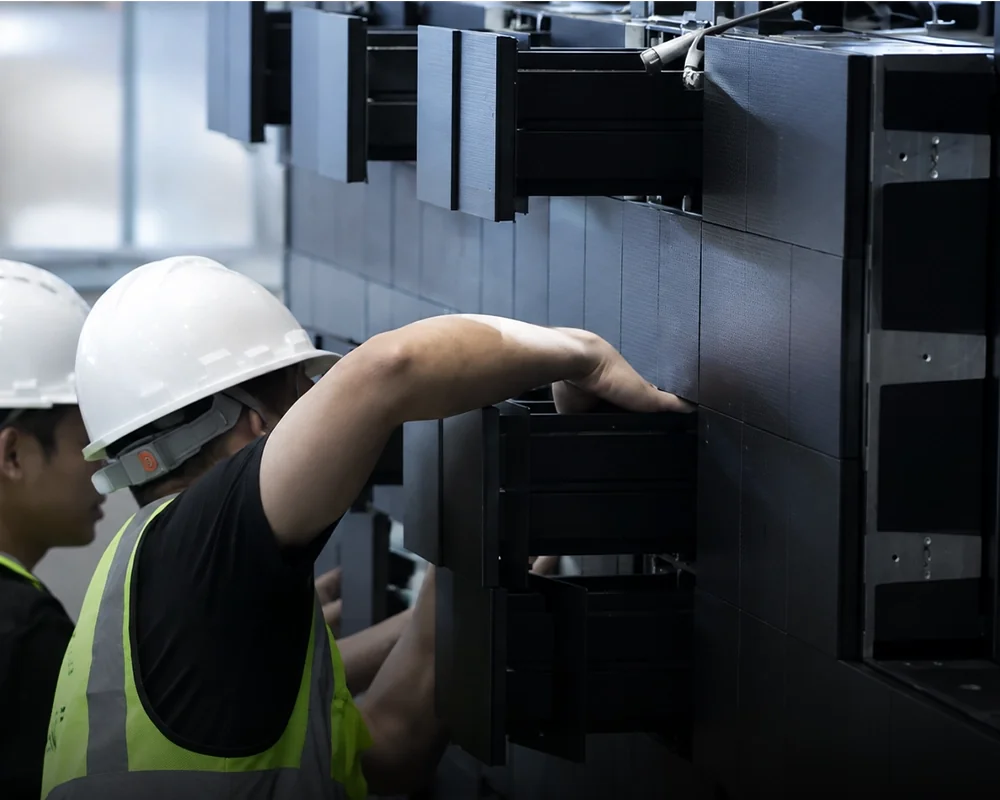
For indoor projects with limited installation depth, SPKI-128 and SPKI-160 support front maintenance.
LED modules and core internal mechanical components can be removed and replaced directly from the front of the display.
No rear maintenance corridor is required.
With its front-service architecture, the SPKI-160 requires only approximately 350 mm of total wall depth for installation.
For large fixed installations and high-elevation projects, the SPKI-250 and SPKO series use rear-maintenance architectures.
During the planning stage, a standard 600–800 mm internal maintenance corridor can be reserved behind the display, allowing technicians to access and service the system without relying on external aerial work equipment.
Maintenance Access Cannot Be Added as an Afterthought
A maintenance corridor must be planned during the architectural and structural design stage.
Once walls are closed and the building structure is finalized, creating new service access can cost many times more than reserving the space during initial construction.
The difference in installation and maintenance planning determines the operating cost of a mechanical LED project over the next five to ten years.
6. Challenge 5: Complex Project Delivery — Real Projects Are the Best Proof of Engineering Capability
Kinetic LED is a highly customized engineering field.
Every project has different dimensions, motion requirements, installation conditions, environmental constraints, and maintenance requirements.
For this reason, a manufacturer’s real-world project experience is one of the most direct ways to evaluate its engineering capabilities.
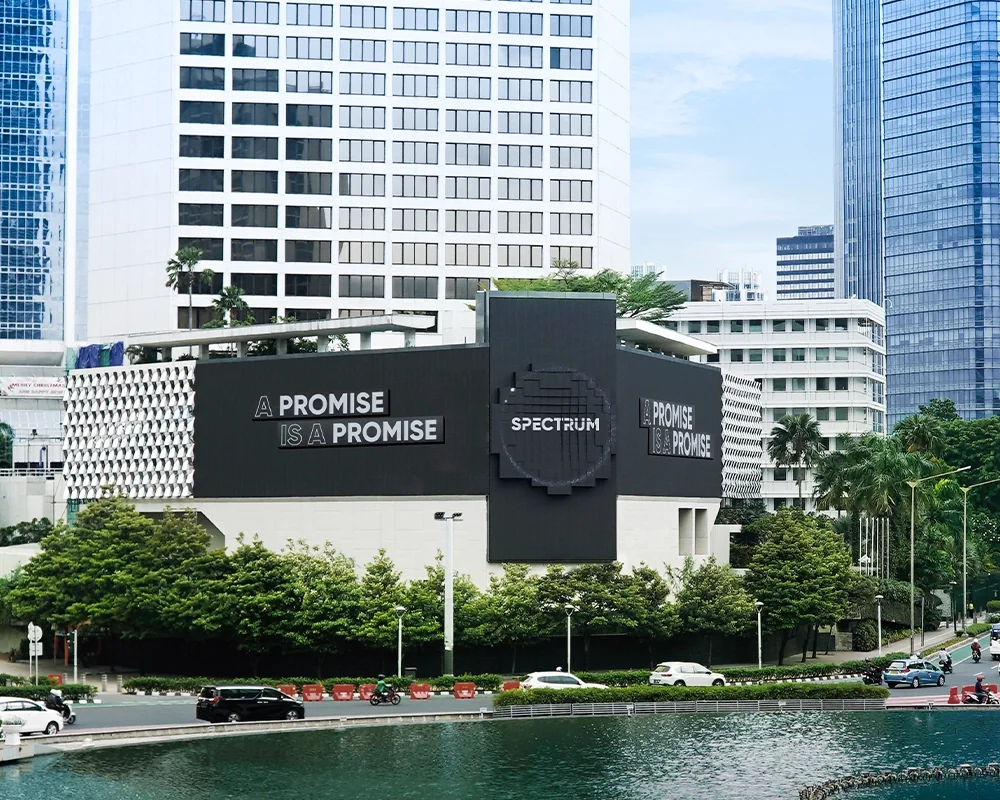
Extreme Environment Project: Mandarin Oriental Jakarta
At the Mandarin Oriental Jakarta in Indonesia, Spectrum Display deployed an SPKO-500 outdoor kinetic LED display.
The project had to operate in an environment characterized by high temperatures, high humidity, and annual rainfall exceeding 2,000 mm.
Spectrum Display addressed these challenges through a combination of:
- Semi-enclosed self-cooling architecture
- Dual redundant primary/backup signal systems
- Independent floor-level power distribution
The result is a system designed for stable all-weather operation in demanding tropical conditions.
Non-Standard Space Project: Singapore Ceiling Installation
At a premium bar in Singapore, Spectrum Display installed an SPKI-160 kinetic LED display directly into the ceiling.
The system measures 1440 × 3840 mm.
The main challenge was extremely limited ceiling depth combined with the absence of a conventional rear maintenance corridor.
The SPKI-160’s 330 mm ultra-slim body and front-maintenance architecture allowed the mechanical LED system to fit into the restricted ceiling cavity.
National-Level Project Recognition: Canton Fair Complex
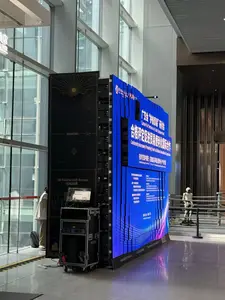
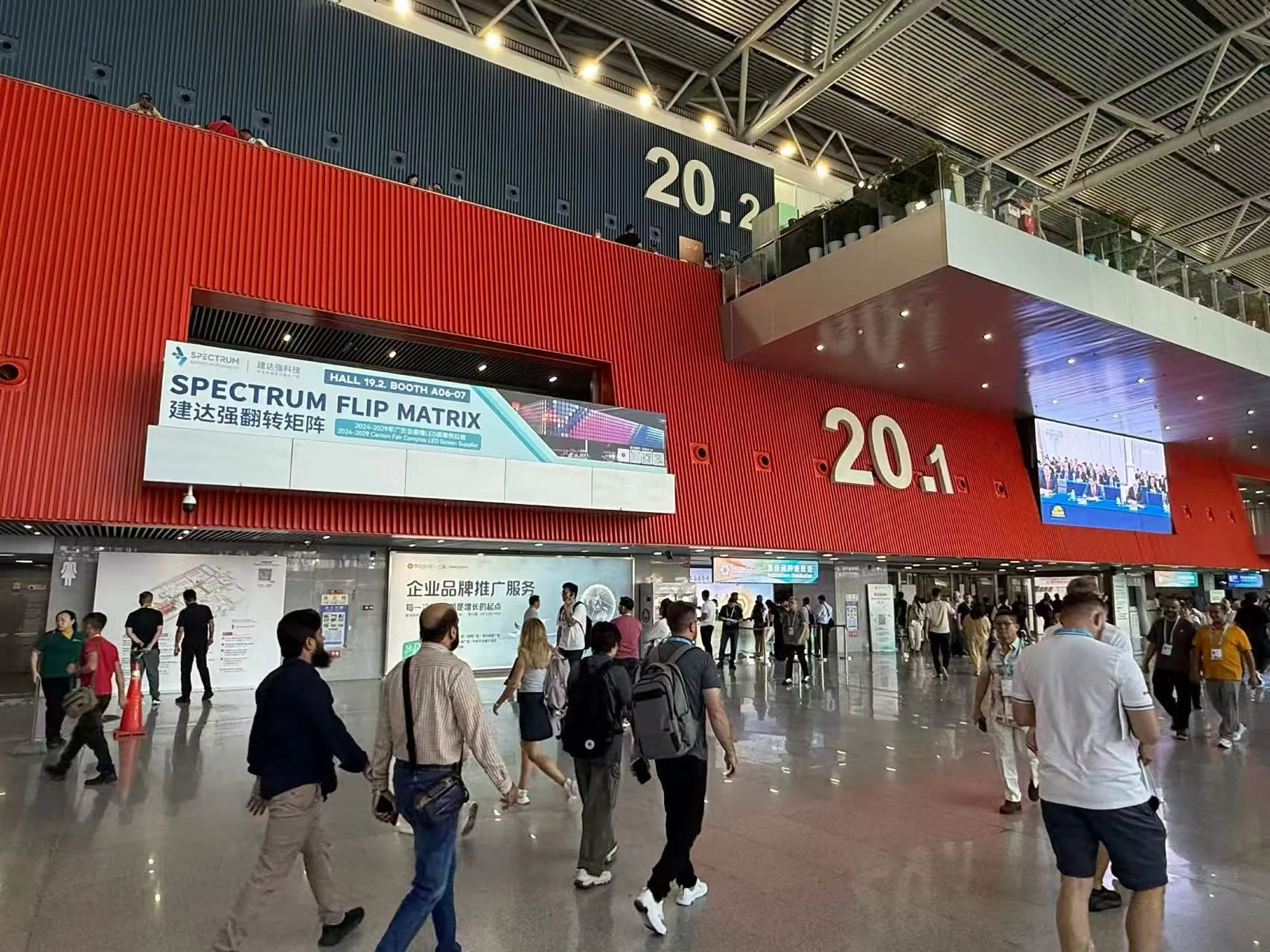
In 2024, Spectrum Display became an Official LED Display Supplier to the Canton Fair Complex for 2024–2029.
The Canton Fair Complex maintains stringent standards for equipment reliability, engineering quality, and project delivery.
This recognition from one of China’s major national-level exhibition platforms provides another reference point for evaluating Spectrum Display’s engineering and delivery capabilities.
The difference in project experience determines whether a supplier simply sells equipment or can support a client throughout the entire project lifecycle.
▶Video · YouTubeWhere Creative Vision Meets Engineering ExcellenceWatch on YouTube →
7. Five Questions to Ask Before Choosing a Mechanical LED Manufacturer
| Engineering Dimension | Questions to Ask |
|---|---|
| Mechanical Structure Design | What are the static and dynamic module gaps? What is the designed lifespan of the core motion components? What is the minimum system depth of the thinnest model? |
| Motion Control System | How many motion units can the system control simultaneously? Does it use open-loop or closed-loop control? Which international standard protocols are supported? |
| Content Ecosystem | Does content creation require programming? What content creation tools are provided? Which interactive technologies can be integrated? |
| Installation & Maintenance | Is the system front-serviceable or rear-serviceable? How long does routine maintenance take? Can maintenance access be added after installation? |
| Complex Project Experience | What projects has the manufacturer delivered in extreme or non-standard environments? Does it have experience with national-level or international projects? |
These questions reveal far more about a mechanical LED manufacturer than a conventional specification sheet.
8. Conclusion
Knowing how to manufacture an LED display does not mean knowing how to engineer a mechanical LED system.
What complex mechanical LED projects truly demand is systematic engineering capability across five dimensions: mechanical structure, motion control, content ecosystem, installation and maintenance, and complex project delivery.
Key Takeaways
1. Mechanical Structure Design
Module gap control, mechanical lifespan, and system depth determine whether the display simply “moves” or moves with visual precision and mechanical refinement.
2. Motion Control
Support for up to 65,536 motion units, closed-loop servo control, and compatibility with DMX512, Art-Net, and sACN determine whether the system can move precisely, synchronously, and reliably at scale.
3. Content Ecosystem
After Effects-based motion creation, Mshow4, TouchDesigner, and UE5 integration determine whether the installation becomes a one-time hardware showcase or a platform for continuous content creation and operation.
4. Installation and Maintenance
Front/rear maintenance architecture and service-access planning directly affect the project’s operating and maintenance costs over the next five to ten years.
5. Complex Project Experience
Projects in extreme environments, non-standard spaces, and major national or international venues provide real-world evidence of engineering capability.
Recommendations for Buyers and Project Teams
- Do not evaluate a mechanical LED manufacturer based only on product specifications. Ask detailed questions across all five engineering dimensions.
- Request real examples of complex project delivery rather than relying solely on product brochures and technical datasheets.
- Whenever possible, visit the manufacturer’s production facility and completed project sites. Mechanical design quality and manufacturing capability are much easier to evaluate in person.
- For more information about mechanical LED engineering capabilities or to discuss a custom project, contact the Spectrum Display team through its official website.