How to Choose High-End Kinetic Screens? Unveiling SPECTRUM DISPLAY's "Hardware + Software" Ecological Moat
At various domestic and international commercial display exhibitions or live performances, you might often see this scene: a kinetic screen composed of hundreds or thousands of modules. The hardware configuration seems extremely luxurious, but during actual demonstrations, it always plays the simplest up-and-down animations. Sometimes, the physical movement of the screen is completely disconnected from the video content, and the physical concavity and convexity ruthlessly tear the video image apart, resulting in a typical "expectations vs. reality" disaster.
This prompts a soul-searching question: Why do expensive Kinetic Screens always play extremely simple lifting animations?
The answer is actually quite cruel: because the vast majority of manufacturers merely piece together a bunch of motors and screen modules, delivering nothing but a "soulless shell." In the creative display field, when clients introduce high-end equipment with full expectations, their biggest pain point is "having the equipment but no content." As an industry-leading creative visual equipment service provider, SPECTRUM DISPLAY deeply understands that to truly let technology empower art, it relies on far more than just cold motors. We must equip "visual magicians" with a set of "god-tier gear" featuring extremely high degrees of freedom—this is the kinetic playback and software ecosystem that SPECTRUM spent eight years building as its core moat.
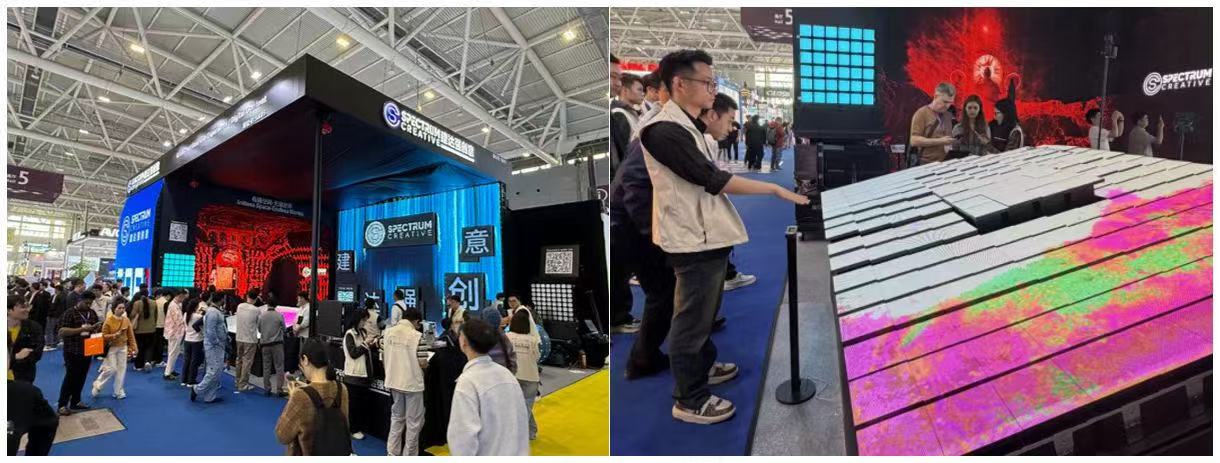
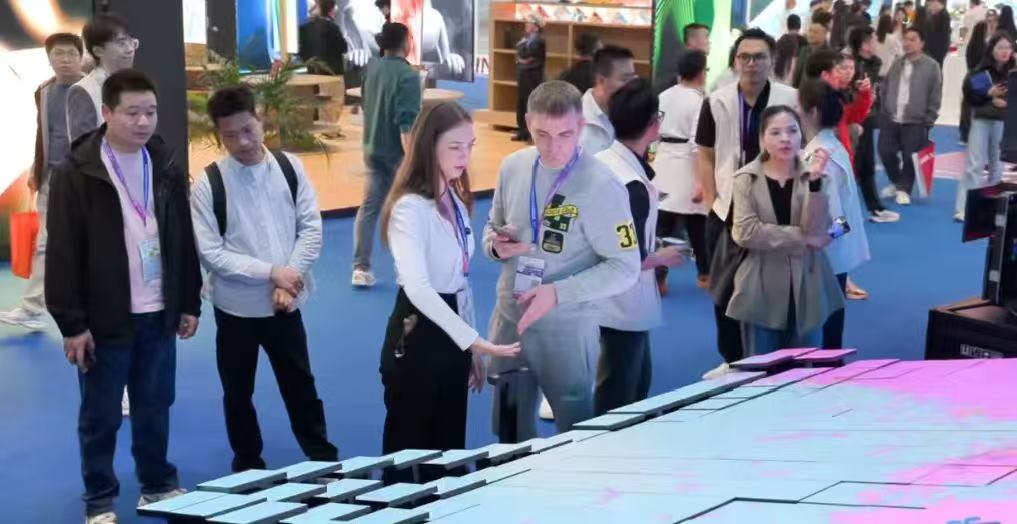
I. Breaking the Deadlock: SPECTRUM's "Hardware + Software" Dual-Track Driven Ecosystem
If the bus-type servo motors and precision hardware with a 0mm visual gap are the robust "bones and muscles" of SPECTRUM's Kinetic Screens, then the comprehensive and open kinetic display playback software system is the "ultimate brain" that gives it life.
We have abandoned the closed, rigid underlying logic of traditional mechanical screens. Adopting the smartphone model of "Hardware + Operating System + Application Ecosystem," we have created a true "creative arsenal" for stage directors, multimedia artists, and system integrators:
AE Plug-in (Motion Matrix 4) — The "Dream Engine" for Video Designers:
Targeting the broadest group of video creators, we have specially developed an LED driver plug-in based on Adobe After Effects. Designers do not need to learn complex mechanical control logic; with basic AE experience, they can use this plug-in to automatically convert grayscale or color data of 2D flat videos into depth data for 3D mechanical movement. It not only supports 3D real-time preview but also achieves a "what you see is what you get" minimalist creation process.TouchDesigner / UE5 Integration — The "Infinite Possibilities" of Interactive Art:
When kinetic vision meets real-time interaction, magic truly descends. The SPECTRUM system seamlessly achieves TouchDesigner/UE5 integration. Through the TD plug-in, our equipment can easily connect to external sensors like radars and motion-sensing cameras, creating breathtaking human-machine matrix interactive art. By integrating the powerful UE5 (Unreal Engine 5) game engine and the dedicated UE2Matrix plug-in, creators can even rely on the Kinetic Screen to develop the most realistic and immersive interactive matrix games.MShow4 — The "3D Presentation Artifact" for Business Elites:
Not limited to performances, we have independently developed the MShow4 software tailored for corporate showrooms and high-end conferences. It allows non-professional business people to easily create and present "3D PPTs" with shocking technological impact, just like making traditional slides.Full Compatibility with Lighting Protocols — "Seamless Connection" for Stage Lighting Designers:
Our system is perfectly compatible with mainstream third-party lighting and VJ software such as MADRIX and Resolume Arena. It fully supports ArtNet/sACN and wired DMX512 protocols, allowing the lifting of the Kinetic Screen to achieve frame-level synchronized integration with the audio, lighting, and electricity of the entire venue.
__
II. Core Value: Breaking Down Technical Barriers, Landing Creativity with "Just One Click"
In traditional kinetic display projects, there is often a huge communication gap between visual designers and underlying electronic control engineers. The wild imaginations of designers are frequently compromised by the limitations of electronic control PLC programming.
The core value of the SPECTRUM DISPLAY ecosystem lies in minimizing the content creation difficulty and technical threshold for designers. Through highly encapsulated LED driver plug-ins and API interfaces, we translate complex CAN bus communication and servo motor position control into the language most familiar to visual creators.
After systematic training by SPECTRUM, an average designer only needs 2-6 hours to fully master the Motion Matrix 4 plug-in. In a TD or UE5 environment, creators can directly call preset nodes to control the hardware. This means your creative team does not need to rely on expensive external code outsourcing; they can autonomously and frequently produce a continuous stream of fresh content for commercial spaces or tours, ensuring every cent of hardware investment generates a long-tail visual premium.
III. Conclusion: Using Ecosystem as a Shield to Reconstruct the Kinetic Display Industry Moat
Buying a mobile phone isn't just to get a piece of glass and metal, but to acquire indispensable application experiences like WeChat and maps. Similarly, when purchasing a Kinetic Screen, what the client ultimately pays for is absolutely not the cold mechanical structure, but the ultimate visual shock brought by the perfect dance between mechanics and imagery.
In the fierce global market competition, hardware parameters may eventually be caught up with, but the kinetic playback and content ecosystem—honed through countless large-scale projects, accumulating massive preset content, and featuring high openness and compatibility—is SPECTRUM DISPLAY's core moat that cannot be easily replicated. We provide not only world-leading kinetic hardware but also the ultimate "god-tier gear" that allows every visual magician to unleash their talent to the fullest. Choosing SPECTRUM means choosing a power source where creativity never runs dry.
Appendix: SPECTRUM DISPLAY Playback Ecosystem Frequently Asked Questions (FAQ)
Q1: If we purchase the equipment, do we need to pay high customized fees for long-term content production?
A: No. Our philosophy is to "teach a man to fish." SPECTRUM not only provides a massive amount of accumulated excellent content source files for your fine-tuning and use, but will also provide your design team with comprehensive AE plug-in or TD integration tutorial training. Your team can completely independently carry out all subsequent content creation, significantly reducing long-term operational costs.
Q2: What are the hardware configuration requirements for the backend control computer to run these kinetic playback software and plug-ins?
A: It depends on your creation and playback needs. If you are doing AE video production, it is recommended to configure 32GB of RAM and a mainstream independent graphics card (such as the NVIDIA series). If you are running high-quality TouchDesigner real-time interaction, a high-end graphics card of RTX 5070 or above is recommended. If it is purely for 4K/8K video playback, a mainstream hard-decoding CPU or multi-output graphics card (such as RTX 4060) can easily handle the task.
Q3: If a client needs to temporarily adjust the playback order at an exhibition site or a large-scale event, is the operation complicated?
A: Very convenient. SPECTRUM's kinetic display playback software has a powerful built-in Mlist playlist manager. On-site directors or operators can directly drag and drop to adjust the playback order of dynamic videos, human-machine interactive programs, or 3D PPTs on the interface. You can even use the dedicated mobile central control APP to demand the required program with one click on your mobile device.
Q4: If the client has their own mature third-party playback system (media server), can it control SPECTRUM's equipment?
A: Fully compatible. Whether your third-party video player is on the same computer as our motion control software or not, as long as your player has the ability to send network commands via Ethernet (TCP/IP), or supports the ArtNet protocol, it can send script commands (such as play, pause, reset, etc.) through our server interface. This perfectly achieves direct takeover and synchronization of underlying hardware actions by an external media server.