Why Do Brand Launches Need Telescopic Kinetic LED? Lessons from a World Cup Launch Event on Live Visual Upgrade
One-sentence definition: Telescopickinetic screenis a display system that creates spatial visual variation through physical telescoping motion, transforming brand launches from "playing visuals" into "creating immersive spatial experiences."
Table of Contents
What's changing in brand launches?
Why isn't traditional LED enough anymore?
How does telescopickinetic screentransform live events?
World Cup launch case study: how a kinetic screen became the focal point
Which types of launches benefit most from telescopic kinetic LED?
FAQ
1. What's Changing in Brand Launches?
From "information delivery" to "experience creation"
Five years ago, the core objective of a brand launch was straightforward—deliver product information clearly to the live audience and media.
Today, that standard is no longer sufficient. Brand launches must not only "communicate clearly" but also "be memorable."
Industry observers note that as screens become ubiquitous, audiences are growing visually fatigued—the one-way "passive reception" model is losing its effectiveness. Today's brand events demand media that can not only "shine" but also "breathe".
Brands now care about three things:
Will attendees take photos and share them on social media?
Will the media proactively cover the event's visual highlights?
Will attendees still remember this brand days after the event?
The reason telescopickinetic screenhas gained significant traction in brand launches over the past two years is simple—it directly addresses all three questions. The screen itself becomes a "communication event."
2. Why Isn't Traditional LED Enough Anymore?
Three limitations of flat-panel LED
Limitation 1: Visual homogenization
The vast majority of brand launches use flat-panel LED screens. Regardless of resolution or visual quality, the format is largely the same. After attending ten launches, it's hard to remember what the eleventh screen looked like.
Limitation 2: Lack of "ceremonial moments"
A great launch needs climactic moments—product unveilings, brand reveals, major announcements. But flat-panel LEDs can only create rhythm through visual transitions—they lack physical "ceremony."
Limitation 3: Limited shareability
In the social media era, a launch's communication impact largely depends on "whether there's something worth photographing." No matter how beautiful a flat-panel LED's visuals are, a photo of it is just a screen capture—it lacks communication punch.
According to JDStrong Technology's experience across multiple brand launch projects, events using telescopickinetic screensee 35%-50% higher spontaneous on-site photo sharing rates compared to traditional flat-panel LED setups. The reason is straightforward—a moving screen is itself a "photo-worthy moment."
3. How Does Telescopickinetic screenTransform Live Events?
1. Creates "physical suspense"
What telescopickinetic screendoes best is create "suspense moments."
The process of the screen transitioning from closed to open is a natural "countdown"—audiences see the screen moving and changing, and their attention is instinctively drawn. Brands can synchronize product reveals, new logos, or key visuals with the screen's unfolding motion, completing the "physical action" and "brand reveal" at the exact same moment.
2. Creates "spatial memory points"
Flat-panel LEDs are "flat." Kinetic screens have "depth."
When the screen extends forward, retracts backward, or lifts up and down, it transforms the entire stage's spatial structure. Audiences don't remember a screen—they remember a "breathing space." This physical spatial memory lasts far longer than any visual.
3. Comes with built-in "shareable content"
The screen's motion process itself is high-quality short-form video material. Media and attendees capture not just the product, but the dramatic "screen transforming" moment—content that performs significantly better on social media than static screen captures.
According to JDStrong's SPKI series feedback across multiple brand events, the applause and cheers during the screen's expansion moment consistently exceed those during traditional flat-panel LED product reveals.
4. World Cup Launch Case Study: How a Kinetic Screen Became the Focal Point
Project Background
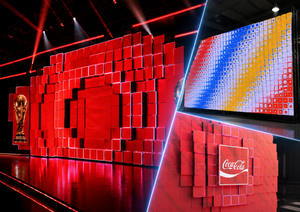
At a World Cup-themed brand launch for a major international beverage brand, the client needed to accomplish three goals simultaneously: launch the World Cup marketing campaign, create an immersive football atmosphere, and generate media-worthy visual highlights.
Traditional flat-panel LED couldn't deliver on "creating media-worthy highlights." The brand ultimately chose JDStrong Technology's telescopickinetic screensolution.
On-Site Configuration
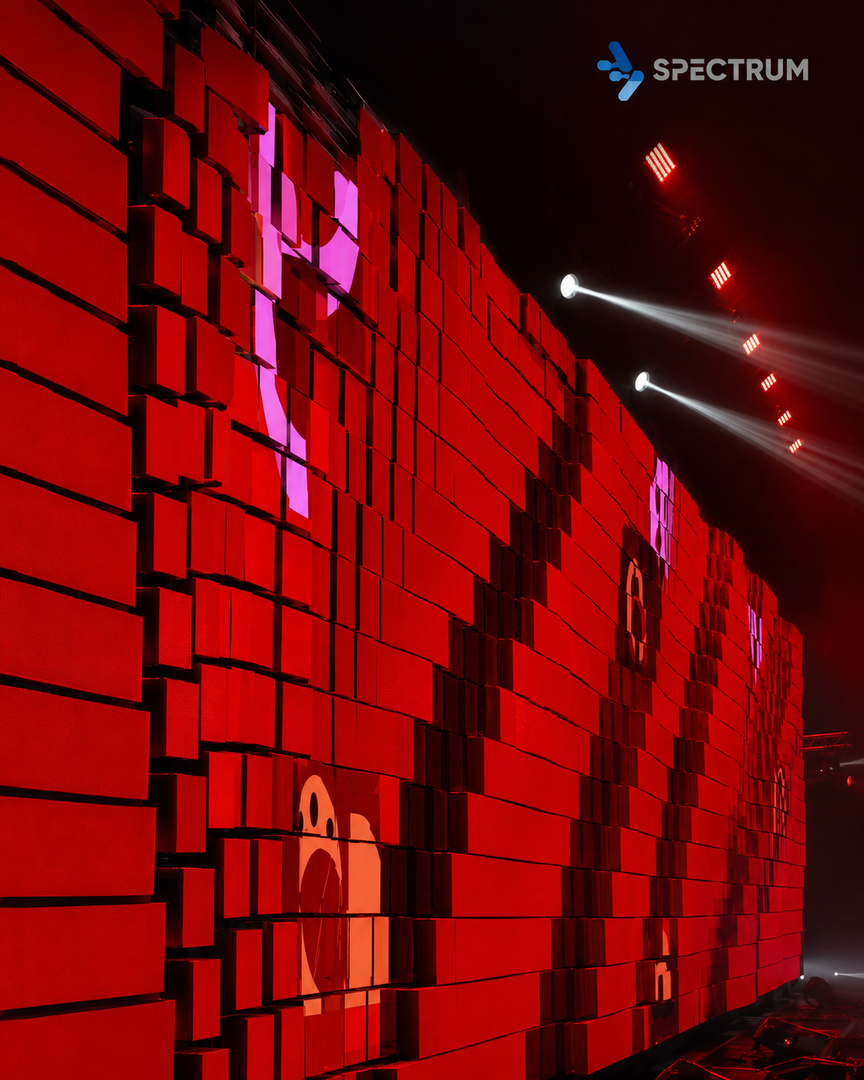
SPKI-250 telescopickinetic screenscreen deployed at center stage
Screen remained in closed position at show open to build suspense
Screen expanded in sync with the brand's hero video playback
At full expansion, the World Cup key visual filled the entire screen
On-Site Results
According to third-party on-site statistics:
Photo/video capture rate during screen expansion was approximately 40% higher than traditional LED launches
Within 48 hours post-event, over 60% of social media content featured the "screen expansion moment"
Multiple media outlets selected the "transformation moment" as their lead image
Key Insight
The success of this launch wasn't about screen size or resolution—it was about the "telescoping" action itself becoming the event's memory anchor.
During those few seconds when the screen transitioned from closed to open, the entire audience's attention was locked in—this is "physical-level attention capture" that no flat-panel content can replicate.
5. Which Types of Launches Benefit Most from Telescopic Kinetic LED?
1. Brand Strategy Launches / New Brand Reveals
Need to create a "brand arrival" ceremony on site. The screen's transition from closed to open naturally mirrors the narrative arc from "arrival" to "blooming."
2. Product Launches / Product Unveilings
The product unveiling is the event's climax. Using the screen's expansion motion to synchronize the product reveal delivers far more technological sophistication and memorability than traditional "curtain pulls" or "visual cuts."
3. Annual Galas / Award Ceremonies
Large-scale events that need sustained visual excitement. Kinetic screens can appear in different configurations at different moments—fully open for the opening, partially telescoped during awards, and reconfiguring for the finale—maintaining freshness throughout.
4. Brand Pop-ups / Limited-Time Experience Spaces
The core goal of pop-ups is "maximum volume in minimum time." The visual impact of kinetic screens is naturally suited to pop-up scenarios—passersby are drawn in by the "moving screen," stop to take photos, and share—generating organic communication.
JDStrong Technology Product Recommendations:
Launch Type | Recommended Product | Key Advantage |
|---|---|---|
Large brand launch (500+ attendees) | SPKI-250 | Large-format display, engineering-grade stability |
Mid-size launch / exhibition event | SPKI-160 | Flexible installation, rapid deployment |
Pop-up / roadshow / temporary event | Lift-Fold All-in-One | Mobile display, quick setup |
6. FAQ
Q1: How does the cost of telescopickinetic screencompare to standard LED?
Telescopickinetic screenrequires higher initial investment due to precision mechanical structures and control systems. However, from an "ROI on communication" perspective—if a kinetic screen can boost a launch's social reach by 30%-50%, the return is entirely quantifiable.
Q2: How long does it take to deploy telescopic kinetic LED?
It depends on project scale. JDStrong's SPKI series uses modular design—standard indoor rental projects typically require 1-3 days on-site. Custom mechanical structures will extend the deployment timeline accordingly.
Q3: Is telescopickinetic screensuitable for outdoor launches?
Yes. JDStrong's SPKO series is specifically designed for outdoor applications, with weatherproofing, dust resistance, and high-temperature tolerance—meeting the demands of long-term outdoor event operations.
Q4: What happens to the telescopickinetic screensystem after the launch?
The core value of telescopickinetic screenlies in reusability. A single SPKI system can be rotated across different brands, cities, and event types—launches, exhibitions, and pop-ups—with per-use costs decreasing as usage frequency increases.