From Walls to Ceilings: Where Else Can a 3D Kinetic LED Screen Be Installed?
One-sentence definition:
A 3D Kinetic LED Screen is no longer just a “display device” mounted on a wall. From ceilings to columns, from storefront windows to irregular spaces, it is becoming a new spatial language for high-end commercial environments.
Contents
- Walls Are Only the Starting Point, Not the Limit
- Ceilings: When the Ceiling Starts to Breathe
- Columns and Corridors: Turning “Obstacles” into Visual Focal Points
- Storefront Windows and Narrow Spaces: How a 330mm Ultra-Thin Body Fits into Limited Space
- Outdoor and Irregular Spaces: More Possibilities for 3D Kinetic LED Screens
- Conclusion: Where Are the Installation Boundaries of a 3D Kinetic LED Screen?
1. Walls Are Only the Starting Point, Not the Limit
When people think of LED displays, the first image that usually comes to mind is a screen mounted on a wall.
That is understandable. Over the past decade, walls have been the most common home for LED displays. From shopping mall atriums to brand showrooms, from product launch stages to corporate lobbies, the screen has almost always appeared as a flat surface on a wall.
But the emergence of the 3D Kinetic LED Screen is breaking this convention.
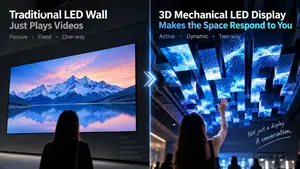
It is not just a flat screen. It is a dynamic system made up of many independently moving units. Each unit can extend, retract, rise, and change independently. This means it does not have to rely on a flat wall surface.
It can be suspended overhead, wrapped around columns, embedded into storefront windows, or even installed upside down on a ceiling.
For a 3D Kinetic LED Screen, the wall is only the starting point — far from the final boundary.
According to Spectrum Display’s official materials, the SPKI Series supports multiple installation methods, including downward-facing ceiling installation, stacking, wall mounting, and upward-facing installation.
In real commercial projects, it has already been installed in a wide range of non-standard locations.
▶Video · YouTubeFrom Installation to Motion — how a kinetic screen turns any surface into a moving displayWatch on YouTube →
2. Ceilings: When the Ceiling Starts to Breathe
Among all non-standard installation methods, ceiling installation may be one of the most visually striking.
The ceiling is one of the most underestimated visual surfaces in commercial spaces. In most environments, it is simply where fire-safety pipes, air-conditioning outlets, and lighting systems are hidden. People are used to looking up and seeing a flat white or black surface. Few expect the ceiling to move.
But a high-end bar in Singapore offered a very different answer.
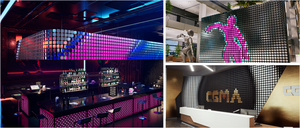
Spectrum Display installed a 1440 × 3840mm SPKI-160 3D Kinetic LED Screen on the ceiling of the bar.
When the music started, the screen units extended, retracted, and moved with the rhythm. The entire ceiling seemed to come alive. In slow mode, it moved gently like breathing. In faster rhythms, it pulsed with the music and worked together with the lighting and audio system.
Why Can SPKI-160 Be Installed on a Ceiling?
Ceiling installation faces two major challenges:
limited ceiling height and no rear maintenance access.
Most traditional kinetic LED screens are more than 600mm thick, making them difficult to fit into a limited ceiling cavity. By contrast, SPKI-160 has a body thickness of only 330mm, with the total finished thickness reduced to approximately 350mm.
More importantly, it supports 100% front maintenance.
The LED modules and key internal mechanical components can be removed and replaced directly from the front of the screen. No rear maintenance space is required. Maintenance teams do not need to dismantle the ceiling or enter the ceiling cavity. All service work can be completed from the front side.
When a ceiling begins to “breathe,” the entire atmosphere of the space changes.
3. Columns and Corridors: Turning “Obstacles” into Visual Focal Points
Commercial spaces often contain structures that seem to get in the way — load-bearing columns, corridor corners, and narrow passageways.
These areas are usually treated as spatial dead zones. Designers can often do little more than wrap them with decorative materials to make them less noticeable.
But a 3D Kinetic LED Screen offers a different approach:
turn these “obstacles” into visual focal points.
In highly constrained spaces such as corridors and column-wrapping applications, SPKI-160 is often the most practical choice. With its 330mm ultra-thin body and approximately 350mm finished thickness, it can be installed close to the structural surface like a standard display.
When a previously ignored load-bearing column becomes a dynamic screen that can move and breathe, it is no longer an obstacle.
It becomes the visual anchor of the space.
When customers enter the space, what they notice is no longer “that column,” but “that moving column.”
This design approach — turning spatial limitations into visual advantages — is being adopted by more commercial spaces.
According to Spectrum Display’s selection guide, corridors, column-wrapping areas, and other highly constrained environments are clearly identified as preferred application scenarios for SPKI-160.
4. Storefront Windows and Narrow Spaces: How a 330mm Ultra-Thin Body Fits into Limited Space
Luxury storefront windows are among the most demanding installation environments.
In luxury retail, a storefront window is never just a place to display products. It is the first conversation between the brand and the consumer.
But luxury storefronts often come with a strict spatial limitation:
the available depth may be only a few dozen centimeters.
Sometimes, even a standard LED display is difficult to fit.
Traditional kinetic LED screens often require more than one meter of rear maintenance space, which makes them unsuitable for many luxury storefront applications.
SPKI-160 offers a different solution.
With its 330mm ultra-thin body and 100% front-maintenance design, the total finished thickness can be kept around 350mm. It can be installed close to an existing storefront wall like a high-resolution digital mural, or embedded directly into a decorative structure.
According to Spectrum Display’s ISLE exhibitor materials, SPKI-160 is positioned as a flagship model for overseas markets. With its lightweight die-cast aluminum cabinet, the body thickness is reduced to 330mm, while 100% front maintenance eliminates the need for rear service access.
It can be seamlessly embedded into luxury storefront windows and high-end commercial walls like a dynamic mural.
This means designers no longer need to compromise their creative ideas because “the screen is too thick to fit.”
The screen can sit close to the back of the storefront and appear from the front like a moving digital artwork — space-saving, visually refined, and integrated with the display environment.
▶Video · YouTubeSPKI-160: 3D Kinetic LED Screen for Luxury Events & Storefront WindowsWatch on YouTube →
5. Outdoor and Irregular Spaces: More Possibilities for 3D Kinetic LED Screens
Beyond ceilings, columns, and storefront windows, the installation possibilities of 3D Kinetic LED Screens continue to expand.
Outdoor Building Facades
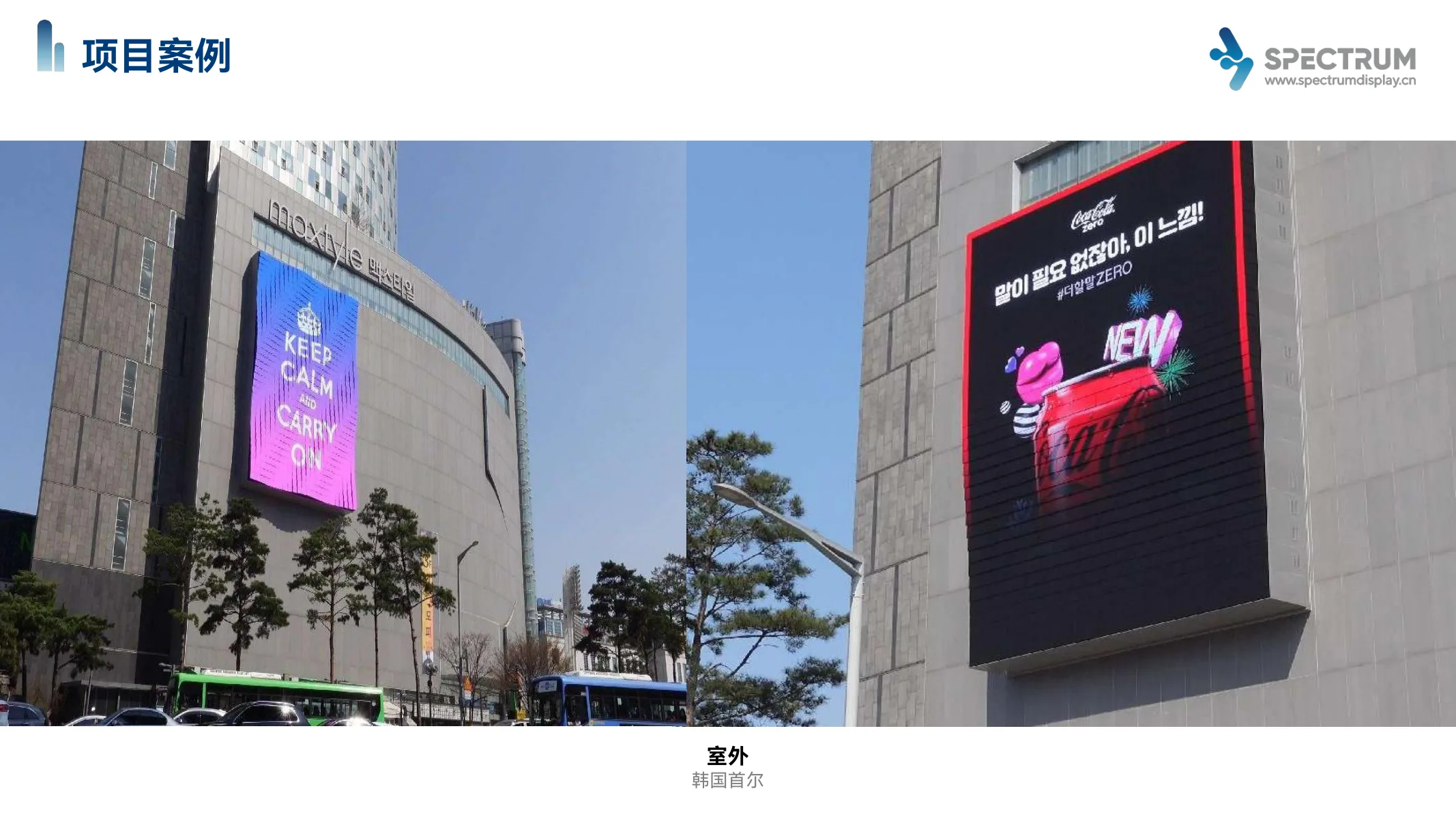
At Mandarin Oriental Jakarta, Spectrum Display deployed an SPKO-500 outdoor 3D Kinetic LED Screen.
The overall facade reached 27 × 9 meters, with the core dynamic kinetic area measuring 8 × 16 meters.
SPKO-500 provides a large 600mm extension stroke and a movement speed of 800mm/s, allowing the facade to create strong three-dimensional visual impact even when viewed from dozens or even hundreds of meters away.
Irregular Spaces
Spectrum Creative, under the Spectrum group, focuses on one-stop services for creative and irregular LED display solutions. Its product portfolio includes double-sided mechanical rotating displays, five-sided immersive LED displays, Moebius ring LED displays, spherical LED displays, LED Lift & Fold All-in-One Displays, and rotating cube displays.
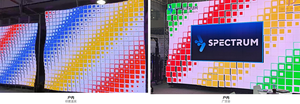
The modular design of the 3D Kinetic LED Screen allows it to adapt to various irregular architectural structures.
Exhibitions and Rental Applications
In exhibition scenarios, 3D Kinetic LED Screens also demonstrate installation flexibility beyond traditional wall-mounted setups.
With quick-install structures and flight-case transportation, the SPKI Series can be deployed within the limited setup window of trade shows and temporary events.
According to Spectrum Display’s product data, the SPKI Series supports multiple installation methods, including downward-facing ceiling installation, stacking, wall mounting, and upward-facing installation.
Whether it is a vertical wall, a horizontal ceiling, an angled irregular surface, or a column-wrapping structure, a 3D Kinetic LED Screen can find its position.
▶Video · YouTubeOutdoor Kinetic Screen in Motion — 600mm stroke, 800mm/sWatch on YouTube →
6. Conclusion: Where Are the Installation Boundaries of a 3D Kinetic LED Screen?
From walls to ceilings, from columns to storefront windows, from indoor spaces to outdoor facades, 3D Kinetic LED Screens are breaking the traditional installation boundaries of display devices.
| Installation Position | Core Challenge | Solution | Representative Model |
|---|---|---|---|
| Ceiling | Limited height and no rear maintenance access | 330mm ultra-thin body + full front maintenance | SPKI-160 |
| Column / Corridor | Extremely limited space | Approx. 350mm finished thickness | SPKI-160 |
| Luxury Storefront Window | Only a few dozen centimeters of depth | Wall-mounted like a dynamic mural | SPKI-160 |
| Outdoor Building Facade | Long-distance viewing and extreme outdoor conditions | 600mm large extension stroke + IP65 protection | SPKO-500 |
| Irregular Space | Non-standard architectural structure | Modular design + customized solution | Customized Series |
Key Takeaways
- Walls are only the starting point.
3D Kinetic LED Screens are breaking the traditional idea that LED displays can only be mounted on walls. - Ceiling installation:
With its 330mm ultra-thin body and full front-maintenance design, SPKI-160 can turn the ceiling from background into the main visual feature. - Columns and corridors:
Previously inconvenient structures can become visual focal points. - Luxury storefront windows:
A 3D Kinetic LED Screen can be seamlessly embedded like a dynamic mural, saving space while preserving the premium look of the environment. - Outdoor and irregular spaces:
The SPKO Series supports outdoor landmark applications, while customized solutions can adapt to non-standard architectural spaces.
Recommendations for Designers and Project Owners
Consider non-traditional installation positions such as ceilings, columns, and corridors from the early design stage. These underused visual surfaces often have the greatest potential for differentiation.
For spaces with limited depth, especially below 400mm, SPKI-160’s 330mm ultra-thin body offers a highly practical 3D Kinetic LED Screen solution.
For ceiling installation, maintenance access must be confirmed in advance. Only models that support full front maintenance are suitable for ceiling cavities where rear access is impossible.
For outdoor projects, extension stroke is critical. Long-distance viewing requires greater physical movement to create a visible three-dimensional effect.
For more installation solutions or customized project support, contact the Spectrum Display team through: