Bigger Motion Units Are Not Always Better: What Does a 248mm Motion Unit Mean for an Outdoor Kinetic Screen?
One-Sentence Definition: In an outdoor kinetic screen, a 248 × 248mm Motion Unit is not a compromise made to reduce engineering costs. It is an optimized engineering choice based on long outdoor viewing distances, structural wind-load requirements, and the need to minimize system complexity and failure points. With a density of 16 motion units per square meter and a P3.9 pixel pitch, the SPKO-250 balances physical visual impact with long-term system reliability.
1. A Common Selection Mistake: Do Larger Motion Units Mean Lower Image Quality?
When purchasing an outdoor kinetic screen, many buyers instinctively evaluate specifications the same way they would evaluate a television:
“Smaller modules mean higher resolution, so the image quality must be better.”
At close indoor viewing distances, that logic can make sense.
Outdoors, however, applying the same logic without considering the engineering environment can create serious problems.
Imagine building a 100 m² outdoor kinetic screen.
If you used small 128mm motion units similar to those used in indoor applications, the system could require more than 6,100 independent motion units.
That means more than 6,100 sets of motors, guide mechanisms, drive electronics, and control nodes.
The SPKO-250 instead uses larger 248 × 248mm motion units.
At a density of 16 units per square meter, a 100 m² installation would require approximately 1,600 motion units.
That is a dramatic reduction in mechanical and control-system complexity.
The core engineering principle of an outdoor kinetic screen is therefore simple:
Once the required image quality and physical impact have been achieved at the intended viewing distance, a simpler system with fewer mechanical components is often more stable, easier to maintain, and more economical over the long term.
This is why 248mm is a key dimension in the SPKO-250.
It is not about using less material.
It is about reducing unnecessary complexity.

2. The Engineering Math: What 16 Motion Units per m² Means for System Complexity
Outdoor environments are demanding.
Kinetic Screen systems may need to operate through high and low temperatures, humidity, salt-laden air, thunderstorms, wind, rain, and long periods of continuous operation.
Under these conditions, one engineering reality becomes increasingly important:
The more mechanical components a system contains, the more potential failure and maintenance points it has.
The SPKO-250 uses 16 motion units per square meter.
Compared with indoor kinetic systems that may use dozens of motion units per square meter, this significantly reduces the number of motors and mechanical transmission components required across a large outdoor installation.
This creates three major engineering advantages.
1. Lower Long-Term Maintenance Complexity
Consider a 100 m² kinetic screen façade.
With the SPKO-250, approximately 1,600 motion units are required.
A much smaller motion-unit architecture could require more than 6,100 units across the same area.
Even if the individual component failure rate is very low, increasing the number of motors, guide mechanisms, drive boards, cables, connectors, and communication nodes inevitably increases the total number of components that must be inspected and maintained.
On a façade installed dozens of meters above ground, every avoided maintenance intervention can also reduce the need for cranes, lifting equipment, technicians, and temporary site closures.
2. Lower Power and Thermal Load
Outdoor systems already operate under significant thermal stress.
Reducing the number of motors and drive components can reduce internally generated heat and simplify thermal management.
For an outdoor kinetic screen operating at high brightness, every reduction in unnecessary thermal load contributes to system stability.
3. Greater Structural Simplicity
Larger motion units also allow the mechanical system to use fewer independent assemblies across the same surface area.
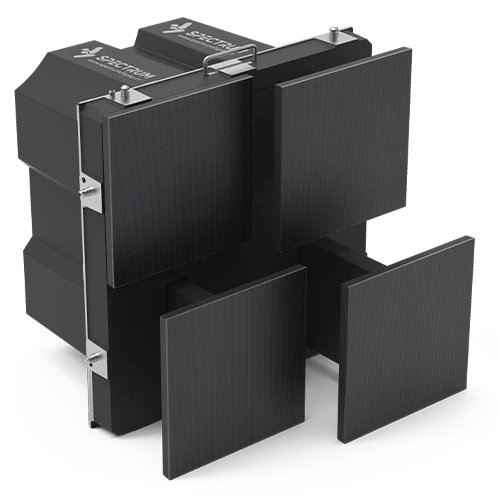
The SPKO-250 combines its 248mm motion units with a 500 × 500mm die-cast aluminum cabinet, creating a rigid modular structure designed for outdoor installation.
For façade applications exposed to wind, structural rigidity and controlled mechanical tolerances are just as important as pixel density.
3. The Visual Logic: Why 248mm + P3.9 Works for Outdoor Viewing
A common question is:
“If the motion units are this large, won’t the screen look pixelated up close?”
At extremely close range, the pixel structure will naturally be more visible.
But an outdoor building façade is not normally designed to be viewed from one meter away.
Its audience is more likely to be:
- Across the street
- At the edge of a plaza
- Walking through a commercial district
- Inside a moving vehicle
- Viewing the building from a longer distance
This is where P3.9 pixel pitch becomes important.
A commonly used LED-display viewing-distance guideline relates the practical viewing distance to the pixel pitch. For a P3.9 outdoor display, viewing distances of several meters and beyond are much more representative of the intended application than extreme close-up viewing.
At these distances, the pixel structure becomes far less noticeable to the viewer.
At the same time, the 248mm physical motion units provide something that smaller units cannot deliver as efficiently:
greater physical presence at outdoor scale.
From a distance, larger moving blocks create a stronger sense of mass, depth, and architectural movement.
The objective is therefore not to maximize pixel density or minimize motion-unit size independently.
It is to match pixel pitch, physical unit size, viewing distance, and kinetic depth to the actual outdoor environment.
4. Why 64 × 64? Understanding the Resolution of Each Motion Unit
Each 248 × 248mm motion unit of the SPKO-250 has a resolution of 64 × 64 pixels.
That means a single motion unit contains:
64 × 64 = 4,096 RGB pixels.
Now scale that across a large kinetic façade.
A 100 m² installation using approximately 1,600 motion units would contain roughly 6.55 million pixels in total.
For a square installation arranged as approximately 40 × 40 motion units, that corresponds to a resolution of around 2560 × 2560 pixels.
Combined with a high refresh rate and fine grayscale processing, the system is designed to deliver smooth visual output while supporting high-brightness outdoor operation and camera shooting.
This matters because outdoor kinetic screen displays are increasingly viewed through two different “eyes”:
the human eye and the camera lens.
A landmark display may be seen directly by thousands of people, but it may also appear in smartphone videos, livestreams, social-media posts, and commercial photography.
Image performance therefore needs to remain stable in both contexts.
5. How Larger Motion Units Reduce the Maintenance Burden Outdoors
Anyone with experience in outdoor LED engineering knows that maintenance at height can become one of the most expensive parts of a project.
The SPKO-250 uses a 500 × 500mm cabinet weighing approximately 17kg.
Its integrated larger-unit architecture, combined with support for both front and rear maintenance, provides greater flexibility for different façade conditions.
If the building provides a rear maintenance corridor, technicians can access the system from behind the display.
If rear access is unavailable, the front-maintenance design provides another servicing option without requiring a large permanent maintenance corridor behind the façade.
The larger 248mm modular architecture also reduces the total number of independent motion units technicians need to manage across the installation.
Instead of dealing with thousands of additional small motors, guide mechanisms, connectors, and control nodes, the system uses a more consolidated modular architecture.
For an outdoor kinetic screen façade, this can make troubleshooting, replacement, and preventive maintenance significantly more manageable.
▶Video · YouTubeDifferent Forms. Endless Display Possibilities.Watch on YouTube →
6. Frequently Asked Questions (FAQ)
Q1: If people will stand very close to the outdoor display, will the SPKO-250 look pixelated?
A: At a viewing distance of only 1–2 meters, the P3.9 pixel structure will naturally be more noticeable.
The SPKO-250 is designed primarily for outdoor façade and advertising applications where viewers typically observe the display from several meters away or farther.
If a project requires extremely close viewing, a finer-pitch solution should be evaluated according to the actual environmental and weather-protection requirements of the installation.
Q2: Do 248mm motion units create obvious physical seams between modules?
A: The system uses precision mechanical positioning and controlled module spacing to minimize the visual impact of seams across the kinetic surface.
At the intended outdoor viewing distance, the objective is for the individual modules to visually merge into a continuous display surface while still retaining their ability to move independently along the Z-axis.
Mechanical precision is particularly important here because a kinetic screen must control both pixel alignment and physical surface alignment.
Q3: Does a density of only 16 motion units per square meter make the image much less detailed than an indoor display?
A: In terms of physical pixel density, an outdoor P3.9 display is naturally lower than a fine-pitch indoor LED display.
But perceived image quality depends heavily on viewing distance.
As the viewer moves farther from the screen, individual pixels become increasingly difficult to distinguish, allowing a lower pixel density to provide sufficient perceived image detail.
This is why outdoor displays should be engineered around their actual viewing distance, rather than compared directly with indoor screens viewed from only one or two meters away.
Q4: Why not use a lighter plastic cabinet to reduce the overall weight?
A: Outdoor kinetic screen systems must maintain mechanical precision despite temperature changes, wind loads, repeated movement, and long-term environmental exposure.
Materials used in the supporting structure therefore need sufficient rigidity, dimensional stability, and corrosion resistance.
The SPKO-250 uses a die-cast aluminum cabinet, balancing a cabinet weight of approximately 17kg with the structural rigidity required for repeated mechanical movement and outdoor installation.
7. Conclusion
Choosing an outdoor kinetic screen is not about packing the façade with the largest possible number of pixels or motion mechanisms.
It is about building a mechanical display system that can continue operating reliably under real outdoor conditions.
Key Takeaways
- System Simplification: A density of 16 motion units per m² significantly reduces the number of motors, guide mechanisms, drive components, and potential maintenance points across a large outdoor installation.
- Viewing-Distance Optimization: The combination of P3.9 pixel pitch and 248mm motion units is designed around outdoor viewing from several meters away and beyond, balancing image detail with physical kinetic impact.
- Strong Image Performance: Each motion unit provides a 64 × 64 resolution with 4,096 RGB pixels. A 100 m² installation can contain approximately 6.55 million pixels, supported by a high refresh rate and fine grayscale.
- Maintenance-Friendly Architecture: The 500 × 500mm, approximately 17kg die-cast aluminum cabinet supports both front and rear maintenance, helping reduce servicing complexity across different outdoor façade conditions.
The engineering logic behind the 248mm motion unit is therefore not:
“How large can we make each module?”
It is:
“What motion-unit size provides the right balance of viewing distance, physical 3D impact, structural reliability, system complexity, and long-term outdoor maintenance?”
For the SPKO-250, the answer is 248 × 248mm.
For more information about SPKO-250 specifications or to evaluate the right motion-unit size for a specific outdoor kinetic screen project, contact the Spectrum Display team through its official website.