200mm Stroke + 500mm/s: How Does an Outdoor Kinetic Screen Create Real Physical 3D?
One-Sentence Definition: The “physical 3D” effect of an outdoor kinetic screen does not rely on visual tricks to fool the eye. Instead, each independent LED module physically extends and retracts along the Z-axis, creating real depth, thickness, highlights, and shadows in three-dimensional space. The SPKO-250 achieves this with a 200mm physical stroke and a maximum motion speed of 500mm/s, allowing a building façade to physically project outward rather than merely appear three-dimensional on a flat screen.
1. Outdoor Advertising Fatigue: Visual-Illusion 3D Is Losing Its Novelty
If you frequently walk through major commercial districts, you may have noticed a trend: the once-novel naked-eye 3D LED billboard is becoming increasingly familiar.
Most conventional “naked-eye 3D” displays are still physically flat LED screens.
They create the illusion of depth through specially designed perspective content—often using corner LED screens, forced perspective, and carefully calculated animation—to make an object appear as though it is emerging from the display.
The first time, it feels surprising.
The second time, it already feels more familiar.
And when every major outdoor screen begins using similar forced-perspective animations, the novelty naturally starts to fade.
Real physical impact does not require viewers to stand in one exact position or rely entirely on a predetermined viewing angle.
With true physical 3D, the display surface itself moves through real three-dimensional space.
Whether viewers approach from the left or the right, they can see the actual height differences between modules. They can see real thickness from the side. They can also see genuine shadows created as light falls across the raised physical surface.
The SPKO-250 is designed to bring this kind of real physical movement to outdoor LED installations.
2. The Foundation of Physical 3D: Independent Z-Axis Motion
Why can’t most LED screens create real physical 3D?
Because a conventional LED cabinet is essentially a fixed surface.
Even if an actuator is added behind the entire screen, moving the whole display forward and backward as one piece does not create a three-dimensional surface. It simply moves a flat plane.
To create physical 3D, the surface itself must be divided into independently controllable sections.
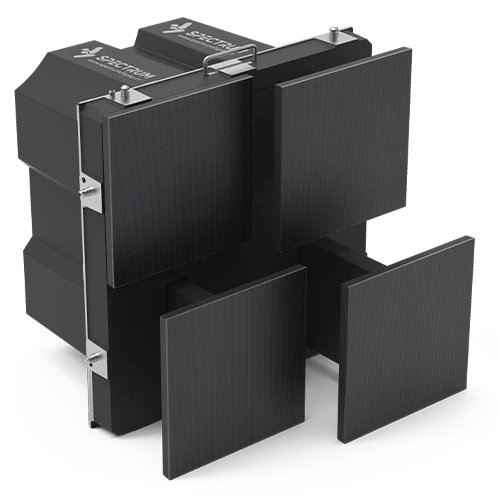
The SPKO-250 divides the display into hundreds—or, in larger installations, thousands—of independent 248 × 248mm motion units.
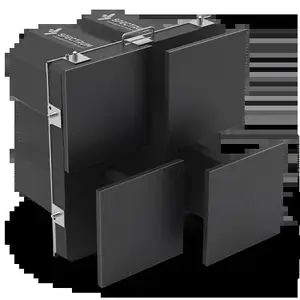
Each standard 500 × 500mm cabinet integrates four independently controlled motion mechanisms.
What does this mean in practice?
One module can extend by 200mm.
The module next to it can stop at 50mm.
Another can remain fully retracted.
When hundreds or thousands of these independently controlled units move according to the content, the display is no longer a flat surface.
It becomes a programmable physical sculpture whose shape can continuously change in real space.
This independent Z-axis movement is the fundamental engineering principle behind a true physical 3D kinetic screen.

3. 200mm Stroke: Creating Real Physical Depth at Outdoor Scale
Indoors, a 200mm difference in depth can already appear dramatic.
Outdoors, however, physical depth faces a much bigger challenge:
Viewing distance.
When viewers stand across a road or plaza—20 meters, 30 meters, or even farther away—the perceived depth of a physical object becomes visually compressed.
If a module moves forward by only a few centimeters, the movement may become almost imperceptible from a distance.
This is why the SPKO-250 uses a 200mm physical stroke.
Combined with its relatively large 248mm motion units, this depth creates a clearly perceptible three-dimensional surface within its intended viewing range.
When the modules extend forward, natural sunlight or architectural lighting creates real highlights and shadows across the raised surface.
The result is fundamentally different from simulated depth on a flat LED screen.
The 200mm movement transforms the façade from a flat digital canvas into a physical relief surface.
When content is designed around flowing or undulating movement, rows of 248mm modules can rise and fall across the building façade, creating large-scale spatial layers that physically change over time.
4. 500mm/s and 0.5 Seconds: Giving Physical 3D Explosive Motion
Simply being able to move is not enough.
If every module extends and retracts too slowly, the movement can feel mechanical, delayed, or disconnected from the visual content.
For physical 3D to create strong impact, motion speed matters.
The SPKO-250 reaches a maximum motion speed of 500mm/s, with a fastest full-stroke time of approximately 0.5 seconds.
What Does This Speed Change?
1. Stronger Visual Impact
During a brand-logo reveal, product launch, countdown, or other dramatic visual moment, rapid physical movement can make the LED surface appear to burst outward.
The combination of real mass, physical displacement, light, and image creates an impact that cannot be reproduced by pixels alone.
This is particularly valuable in outdoor environments where brands have only a few seconds to capture the attention of passing viewers.
2. Better Synchronization with Fast-Paced Content
Outdoor advertising content often uses fast transitions and strong visual rhythms.
The physical surface therefore needs to respond quickly enough to remain synchronized with the image.
A fast motion system allows the Z-axis movement to follow visual transitions more closely, rather than leaving the mechanical surface moving long after the video has already changed.
In a kinetic screen, content timing and mechanical timing must work as one system.
5. Industrial CAN Bus: How Do Thousands of Motion Units Stay Synchronized?
Imagine a 100 m² outdoor kinetic screen.
At a density of 16 motion units per square meter, the display could contain approximately 1,600 independently controlled motion units.
Now imagine all 1,600 units performing a coordinated rising-and-falling sequence.
If only a few modules respond late or drift out of position, a smooth physical surface can immediately become irregular.
The quality of physical 3D therefore depends not only on mechanical stroke and speed, but also on large-scale synchronization.
This becomes even more challenging outdoors, where electrical systems may operate in more complex electromagnetic environments.
The SPKO-250 uses an industrial CAN bus architecture for motion communication and control.
CAN technology is designed for reliable communication in demanding environments, with strong interference resistance, error detection, and retransmission capabilities.
For a large kinetic screen installation, this helps motion commands reach large numbers of individual units with precise timing.
The objective is simple:
When thousands of Z-axis units are supposed to move as one surface, they must actually move as one surface.
Without reliable synchronization, physical 3D quickly loses its visual continuity.
▶Video · YouTubeDesigned for Lightning-Fast Setup at Rental EventsWatch on YouTube →
6. Frequently Asked Questions (FAQ)
Q1: What is the difference between the SPKO-250’s physical 3D and a conventional naked-eye 3D corner LED billboard?
A: A conventional naked-eye 3D billboard primarily creates visual-illusion 3D.
The LED surface itself remains physically flat, while specially designed perspective content creates the illusion that an object is extending beyond the screen.
The SPKO-250 creates real physical 3D.
Its individual LED modules can physically extend by up to 200mm along the Z-axis. When viewed from the side, the audience can see the actual thickness and physical depth of the moving surface.
In other words:
Naked-eye 3D creates perceived depth through content. Physical 3D creates actual depth through mechanical movement.
Q2: Can strong outdoor wind damage modules when they are extended by 200mm?
A: The SPKO-250 uses a high-rigidity die-cast aluminum cabinet and precision mechanical guide structures designed for outdoor installations.
However, wind-load requirements depend on factors such as installation height, building location, screen area, supporting steel structure, and local wind conditions.
For large façade projects, the complete installation should therefore be evaluated through project-specific structural and wind-load engineering rather than considering the LED module alone.
Q3: Is a maximum speed of 500mm/s safe in public outdoor spaces?
A: The SPKO-250 incorporates an anti-pinch protection threshold of 3kg as part of its motion-safety design.
When abnormal resistance is detected during movement, the motion-control system can respond to the obstruction rather than continuing to drive the unit normally.
Safety, however, must be considered at the complete project level. Installation height, public access, barriers, operating modes, emergency-stop systems, and site-specific risk assessment should all be incorporated into the final engineering design.
Q4: Does physical 3D require specially designed content?
A: Yes.
Simply playing a conventional flat video does not automatically produce an effective kinetic experience.
The content needs to coordinate the LED image with Z-axis displacement.
Using Spectrum Display’s After Effects-based motion workflow, grayscale information can be converted into physical displacement instructions, allowing designers to coordinate visual brightness, shapes, timing, and mechanical movement.
The strongest physical 3D effects occur when the image and the physical surface are designed together from the beginning.
7. Conclusion
Physical 3D is where visual content and mechanical engineering meet.
Instead of using perspective alone to simulate depth, an outdoor kinetic screen physically changes the geometry of its display surface.
Key Takeaways
- Independent Z-Axis Motion: Each 248mm motion unit can extend and retract independently, forming the foundation of a programmable physical relief surface.
- 200mm Physical Stroke: The large Z-axis travel creates real, perceptible depth for outdoor viewing rather than relying solely on simulated 3D content.
- 500mm/s Motion Speed: Fast physical response allows kinetic movement to follow dynamic advertising content and create stronger visual impact.
- Industrial CAN Bus Control: Reliable large-scale communication helps hundreds or thousands of independent motion units remain synchronized as one physical surface.
The key difference is simple:
A conventional 3D LED billboard makes a flat screen look three-dimensional. An outdoor kinetic screen makes the screen itself three-dimensional.
For more information about the SPKO-250 or to discuss a customized outdoor physical 3D solution, contact the Spectrum Display team through its official website.