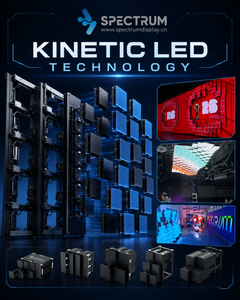
Many lighting designers have shared this feedback with us: Kinetic screen effects programming is too complex and usually requires learning dedicated mechanical control software. Can we control the screen's undulations directly using the faders on our lighting consoles, just like controlling a moving head light?
As a comprehensive service provider of dynamic display systems and spatial digital equipment, SPECTRUM has completely shattered this barrier with our proprietary zero-latency screen control technology. Today, we provide an in-depth technical breakdown: how to perfectly link a grandMA console with retractable kinetic screens via the ArtNet protocol to achieve true audio, visual, lighting, and mechanical integration.
I. The Technical Foundation: Why Can SPECTRUM Achieve "Zero-Latency" Response?
In large-scale live events, the synchronization precision of audio, lighting, and visuals is measured in "frames." Ordinary mechanical control systems often suffer from signal conversion latency, causing the screen's physical movements to lag behind the musical downbeats.
SPECTRUM achieves the ultra-fast response of DMX512-controlled retractable kinetic screens through three core underlying architectures:
Automotive-Grade CAN Bus Ecosystem: At the foundational level, our system abandons unstable serial protocols and adopts the CAN bus communication developed by German Bosch for airbags. It possesses exceptionally strong anti-interference capabilities and can support up to 65,536 units online synchronously, ensuring command transmission is absolutely foolproof.
FOC Vector Closed-Loop Control: Every single servo motor we use runs on advanced FOC algorithms. Unlike traditional stepper motors, our closed-loop control system provides real-time position feedback. This ensures that during the lightning-fast <0.5s extension/retraction process, the screen is not only whisper-quiet and silky smooth but also precise in its trajectory, never losing its position.
Mshow4 Protocol Hub: Our proprietary control software acts as the ultimate bridge, capable of converting ArtNet/DMX signals from the lighting console into mechanical displacement commands within milliseconds.
II. Practical Tutorial: How to Use an MA Console for Stage Visual Effects Programming?
For integrators and lighting designers, workflow is everything. The core philosophy behind SPECTRUM's system design is "making the screen adapt to the console," rather than forcing the lighting designer to learn mechanics.
Step 1: Protocol Docking Connect the SPECTRUM control computer to professional consoles like a grandMA via the ArtNet protocol. At this point, the console will automatically recognize the various motion channels of the kinetic screen.
Step 2: Attribute Allocation Lighting designers can assign the Z-axis stroke (depth) to each retractable module exactly like assigning X/Y axis coordinates to a moving head light.
Step 3: Real-Time Fader Control Pull the fader on the console, and the screen modules will extend or retract in real-time based on the value. You can utilize the console's built-in Effect Engine to generate complex stage visual effects programming—such as water ripples, sine waves, or random jumping effects—with a single click.
Through this workflow, the physical rhythm of the screen achieves true "frequency resonance" with the live lighting and sound effects in a physical sense.
III. Scenario Applications: The Visual Leap Brought by ArtNet Kinetic Screen Linkage
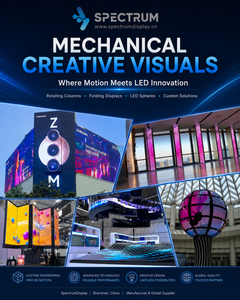
This deep integration technology is providing unprecedented expressive power for high-end exhibitions and stage performances:
Science Museum Interactive Displays: Paired with radar sensors, when a visitor waves their hand, the MA console triggers real-time DMX commands, allowing high-precision modules like the SPKI-128 to ripple in response to human movement.
Luxury Window Shows: Utilizing ArtNet kinetic screen linkage, the window display background can physically change its depth as models walk by, creating a highly premium digital art space.
Concert Ultimate Beat-Drops: At the climax of a song, thousands of modules shoot forward simultaneously alongside powerful light beams. The sheer physical pressure and impact of this kinetic moment are unmatched by any traditional flat LED screen.
💡 FAQ
Q: How do you achieve synchronized control between a retractable kinetic screen and an MA lighting console?A: The key to achieving ArtNet kinetic screen linkage lies in protocol compatibility. SPECTRUM's control system supports international standard protocols including DMX512, ArtNet, and sACN. Lighting designers simply connect the console to the system network, and they can directly drive the Z-axis stroke of the kinetic modules using standard channel data, achieving perfect synchronization with the lighting show.
Q: In stage visual effects programming, how do you solve the safety issues of mechanical movement?A: SPECTRUM embeds 3kg intelligent anti-pinch protection technology as a standard feature at the hardware level. Even during complex stage visual effects programming, if the moving screen senses resistance from a visitor or performer, the motor will automatically lose power in milliseconds and slowly reset. This fundamentally eliminates the risk of pinching injuries, ensuring the performance is 100% safe.
Q: What is the load capacity limit for a DMX512-controlled retractable kinetic screen?A: Relying on our automotive-grade CAN bus technology, SPECTRUM's system boasts massive load capacities. A single system can support up to 65,536 motion units online simultaneously. Whether it's a dozens-of-square-meters showroom background or a thousands-of-square-meters outdoor landmark, we guarantee stable, zero-latency screen control.
[Conclusion] In the race of spatial digital equipment, SPECTRUM is always dedicated to making the most cutting-edge technology the easiest to use.
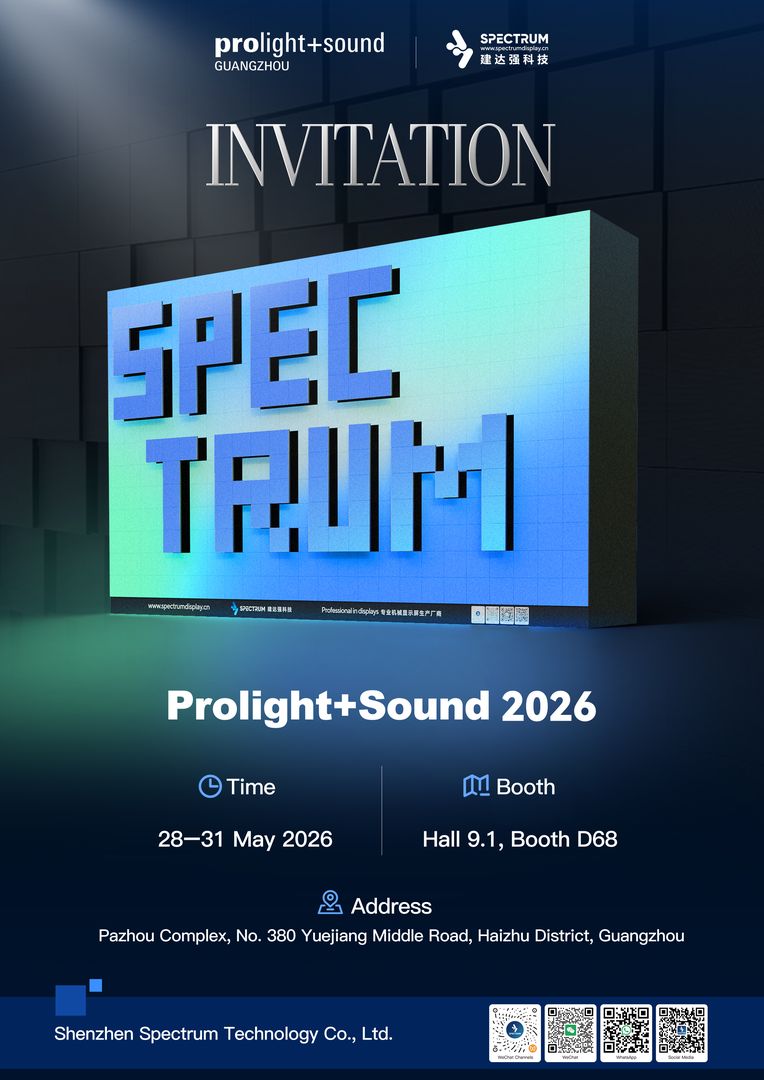
Want to get the complete DMX channel sheet or book a remote demonstration with a technical consultant? Visit SPECTRUM's official website at www.spectrumdisplay.cn, or visit us this May at the 2026 Guangzhou Prolight + Sound (Booth D68, Hall 9.1) to experience the ultimate thrill of "pushing a screen like pushing a light"!