One-Sentence Definition:
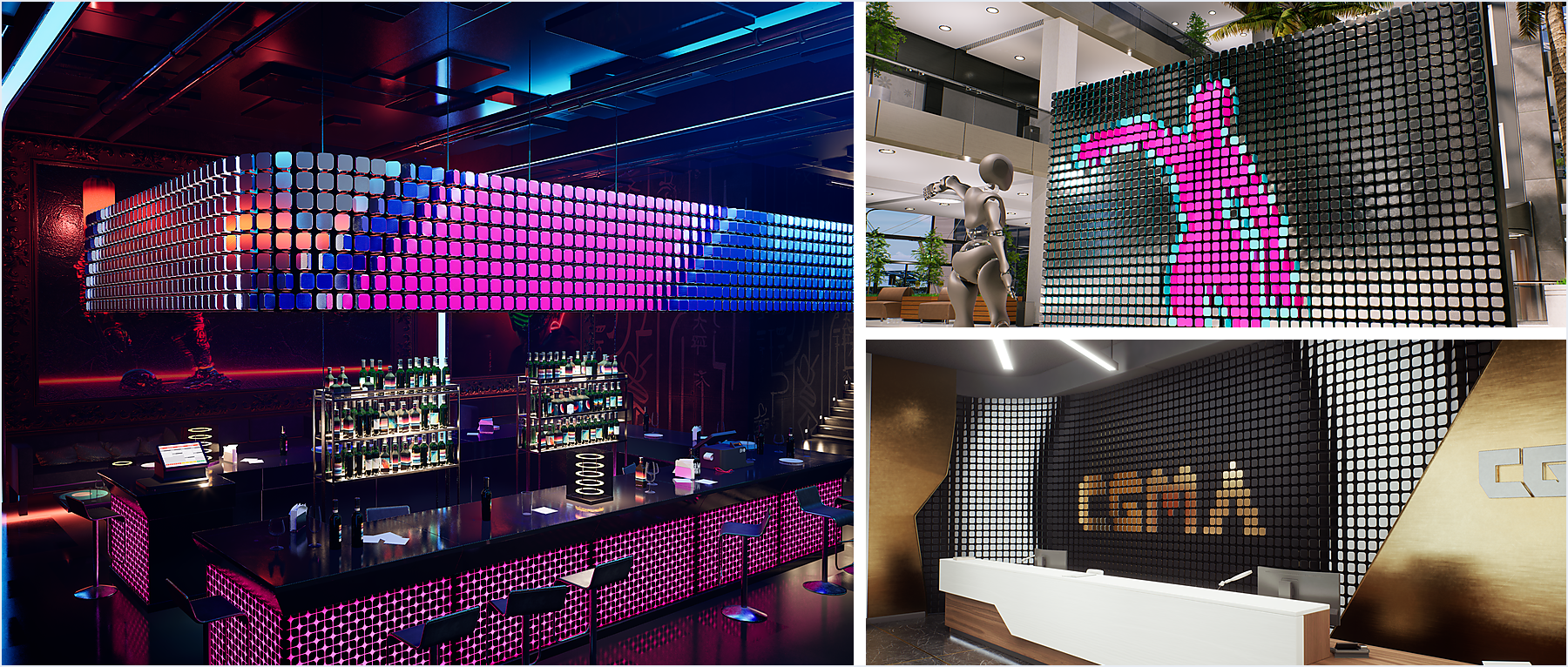
Flip Matrix is not simply a “wall that flips.” It is a highly customizable spatial expression system. From panel colors to surface materials, from RGB lighting to interactive logic, every wall can be tailored for each brand, each space, and each creative concept.
Color, Material, Lighting, and Interaction Can All Be Customized: What Else Can Flip Matrix Do?
Contents
When a Wall Can “Change Its Face,” Space Begins to Express Itself
What Can Be Customized in Color — From Brand Colors to Gradient Effects
What Can Be Customized in Materials — From Plastic Self-Color to Electroplated Mirror Finishes
What Can Be Customized in Lighting — A Wall by Day, Light by Night
What Can Be Customized in Interaction — Teaching the Wall to “Respond”
Four Models, Four Customization Directions
Conclusion: One Wall, Infinite Expressions
1. When a Wall Can “Change Its Face,” Space Begins to Express Itself
Walk into a high-end flagship store. The wall materials are refined, the lighting is precise, and the product display is carefully arranged. Everything looks flawless.
But five minutes after leaving the store, can you still remember what that wall looked like?
This is the challenge facing many commercial spaces today:
refined, but not memorable.
Traditional commercial space design often follows a mature formula: marble, wood veneer, metal panels, and illuminated signage. This formula ensures a basic sense of quality, but it also creates serious homogenization.
When every wall uses similar materials, similar colors, and similar lighting, consumers’ brains automatically classify this information as background noise. They see it, but they do not remember it.
Flip Matrix offers a completely different possibility:
the same wall can have countless expressions.
It is not a screen that simply “plays visuals.” It is a dynamic mechanical matrix composed of a large number of independent flipping units. Each flipping unit acts like a “mechanical pixel.” Through precision motor control, it can achieve three-sided flipping and generate visual effects such as undulating motion, color block switching, pattern changes, and lighting linkage across a matrix layout.
More importantly, these three display surfaces can be customized in color, pattern, and texture according to project needs, allowing each wall to become a unique expression of the brand.
2. What Can Be Customized in Color — From Brand Colors to Gradient Effects
Each Flip Matrix unit has three physical display surfaces, and the time required to switch to another surface is only 0.15 seconds. These three surfaces can carry completely different color schemes.
Single Brand Color
This is the most direct application.
All three surfaces can use the same brand color, creating a dynamic “color emergence” effect through flipping motion.
When the units carrying the brand logo flip in sequence, the brand color spreads across the wall like a tide. This kind of physical color expression feels more tactile and substantial than color shown on a conventional screen.
Two-Color or Three-Color Switching
The three surfaces can also use different colors, allowing the system to create gradients, alternations, and rhythmic color changes through programmed control.
With 64 units per square meter, SPFM-100 delivers refined color transitions at close viewing distances. Every flipping color block is clearly visible. In luxury window displays, this sense of precision itself becomes an extension of the brand language.
Customized Pattern Printing
Color does not have to mean only solid colors.
Through processes such as UV printing, brand patterns, textures, and gradient effects can be printed directly onto the surface of the flipping units.
A wall can become an abstract artwork, a brand visual symbol, or a constantly changing dynamic canvas.
In a customized folding screen project, the closed screen was designed to blend perfectly into the architecture through customized surface materials. A black surface with a wood-grain finish created a harmonious dialogue with the exhibition hall’s white main tone.
It could not look like a screen. It had to look like a wall, a window, or part of the building itself.
3. What Can Be Customized in Materials — From Plastic Self-Color to Electroplated Mirror Finishes
Color determines what a wall looks like.
Material determines what it feels like, and what kind of brand tone it communicates.
The surface of Flip Matrix units supports multiple finishing processes:
Plastic Self-Color
This is the most basic option, with controllable cost and stable visual consistency. It is suitable for large-area commercial spaces and can be combined with various color schemes.
UV Printing
High-precision UV printing can be applied directly to the unit surface, supporting complex patterns, gradient colors, and brand visual elements. It is suitable for projects that require a highly customized visual identity.
Electroplating
Electroplating creates a metallic surface with mirror-like gloss. It is suitable for technology showrooms, futuristic spaces, automotive brand showrooms, and other environments that require a premium visual impact.
Adhesive Color Film
Adhesive film offers a flexible color solution and can be replaced when needed. It is suitable for commercial spaces that require periodic visual updates.
Texture Options
The texture options are equally rich:
Glossy finishes suit spaces that require brightness and transparency.
Matte finishes help communicate an understated and restrained brand tone.
Mirror finishes are suitable for technological and futuristic environments.
Color-changing finishes create different visual effects under different viewing angles and lighting conditions.
In luxury window displays, a matte surface communicates quiet sophistication.
In technology exhibition halls, mirror or metallic textures enhance the sense of “the future is here.”
In commercial spaces, UV printing allows brand patterns to grow directly onto the wall surface.
The same mechanical structure can create completely different spatial languages.
4. What Can Be Customized in Lighting — A Wall by Day, Light by Night
SPFM-138L offers a unique capability:
RGB full-color lighting is added on top of the mechanical flipping structure.
Two Expressions in One System
By day, it is a Flip Matrix wall. Through color block switching, it presents brand patterns, graphics, or text. Every flipping action is visible and perceptible, creating a distinctive “physical pixel” texture.
By night, RGB full-color lighting takes over the visual expression.
The wall becomes a flowing river of light, with gradient colors, dynamic lighting effects, and rhythmic movement.
Lighting and Flipping Linkage
The lighting does not operate separately.
Through DMX512 and Art-Net protocols, lighting effects can be precisely synchronized with flipping actions.
When a unit flips, the light can turn on at the exact moment.
When the surface moves in sequence, the lighting color can flow with the motion.
This “light following movement” effect creates an immersive experience that traditional lighting systems cannot easily achieve.
Designed for Nighttime Commercial Spaces
SPFM-138L integrates 36 independently controlled flipping units per square meter, with RGB full-color lighting built into each unit.
It is suitable for:
nighttime commercial spaces
bars and nightclub atmosphere walls
art installations
lighting interaction scenarios
One mechanical system. Two completely different spatial expressions.
5. What Can Be Customized in Interaction — Teaching the Wall to “Respond”
The interactive capability of Flip Matrix upgrades it from “a wall that moves” to “a wall that responds.”
Protocol Layer: Compatible with Mainstream Control Standards
The full SPFM series supports DMX512 and Art-Net protocols.
This means it can connect with stage lighting consoles, intelligent lighting systems, and building management systems.
Lighting designers do not need to learn a new control platform. They can control the flipping and lighting of the wall just like controlling stage lights.
Content Layer: An Open Content Ecosystem
Through professional lighting software such as MADRIX, lighting, music, and mechanical flipping can be programmed together.
Brands can update the display content according to seasons, festivals, campaign themes, or promotional needs.
One wall can have infinite expressions.
Interaction Layer: Turning Audiences into Participants
Through deep integration with TouchDesigner, Flip Matrix can connect with sensors such as cameras and LiDAR.
When audiences walk closer, the wall can respond.
When audiences wave, the wall can change with them.
Audiences are no longer passive viewers. They become co-authors of the spatial narrative.
This physical, real-time feedback is redefining the boundaries of interaction in commercial spaces.
When the wall learns to respond, the space gains real vitality.
6. Four Models, Four Customization Directions
Flip Matrix is not a single product. It is a product series.
The SPFM series includes four models, each with a different customization focus.
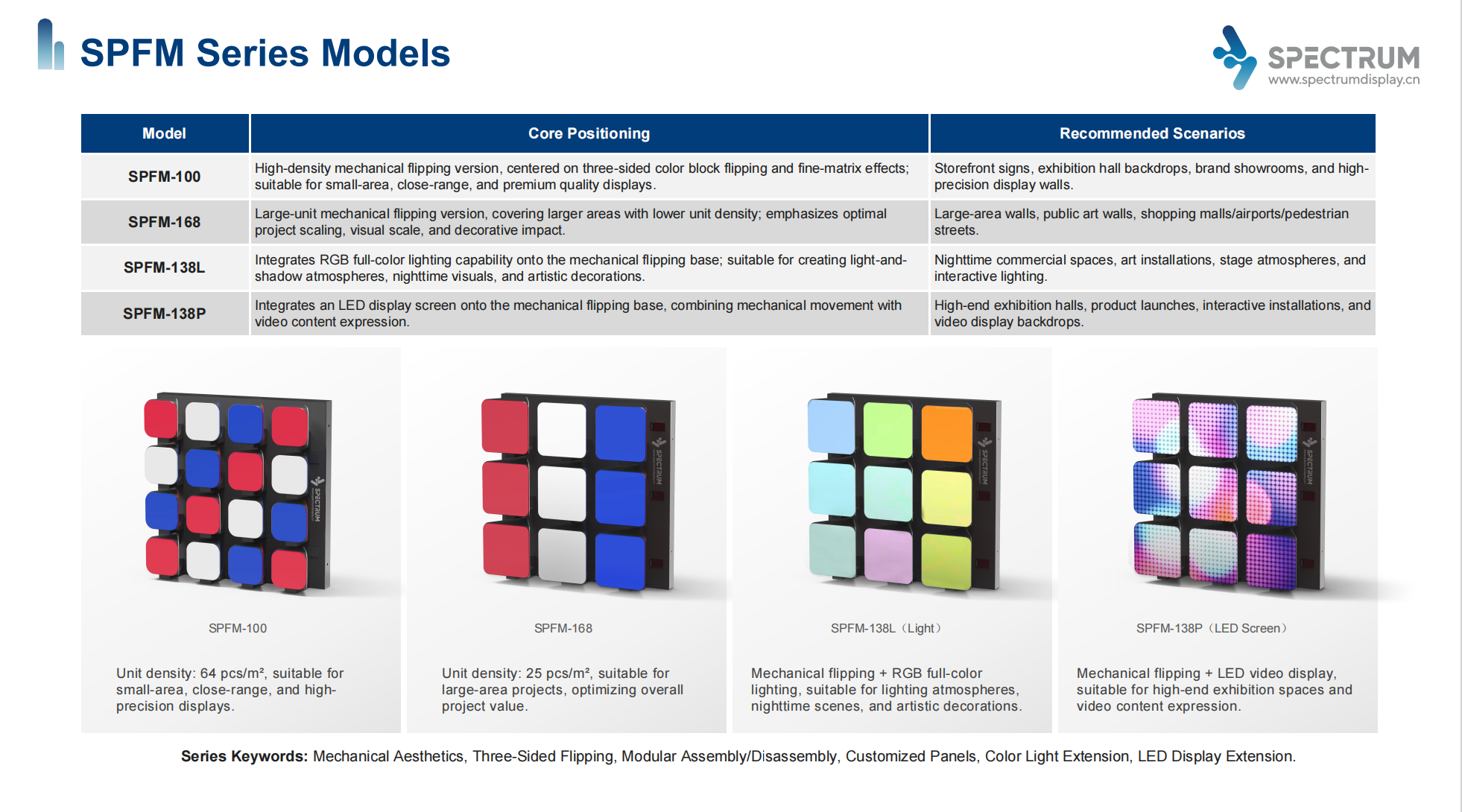
SPFM-100 uses 64 units per square meter and a 0.15-second switching speed, delivering refined color and material details for close-viewing scenarios such as boutique windows.
SPFM-168 uses 25 units per square meter to cover large wall areas, retaining the core visual impact of mechanical flipping while controlling project cost. It is suitable for large-area projects with budget considerations.
SPFM-138L combines mechanical flipping with RGB full-color lighting, creating a dual day-and-night spatial expression.
SPFM-138P combines mechanical flipping with an LED display surface. One side provides LED video display, while the other two sides can be customized with colors, patterns, and materials.
7. Conclusion: One Wall, Infinite Expressions
The value of Flip Matrix is not only that it can flip.
Its real value lies in how far it can be customized.
Key Takeaways
Color can be customized — from a single brand color to two-color or three-color switching, from solid colors to complex patterns created through UV printing.
Materials can be customized — plastic self-color, UV printing, electroplating, adhesive color film, glossy, matte, mirror, and color-changing finishes all communicate different brand languages.
Lighting can be customized — SPFM-138L combines mechanical flipping with RGB full-color lighting, creating a wall by day and light by night.
Interaction can be customized — DMX512 and Art-Net compatibility, MADRIX lighting programming, and TouchDesigner sensor integration allow the wall to respond to people and environments.
Four models, four directions — SPFM-100 for high-density precision, SPFM-168 for large-area coverage, SPFM-138L for RGB lighting, and SPFM-138P for LED display integration.
Recommendations for Brands and Designers
Define what the wall is meant to communicate at the beginning of the project. Is it brand color, spatial texture, or an interactive surprise?
Choose precision according to viewing distance. Use SPFM-100 for close-range viewing and SPFM-168 for larger-distance and large-area spaces.
Choose functions according to operating time. If the project is mainly used during the day, a standard version may be suitable. If nighttime atmosphere is important, SPFM-138L is worth considering.
To learn more about customization details or request a tailored solution, contact Spectrum Display through:
www.spectrumdisplay.cn