How Do You Fit a Complete 3D Kinetic LED System into Less Than 350 mm of Ceiling Space?
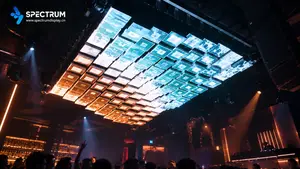
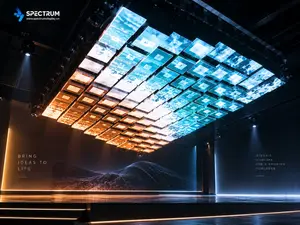
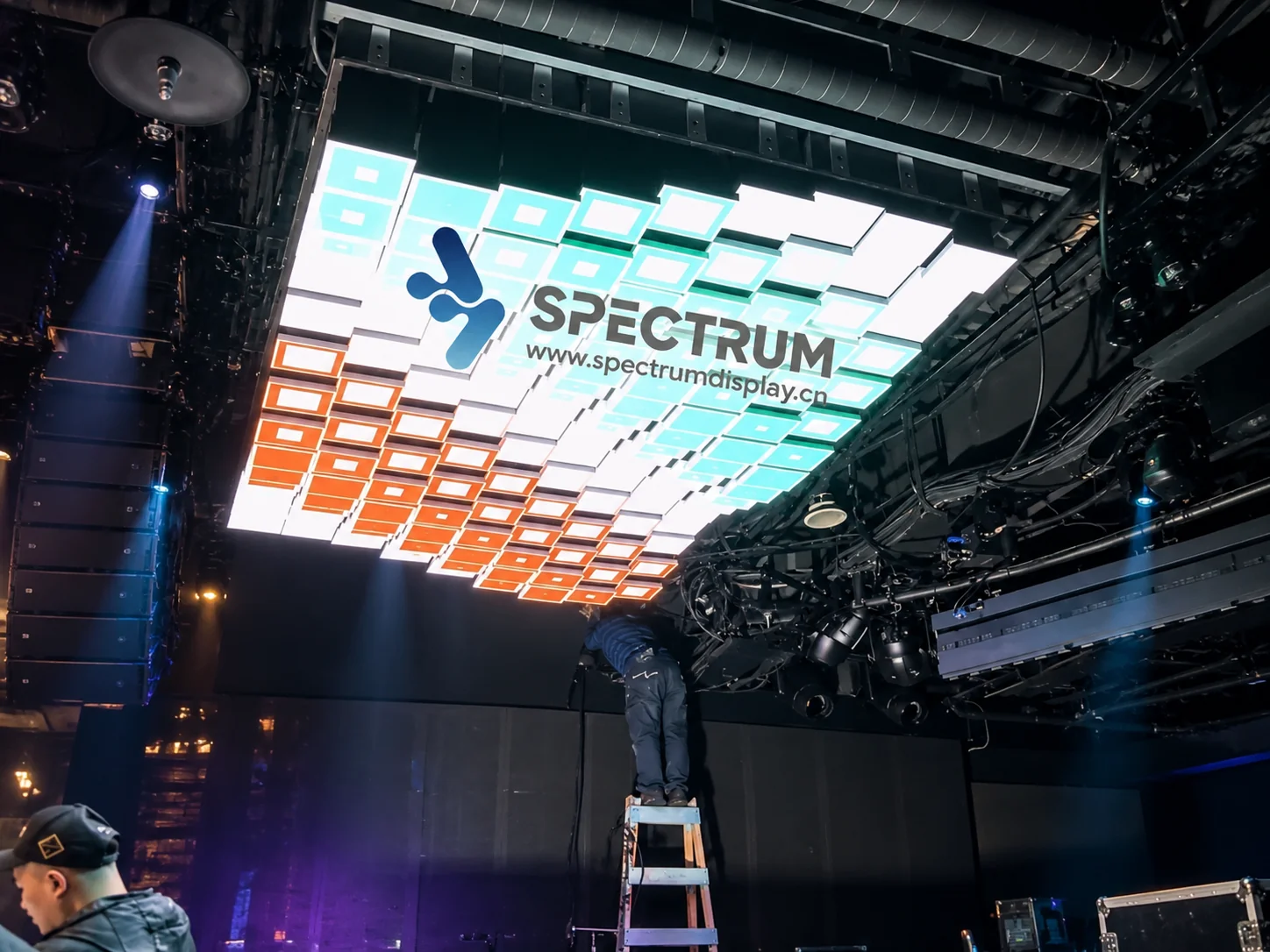
One-Sentence Definition: A premium bar in Singapore installed an SPKI-160 kinetic LED display on the ceiling — because the floor and walls were already fully occupied, while the ceiling was the only unused “visual surface.” The 1440 × 3840 mm dynamic matrix transformed an otherwise passive ceiling into a “breathing skin” for the entire space.
1. The Floor and Walls Were Full — but the Ceiling Was Still Empty
How competitive is Singapore’s nightlife market?
In a city-state covering just over 700 square kilometers, the density of premium bars and clubs is remarkably high. Many venues are competing for the same group of high-value customers — people who are well-traveled, familiar with world-class venues, and increasingly difficult to impress with something that is merely “good.”
Traditional competitive advantages are becoming less effective.
Better drinks, more expensive interiors, and more famous DJs once helped a venue stand out. Today, they are increasingly becoming the price of entry.
What creates real differentiation is the spatial experience itself.
That was exactly the challenge facing this premium bar in Singapore.
The floor was already occupied by seating. The walls were already filled with decorative elements. There was only one visual surface left largely untouched:
the ceiling.
In most commercial spaces, the ceiling is one of the most underestimated pieces of “visual real estate.”
People are accustomed to looking up and seeing a flat black or white surface hiding fire-protection pipes, ventilation systems, and air-conditioning outlets. The ceiling is rarely treated as the protagonist of the interior design.
But what if the ceiling itself could come alive?
2. Challenge 1: Only 350 mm of Ceiling Space — How Could the System Fit?
The ceiling cavity in this bar offered extremely limited installation depth.
A conventional kinetic LED display can easily require more than 600 mm of structural depth, making it impossible to fit into such a restricted ceiling space.
Why Are Kinetic LED Displays Usually So Deep?
A retractable kinetic LED display needs sufficient physical space for each motion unit to extend and retract.
The total system depth generally consists of three major layers:
LED module layer + motion mechanism layer + control system layer
In conventional designs, stacking these layers can push the overall system depth beyond 600 mm.
The SPKI-160 Solution: A 330 mm Ultra-Slim Body
The SPKI-160 compresses the system body depth to just 330 mm.
Combined with its precision mounting structure, the total finished installation depth can be limited to approximately 350 mm.
That difference determines whether the project is simply “difficult to install” or physically impossible to install.
How Can the SPKI-160 Be So Thin?
Die-cast aluminum cabinet design. The SPKI-160 uses high-strength die-cast aluminum to reduce system weight while maintaining structural rigidity. The system weighs only approximately 75 kg/m².
Highly integrated mechanical architecture. The LED modules, motion mechanisms, and control systems are tightly integrated to minimize unnecessary stacked depth.
Industrial-grade linear guides. High-precision linear guides replace bulkier conventional guide structures, maintaining motion accuracy while reducing the space required by the mechanical system.
For a ceiling-mounted kinetic LED installation, every millimeter matters.
The 330 mm body depth of the SPKI-160 is not simply a product specification — it is what makes this type of installation possible.
3. Challenge 2: No Rear Maintenance Access — How Could It Be Serviced?
The limited ceiling cavity created another problem:
There was no room for a rear maintenance corridor.
The area above the bar ceiling was enclosed. There was no practical space for technicians to crawl behind the display and perform maintenance.
A conventional rear-maintenance architecture would therefore be impractical.
If the system could only be serviced from behind, every maintenance operation could require parts of the ceiling to be dismantled.
The SPKI-160 Solution: Front Maintenance
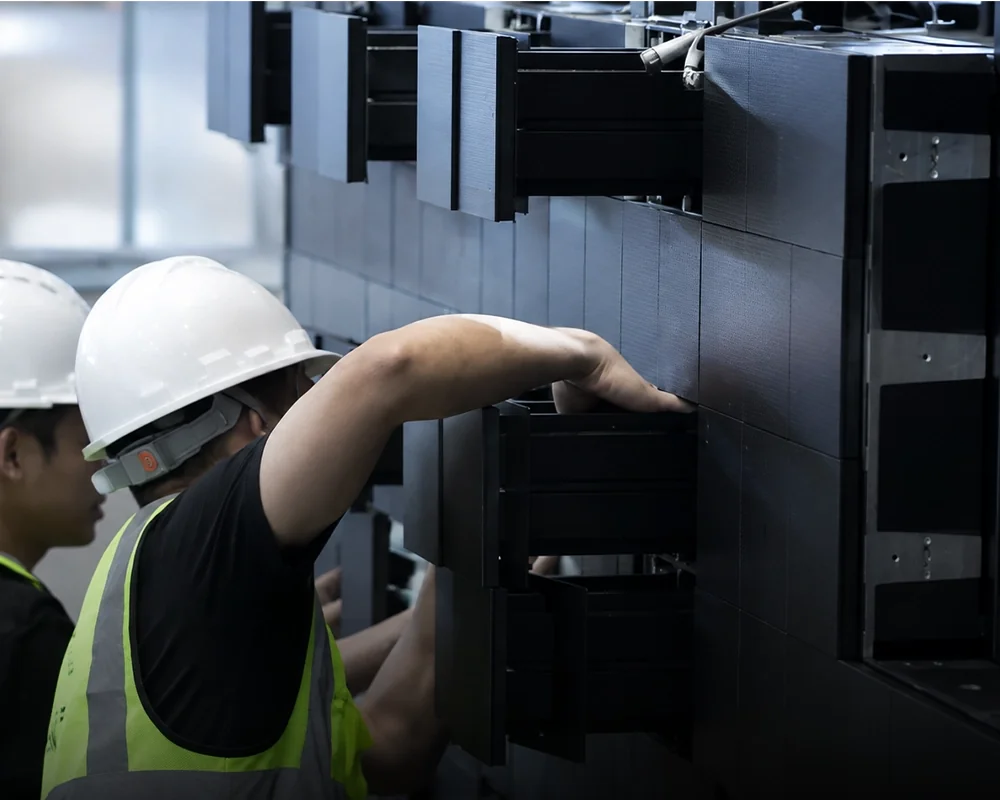
The SPKI-160 supports a front-maintenance architecture.
LED modules and key internal mechanical components can be removed and replaced directly from the display side without requiring access to the rear of the system.
This means technicians do not need to dismantle the ceiling or enter the ceiling cavity to perform routine servicing.
How Does Front Maintenance Work?
Individually removable LED modules. Each LED module can be removed independently from the front without dismantling the entire display.
Modular motion units. The motion mechanisms and drive systems use a modular architecture, allowing individual faulty units to be replaced separately.
Magnetic / quick-release structure. LED modules use magnetic or specially designed quick-release mechanisms to simplify module replacement from the display side.
According to Spectrum Display’s product selection guidelines, the SPKI-160’s front-maintenance architecture allows the complete system to be installed within approximately 350 mm of total installation depth.
In commercial spaces where every centimeter is valuable, this difference can determine whether a kinetic LED concept can actually be realized.
4. Challenge 3: A Bar Needs Atmosphere, Not Mechanical Noise
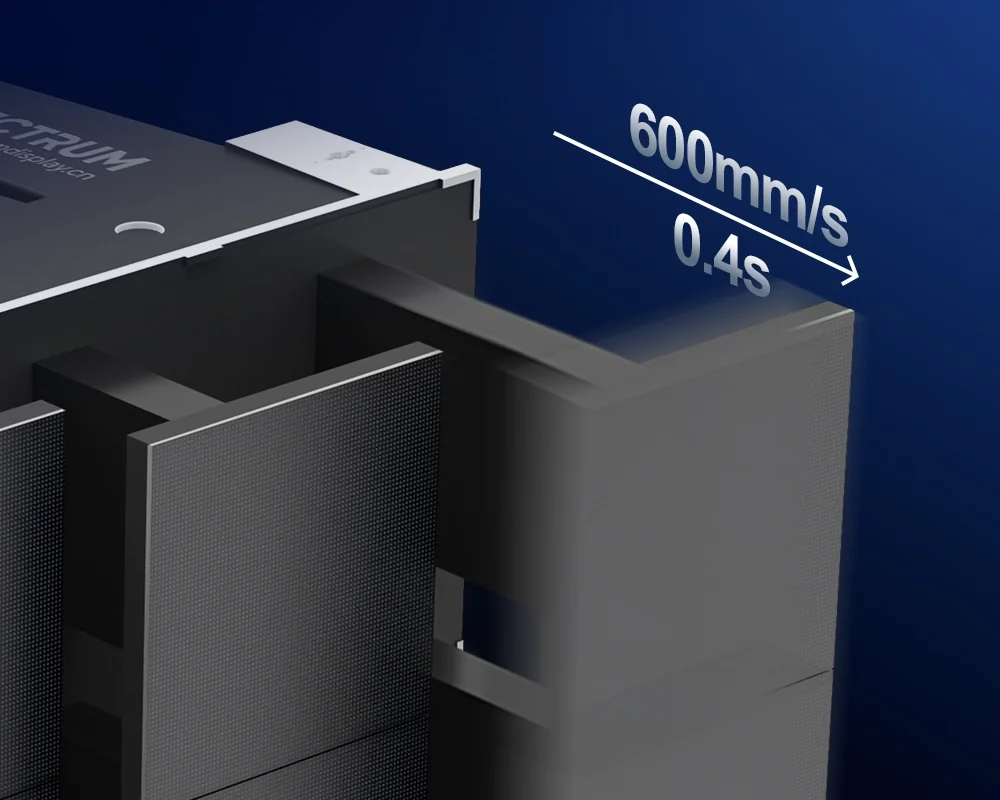
A bar needs atmosphere, not mechanical noise.
Kinetic LED displays inevitably involve moving mechanical components, which can generate sounds from motors, linear guides, transmission mechanisms, and structural vibration.
If the system is too loud, it can interfere with the guest experience and undermine the carefully designed atmosphere of the venue.
The SPKI-160 Solution: Proprietary Bus-Based Servo Drive System
The SPKI-160 uses Spectrum Display’s proprietary bus-based servo drive system, designed for smooth and quiet operation.
Combined with FOC algorithms and 100% closed-loop control, the mechanical movement remains unobtrusive even during quieter, off-peak periods in the venue.
Why Is the System Quieter?
Servo motors instead of conventional stepper motors. Closed-loop servo systems operate more smoothly and quietly than conventional open-loop stepper systems.
Multi-layer noise-reduction design. The SPKI-160 incorporates multiple mechanical noise-reduction measures to maintain low operating noise in indoor environments.
FOC vector control. Field-Oriented Control precisely manages motor torque and speed, enabling smooth start-up, controlled acceleration, and soft stopping while reducing mechanical impact and noise.
5. Project Solution and Technical Specifications
| Item | Specification |
|---|---|
| Product Model | SPKI-160 |
| Installation Method | Ceiling-mounted installation |
| Display Size | 1440 mm (H) × 3840 mm (W) |
| Total Display Area | Approx. 5.53 m² |
| Module Size | 160 × 160 mm |
| Pixel Pitch | P1.98 |
| Number of Motion Units | Approx. 88 independent motion units (39 units/m²) |
| Module Gap | <1.5 mm |
| System Body Depth | 330 mm |
| Finished Installation Depth | ≤350 mm |
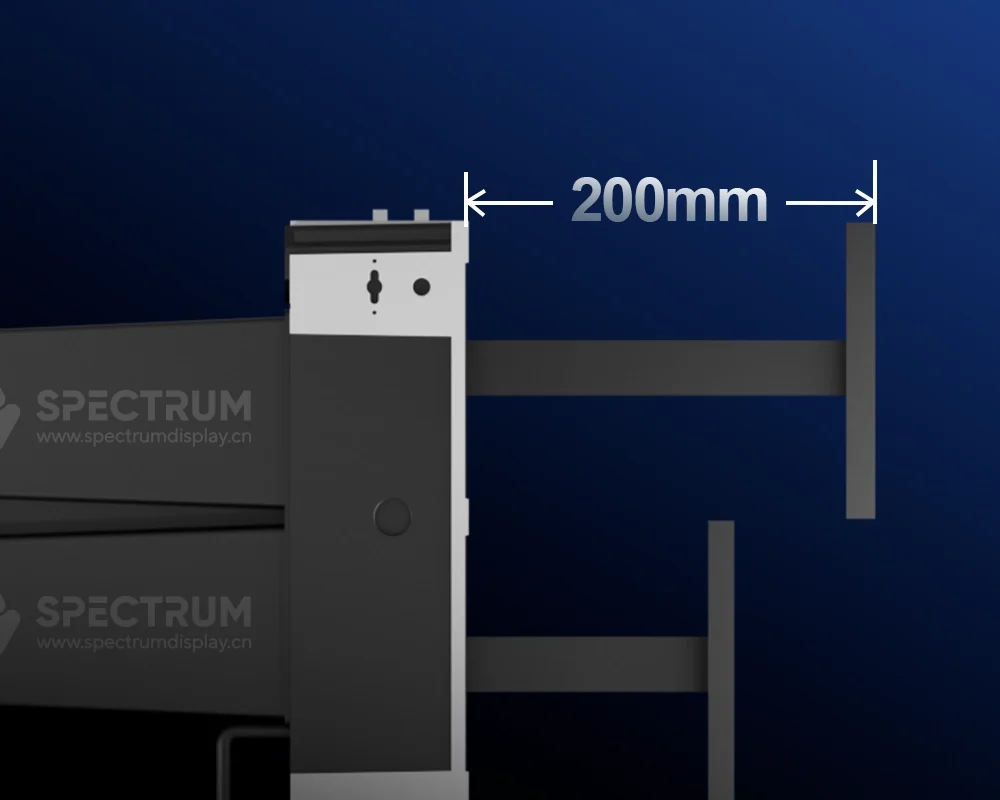
| Maximum Motion Stroke | 200 mm |
| Maintenance Method | Front maintenance |
| Control Solution | Integrated with the bar’s lighting control system via DMX512 |
Control and Content Solution
Music synchronization. Through DMX512, the physical movement of the kinetic LED display can be synchronized with the DJ’s music.
The lighting operator can use a professional lighting console to directly control the rhythm and amplitude of the display’s physical movement.
In other words:
the rhythm of the music becomes the rhythm of the screen.
Preset scene modes. Different operating modes can be created for different moments during the night:
- Welcome Mode: slow, gentle movement
- Warm-Up Mode: faster rhythmic motion
- Peak Mode: full-stroke kinetic impact
Different times and different atmospheres can be activated with a simple mode switch.
Content updates. Operating modes can be changed through a mobile app or professional control console, allowing customized effects for different themed events.
The same ceiling can behave completely differently for Halloween, Christmas, New Year’s Eve, or a branded event.
One ceiling, unlimited expressions.
6. The Result: When the Ceiling Starts to “Breathe”
The moment the system came to life, the atmosphere of the entire space changed.
As the music began, individual LED units extended, retracted, rose, and fell with the rhythm.
The entire ceiling appeared to come alive.
This was not projection mapping.
It was not a visual effect created on a flat LED screen.
It was real physical movement — visible, tangible, and spatial.
A Ceiling That Breathes
In slow-motion mode, the surface rises and falls gently, almost like breathing, creating a calm and immersive atmosphere.
When the music becomes more energetic, the kinetic matrix moves faster and synchronizes with the lighting and sound system.
The entire venue becomes surrounded by a sense of energy flowing from above.
Millisecond-Level Synchronization with Music
Through DMX512 integration, the rhythm, amplitude, and frequency of the kinetic LED movement can be synchronized with the DJ’s music at the millisecond level.
The display is no longer just a background.
It becomes part of the performance — music made visible.
A Different Experience Every Time
Because the movement content is programmable, the kinetic patterns can be changed according to different themed events.
Guests can return to the same venue and experience a completely different ceiling.
The hardware remains the same.
The spatial expression continues to evolve.
7. Commercial Value: Turning Guests into Organic Content Creators
In the age of social-media-driven consumption, how “photographable” a venue is can directly influence its visibility.
A Memorable “Look-Up” Moment
When guests enter a bar, they naturally look around.
But when they look up in this venue, instead of seeing a conventional flat ceiling, they encounter a dynamic matrix physically moving above them.
That unexpected moment transforms the ceiling into one of the venue’s most distinctive spatial signatures.
Organic Photo and Video Sharing
The constantly changing ceiling creates highly visual moments that naturally encourage guests to take photos and short videos.
This increases the potential for secondary exposure across social platforms.
According to the industry observations referenced in the project context, venues with interactive installations can see more than 60% of customers voluntarily raising their phones to capture content, while social exposure can reach several times that of conventional venues.
A Differentiated Competitive Advantage
In Singapore’s highly competitive nightlife market, the “breathing ceiling” gives the venue a spatial experience that is difficult to replicate with conventional interior decoration or flat LED displays.
Instead of simply adding another display to the space, the project turns an underused architectural surface into a dynamic part of the venue experience.
8. Frequently Asked Questions (FAQ)
Q1: How is the structural load handled for a ceiling-mounted kinetic LED display?
A: The SPKI-160 uses a lightweight die-cast aluminum cabinet design and weighs approximately 75 kg/m².
The ceiling system can be supported by a conventional steel structural support frame without requiring extensive modification or reinforcement of the main building structure, significantly reducing the engineering threshold for ceiling-mounted applications.
Q2: Can the SPKI-160 be installed if the bar has limited ceiling space?
A: Yes.
The SPKI-160 has a body depth of only 330 mm, with a finished installation depth of ≤350 mm, including the necessary installation and heat-dissipation space.
Compared with conventional kinetic display systems that can require more than 600 mm of depth, the SPKI-160 significantly reduces the ceiling-space requirement and can be integrated into many standard commercial interiors.
Q3: Will mechanical noise interfere with the music experience in a bar?
A: The SPKI series uses Spectrum Display’s proprietary bus-based servo drive system, which operates significantly more quietly than conventional stepper-motor systems.
Combined with FOC algorithms and 100% closed-loop control, the system is designed to maintain smooth, low-noise mechanical operation even during relatively quiet, off-peak periods.
Q4: How is a ceiling-mounted kinetic LED display serviced? Does the ceiling need to be dismantled?
A: No.
The SPKI-160 supports front maintenance.
LED modules and key mechanical components can be removed and replaced directly from the display side, so technicians do not need to enter the ceiling cavity or dismantle the ceiling structure.
This significantly reduces the difficulty and long-term cost of maintenance.
Q5: Can the kinetic LED display synchronize with music?
A: Yes.
The SPKI series supports standard stage-control protocols including DMX512, ArtNet, and sACN.
It can be integrated directly with professional lighting consoles such as grandMA, allowing music-related control signals to drive the physical movement of the display and create synchronized integration between sound, lighting, video, and physical motion.
Q6: How is the display content changed? Is programming required?
A: Programming is not required for routine content creation and operation.
Spectrum Display’s Mshow4 no-code control software allows operators to create and arrange motion sequences directly on a computer.
Preset modes can also be switched through a mobile app, allowing venue operators to quickly change kinetic effects for different parties, events, and themes.
▶Video · YouTubeWhen the Screen Starts Moving — physical motion you can see from belowWatch on YouTube →9. Conclusion
The Singapore bar ceiling project is a representative commercial entertainment application of the Spectrum Display SPKI-160 kinetic LED display.
Project Value at a Glance
1. Precise Product Selection The combination of a 330 mm ultra-slim body + front maintenance provides a practical solution for ceiling installations with extremely limited space.
2. Efficient Installation The lightweight cabinet design at approximately 75 kg/m² reduces structural requirements, while front maintenance eliminates the need for a rear service corridor.
3. High-Impact Spatial Experience The physical 3D kinetic matrix transforms a conventional ceiling into a dynamic, “breathing” architectural surface.
4. Flexible Operation DMX512 integration allows the kinetic display to synchronize with music, while preset modes can be switched for different events and atmospheres.
5. Long-Term Content Flexibility The physical hardware can remain in place while motion sequences and visual content continue to evolve for different themed parties, campaigns, and events.
Recommendations for Bar and Nightclub Owners
- Commercial venues with a ceiling height of 3.5 meters or more can consider a ceiling-mounted kinetic LED display solution.
- Plan the kinetic LED system together with the lighting and audio systems from the beginning to maximize the overall spatial effect.
- Reserve a DMX512 control connection during the project planning stage to support future content updates and show-control integration.
- For more information about the project or a customized ceiling-mounted kinetic LED solution, contact the Spectrum Display team through its official website.