The "Physical Engine" of Offline Traffic: Unveiling the Underlying Logic and Sensor Technology of High-Frequency Human-Machine Interaction at ISLE
If traditional static visual merchandising is the "outerwear" of commercial spaces, then interactive installations with real-time perception capabilities are becoming the "physical engines" driving offline traffic.
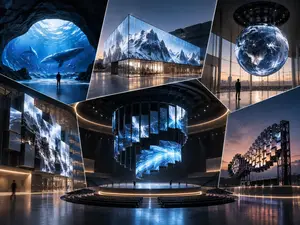
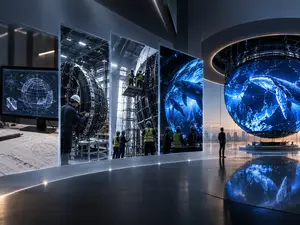
At the currently bustling ISLE 2026 (International Smart Display & Integrated System Exhibition) in Shenzhen, the Spectrumdisplay booth has drawn phenomenal crowds and queues. A massive wall composed of hundreds of independent modules seems to have come alive—as visitors approach, the wall automatically recedes like ocean waves; as they wave, the screen pixels, accompanied by the undulation of the physical matrix, accurately recreate the contours of human movements.
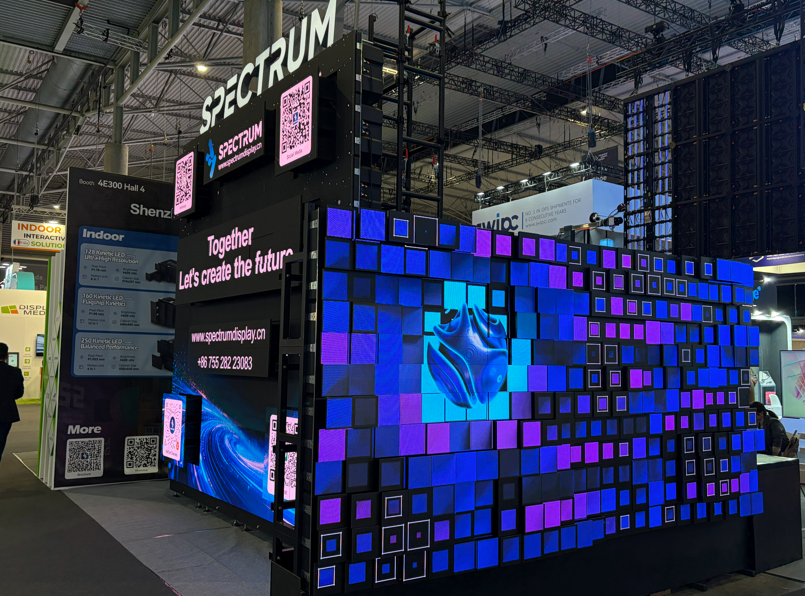
This dimension-breaking experience is precisely the spatial awe brought by the interactive kinetic screen. Today, we will step beyond the dazzling visual facade to deeply deconstruct the sensor technology and underlying kinematic logic behind this "living" wall.
Live on Site: When Digital Pixels Acquire "Perception"
During the live demonstrations at ISLE, what amazed professional audiences the most was not merely the 3D visual content, but the screen's "instantaneous feedback" to the human body.
At the exhibition, visitors did not need to wear any cumbersome VR/AR devices. By simply walking, waving, or standing naturally, the massive kinetic matrix responded immediately. This immersive experience of "waves rising as you walk, wind following your wave" completely overturned the traditional limitation of exhibition equipment being "for viewing only." It transformed the audience from passive receivers into co-creators of digital art, which not only significantly extended the booth's dwell time but also triggered spontaneous, explosive sharing on social media.
Behind all this seamless experience is the highly efficient synergy of complex edge computing and precision machinery.
Interaction Deconstructed: The Invisible Empowerment of Multi-Sensor Fusion and Mobile Control
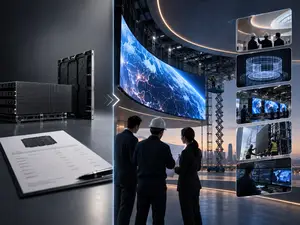
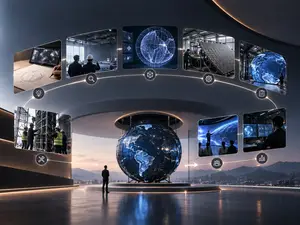
To enable a cold metal wall to "understand" human intentions, the core lies in endowing it with an acute sensory system. In this interactive kinetic screen, Spectrum has established a full-link ecosystem from environmental perception to command execution.
1. Multi-Sensor Fusion
Traditional single infrared sensing often suffers from large blind spots and low recognition accuracy. To capture more nuanced motion features, the system adopts a seamless integration solution of Depth Cameras and LiDAR.
Radar Tracking: Responsible for large-scale spatial positioning. When a visitor enters a specific area, the radar instantly locks onto their movement trajectory, driving the kinetic screen to produce large-area following undulations.
Depth Camera Analysis: During close-range interaction, depth cameras accurately capture the skeletal nodes and edge contours of the human body. Through Spectrum's proprietary TD2Matrix node mapping, human posture data is translated into Z-axis displacement commands for the kinetic modules in real-time, achieving a physical reconstruction akin to a "digital mirror."
2. Proprietary Mobile Control System: A Minimalist Interactive Portal
Beyond motion sensing, Spectrum has also created an ultra-low-threshold intervention method for high-frequency commercial exhibitions: a proprietary mobile control system.
Visitors on-site do not need to download any cumbersome apps. By simply scanning the QR code on the screen with their phones, their smartphones turn into a "remote control" for this giant kinetic wall. Whether switching video programs, altering wave patterns, or triggering specific physical effects, complex backend logic is encapsulated in a minimalist touchscreen interface. This interactive design of "controlling the big screen in the palm of your hand" greatly enhances user engagement in commercial scenarios.
Kinematic Support: Reshaping Spatial Experience with <0.5s Full-Process Response
All advanced sensing and control technologies must ultimately be implemented at the mechanical execution level. In human-machine interaction, there is a fatal experience killer: "latency."
If the screen takes 1 second or longer to react after a viewer waves, that sense of disconnect will instantly destroy the immersive experience. True zero-latency physical feedback is an extreme test of the underlying kinematic architecture.
The reason Spectrum's SPKI Indoor Series kinetic screen can display such silky-smooth tracking effects at ISLE is due to its exceptionally powerful servo drive performance.
Extreme Explosive Power: From receiving a command, starting acceleration, and reaching the designated stroke, to precise braking, the complete physical response time of a single kinetic module is strictly controlled to under 0.5 seconds.
Eliminating Perceptual Deviation: This ultra-fast response, which surpasses human persistence of vision, completely eradicates the time gap during interaction. When actions and physical feedback are highly synchronized, the kinetic screen is no longer an external display but feels like an extension of the viewer's body.
Outlook on Commercial Application Potential
This technical architecture, based on ultra-fast kinematics and multi-sensor fusion, is unlocking new imagination for retail and commercial spaces. In top-tier luxury window displays, it can be metal flowers blooming in sync with customers' footsteps; in large commercial atriums, it can be an artistic landmark that breathes automatically based on ambient volume and crowd density. It endows architecture with emotion, granting commercial spaces the ability to truly engage in deep dialogue with consumers.