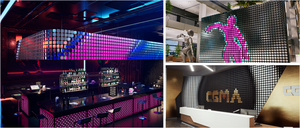
In grand indoor spaces such as large shopping mall atriums, international airport hubs, and super corporate headquarters, traditional flat display screens struggle to leave a lasting impression on hurried crowds. Kinetic screens, with their visually stunning 3D spatial impact, are becoming the premier choice for creating super indoor landmarks.
However, when project areas easily exceed hundreds of square meters and installation heights reach over a dozen or even tens of meters, a fatal engineering pain point is exposed: the "high-altitude nightmare" of later-stage operations and maintenance (O&M). If conventional front-maintenance equipment is used, every subsequent inspection or module replacement requires the cumbersome nighttime setup of high scaffolding or the rental of expensive aerial lifts. This not only causes O&M costs to climb exponentially but also brings significant safety hazards to the commercial space's normal operations and on-site personnel.
Facing the fixed-installation challenges of ultra-large areas and ultra-high positions, SPECTRUM DISPLAY, leveraging its profound engineering heritage, has launched the SPKI-250 Kinetic Screen, tailor-made for large architectural spaces. With its pure "engineering DNA," it provides a once-and-for-all solution for ultra-large indoor kinetic display projects.
Core Parameter Analysis: The "Engineering DNA" of Simplifying Complexity
As a benchmark large-scale indoor fixed-installation kinetic screen, the design logic of the SPKI-250 is no longer merely pursuing extreme close-range delicacy, but prioritizing "ultimate stability" and "highly efficient O&M":
1. Pure Rear-Maintenance Design: Bidding a Final Farewell to Aerial Lifts
The SPKI-250 is a pure rear-maintenance kinetic LED screen. During the initial project design, simply reserving a standard maintenance access channel behind the screen easily resolves all future inspection work. When a module or servo motor requires maintenance, technicians only need to enter the rear channel to effortlessly and unobstructed disassemble and repair the entire motion unit (including mechanical transmission parts and LED modules) in a safe, spacious environment. This engineering-grade rear-maintenance solution completely eliminates the cumbersomeness and danger of on-site high-altitude work, compressing the time and cost of a single fault troubleshooting to the absolute minimum.
2. 248.5 × 248.5 mm Large Unit Size: Simplifying Complexity, As Stable as Mount Tai
In giant kinetic screens exceeding hundreds of square meters, the more fragmented the unit division, the more the number of motors, communication nodes, and failure probabilities multiply. The SPKI-250 takes a different approach by enlarging a single physical motion unit to 248.5 × 248.5 mm (only 16 units per square meter). This physical scale of "simplifying complexity" greatly reduces the electronic control complexity of super-large area system integration. With fewer nodes and a more stable structure, it guarantees an ultra-low failure rate for the equipment under year-round, 24/7 operation from the physical root.
3. Flexible Multi-Pitch Selection: Precisely Matching Project Budgets
Super-large area projects strictly control their budgets. Therefore, the SPKI-250 is crafted as a flexible multi-pitch kinetic screen. It offers multiple high-spec pixel pitch options from P1.56, P1.95, P2.6, to P3.91. Clients can implement the most scientific configuration based on the atrium's actual floor height, main viewing distance, and project budget (for example: choosing P3.91 for high-floor, long-distance viewing areas, and P1.95 for low-floor, main visual areas), ensuring every cent of the engineering budget is spent wisely.
Scenario Extension: Creating a Magnificent "Sense of Breathing Undulation"
In the practical application of creative displays in mall atriums or large transportation hubs, the audience's viewing distance is usually 10 meters or even over 30 meters away. From this macroscopic perspective, the kinetic arrangement of the SPKI-250's 16 units per square meter actually presents the optimal visual tension.
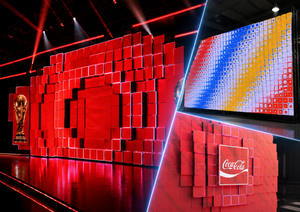
When the screen links with exclusive 3D naked-eye content, the wide mechanical units, driven by industrial-grade servo motors, can display the majestic momentum of surging ocean waves or the deep undulating rhythm of a giant beast breathing. This expansive, magnificent physical movement creates an immense visual pressure and spatial dominance when viewed from afar, instantly capturing the attention of the entire atrium or departure hall and pushing the building's technological aesthetics to the pinnacle.
Conclusion: The Worry-Free Choice for Large Fixed-Installation Projects
Small screens rely on precision; giant screens rely on engineering. The SPKI-250 Kinetic Screen is not a simple display monitor, but a heavy-duty kinetic architectural material that possesses ultimate stability and supports highly efficient rear maintenance.
For commercial real estate developers, airport builders, and large system integrators, choosing the SPKI-250 means choosing long-term peace of mind and an extremely low total cost of ownership. Welcome to contact SPECTRUM DISPLAY to obtain your exclusive engineering landing solution for large-scale indoor kinetic displays.
SPKI-250 Large Indoor Fixed-Installation Kinetic Screen FAQ
Q1: The load-bearing capacity of mall atriums is usually limited. Even though the SPKI-250 is rear-maintenance, will it be too heavy?
A: No. Although the SPKI-250 utilizes a rear-maintenance architecture, SPECTRUM controls the overall weight within a very reasonable range through a high-strength aluminum skeleton and lightweight cabinet design. During the solution design phase, our engineers will provide scientific load distribution calculations and installation drawings based on your site's wall structure or steel frame load-bearing capacity, ensuring the safety of the large-scale fixed installation.
Q2: If using rear maintenance, how wide of a maintenance access channel do we need to reserve behind the screen?
A: To ensure technicians can safely and efficiently conduct internal inspections and component replacements, we recommend reserving a maintenance access channel width of at least 600mm to 800mm behind the screen. Although this occupies some rear space, for large-scale atrium fixed-installation projects that are easily over a dozen meters high, this is the optimal solution to eliminate massive future high-altitude maintenance costs.
Q3: Is the operating noise of this large rear-maintenance equipment loud? Will it affect the mall environment?
A: Not at all. Despite the SPKI-250's grand undulations, its underlying layer is still equipped with SPECTRUM's core closed-loop servo motors and high-precision linear guide rail systems. During high-speed extension and retraction, its mechanical noise is excellently suppressed to extremely low decibels. It will be completely masked by the normal ambient sound of the mall or airport, causing absolutely no auditory disturbance to on-site customers.
[Witness the Pinnacle of Visuals]
Explore the Future of Vision—Your Journey Starts Here!
June 17-19, 2026 | Las Vegas Convention Center | Booth C5466
🌐 Get your digital invitation and product white papers: www.spectrumdisplay.cn