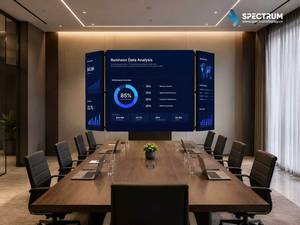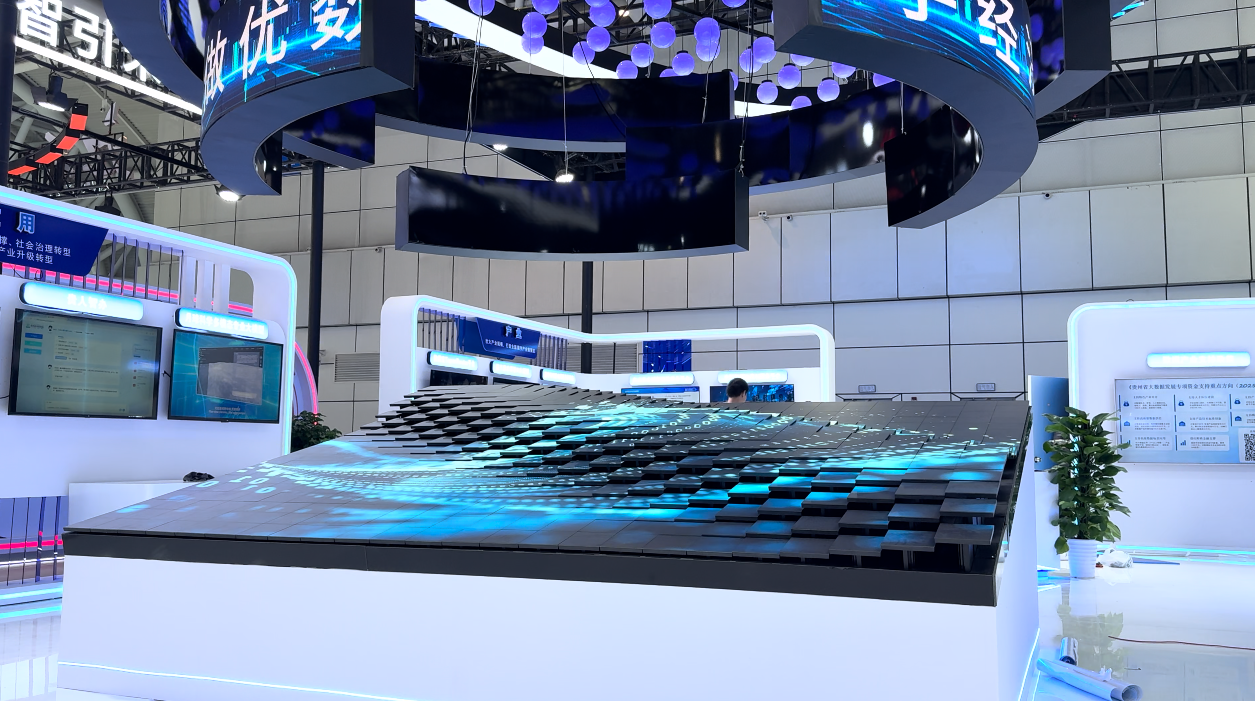
One-sentence definition: Exhibition kinetic screen visual design is an exhibition space design methodology that uses telescoping, lifting, and folding mechanical LED display systems to create dynamic visual focal points in booth spaces—extending audience dwell time, enhancing booth attractiveness, and boosting brand memorability.
Table of Contents
What's changing in exhibition lead generation?
Why can't traditional booths hold audience attention?
How does telescopic kinetic screen create dwell points?
JDStrong Technology exhibition case studies
Practical tips for deploying kinetic screen at exhibitions
FAQ
1. What's Changing in Exhibition Lead Generation?
From "waiting for visitors" to "competing for attention"
Large exhibitions never lack foot traffic—the question is whether that traffic stops at your booth.
Take the Canton Fair as an example. Known as "China's No.1 Exhibition," this global trade event attracts over 200,000 overseas buyers and professional visitors per session, with more than 25,000 exhibitors. In an environment where thousands of booths compete for audience attention simultaneously, "dwell time" has become the scarcest resource.
The traditional booth design logic—"put the information out there and wait for people to come"—is failing in today's exhibition environment:
Audience attention spans are getting shorter
Visual homogenization among booths is getting worse
High-definition video alone can no longer create "shareable moments"
Brands face three core challenges at exhibitions:
How do I get passing visitors to stop?
How do I get stopped visitors to stay longer?
How do I get departing visitors to take photos and share?
The reason telescopic kinetic screen has gained significant traction at major international exhibitions in recent years is simple—it addresses all three challenges simultaneously.
2. Why Can't Traditional Booths Hold Audience Attention?
Three pain points of traditional booths
Pain point 1: Static visual fatigue
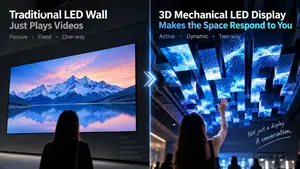
The core visual element of most booths is one or more flat-panel LED screens. Regardless of resolution or content quality, it's essentially "a flat screen playing video." Walking through the exhibition hall, visitors see similar visuals everywhere—it's hard for any single booth to leave a lasting impression.
Pain point 2: Lack of a "reason to stop"
When a visitor passes a booth, they have only a few seconds to decide whether to stop. Flat-panel LEDs offer very limited "reasons to stop"—unless the content happens to hit the visitor's interest, it's hard to make them pause.
Pain point 3: Low shareability
The golden rule of exhibition communication is: whatever visitors photograph is what gets shared. No matter how beautiful a flat-panel LED's visuals are, a photo of it is just a screen capture—lacking visual impact and social sharing appeal. In the social media era, without "photo-worthy" visuals, you lose the post-exhibition second-wave communication opportunity.
According to JDStrong Technology's observations across multiple international exhibitions, booths using telescopic kinetic screen see 35%-50% higher spontaneous photo-sharing rates compared to traditional flat-panel LED booths. The reason is straightforward—a moving screen is itself a "photo-worthy moment."
3. How Does Telescopic kinetic screen Create Dwell Points?
1. Creates "physical surprise"—making visitors "can't help but look"
The human visual system is inherently sensitive to "motion." In a hall full of static booths, a screen that's telescoping, undulating, and transforming captures attention instantly.
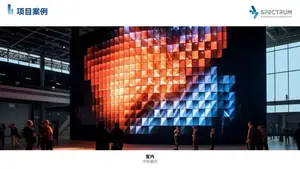
As the Official LED Screen Supplier of the Canton Fair Complex (2024-2029) , JDStrong Technology deployed a 3D telescopic kinetic mega-screen at the Canton Fair. With its unique "Dual 3D Effect"—where not only the visuals are three-dimensional, but the physical screen itself literally "moves toward" the audience—it became a visual focal point that stopped countless international buyers in their tracks.
2. Creates "immersive moments"—making visitors "willing to stay"
Getting visitors to stop is only the first step. Getting them to stay is what matters.
The dynamic changes of a telescopic kinetic screen are continuous and unpredictable—the screen telescoping, undulating, reconfiguring. Each morphological change delivers a new visual stimulus. This "continuous novelty" effectively extends visitor dwell time.
At the Canton Fair Complex's Zone D (south gate of the Canton Fair Hall), JDStrong exclusively sponsored a landmark kinetic mega-screen. With millisecond-precision physical telescoping perfectly synchronized with customized video content, it became the most recognizable visual landmark of the entire exhibition.
3. Comes with built-in "shareable content"—making visitors "share proactively"
The screen's motion process itself is high-quality short-form video material. Visitors capture not just a booth, but the dramatic "screen transforming" moment—content that performs significantly better on social media than static screen captures.
At the Canton Fair, when the screen displayed dazzling fireworks and 3D imagery of the Canton Tower, JDStrong's closed-loop servo motors ensured that hundreds of modules moved without delay, with silk-smooth precision. This fully integrated hardware-software visual experience is the true "traffic code" that impressed countless international buyers enough to pull out their phones and start recording.
4. JDStrong Technology Exhibition Case Studies
Case Study 1: ISE 2026 (Integrated Systems Europe)
Exhibition background: ISE is the world's premier AV technology event, bringing together the most professional integrators, brands, and designers globally.
JDStrong booth highlights:
Two flagship products—SPKI-160 and SPKI-250—showcased side by side, precisely targeting different market needs
SPKI-160 designed for commercial showrooms, brand events, and stage rental—with quick-assembly structure and integrated cabinet design that perfectly solves the core pain points of tight timelines and complex setup at exhibition sites
Interactive experience zone where visitors could use MShow4 software to create dynamic content and drive the screen in real-time
Became the focal point on opening day, attracting professional visitors from around the world
Case Study 2: Canton Fair (China Import and Export Fair)
Exhibition background: The Canton Fair is one of the world's largest and most influential comprehensive international trade events, attracting over 200,000 overseas buyers per session.
JDStrong booth highlights:
JDStrong Technology became the Official Authorized LED Screen Supplier of the Canton Fair Complex (2024-2029) , powered by innovative solutions including naked-eye 3D and 3D mechanical telescopic LED screens
Exclusively sponsored a landmark telescopic kinetic mega-screen at Zone D (south gate of the Canton Fair Hall), delivering a "Dual 3D Effect"—3D visuals combined with physical screen telescoping—creating the most recognizable visual landmark
The overseas flagship SPKI-160 made a major debut, featuring a 330mm ultra-thin cabinet and 100% pure front-maintenance architecture—completely solving the cross-border after-sales maintenance cost concerns that overseas buyers care about most
The pure front-maintenance design allows local overseas technicians to perform repairs from the front of the screen, compressing troubleshooting time from hours to under 1 minute—eliminating the exorbitant after-sales maintenance costs of international orders
The booth became the undisputed traffic magnet of the entire show, thanks to the visual marvel of "0mm visual gaps" and "<0.5s zero-latency" high-frequency human-machine interaction
Case Study 3: ISLE 2026 (International Smart Display & System Integration Exhibition)
Exhibition background: ISLE is one of China's most influential smart display professional exhibitions.
JDStrong booth highlights:
Featured SPKI series telescopic kinetic screens and seamless spherical LED screens
SPKI-250 equipped with independently developed mobile smart control system—enabling one-click content delivery and instant mechanical motion preview
This "dancing" kinetic screen delivered a revolutionary interactive experience, moving beyond the single static presentation of ordinary screens
Attracted large numbers of domestic and international professional visitors for hands-on experience and in-depth discussions
5. Practical Tips for Deploying kinetic screen at Exhibitions
Tip 1: Choose the right product model
Exhibition Type | Recommended Product | Key Advantage |
|---|---|---|
Large international exhibition (300㎡+ booth) | SPKI-250 | Large-format visual impact, engineering-grade stability |
Mid-size exhibition / rental scenarios | SPKI-160 | Quick-assembly structure, rapid deployment, pure front-maintenance |
Custom booth / brand experience zone | Lift-Fold All-in-One | Flexible transformation, mobile display |
Tip 2: Reserve an interactive content experience zone
At both ISE 2026 and the Canton Fair, JDStrong focused on moving visitors from "passive viewing" to "active participation." This significantly increases both dwell time and memory retention.
Tip 3: Use the mechanical motion itself to create shareable content
The "transformation moment" of a kinetic screen is the most shareable visual. At exhibitions, synchronize brand visuals with the screen's opening, retracting, and transforming process—giving visitors "photo-worthy" moments to capture.
Tip 4: Plan booth traffic flow in advance
The visual attraction of kinetic screen should serve the booth's overall traffic flow design. Position the kinetic screen at the booth entrance or visual center, using its dynamic appeal to "pull" visitors deeper into the booth—then combine with product displays and business meeting areas to form a complete "attract-stay-convert" pathway.
6. FAQ
Q1: Does deploying telescopic kinetic screen at exhibitions take a long time?
No. JDStrong's SPKI series features modular design and quick-assembly structure, with military-grade aviation plug ecosystem supporting "blind-plug instant connection". Rental teams can complete setup and teardown of large-scale matrices in minimal time, "like building with LEGO".
Q2: Are telescopic kinetic screens prone to failure at exhibitions?
JDStrong's SPKI series has undergone rigorous engineering validation, with mechanical structure design life exceeding 50,000 hours. The SPKI-160 supports 100% pure front-maintenance—local overseas technicians can perform repairs from the front of the screen, compressing troubleshooting time to under 1 minute.
Q3: Is telescopic kinetic screen suitable for small booths?
Yes. The SPKI-160 has a cabinet depth of just 330mm and supports 100% front-access module maintenance and rapid replacement—ideal for small to mid-size booths with limited space that still want visual differentiation.
Q4: What happens to the telescopic kinetic screen system after the exhibition?
The core value of telescopic kinetic screen lies in reusability. A single SPKI system can be rotated across different cities, exhibitions, and brand events—with per-use costs decreasing as usage frequency increases. This is why more and more rental integrators are purchasing kinetic screen systems as capital assets.