650mm/s and 0.4-Second Full-Stroke Motion: Why Does Speed Create More Impact in a Kinetic LED Screen?
One-Sentence Definition: In a 3D kinetic LED screen, motion speed—such as 650mm/s—and full-stroke response time—such as 0.4 seconds—are key parameters that determine visual impact and commercial value. They are more than physical hardware specifications: they determine whether the screen can achieve millisecond-level frame synchronization with fast-paced music, dynamic video content, and real-time interaction.
Contents
- When a Kinetic LED Screen Misses the Beat, Even Great Creative Content Falls Apart
- The Engineering Logic Behind Speed: Why Is 0.4 Seconds a Critical Threshold?
- How Does Speed Transform the Visual Experience? — Three Key Scenarios
- How Does the SPKI-166 Deliver Such Powerful Motion? — Engineering Explained
- The Faster the Motion, the More Important the Safety System
- Frequently Asked Questions (FAQ)
- Conclusion
1. When a Kinetic LED Screen Misses the Beat, Even Great Creative Content Falls Apart
At many exhibitions and product launches, there is one awkward situation that appears more often than you might expect.
Powerful electronic music is playing. The LED screen shows an intense dynamic visual, while the mechanical modules behind the image extend forward too slowly. By the time the video has already moved on to the next scene, the modules still have not reached their maximum position.
This is one of the biggest problems a kinetic LED screen can have: perceptible motion lag.
Traditional mechanical transmission systems, such as screw-driven lifting mechanisms, can be limited by motor power and structural inertia, with a full-stroke movement often taking 1.5 seconds or longer. This type of slow physical response may work for gentle, slow-paced storytelling. But once the content becomes faster, the mechanical movement can begin to feel heavy and unnecessary.
Instead of experiencing impact, the audience experiences a disconnect between the digital content and the physical motion.
For a kinetic LED screen to create a truly powerful live experience, motion speed and response time must cross a certain performance threshold.
2. The Engineering Logic Behind Speed: Why Is 0.4 Seconds a Critical Threshold?
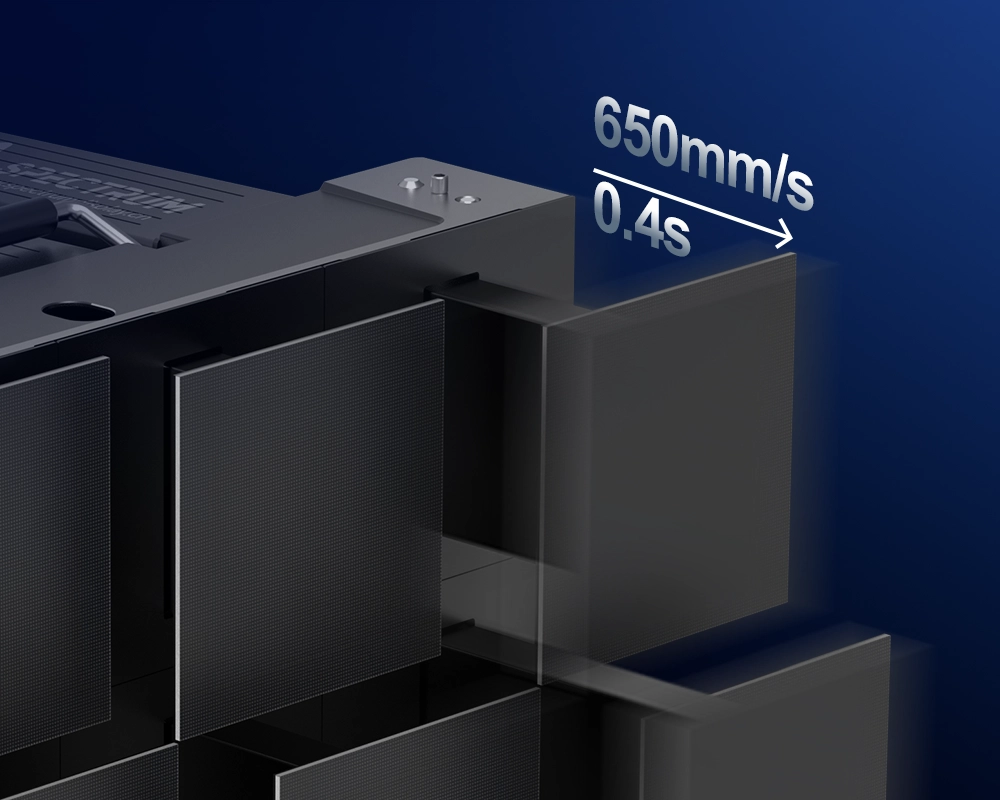
Two parameters matter here: maximum motion speed of 650mm/s and a 0.4-second full-stroke response time.
Full stroke refers to the complete movement of the module from its fully retracted position at 0mm to its fully extended position at 230mm.
0.4 seconds is roughly comparable to the time it takes to blink.
Why does this number matter so much?
Because human perception is highly sensitive to timing—especially when visual movement is paired with strong musical beats. In audiovisual experiences, tight audio-visual synchronization generally requires timing differences to remain within approximately 0.1 seconds.
If a kinetic LED module takes one second to complete a 230mm movement, it is primarily suited to slower background music and gradual visual transitions.
At 0.4 seconds, however, the system can respond much more effectively to electronic music above 120 BPM, rapid percussion, countdown sequences, and high-impact event climaxes.
It allows physical movement and digital content to operate on a much more closely aligned timeline.
Combined with a peak motion speed of 650mm/s, the rapid acceleration and deceleration of the modules create a stronger sense of physical punch, further amplifying the visual tension of the content.
3. How Does Speed Transform the Visual Experience? — Three Key Scenarios
Scenario 1: Product Launch Countdowns and Reveal Moments
When the countdown reaches “3, 2, 1,” the LED modules can rapidly extend at up to 650mm/s and complete the 230mm movement within 0.4 seconds.
Combined with a heavy bass hit, this sudden physical movement can instantly intensify the climax of a product launch.
It creates a sense of ceremony and physical impact that flat-screen visual effects alone cannot replicate.
Scenario 2: Music Festivals and Electronic Music Events
In stage design, visual movement needs to follow the BPM—beats per minute—of the music.
A 0.4-second full-stroke response allows the kinetic LED surface to behave almost like a physical percussion instrument.
As the rhythm becomes more intense, the display surface can move faster with the beat, turning the LED wall itself into part of the performance and energizing the entire space.
Scenario 3: High-Frequency Interactive Installations
When a visitor approaches the screen or waves a hand, radar sensors or cameras can capture the movement.
If the mechanical system reacts half a beat too late, the interaction immediately feels disconnected.
The fast response of the SPKI-166 allows the physical surface to behave almost like a responsive mirror: as a person moves, the surface reacts; as a hand moves, the physical form changes.
This creates a much more immediate and natural real-time interactive experience.
4. How Does the SPKI-166 Deliver Such Powerful Motion? — Engineering Explained
Moving thousands of precision modules through a 230mm stroke in 0.4 seconds—without structural instability or missed steps—requires much more than simply installing a larger motor.
It requires system-level engineering.
1. Lightweight Cabinet Design Reduces Mechanical Load
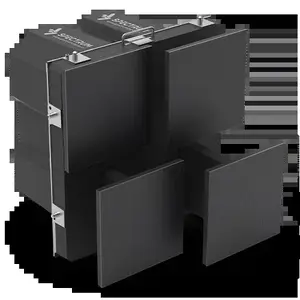
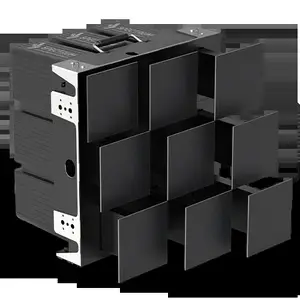
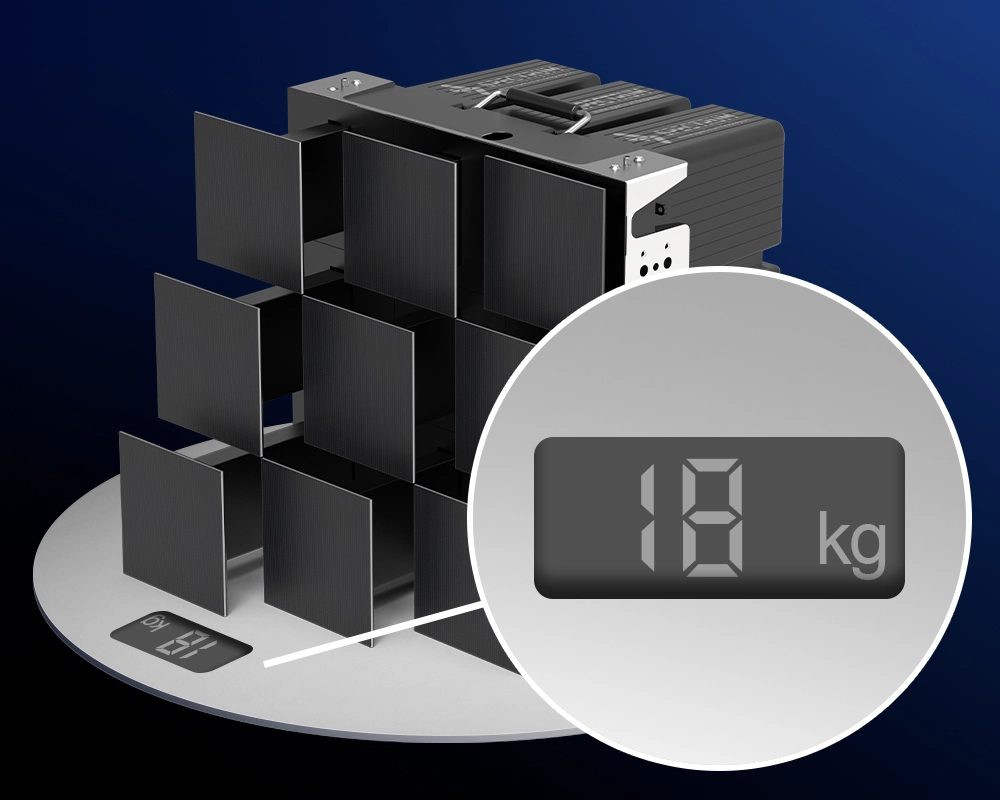
The SPKI-166 reduces the weight of its 500 × 500mm die-cast aluminum cabinet to 18kg.
Reducing the weight of the structure lowers mechanical inertia, creating a stronger physical foundation for rapid acceleration and precise deceleration.
2. Proprietary Bus-Based Servo Motor System
Instead of relying on conventional open-loop stepper motors that are more susceptible to missed steps, the SPKI-166 uses a servo drive system equipped with high-precision encoders.
The system can provide strong instantaneous torque while maintaining precise position control, allowing each motion unit to reach and hold its target position accurately during rapid 0.4-second movements.
3. Industrial CAN Bus Communication
The faster the mechanical movement becomes, the more demanding real-time command transmission becomes.
The industrial CAN Bus architecture enables the motion units to receive coordinated commands with millisecond-level timing, helping prevent visible tearing or cascading delays across a large kinetic LED surface during high-speed movement.
5. The Faster the Motion, the More Important the Safety System
When a kinetic LED screen can move at speeds of up to 650mm/s, safety becomes especially important in public environments such as exhibition halls and shopping malls.
High-speed motion therefore needs to be supported by an effective anti-pinch and emergency-stop protection system.
The SPKI-166 comes standard with a 3kg anti-pinch force threshold.
During high-speed extension or retraction, if a module detects abnormal resistance exceeding 3kg—for example, contact with a person’s hand or fingers—the internal closed-loop control system immediately cuts power to the drive.
The motion unit is immediately disabled and stopped, remains stationary for several seconds, and then returns smoothly to its safe position.
This mechanism is designed to protect both the equipment and people near the installation.
▶Video · YouTubeCome Feel the Stunning Effect of Spectrum's 3D Immersive LED ScreenWatch on YouTube →6. Frequently Asked Questions (FAQ)
Q1: Does faster movement cause the mechanical components to wear out more quickly?
A: No. The core motion components of the SPKI-166 undergo rigorous fatigue testing before leaving the factory, with accumulated high-intensity fault-free operation testing exceeding 18,000 hours.
Its modular architecture and lightweight cabinet design also significantly reduce the operating load on the motors.
Q2: Does every piece of content use the full 0.4-second response?
A: No. The hardware supports this level of performance, but the actual motion speed depends on how the content is designed.
If a designer uses a gradual grayscale transition, the screen will rise and fall slowly. If the content uses an instantaneous black-to-white transition, the modules can perform a rapid movement and take advantage of the system’s 0.4-second response capability.
In other words, speed is a creative resource rather than a mode that must always run at maximum output.
Q3: Is the SPKI-166 noisy when operating at 650mm/s?
A: The SPKI-166 uses an open self-cooling architecture and an optimized low-noise transmission system.
Even during high-speed operation at 650mm/s, mechanical noise is kept at a low level so that it does not interfere with event audio or presentation sound.
Q4: Can 650mm/s motion speed be maintained on a very large kinetic LED installation?
A: Yes. Based on an industrial CAN Bus architecture, the system can support up to 65,536 motion units online simultaneously.
Whether the installation is a 10m² exhibition wall or a large kinetic LED surface exceeding 100m², the control architecture is designed to maintain synchronized high-speed response across the system.
7. Conclusion
In the world of mechanical LED displays, slow movement creates limitations; speed gives content creators freedom.
Key Takeaways:
- Speed determines performance: A 0.4-second full-stroke response and maximum speed of 650mm/s provide the physical foundation for audiovisual synchronization, beat-driven movement, and high-impact dynamic effects.
- High speed requires system-level engineering: Performance depends not only on the motor, but also on the coordinated design of the 18kg lightweight cabinet, servo motor system, and CAN Bus control architecture.
- Safety remains essential: The 3kg anti-pinch emergency protection system provides a critical safety layer during high-speed operation.
The real value of a fast kinetic LED screen is not simply that it moves faster. It is that physical movement can keep pace with digital content—allowing motion, music, video, and interaction to become part of the same synchronized experience.
For more information about the SPKI-166 or a customized kinetic LED solution, contact the Spectrum Display team through the Spectrum Display official website.