One-Sentence Definition:
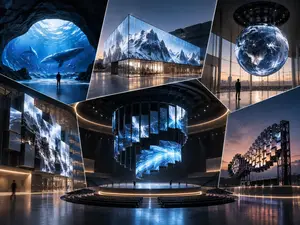
For the same 3D kinetic LED screen project, some people use it only to play videos, while others turn it into a “breathing spatial installation.” The difference is not the hardware itself, but whether the content is truly integrated with motion.
Traditional LED Walls Only Play Videos. 3D Kinetic LED Screens Make Spaces “Respond” to People
Contents
Two Different Futures for One Screen
Difference 1: Is the Content “Played” on the Wall, or Does It “Grow” from the Wall?
Difference 2: Is the Wall “Looping,” or Is It “Responding in Real Time”?
Difference 3: Is the Audience “Watching,” or “Participating”?
How to Turn a Wall into a Spatial Installation
Case Study: When a Brand Decides Not to “Play a Video”
Conclusion: It Is Still the Same Wall. The Difference Is How It Is Used.
1. Two Different Futures for One Screen
At the same trade show, imagine two LED walls with similar size and brightness.
The first wall is playing a brand video. The visuals are polished, and the rhythm is tight. Visitors pass by, stop for less than three seconds, and keep walking.
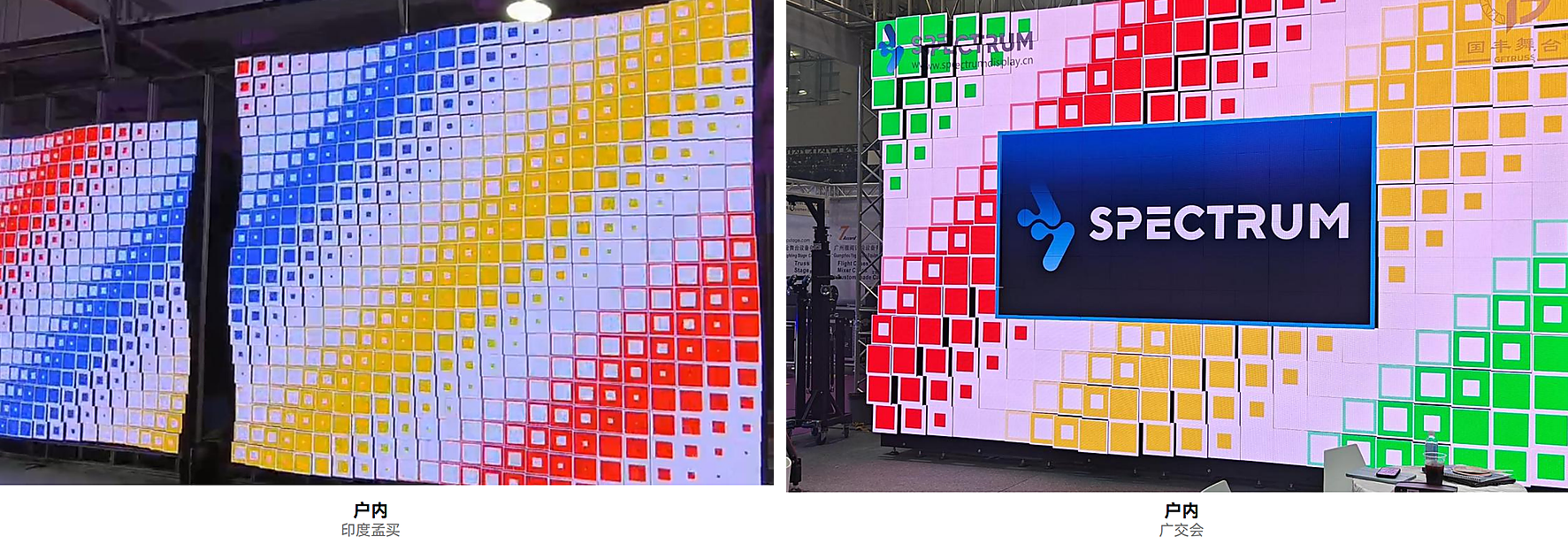
The second wall does not feel like it is “playing” anything. The surface is moving, slowly and evenly, almost like breathing. When a visitor walks closer, one area ripples as if touched by wind. When the visitor waves, the direction of the motion changes. People around them stop and take out their phones.
Two walls. Similar technology. Similar physical size.
One is a screen.
The other is a spatial installation.
The difference is not the hardware. It is whether the content is integrated with motion.
Over the past decade, large flat LED screens have carried most visual communication functions in commercial spaces and exhibition design. But one overlooked problem is emerging:
when screens are everywhere, audiences become visually fatigued.
The traditional one-way model of passive visual reception is losing effectiveness.
When a screen can only “play” content, it is not fundamentally different from a larger television.
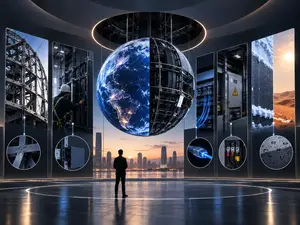
Only when a screen learns to “express” does it truly become part of the space.
2. Difference 1: Is the Content “Played” on the Wall, or Does It “Grow” from the Wall?
In traditional LED projects, “content” and “screen” are separated.
The content is a video. It is played on the screen.
The screen itself remains still. Only the image moves.
This relationship—content moving while the screen stays fixed—is essentially the same as a television. Even if the screen becomes larger and the resolution becomes higher, it is still just a “larger TV.”
But a 3D kinetic LED screen creates a new possibility:
content no longer exists only in the image. It can extend into the physical movement of the screen.
Traditional mechanical screen content production often requires programmers to write complex low-level control code. Visual content and mechanical movement are separated, which makes alignment difficult and revisions extremely time-consuming.
Spectrum Display’s self-developed MotionMatrix4 plugin breaks this barrier. It turns complex mechanical control into the layer-based workflow that designers are already familiar with, making 3D interaction much easier to create.
In After Effects, designers can use the principle of grayscale and brightness to drive physical displacement:
Pure black, 0% brightness: the mechanical module stays in its initial position, not extended
Pure white, 100% brightness: the mechanical module reaches its maximum extension
Different grayscale levels, 1%–99%: the module stops at the corresponding physical depth
A designer only needs to create a grayscale animation, such as a circular gradient or ripple effect, inside After Effects. The system can then generate the motion path of the screen.
What the designer outputs in the video becomes the movement of the wall.
This is the first difference between “playing a video” and creating a “spatial installation”:
In the former, only the content moves. In the latter, the content and the screen move together.
3. Difference 2: Is the Wall “Looping,” or Is It “Responding in Real Time”?
In traditional LED projects, there is almost no sense of immediacy.
A fixed LED screen plays a video. No matter how impressive the content is, it remains predictable. The audience knows what will happen next because the video is looping.
But the charm of a good spatial installation lies in unpredictability.
At ISE 2026, Integrated Systems Europe, Spectrum Display’s booth became one of the most eye-catching highlights of the exhibition and stood out as the only exhibitor presenting a 3D kinetic LED screen.
When visitors waved, the screen moved with them. When visitors approached, the modules retracted precisely.
This kind of physical, real-time feedback is redefining the boundaries of offline marketing.
“Immediacy” is one of the essential differences between a spatial installation and a traditional screen.
A traditional screen is pre-programmed.
A spatial installation is generated onsite.
The former loops.
The latter responds.
This unpredictability makes every moment unique. And unique moments are the fuel of social media sharing.
The human-machine interaction experience at ISE 2026 generated strong social media attention because participants actively shared “their dialogue with the wall.”
In its coverage of ISE 2026, German professional media outlet netscreens described 3D dynamic LED displays as a combination of dynamic content and physically moving display elements, creating an extraordinary appearance that attracts attention and sparks discussion.
4. Difference 3: Is the Audience “Watching,” or “Participating”?
The logic of a traditional screen is “watching.”
The audience is the observer.
The content is the object.
The screen is the container.
There is a clear boundary between the three.
The logic of a spatial installation is “participation.”
The audience enters the space, raises a hand, and the wall changes.
They are no longer just observers. They become co-authors of the spatial narrative.
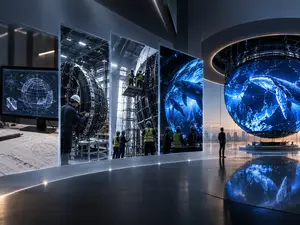
At ISE 2026, traditional flat LED screens remained part of the background. By contrast, Spectrum Display’s 3D kinetic LED screen used physical Z-axis displacement to create a real-time “dialogue” with the audience.
This physical dimension instantly turned visitors from observers into participants.
Human-machine interaction is natural social currency.
When visitors “play with” an advertisement, they voluntarily record and share it on social platforms. For brands, this is not only onsite traffic, but also efficient, low-cost global secondary communication.
What people remember is not the content. It is the interaction.
What gets shared is not the video.
It is the experience.
This is the third difference between “playing a video” and creating a “spatial installation”:
The former makes people watch.
The latter invites people to participate.
And participation is where memory begins.
5. How to Turn a Wall into a Spatial Installation
A spatial installation is not created by hardware alone.
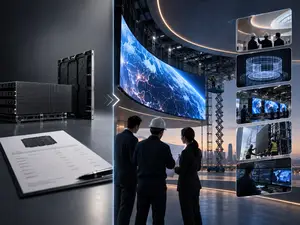
It requires a complete workflow that integrates creativity, content, and motion.
Step 1: Let Content “Learn to Move”
Spectrum Display’s self-developed MotionMatrix4 plugin is deeply integrated into Adobe After Effects, one of the world’s most widely used visual design tools.
Designers with basic After Effects experience can usually learn the workflow quickly, helping shorten the project delivery cycle.
The plugin supports everything from simple ripple effects to complex modular motion.
Inside After Effects, designers can bind the visual layer with a grayscale control layer in a true “what you see is what you get” workflow.
The screen generates smooth physical movement based on the brightness changes of the grayscale layer.
Step 2: Let the Wall “Learn to Respond”
Spectrum Display provides dedicated plugins deeply integrated with TouchDesigner and Unreal Engine 5.
Designers can drive physical modules directly, much like operating a 3D software model, achieving frame-level synchronization between visual content and mechanical movement.
Compared with traditional development methods, the development cycle can be significantly shortened.
The system natively supports radar, depth cameras, LiDAR, facial recognition, and voice interaction.
At ISE 2026, precise sensor input allowed the screen to move in real time according to the audience’s body contours and gestures.
Step 3: Let Content Continue to Evolve
The value of a spatial installation does not end when it is built.
Its real value lies in continuous operation.
Spectrum Display’s content ecosystem allows non-technical operators to keep creating new content.
Its MShow4 software makes the creation of engaging 3D presentation content as intuitive as making a PowerPoint.
One wall can have endless expressions:
Today, a ripple.
Tomorrow, a mountain.
The day after, a brand logo.
No reprogramming.
No reinstallation.
6. Case Study: When a Brand Decides Not to “Play a Video”
The Coca-Cola World Cup launch event is a strong example.
The brand made a bold decision:
not to play a traditional video.
On a 5m × 3m SPKI-250 3D kinetic LED screen, there was no “video content” in the conventional sense.
Instead, Coca-Cola’s brand elements appeared through physical movement and depth.
The screen was no longer a background.
It became part of the performance.
What the audience saw was not “a video about Coca-Cola.”
It was Coca-Cola flowing through space.
The screen was no longer a player.
It became a participant.
The most memorable moment of the event was not only a celebrity appearance or a product reveal.
It was the “breathing Coca-Cola wall.”
Based on Spectrum Display’s experience across multiple brand launch projects, events using 3D kinetic LED screens can generate a higher rate of spontaneous photo and video sharing than traditional flat LED screens.
The reason is simple:
a moving screen is already a moment worth recording.
This case shows that when a brand decides not to “play a video,” the spatial installation truly begins.
7. Conclusion: It Is Still the Same Wall. The Difference Is How It Is Used.
The same 3D kinetic LED wall can have completely different outcomes depending on how it is used.
If it is treated only as a “moving LED screen,” it can play videos and attract attention. But once the audience leaves, it may quickly be forgotten.
If it is treated as a spatial installation, it can create immediacy, respond to the audience, and generate unpredictable moments.
These moments stay in memory.
They get shared on social media.
They become brand assets.
Key Takeaways
Same hardware, completely different results.
The difference is not the equipment itself, but whether content and motion are truly integrated.Three key differences:
Is the content played on the wall, or does it grow from the wall?
Is the wall looping, or responding in real time?
Is the audience watching, or participating?A spatial installation is designed, not simply installed.
It requires content that can move, a wall that can respond, and content that can continue to evolve.The content creation ecosystem is critical.
MotionMatrix4 for After Effects, MShow4, TouchDesigner plugins, and UE5 plugins allow creative teams to drive physical movement without traditional programming.Case proof:
At the Coca-Cola World Cup launch event, the brand chose not to rely on a conventional video. Instead, it created a memorable and hard-to-replicate brand moment through physical movement.
Recommendations for Project Owners
Before starting a project, ask one question: do you want a moving screen, or a responsive space?
Include content creation in the project plan from the beginning, instead of adding content after hardware delivery.
Discuss the content creation ecosystem with the supplier. The question is not only whether the screen can move, but whether your team can easily create content for it.
To learn more about content customization or request a tailored solution, contact Spectrum Display through:
www.spectrumdisplay.cn