How the SPKI-250 Kinetic Screen Redefines Engineering Standards with Pure Rear Maintenance
In the design of modern high-end commercial real estate and comprehensive transportation hubs, grand atriums with heights of a dozen or even tens of meters have become standard architectural configurations. To activate the commercial value of these landmark spaces, mall atrium creative display is evolving toward the visually stunning realm of dynamic three-dimensional technology. However, as the brilliant physical matrix undulates in the ultra-high air to amaze the crowd, an invisible nightmare is also born for countless property operators and system integrators—high-altitude operations and maintenance (O&M).
For traditional indoor fixed-installation display screens, once a core module or transmission component experiences a sudden failure during year-round operation, every subsequent inspection is tantamount to a hair-raising "high-altitude acrobatic show." Due to the lack of independent maintenance access, technicians must block off the site in the middle of the night after the mall closes to erect high scaffolding or rent extremely expensive aerial lifts. This not only causes O&M costs to climb exponentially but also brings significant safety hazards to public spaces, severely disrupting normal business operations.
To completely subvert this high-altitude O&M dilemma, SPECTRUM DISPLAY has launched its flagship indoor rear-maintenance fixed-installation kinetic screen)—the SPKI-250, infused with pure "engineering DNA." It establishes a brand-new industry standard with a once-and-for-all LED screen high-altitude O&M solution.
Hardcore Solution: An "Engineering DNA" Built for Ultimate Stability
From its very inception, the underlying design logic of the SPKI-250 kinetic screen was not to blindly pursue close-range planar delicacy, but to put "long-term ultimate stability" and "highly efficient, safe O&M" at the highest priority.
Pure Rear-Maintenance Architecture, Saying Goodbye to Aerial Lifts Completely: The SPKI-250 is a pure rear-maintenance system. During the initial project planning phase, simply reserving a standard internal maintenance corridor of 600mm to 800mm behind the screen solves everything. Later, when any motion unit requires inspection or repair, technicians no longer need to borrow any external high-altitude equipment. They can simply step into the safe rear channel to perform unobstructed maintenance on the entire power unit—including mechanical transmission components and LED modules—in a stable, spacious, and comfortable environment. This compresses fault troubleshooting time and comprehensive O&M costs to the absolute minimum.
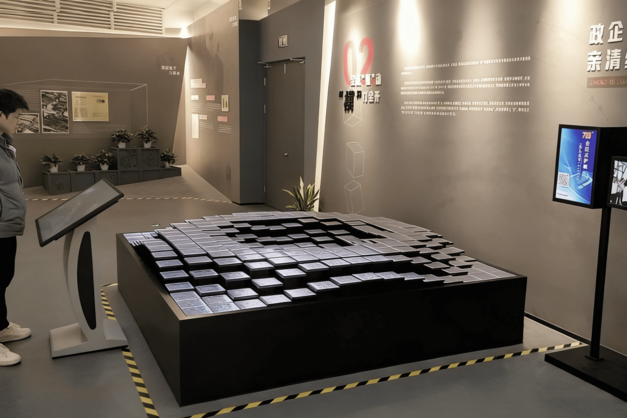
248.5×248.5mm Large Unit Size, Simplifying Complexity: In a giant kinetic matrix easily spanning hundreds of square meters, the more fragmented the unit division, the more the number of motors, communication nodes, and failure probabilities multiply. The SPKI-250 takes a different approach by enlarging the single physical motion unit to 248.5×248.5mm (only 16 units per square meter). This physical scale of "simplifying complexity" greatly reduces the electronic control complexity of super-large area system integration. With fewer nodes and a more stable structure, it guarantees an ultra-low failure rate for the equipment under year-round, 24/7 operation from the physical root.
High-Precision Transmission, Silently Blending into Premium Environments: As a top-tier indoor heavy-duty kinetic architectural material, the extension and retraction of the SPKI-250 rely entirely on high-precision linear guide rails combined with closed-loop servo motors. It not only provides millimeter-level precise displacement feedback and a majestic undulating rhythm akin to surging ocean waves but also perfectly suppresses mechanical operational noise to extremely low decibels. The sound is completely masked by the normal ambient noise of the mall or airport, causing absolutely no auditory disturbance to on-site customers.
Commercial Conversion: Getting the Selection Right Once to Save Exorbitant Costs for the Next Decade
In landmark fixed-installation projects spanning hundreds of square meters and requiring massive investments, shrewd decision-makers never look solely at the upfront equipment purchase price; they focus heavily on the long-term Total Cost of Ownership (TCO).
Choosing the SPECTRUM DISPLAY SPKI-250 represents a once-and-for-all, scientific investment for commercial real estate developers and large-scale system integrators. Making the right engineering-grade selection at the beginning will directly save immeasurable costs over the next ten years in aerial lift rentals, manual labor fees, and business shutdown losses. Welcome to contact SPECTRUM DISPLAY to obtain your exclusive engineering landing solution for large-scale indoor kinetic displays, ensuring your landmark building drives long-term traffic within a safe, smooth, and stable life cycle.
Appendix: SPKI-250 Indoor Rear-Maintenance Kinetic Screen FAQ
Q1: Will the maintenance access channel reserved behind the screen heavily squeeze the valuable architectural space of the mall atrium?A: Although the pure rear-maintenance architecture occupies a rear depth of 600mm-800mm, for large fixed-installation atrium projects with heights of a dozen meters and generous overall space, this minor space investment is the optimal solution to eliminate massive future O&M risks. Meanwhile, SPECTRUM controls the overall weight within a very reasonable range through a high-strength aluminum skeleton and lightweight cabinet design, ensuring the absolute safety of the large fixed installation.
Q2: What pixel pitches are available for this equipment, and how do they match the project budget?A: The SPKI-250 is crafted as a flexible multi-pitch kinetic screen, offering multiple high-spec pixel pitch options from P1.56, P1.95, P2.6, to P3.91. Clients can implement the most scientific configuration based on the atrium's actual viewing distance and project budget (for example: choosing P1.95 for low-floor, main visual areas, and P3.91 for high-floor, long-distance viewing areas), ensuring every cent of the engineering budget is spent wisely.