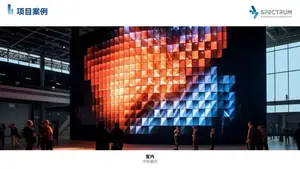
One-sentence definition: The Flip Matrix is a dynamic mechanical display product under Spectrum Display's SPFM series, composed of a large number of independent flipping units arranged in a matrix to achieve visual effects such as undulating waves, three-sided flipping, color block switching, and lighting variations, transforming mechanical movement itself into an artistic expression of commercial space.
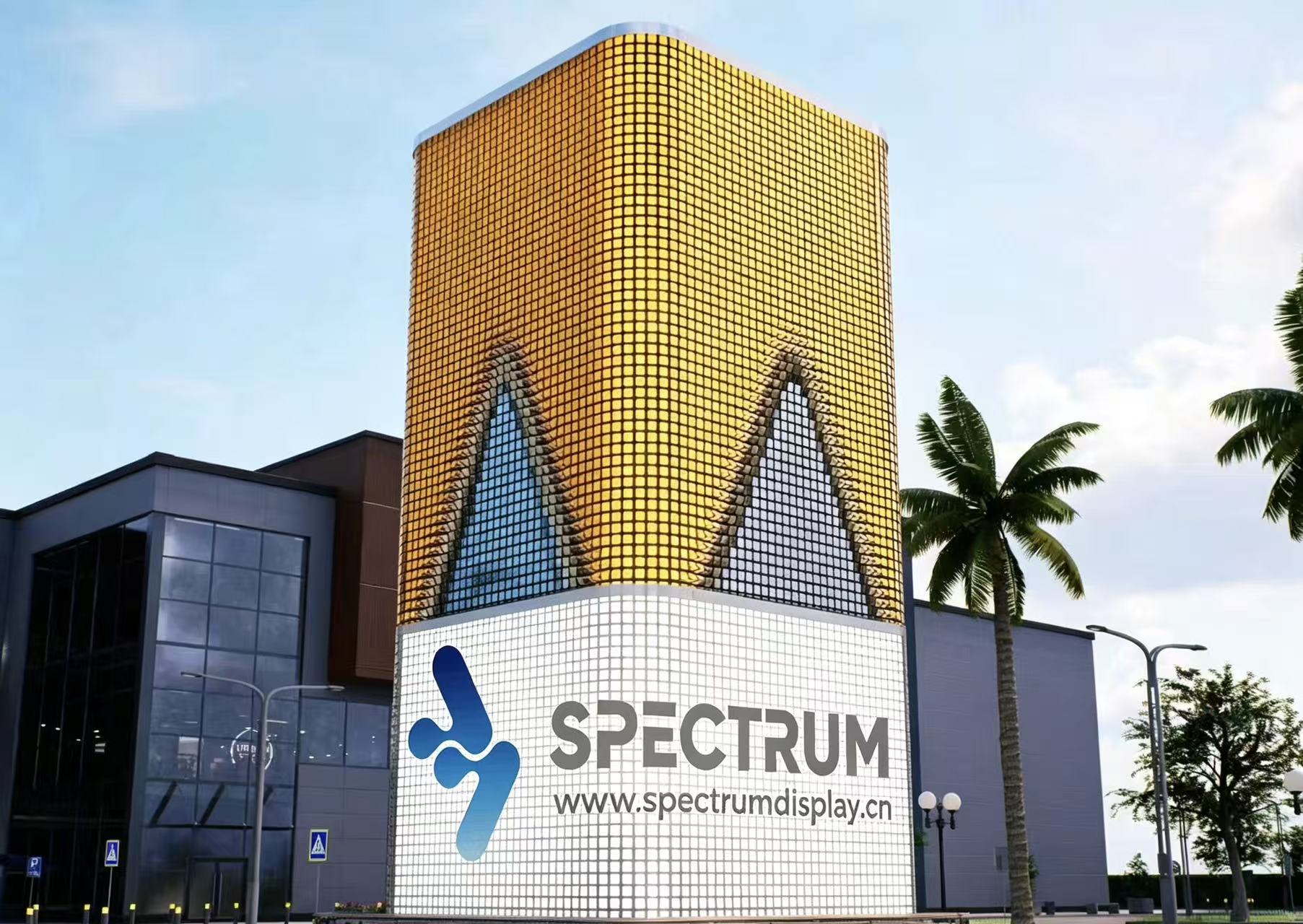
Table of Contents
What Is a Flip Matrix
How to Choose Among Four SPFM Series Models
Five Core Selling Points of the Flip Matrix
Six Application Scenarios
Frequently Asked Questions (FAQ)
Summary and Action Recommendations
I. What Is a Flip Matrix
The Flip Matrix is a dynamic mechanical display product under Spectrum Display's SPFM series. It consists of a large number of independent flipping units arranged in a matrix to achieve visual effects such as undulating waves, three-sided flipping, color block switching, lighting variations, and interactive linkage.
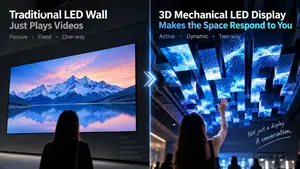
Unlike traditional display screens that simply play video, the Flip Matrix transforms mechanical movement itself into spatial expression, giving walls, storefront signs, ceilings, exhibition stands, and stage backdrops the ability to move, be customized, interact, and generate buzz.
Key Differences from Traditional LED Screens
Traditional LED Screen | Flip Matrix | |
|---|---|---|
Core Principle | Pixel illumination for video display | Physical units flipping to switch colors/lighting |
Visual Experience | Flat video playback | Real physical undulation and dynamic matrix |
Spatial Presence | The screen itself is flat | Each unit is a three-dimensional element |
Mechanical Aesthetics | None | Every flip is visible and perceptible |
Key Differences from Traditional Flip-Disc Displays
Traditional flip-disc displays (such as bus route signs) use electromagnets to flip circular discs between black and white, only capable of simple text and patterns. The Flip Matrix, by contrast, is a commercial-grade dynamic decorative system—featuring three-sided flipping, RGB lighting and LED display integration, interactive control, and customizable appearance and materials—truly capable of supporting brand visual presentation and spatial narrative functions.
II. How to Choose Among Four SPFM Series Models
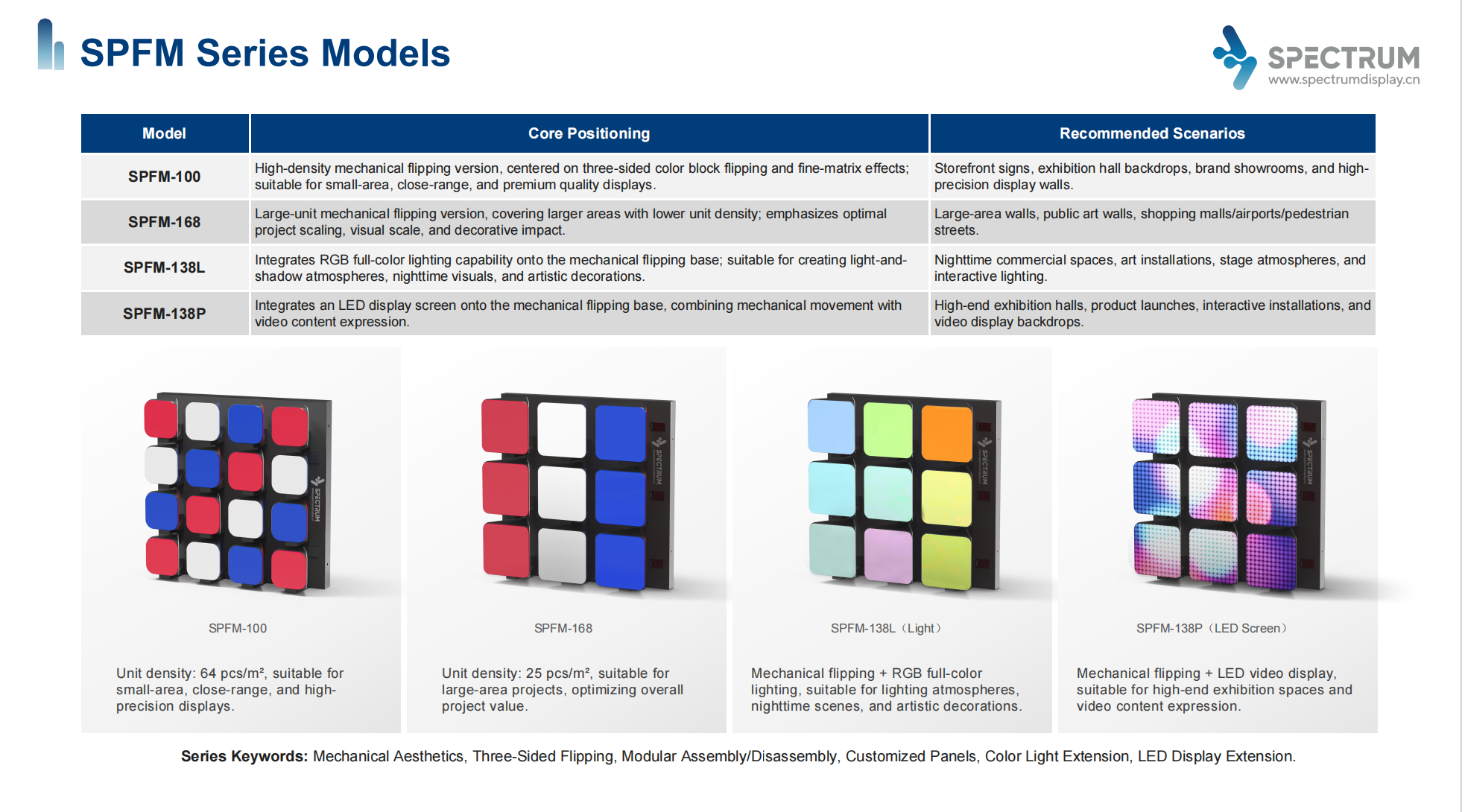
The Flip Matrix offers four models covering everything from boutique show windows to large-scale public spaces.
Specification | SPFM-100 | SPFM-168 | SPFM-138L | SPFM-138P |
|---|---|---|---|---|
Version Type | Standard | Large Unit | Lighting | LED Screen |
Color Block Size | 100×100mm | 168×168mm | 138×138mm | 138×138mm |
Unit Size | 125×125mm | 200×200mm | 166.7×166.7mm | 166.7×166.7mm |
Quick-Install Cabinet Size | 500×500mm (4×4) | 600×600mm (3×3) | 500×500mm (3×3) | 500×500mm (3×3) |
Cabinet Thickness | 160mm | 225mm | 200mm | 200mm |
Cabinet Weight | 7.3kg | 8kg | 7kg | 8kg |
Cabinet Power | 45W | 36W | 45W | 100W |
Units per m² | 64 pcs/㎡ | 25 pcs/㎡ | 36 pcs/㎡ | 36 pcs/㎡ |
Weight per m² | 29.2kg/㎡ | 22.2kg/㎡ | 28kg/㎡ | 32kg/㎡ |
Power per m² | 180W/㎡ | 120W/㎡ | 180W/㎡ | 400W/㎡ |
Lighting/Display | No light | No light | RGB Full-Color Light | LED Screen-P10 |
Max Rotation Speed | 3 Rev/s | 3 Rev/s | 3 Rev/s | 3 Rev/s |
Time to Switch Side | 0.15s | 0.15s | 0.15s | 0.15s |
SPFM-100 — High-Density Precise Flipping, Best for Close-Range Viewing
Unit density of 64 units/m² with 100×100mm color blocks. Suitable for small areas, close-range viewing, and high-precision displays.
Best for: Brand show windows, exhibition hall premium display walls, high-end storefront signs. At close range, the high-density matrix delivers delicate dynamic effects with each flipping unit's color block switching clearly visible.
SPFM-168 — Large Units for Cost-Effective Large-Area Coverage
Unit density of 25 units/m² with 168×168mm color blocks. Covers larger areas with lower unit density, emphasizing engineering value, visual scale, and decorative impact.
Best for: Large-area walls, shopping mall atriums, airport/pedestrian street public art walls. For projects requiring extensive coverage with limited budgets, SPFM-168 preserves the core visual impact of mechanical flipping while reducing overall costs.
SPFM-138L — Mechanical Flipping + RGB Full-Color Lighting
Integrates RGB full-color lighting capability on top of mechanical flipping, with 138×138mm color blocks. Suitable for lighting atmospheres, nighttime visuals, and artistic decorations.
Best for: Nighttime commercial spaces, art installations, stage atmospheres, interactive lighting. During the day, flipping color blocks create patterns and text; at night, RGB full-color lights can be independently controlled for dynamic lighting effects—achieving dual-purpose functionality.
SPFM-138P — Mechanical Flipping + LED Display Surface
Integrates an LED display screen (P10) on top of mechanical flipping, combining mechanical movement with video content expression.
Best for: High-end exhibition halls, product launches, interactive installations, video display backdrops. When units flip into position, the surface LED screens can play high-definition video content; during the flipping motion, mechanical movement and LED display switching synchronize for dual-impact visual presentation.
III. Five Core Selling Points of the Flip Matrix
Selling Point 1: Mechanical Aesthetics
Real mechanical flipping creates dynamic effects such as waves, matrices, and multi-sided flipping, offering a stronger sense of spatial presence compared to conventional display screens. Every flip of every unit is visible and perceptible, creating a unique mechanical aesthetic.
Selling Point 2: Assembly & Maintenance
Quick-install cabinets + front/rear maintenance structures facilitate easy installation, disassembly, transportation, and subsequent routine inspection. The modular quick-install design allows individual units to be replaced separately without affecting the entire screen.
Selling Point 3: Interactive Experience
Supports integration with TouchDesigner, cameras, and LiDAR, allowing audience movements to trigger screen variations. Through DMX512/ArtNet protocols, the Flip Matrix can synchronize with lighting, music, and audience movements at millisecond precision.
Selling Point 4: Content Expansion
Supports lighting effects, video displays, color block patterns, and customized programming, suitable for long-term content updates. Brands can switch display content at any time to match seasons, holidays, or themes—achieving multi-purpose use of a single installation.
Selling Point 5: Customized Appearance
Colors, materials, and textures can be fully customized according to project requirements, satisfying the demands of brand spaces, exhibition themes, and art installations.
Available Processes: Plastic injection molding self-color, metal foil stickers, spray painting, electroplating, stickers, UV printing
Available Textures: Glossy, matte, mirror, color-changing
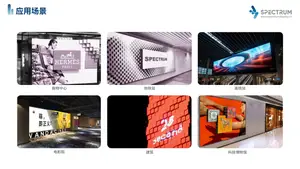
IV. Six Application Scenarios
Scenario | Application Description | Recommended Model |
|---|---|---|
Store Renovation | Storefront signs, corridors, ceilings, reception desks, brand show windows | SPFM-100 |
Public Space Art | Shopping malls, airports, pedestrian streets—decorative and tech-forward | SPFM-168 |
Exhibition Halls | Science museums, planning halls, corporate showrooms—guided presentations and interaction | SPFM-100/138P |
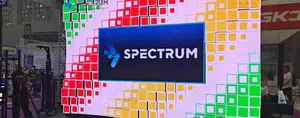
Exhibition Rental | Industry exhibitions, product launches—attracting foot traffic with dynamic visuals | SPFM-168/138P |
Stage Performances | Stage backdrops—changing with music, lighting, and performance rhythm | SPFM-138L/138P |
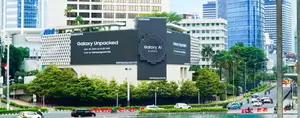
Commercial Advertising | Upgrading static ad spaces to dynamic mechanical visual spots—increasing dwell time, filming, and sharing | SPFM-100/138L |
At the 7th Chengdu Creative Design Week, a massive mechanical matrix flip screen measuring approximately 7 meters in length and 3 meters in height, with 4,608 independent pixel units, drew significant audience attention—demonstrating the application value of Flip Matrix-type products in public spaces.
V. Frequently Asked Questions (FAQ)
Q1: What's the difference between the Flip Matrix and a Kinetic Screen?
A: The Kinetic Screen produces three-dimensional wave effects through Z-axis front-to-back telescoping motion. The Flip Matrix produces color block switching and wave undulation through three-sided unit flipping. The two are complementary in motion method and visual presentation.
Q2: Is the Flip Matrix the same as a traditional flip-disc display (bus route sign)?
A: No. Traditional flip-disc displays use electromagnets to flip circular discs between black and white, only capable of simple text and patterns. The Flip Matrix is a commercial-grade dynamic decorative system featuring three-sided flipping, RGB lighting and LED display integration, customizable appearance and materials, and full compatibility with brand spatial aesthetics.
Q3: How do I choose between SPFM-100, SPFM-168, SPFM-138L, and SPFM-138P?
A: For boutique show windows/close-range exhibition halls choose SPFM-100 (64 units/m² high density). For large-area walls/public spaces choose SPFM-168 (25 units/m² cost-effective coverage). For nighttime/lighting scenarios choose SPFM-138L (RGB full-color lighting). For video content playback choose SPFM-138P (LED display surface).
Q4: Is the Flip Matrix energy-intensive?
A: SPFM-100 and SPFM-138L are 180W/m², SPFM-168 is 120W/m², and SPFM-138P is 400W/m². Except for the LED screen version, energy consumption is comparable to or even lower than traditional LED screens.
Q5: Can the Flip Matrix integrate with existing lighting systems?
A: Yes. The entire SPFM series supports DMX512 and Art-Net protocols, enabling integration with stage lighting consoles, content production systems, and interactive control systems.
Q6: Can the surface finish of the Flip Matrix be customized?
A: Yes. Multiple processes are available including plastic injection self-color, metal foil stickers, spray painting, electroplating, stickers, and UV printing. Textures can be glossy, matte, mirror, or color-changing to match different spatial brand identities.
VI. Summary and Action Recommendations
Key Takeaways:
The Flip Matrix is a dynamic mechanical display product under Spectrum Display's SPFM series, transforming mechanical movement itself into spatial expression
Four models: SPFM-100 (high density, close-range), SPFM-168 (large-area cost-effective), SPFM-138L (RGB lighting), SPFM-138P (LED display)
Five selling points: Mechanical aesthetics, assembly & maintenance, interactive experience, content expansion, customized appearance
Six scenarios: Store renovation, public space art, exhibition halls, exhibition rental, stage performances, commercial advertising
Core specifications: Max rotation speed 3 Rev/s, time to switch side just 0.15s
Next Steps:
Identify your use case: show window/storefront, public space, exhibition hall, or stage performance?
Select by area and budget: small boutique displays → SPFM-100, large public spaces → SPFM-168, lighting effects → SPFM-138L, video display → SPFM-138P
For more product details or custom solutions, contact Spectrum Display via www.spectrumdisplay.cn