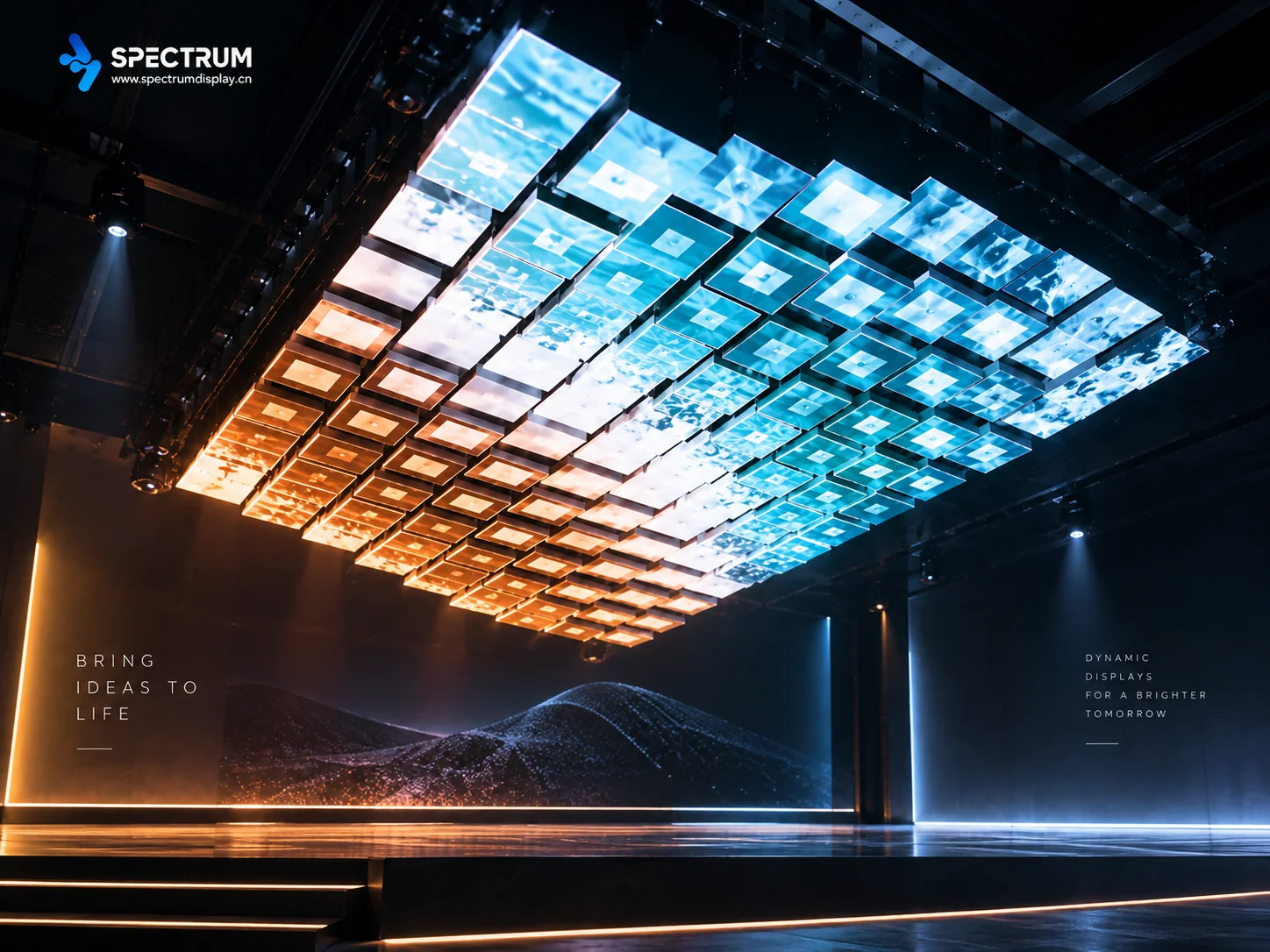
One-Sentence Definition: A high-end bar in Singapore installed an SPKI-160 3D Kinetic LED Screen on the ceiling because the floor and walls were already fully occupied, while the ceiling was the only remaining “visual surface.” With a dynamic matrix measuring 1440 × 3840mm, the once-idle ceiling was transformed into a “breathing skin” for the entire space.

Why Install a Screen on the Ceiling? A Singapore Bar Ceiling-Mounted 3D Kinetic LED Screen Case Study
Contents
The Floor and Walls Were Full. The Ceiling Was Still Empty.
Why the Ceiling? The Most Valuable Space Is Often Overhead.
Why SPKI-160? 330mm Ultra-Thin Body + Front Maintenance
Project Solution and Technical Specifications
The Effect: When the Ceiling Starts to “Breathe”
Commercial Value: Customers Spontaneously Take Photos and Share
Conclusion: The Creative Boundary of Mechanical LED Depends on Where You Dare to Place the Screen
1. The Floor and Walls Were Full. The Ceiling Was Still Empty.
How competitive is Singapore’s nightlife scene?
In this city-state of just over 700 square kilometers, the density of high-end bars and clubs is far beyond what many people imagine. Every venue is competing for the same group of high-net-worth customers — people who have seen the world, visited top-tier venues, and become immune to anything that is merely “good.”
Traditional competitive advantages are losing their power. Better drinks, more expensive interiors, and famous DJs used to define competitiveness. Today, they are only the entry ticket.
What truly creates differentiation is the spatial experience itself.
This high-end bar in Singapore faced exactly that challenge: the floor was already filled with seating, and the walls were already covered with decoration.
The only remaining visual surface in the entire space was the ceiling.
In most commercial spaces, the ceiling is one of the most underestimated pieces of “visual real estate.” People are used to looking up and seeing a flat white or black surface — a place that hides fire protection pipes and air-conditioning outlets, but rarely becomes the protagonist of the design.
But what if the ceiling could come alive?
2. Why the Ceiling? The Most Valuable Space Is Often Overhead.
Competition in commercial spaces is essentially a competition for visual surfaces.
The floor is for circulation.
The walls are for display.
Together, they carry most of a space’s visual function. The ceiling, however, is often treated as background.
But in entertainment spaces such as bars, the ceiling may actually be the most promising visual surface. When people sit down, drink, and look up, the ceiling is directly above them.
Unique Advantages of Ceiling Installation
It does not occupy the floor or walls.
In commercial spaces where every square meter matters, the floor and walls are revenue-generating areas. The ceiling is often the only unused visual surface. Using it to install a screen is like gaining a new display surface without sacrificing operational space.
It creates a sense of being surrounded.
When the screen moves, rises, and changes directly above customers, the entire space is wrapped in a top-down visual energy. This sense of immersion cannot be created by a wall-mounted screen alone.
It creates a differentiated visual memory.
When most bars are still competing over the size of their wall screens, a bar that installs a screen on the ceiling has already won the battle of being remembered.
According to industry observations, dynamic ceiling installations in high-end entertainment spaces can significantly extend average customer dwell time, while the proportion of customers who actively take photos and share them is much higher than in ordinary venues.
This was the core logic behind the Singapore bar’s decision to choose a ceiling-mounted solution.
3. Why SPKI-160? 330mm Ultra-Thin Body + Front Maintenance
Model selection determined whether this project could succeed.
For this Singapore bar project, SPKI-160 was the only viable choice — not because other screens were not good enough, but because they simply could not be installed in this space.
Challenge 1: Limited Ceiling Height
Bar ceilings usually do not reserve much installation space.
Conventional 3D kinetic LED screens often exceed 600mm in thickness, making them impossible to fit into limited ceiling cavities.
The SPKI-160 has a body thickness of only 330mm, with the overall finished thickness compressed to 350mm.
This makes it one of the thinnest 3D kinetic LED screens available and the only option that could fit into this ceiling space.
Challenge 2: No Rear Maintenance Access
The space above the bar ceiling was enclosed, leaving no room for technicians to enter for rear maintenance.
Conventional rear-maintenance solutions were completely unworkable here.
SPKI-160 supports front maintenance. LED modules and internal core mechanical components can be removed and replaced directly from the front of the screen, without entering the ceiling cavity.
This means maintenance personnel do not need to dismantle the ceiling or crawl into the ceiling void. All inspection and repair work can be completed from below.
Challenge 3: Noise Requirements in a Bar Environment
A bar needs atmosphere, not mechanical noise.
SPKI-160 uses Spectrum Display’s self-developed bus-type servo power system, offering extremely quiet operation.
Even during relatively quiet off-peak hours in the bar, the mechanical movement is not easily noticeable.
Model Selection Conclusion
Under the three constraints of limited ceiling height, no rear maintenance access, and quiet operation requirements, SPKI-160 was the only feasible solution.
4. Project Solution and Technical Specifications

Technical Highlights
330mm ultra-thin body.
SPKI-160 compresses the body thickness to 330mm. With a precision mounting structure, the overall finished thickness can be reduced to 350mm. In the limited space of a bar ceiling, this 350mm thickness determines whether the project can be installed at all.
Front-maintenance structure.
All LED modules and core mechanical components can be removed and replaced from the front of the screen. Maintenance personnel can complete all inspection and repair work from below, without entering the ceiling cavity.
39 high-density units per square meter.
In close-viewing scenarios, the high-density unit layout delivers refined dynamic effects. Every extension and retraction movement is clearly visible.
5. The Effect: When the Ceiling Starts to “Breathe”
The moment the screen lit up, the atmosphere of the entire space changed.
When the music started, the screen units extended, retracted, rose, and moved with the rhythm. The whole ceiling seemed to gain life.
This was not projection.
This was not a visual effect on a flat LED screen.
It was real physical movement — visible, tangible, and perceptible.
A Breathing Ceiling
In slow mode, the screen rises and falls gently like breathing, creating a calm and immersive atmosphere.
In fast rhythm mode, the screen moves with the music, linking with lighting and sound to wrap the entire space in a top-down sense of energy.
Millisecond-Level Synchronization with Music
Through the DMX512 protocol, the motion rhythm, amplitude, and frequency of the screen can be synchronized with the live DJ music at millisecond-level precision.
The screen is no longer a background element.
It becomes part of the performance.
It is music made visible.
A Different Experience Every Time
The content is programmable, allowing the motion mode of the screen to change according to different themed parties.
Every time customers visit, they can see a different ceiling.
6. Commercial Value: Customers Spontaneously Take Photos and Share
In the social-media-driven consumer era, how “photographable” a bar is directly affects its popularity.
A Memorable “Look-Up Moment”
When customers walk into the bar and naturally look up, they no longer see a flat ceiling.
They see a living matrix that is rising, retracting, and changing.
This visual impact turns the ceiling into the bar’s most distinctive memory point.
Spontaneous Photo and Video Sharing
When the ceiling is in motion, the visual effect is highly striking.
Customers are more likely to take photos, record short videos, and share them on social platforms, creating secondary exposure.
According to industry observations, venues with interactive installations can see more than 60% of customers actively raising their phones to record, with social exposure several times higher than ordinary venues.
Differentiated Competitive Advantage
In Singapore’s highly competitive nightlife market, this bar created a difficult-to-replicate spatial experience barrier through a “breathing ceiling.”
7. Conclusion: The Creative Boundary of Mechanical LED Depends on Where You Dare to Place the Screen
The Singapore bar ceiling project is a representative case of the SPKI-160 3D Kinetic LED Screen in commercial entertainment spaces.
Project Core Value
Precise model selection:
330mm ultra-thin body and front maintenance made SPKI-160 the viable solution for a ceiling installation with limited space.Efficient installation:
The lightweight cabinet design required no major structural reinforcement and no rear maintenance corridor.Powerful visual impact:
The physical 3D dynamic matrix created a “breathing ceiling.”Flexible operation:
DMX512 integration allowed the screen to link with music rhythm, while control modes could be switched easily.Long-term usability:
The system supports ongoing content updates and can adapt to different themed parties.
Key Takeaways
When the floor and walls are already full, the ceiling becomes the only remaining visual surface. Ceiling installation is a seriously underestimated form of visual real estate in commercial spaces.
The 330mm ultra-thin body and front-maintenance design of SPKI-160 made it the feasible solution for ceiling-mounted applications.
A 1440 × 3840mm dynamic matrix transformed the ceiling from background into protagonist.
Spontaneous photo and video sharing turned the ceiling itself into social currency for the brand.
Recommendations for Bar and Nightclub Owners
Ceiling-mounted 3D kinetic LED screens can be considered when the ceiling height is 3.5m or above.
The system should ideally be designed together with lighting and audio systems to maximize the final effect.
A DMX512 control link should be reserved for future content iteration.
To learn more about project details or request a tailored solution, contact Spectrum Display through:
www.spectrumdisplay.cn
Case Note
This article is based on Spectrum Display’s SPKI-160 ceiling-mounted 3D kinetic LED screen project for a high-end bar in Singapore, with a screen size of 1440 × 3840mm. Project parameters and product specifications are based on Spectrum Display’s internal project materials and public product manuals. Control logic and protocol compatibility descriptions are based on SPKI series technical specifications.