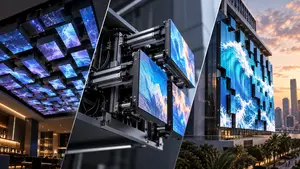
One-Sentence Definition: At the China Hi-Tech Fair, one of China's leading technology exhibitions, true innovation in display technology goes beyond higher screen resolution. It also involves transforming digital content into real physical movement. Spectrum Display (Shenzhen Spectrum Technology Co., Ltd.) is showcasing its SPKI-160 and SPKI-250 Kinetic Screens, demonstrating how physical 3D effects can create a new dimension of visual engagement beyond conventional flat LED displays.
1. China Hi-Tech Fair 2026: Spectrum Display at Two Exhibition Booths
On November 26, 2026, the 28th China Hi-Tech Fair (CHTF 2026) opens at the Shenzhen World Exhibition & Convention Center in Bao'an, Shenzhen, China.
As a major platform for showcasing technological innovation, the exhibition brings together companies, developers, manufacturers, and industry professionals exploring the next generation of technology.
This year, Spectrum Display is presenting its Kinetic Screen technology across two exhibition areas: the Huizhou Delegation and the Guangdong Delegation.
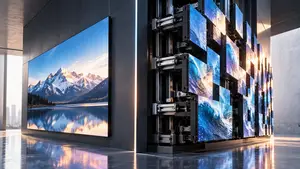
Unlike conventional flat LED displays, Kinetic Screens combine digital imagery with real mechanical movement.
Individual LED modules extend and retract along the Z-axis, allowing the display surface itself to change shape and create physical three-dimensional effects.
Visitors can explore two different indoor Kinetic Screen configurations: the SPKI-160 and SPKI-250.
Visit Spectrum Display at CHTF 2026
Exhibition: The 28th China Hi-Tech Fair
Dates: November 26–28, 2026
Venue: Shenzhen World Exhibition & Convention Center (Bao'an), Shenzhen, China
Hall: 15
Huizhou Delegation — Booth 15-C7-36
Featured Product: SPKI-160 Indoor Kinetic Screen
Display Size: 1.92 × 1.92 m
Guangdong Delegation — Booth 15-A6-61
Featured Product: SPKI-250 Indoor Kinetic Screen
Display Size: 0.5 × 1.5 m
Both installations illustrate how mechanical movement can add physical depth to digital display content.
2. Huizhou Delegation: SPKI-160 Creates a 1.92 m Physical 3D Display Wall
At Booth 15-C7-36, within the Huizhou Delegation exhibition area, Spectrum Display is presenting a 1.92 × 1.92 m SPKI-160 Indoor Kinetic Screen.
Designed to balance visual performance and practical installation requirements, the SPKI-160 is suitable for corporate showrooms, exhibition environments, commercial displays, and other indoor applications.
With a P1.98 pixel pitch, the SPKI-160 combines fine LED imagery with physical Z-axis movement.
Each motion unit measures 160 × 160 mm, enabling the screen to create coordinated three-dimensional surface effects.
SPKI-160 Key Specifications
| Specification | SPKI-160 |
|---|---|
| Pixel pitch | P1.98 |
| LED module size | 160 × 160 mm |
| Cabinet dimensions | 644 × 483 mm |
| Cabinet depth | 330 mm |
| Maximum extension stroke | 200 mm |
| Maximum extension speed | 600 mm/s |
| Fastest one-way full extension | 0.4 seconds |
| Maintenance | Front maintenance |
Engineering Highlight 1: Front Maintenance for Indoor Installations
One important feature of the SPKI-160 is its front-maintenance design.
With a cabinet depth of 330 mm, the product can be considered for installations where the available depth and rear access are limited.
Front maintenance allows relevant servicing operations to be performed from the display side, potentially reducing the need for a dedicated rear service corridor.
However, the complete installation must still provide sufficient space for structural support, the display's movement envelope, cable routing, and safe maintenance access.
For corporate showrooms and exhibition installations, this flexibility can be particularly valuable.
Engineering Highlight 2: Physical 3D Through Coordinated Movement
The SPKI-160 features a maximum extension stroke of 200 mm and a maximum extension speed of 600 mm/s.
Its fastest one-way full extension takes approximately 0.4 seconds.
These capabilities allow content creators to design dynamic physical effects, including waves, geometric transformations, and animated depth patterns.
Through coordinated mechanical movement, digital graphics can become part of a changing physical surface.
For technology exhibitions, this creates a different viewing experience from conventional LED video playback.
The SPKI-160 demonstrates how a display can do more than show a three-dimensional image: it can physically change its surface to create depth.
3. Guangdong Delegation: SPKI-250 Demonstrates Large-Format Kinetic Effects
At Booth 15-A6-61, within the Guangdong Delegation exhibition area, Spectrum Display is presenting a 0.5 × 1.5 m SPKI-250 Indoor Kinetic Screen.
The SPKI-250 belongs to Spectrum Display's larger-motion-unit indoor series.
It is designed for applications where larger mechanical units and substantial physical movement are appropriate for the intended visual experience.
Each SPKI-250 motion unit measures 248.5 × 248.5 mm.
With approximately 16 motion units per square meter, the product provides a different physical movement scale from smaller-unit Kinetic Screens.
This makes it relevant for larger indoor installations, elevated displays, exhibition stages, and major visual presentation areas.
SPKI-250 Key Specifications
| Specification | SPKI-250 |
|---|---|
| Pixel pitch options | P1.56 / P1.95 / P2.6 |
| Motion unit size | 248.5 × 248.5 mm |
| Motion units per square meter | 16 |
| Cabinet dimensions | 500 × 500 mm |
| Maximum extension stroke | 200 mm |
| Maximum extension speed | 500 mm/s |
| Fastest one-way full extension | 0.5 seconds |
| Maintenance | Rear maintenance |
Engineering Highlight 1: Strong Physical Depth Effects
With a maximum extension stroke of 200 mm and a maximum movement speed of 500 mm/s, the SPKI-250 can create noticeable changes in the physical depth of the LED display surface.
Its fastest one-way full-extension time is 0.5 seconds.
Compared with smaller motion-unit configurations, the SPKI-250 uses larger individual moving surfaces.
This difference affects the spatial character of the mechanical effects.
For example, the larger modules can be used to create bold geometric transformations and substantial physical relief patterns.
The SPKI-250 is therefore worth considering when the visual concept emphasizes larger-scale mechanical movement rather than extremely fine spatial detail.
Engineering Highlight 2: Rear Maintenance for Large Installations
The SPKI-250 features a rear-maintenance architecture.
This is particularly relevant to large indoor installations where technicians can access the equipment from a dedicated service area behind the display.
For elevated installations, an appropriately designed rear service arrangement may also provide practical maintenance advantages.
However, the required service corridor, access platform, and maintenance procedures must be considered during the project design stage.
The SPKI-250 is designed to support large-scale kinetic visual effects, with rear maintenance forming an important part of its engineering configuration.
4. Why Physical 3D Matters at Technology Exhibitions
Technology exhibitions are places where companies introduce new ideas, demonstrate engineering capabilities, and explore future commercial applications.
Digital displays play an essential role in these environments.
However, as large LED screens become increasingly common, brands and exhibition designers face a new challenge:
How can a display create a distinctive experience when high-resolution video is already everywhere?
Physical 3D Kinetic Screen technology offers another approach.
Instead of relying entirely on visual illusions, it introduces actual mechanical displacement into the display experience.
This creates two important opportunities.
1. Turning Digital Content into Physical Movement
Traditional LED displays create visual depth through digital imagery.
A Kinetic Screen adds another dimension by physically moving sections of its display surface.
The result is a combination of image content and real spatial transformation.
For example, a digital wave can be accompanied by coordinated extension and retraction of the LED modules.
A geometric animation can become a changing three-dimensional surface.
This makes Kinetic Screens relevant for applications where physical movement contributes to the intended storytelling or visitor experience.
2. Integrating Visual Content with Mechanical Control
Kinetic Screens require coordination between digital content and mechanical movement.
Spectrum Display provides a broader motion control ecosystem, including communication and content creation technologies designed for Kinetic Screen applications.
Professional control workflows may involve protocols such as DMX512 and Art-Net, depending on the selected control configuration.
These can support integration with compatible exhibition or stage-control systems.
However, the specific interfaces and synchronization capabilities must be verified for each project.
Software tools such as MotionMatrix4 can also help designers preview physical movement and evaluate motion content before deployment.
Through these technologies, digital imagery and mechanical movement can be developed as elements of a coordinated visual presentation.
Physical 3D is not simply about making an LED screen move. It is about using movement as part of the visual communication itself.
5. Frequently Asked Questions (FAQ)
Q1: Which is more suitable for a corporate showroom, the SPKI-160 or SPKI-250?
A: Both products are designed for indoor Kinetic Screen applications, but they serve different project requirements.
The SPKI-160 features 160 × 160 mm motion units, a P1.98 pixel pitch, a 330 mm cabinet depth, and front maintenance.
It is worth considering for corporate showrooms and exhibition installations where relatively fine physical movement and front-side service access are important.
The SPKI-250 uses larger 248.5 × 248.5 mm motion units and features rear maintenance.
It is more suitable for projects where larger mechanical relief effects and a rear-access installation arrangement align with the design requirements.
The final choice should consider viewing distance, content design, installation space, maintenance access, and structural conditions.
Q2: Are Kinetic Screens noisy during operation? Could they interfere with presentations?
A: Mechanical noise is an important consideration for indoor Kinetic Screen projects.
The actual noise level depends on the motion mechanism, movement speed, the number of active units, and the surrounding acoustic environment.
The SPKI-160 and SPKI-250 are designed for indoor applications, but the confirmed specifications do not provide a universal noise rating in decibels.
For projects with strict acoustic requirements, buyers should request relevant operating noise data or arrange a demonstration under representative conditions.
Q3: Can the SPKI-160 and SPKI-250 be customized for different installation sizes?
A: Both products use modular cabinet structures that allow different display configurations to be planned.
The SPKI-160 installation at CHTF 2026 measures 1.92 × 1.92 m, while the SPKI-250 installation measures 0.5 × 1.5 m.
These are exhibition display configurations rather than universal size limits.
For a specific project, the available dimensions and installation arrangements should be evaluated according to cabinet geometry, structural support, viewing distance, and the intended motion effects.
Spectrum Display can discuss suitable configurations based on the requirements of the installation.
6. Conclusion
The 28th China Hi-Tech Fair provides an opportunity to explore how physical movement can transform conventional LED display experiences.
At this year's exhibition, Spectrum Display is showcasing two indoor Kinetic Screen solutions:
SPKI-160 — Huizhou Delegation, Booth 15-C7-36
A 1.92 × 1.92 m installation featuring P1.98 pixel pitch, 200 mm maximum extension stroke, and front maintenance.
SPKI-250 — Guangdong Delegation, Booth 15-A6-61
A 0.5 × 1.5 m installation featuring larger motion units, 200 mm maximum extension stroke, and rear maintenance.
Key Takeaways
1. Two Models, Different Applications
The SPKI-160 emphasizes a balance of detailed movement, visual quality, and front-maintenance flexibility. The SPKI-250 provides larger motion units for a different scale of physical relief effects.
2. Physical 3D Goes Beyond Flat Display Technology
By combining digital imagery with real mechanical displacement, Kinetic Screens provide a new way to present visual content.
3. Engineering Matters as Much as Visual Impact
Motion control, maintenance access, structural planning, and installation conditions all influence the final result.
4. See the Technology at CHTF 2026
Visitors can explore both products in Hall 15 at the Shenzhen World Exhibition & Convention Center from November 26 to 28, 2026.
The future of immersive display technology is not only about what appears on a screen, but also about how the screen itself can move through physical space.
Visit Spectrum Display at China Hi-Tech Fair 2026
We welcome technology companies, exhibition designers, system integrators, architects, and international buyers to explore our Kinetic Screen solutions.
Exhibition: China Hi-Tech Fair 2026
Date: November 26–28, 2026
Venue: Shenzhen World Exhibition & Convention Center, Bao'an, Shenzhen, China
Hall: 15
Booth 15-C7-36: SPKI-160 — Huizhou Delegation
Booth 15-A6-61: SPKI-250 — Guangdong Delegation
For more information about SPKI Series Kinetic Screens, customized installation solutions, or product specifications, contact the Spectrum Display team through our official website: