What Is the SPKO-250? A Complete Guide to Spectrum Display’s Outdoor Kinetic Screen
One-Sentence Definition: The SPKO-250 is an outdoor kinetic screen developed by Shenzhen Spectrum Technology Co., Ltd. (Spectrum Display), featuring ≥5,000 nits brightness, a P3.9 pixel pitch, and 200mm of physical Z-axis travel. Designed for outdoor advertising, commercial façades, and architectural landmarks, it delivers stable physical 3D motion even under heavy rain, high temperatures, and direct sunlight.
1. What Is the SPKO-250? — Product Positioning and Key Breakthroughs
In the outdoor LED display industry, conventional flat LED screens can only simulate three-dimensional effects through visual content.
The SPKO-250, however, is an Outdoor Kinetic Screen that creates real physical depth.
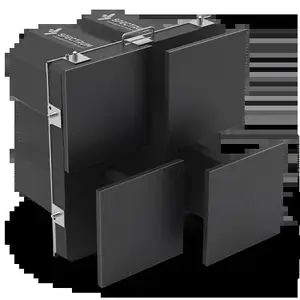
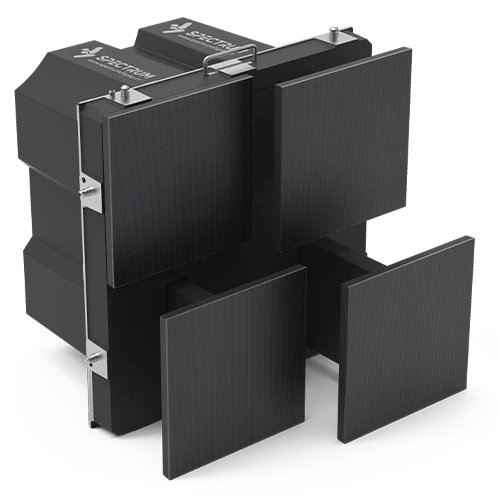
The system consists of numerous independent 248 × 248mm motion units, each driven by a precision mechanical transmission mechanism. During content playback, the LED modules do more than illuminate: they physically extend forward and retract backward in synchronization with the visual content, creating a real three-dimensional relief effect across a building façade.
The SPKO-250 is built around three key outdoor-performance characteristics.

1. ≥5,000 Nits High Brightness for Direct Sunlight
Under strong outdoor sunlight, conventional displays can appear washed out or become difficult to read.
With brightness of ≥5,000 nits, the SPKO-250 is designed to maintain vivid, high-contrast visuals even under bright daytime conditions.
2. 200mm Physical Motion Stroke
With a 200mm physical stroke applied to each 248 × 248mm motion unit, the system creates a clearly visible difference in physical depth.
Instead of remaining a flat digital surface, the building façade can physically transform into a dynamic, sculptural display.
3. IP65 All-Weather Protection
The SPKO-250 is designed for rain resistance, dust protection, and operation across temperatures from -10°C to 60°C.
Its outdoor-oriented structure is designed to help the mechanical system continue operating reliably in demanding environments involving heavy rain, dust, heat, and changing weather conditions.
Unlike the indoor SPKI Series, the SPKO-250 was engineered for outdoor environments from the beginning.
2. How Does It Physically Move Outdoors? — Mechanical Principles Explained
The movement of the SPKO-250 is not a visual effect. It is the result of integrated mechanical, electrical, and control engineering.
Independent Motion Units and Mechanical Transmission
Each 248 × 248mm LED module is driven by an independent motion mechanism.
A standard 500 × 500mm quick-installation cabinet integrates four independent motion units in a 2 × 2 configuration.
This means that even within a single cabinet, individual modules can create different physical depths. When hundreds or thousands of these units are assembled into a large display, the result is a much more dramatic three-dimensional moving surface.
Industrial-Grade CAN Bus Control
Outdoor environments can involve significantly more complex electromagnetic conditions than indoor installations.
At the control layer, the SPKO-250 uses the CAN bus protocol originally developed by Bosch for automotive applications. CAN communication provides strong interference resistance, error detection, and retransmission capabilities.
This allows hundreds or thousands of outdoor motion units to remain synchronized at the millisecond level, helping prevent positional drift or missed motion steps even in complex electromagnetic environments involving thunderstorms or high-voltage electrical systems.
Semi-Enclosed Self-Cooling Design
Heat is one of the major challenges facing outdoor LED systems.
The SPKO-250 motion unit incorporates a semi-enclosed self-cooling structure with assisted ventilation, helping dissipate internal heat while maintaining outdoor protection.
This reduces the risk of excessive temperature affecting motors, electronics, or LED performance.
3. Complete Technical Specifications
| Parameter | Specification |
|---|---|
| Product Model | SPKO-250 (Outdoor) |
| Pixel Pitch | P3.9mm |
| LED Module Size | 248 × 248mm |
| Motion Unit Size | 248 × 248mm (0.0615 m²) |
| Resolution per Unit | 64 × 64 |
| Maximum Motion Stroke | 200mm |
| Maximum Motion Speed | 500mm/s |
| Fastest Full-Stroke Time | 0.5 seconds |
| Motion Units per m² | 16 units/m² |
| Quick-Installation Cabinet | 500 × 500mm (2 × 2 units) |
| Cabinet Depth | 330mm + maintenance access |
| Cabinet Weight | 17kg |
| Brightness | ≥5,000 nits |
| Refresh Rate / Grayscale | High refresh rate / fine grayscale |
| Protection Rating | IP65 (rain and dust protection) |
| Operating Temperature | -10°C to 60°C |
| Operating Humidity | ≤95% RH, suitable for rain and condensation environments |
| Maintenance | Front + Rear Maintenance |
| Installation Methods | Downward suspension, stacking, wall mounting, upward-facing installation |
What Do These Specifications Mean in Real Projects?
16 motion units per square meter: The relatively large 248mm motion units allow the system to cover large outdoor areas with fewer mechanical units. For building façades and advertising displays viewed from a distance, this provides a balance between physical visual impact and project cost.
500mm/s speed + 0.5-second full stroke: Outdoor advertising often relies on bold, immediate visual changes. Completing a 200mm motion cycle in as little as 0.5 seconds allows the physical movement to synchronize with product reveals, logo animations, countdowns, and other high-impact advertising moments.
17kg cabinet weight: Despite its outdoor protection requirements, the cabinet maintains a relatively lightweight design, helping reduce structural loads on steel frames and simplifying high-level installation.
4. Software & Content Ecosystem — How Is Outdoor Kinetic Content Created?
Outdoor kinetic screen displays introduce a challenge that conventional LED screens do not have:
How do you create content not only for pixels, but also for physical movement?
The SPKO-250 uses the same integrated content creation ecosystem as Spectrum Display’s indoor kinetic screens.
MotionMatrix4 — After Effects Plugin
Designers can use grayscale values directly inside Adobe After Effects to generate physical Z-axis movement instructions.
Black = retract White = extend
Dynamic surface movement, logo reveals, raised product outlines, and other physical motion effects can therefore be designed directly within the familiar AE workflow.
Mshow — 3D Presentation Platform
For operators without professional animation experience, Mshow provides a more accessible workflow similar to creating a presentation.
Content can be arranged and adjusted through a visual interface, making it suitable for frequent outdoor advertising updates.
DMX512 / Art-Net Integration
The SPKO-250 can be integrated with outdoor lighting shows and architectural lighting systems through DMX512 and Art-Net.
This enables physical LED movement to synchronize with façade lighting, creating a unified nighttime landmark experience.
TouchDesigner / UE5 Integration
For interactive outdoor installations and more complex real-time rendering applications, the system can also be integrated with TouchDesigner and Unreal Engine 5 (UE5) workflows.
A Key Principle for Outdoor Kinetic Content
Because outdoor displays are often viewed from a greater distance and under much stronger ambient light, content should prioritize:
large color blocks, high contrast, bold outlines, and clear physical movement.
Fine text and highly detailed textures can lose visibility at long viewing distances and may be visually disrupted by the physical depth of the moving surface.
For the SPKO-250, the P3.9 pixel pitch provides a balance between image clarity and large-scale outdoor visual impact.
5. Installation & Maintenance — Engineering Essentials for Outdoor Projects
Maintenance is significantly more challenging for an outdoor kinetic screen than for a conventional indoor display.
For this reason, the SPKO-250 is designed with outdoor engineering and maintenance requirements in mind.
Front + Rear Maintenance
The system supports both maintenance approaches.
Rear Maintenance: Suitable for permanent outdoor installations with a dedicated rear maintenance corridor. Technicians can access motors, LED modules, and control components from behind the display without relying on aerial work platforms.
Front Maintenance: When rear access is unavailable, modules can be serviced from the front, reducing the need to modify or dismantle the building façade.
Installation Depth and Space Requirements
The cabinet itself has a depth of 330mm, but outdoor installations must also account for maintenance access.
For rear-maintenance configurations, sufficient working space must be reserved behind the screen.
For front-maintenance or wall-mounted installations, the project team must confirm that safe front-side access is available.
Outdoor Protection
The SPKO-250 is rated IP65, providing protection against rain and dust.
However, IP-rated hardware does not eliminate the need for correct installation practices.
All cable connections must be properly waterproofed, cabinet sealing strips must remain fully compressed and intact, and drainage paths must not be blocked.
Outdoor reliability depends on both the product design and the quality of project execution.
▶Video · YouTubeDifferent Forms. Endless Display Possibilities.Watch on YouTube →
6. Frequently Asked Questions (FAQ)
Q1: The SPKO-250 and indoor SPKI-250 have similar specifications. Can the SPKI-250 simply be installed outdoors?
A: No.
The SPKO-250 is specifically designed for outdoor environments, with IP65 protection, ≥5,000 nits brightness, and an operating temperature range of -10°C to 60°C.
The indoor SPKI-250 does not provide the same rain and dust protection required for outdoor use. The two products also differ fundamentally in thermal management, sealing, environmental protection, and brightness.
Q2: Is 5,000 nits bright enough for outdoor daytime use?
A: Yes. A brightness level of approximately 5,000 nits is commonly used for high-brightness outdoor advertising displays and can maintain strong visibility under bright daytime conditions.
For projects located in extremely high-sunlight environments with little or no shading, higher-brightness customized options can be evaluated. For most commercial façades and outdoor advertising applications, however, ≥5,000 nits provides an effective level of daytime visibility.
Q3: Is a 200mm motion stroke noticeable when viewed from a distance outdoors?
A: Yes.
Outdoor viewing distances typically begin at several meters. Combined with the relatively large 248mm motion units, a 200mm physical stroke creates enough depth difference to produce a clearly visible three-dimensional relief effect.
The perceived impact of motion depends on the relationship between motion-unit size, physical stroke, content design, and viewing distance.
Q4: How is an outdoor kinetic screen maintained? Does it require scaffolding?
A: The SPKO-250 supports both rear and front maintenance.
If a rear maintenance corridor is incorporated during project planning, technicians can service the system from behind the display without requiring scaffolding or aerial work platforms.
For front-maintenance configurations, safe access conditions on the display side must be evaluated.
The maintenance strategy should therefore be determined during the project design stage rather than after installation.
Q5: How large can an SPKO-250 display be?
A: The SPKO-250 uses standardized 500 × 500mm modular cabinets, allowing the system to be scaled for different project dimensions.
The practical size limit depends on structural load capacity, control-system capacity, electrical infrastructure, installation conditions, and project budget.
For very large outdoor installations, the structural and control architecture should be engineered specifically for the project.
Q6: How is outdoor kinetic screen content different from indoor content?
A: Outdoor content generally requires stronger contrast, larger color blocks, simpler shapes, and more obvious motion.
Because viewing distances are longer and ambient light is stronger, fine text, subtle gradients, and highly detailed textures can become less visible.
For SPKO-250 content, designers should prioritize high contrast, bold lines, large visual elements, and clear physical motion, allowing the kinetic movement itself to become a central part of the visual experience.
8. Conclusion
The SPKO-250 is not simply an indoor kinetic screen adapted for outdoor use.
It is a dynamic outdoor display system engineered around the structural, thermal, environmental, brightness, installation, and maintenance requirements of outdoor projects.
Key Takeaways
- Product Positioning: An outdoor kinetic screen combining ≥5,000 nits brightness, a 200mm physical stroke, and a P3.9 pixel pitch.
- Outdoor Engineering: IP65 protection, a -10°C to 60°C operating range, and a semi-enclosed self-cooling structure designed for demanding outdoor environments.
- Engineering Advantages: A 17kg lightweight cabinet, front and rear maintenance options, and automotive-grade CAN bus communication for large-scale synchronized motion.
- Content Ecosystem: MotionMatrix4 for After Effects, Mshow, DMX512 / Art-Net, TouchDesigner, and UE5 create an integrated workflow from motion-content creation to real-time system integration.
- Best-Fit Applications: Commercial façades, outdoor advertising, cultural tourism and nighttime attractions, public art, and premium architectural installations. It is not intended as a substitute for indoor LED products, nor should it be installed in high-level locations without a clearly planned maintenance strategy.
For more information about the SPKO-250 or to discuss a customized outdoor kinetic screen project, contact the Spectrum Display team through www.spectrumdisplay.cn.